
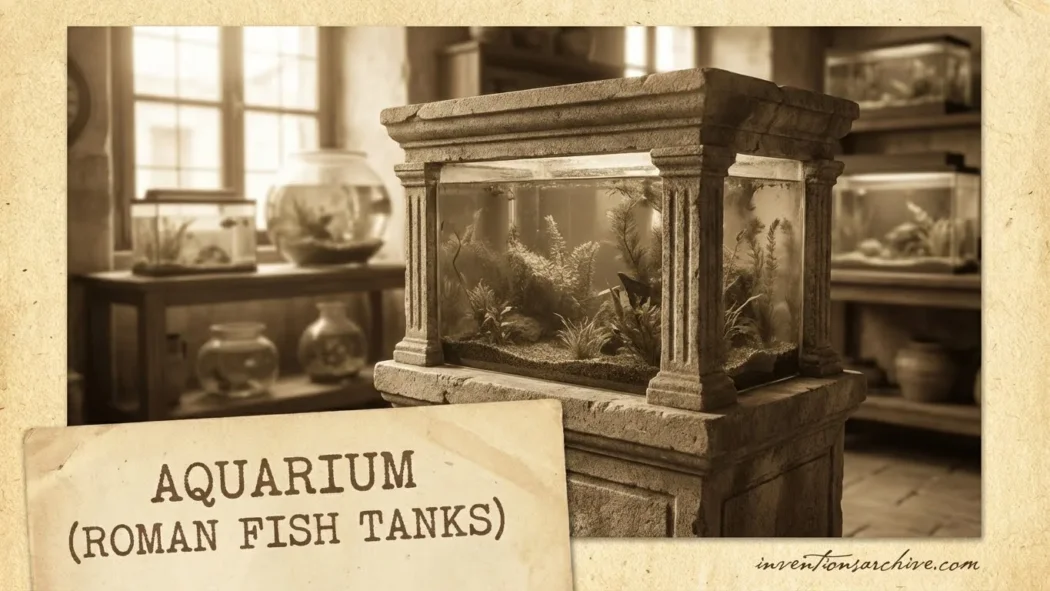
| Invention Name | Aquarium in the sense of Roman fish tanks, also called piscinae or vivaria |
|---|---|
| Short Definition | Built or rock-cut water enclosures used to keep, breed, sort, and display live fish. |
| Approximate Date / Period | Mostly 1st century BC to 1st century AD Approximate |
| Geography | Roman Mediterranean, especially the Tyrrhenian coast of Italy |
| Inventor / Source Culture | Anonymous / collective Roman engineering tradition; elite owners and builders developed many forms |
| Category | Aquaculture, water engineering, food storage, villa architecture, controlled animal keeping |
| Evidence Status | Archaeological remains and Roman texts Based on surviving evidence |
| Main Problem Solved | Keeping fish alive near homes, villas, markets, and coastal estates before refrigeration |
| How It Worked | Seawater or freshwater moved through tanks by channels, gates, tidal flow, springs, or aqueduct-fed systems |
| Material / Technical Base | Coastal rock, masonry, hydraulic concrete, channels, sluice-like openings, water-level ledges |
| Early Use | Fish holding, breeding, sorting by species, villa display, food supply, local trade |
| Surviving Evidence | Rock-cut coastal basins, built tank walls, channels, sluice features, archaeological fishery sites |
| Development Path | Freshwater ponds → Roman piscinae / vivaria → managed coastal fishponds → modern aquaculture and public aquariums |
| Related Inventions | Roman aqueducts, hydraulic concrete, fish traps, harbor works, oyster ponds, water-lifting devices |
| Modern Descendants | Fish farms, hatcheries, marine research tanks, public aquariums, ornamental ponds |
| Historical Caution | Not a modern glass aquarium; the Roman form was usually a built water enclosure |
The Roman fish tank was one of the earliest known forms of a managed aquatic enclosure. It answered a practical problem: fish spoil quickly, and fresh fish was harder to supply before modern transport and refrigeration. A Roman piscina or vivarium could hold living fish near a coastal villa, lagoon, harbor, or freshwater source. Some tanks were built for food. Some were also status objects. Many did both.
What a Roman Fish Tank Was
A Roman fish tank was a built or carved water enclosure designed to keep aquatic life alive under human control. In Latin sources and modern scholarship, related terms include piscina, vivarium, and fishpond. The meaning changes with context.
A small indoor glass aquarium is a much later idea. The Roman version was usually a piece of water architecture: a basin cut into rock, a masonry pool beside the sea, a lagoon installation, or a divided fishpond attached to a wealthy estate.
These tanks could serve several purposes:
- keeping fish alive until they were eaten or sold;
- separating different species or sizes;
- breeding or fattening selected fish;
- creating a controlled water feature in villa life;
- supporting trade in fish products near ports and lagoons.
How Its Origin Is Traced
The origin is not tied to one named inventor. Fish keeping grew from earlier practices: pond management, lagoon fishing, shellfish holding, and the use of coastal barriers to control fish movement. Roman builders then applied masonry, water channels, marine concrete, and villa planning to create more stable and specialized tanks.
Roman writers also preserve names linked to early fishpond culture. Pliny the Elder reports Sergius Orata in connection with oyster vivaria and Licinius Murena in connection with fish vivaria, with later aristocratic examples following. This is useful literary evidence, but it should not be read as a simple “one inventor created the aquarium” story.[b]
The safest statement is this: Roman fish tanks were a developed Roman engineering and social practice, not a single-person invention.
The Problem It Answered
Fresh fish was valuable because it was perishable. Coastal communities could catch fish, but keeping them alive near a house, market, or estate required water control. A tank solved this by turning part of the sea, a spring, or a lagoon into a managed space.
Before controlled fish tanks, people relied on direct fishing, drying, salting, fermenting, shellfish beds, and natural lagoons. These methods worked, but each had limits. A built tank offered something different: living storage.
| Before the Invention | What Changed After It |
|---|---|
| Fish had to be consumed, salted, dried, or processed soon after capture. | Selected fish could be kept alive close to villas, harbors, or fishery centers. |
| Natural ponds and lagoons offered limited control over species and water flow. | Divided tanks allowed better sorting, holding, and water management. |
| Fresh fish supply depended heavily on the day’s catch and local conditions. | Owners gained a more reliable reserve of live fish for household or commercial use. |
| Water features were often decorative or practical, but not always species-managed. | Fish tanks could combine food production, display, and elite villa design. |
| Knowledge of marine water control was scattered across fishing practice and harbor work. | Roman builders linked aquaculture with channels, sluices, rock cutting, and hydraulic materials. |
How Roman Fish Tanks Worked
The basic principle was simple: fish need usable water, oxygen, space, and protection. Roman tanks answered this through controlled circulation. A coastal tank could let seawater pass in and out through channels. A freshwater or mixed-water tank could use springs, streams, or aqueduct-fed supply.
Technical studies of Roman fish tanks focus on features such as channels, sluice-like openings, walking ledges, and water-level markers. Some tanks were placed so tidal movement helped refresh the basin. Others used freshwater input to create less salty conditions for species such as seabass and mullet. Roman marine structures also used hydraulic mortar and pozzolanic materials where water resistance mattered.[c]
The Main Working Elements
- Basins: the main holding spaces for fish.
- Channels: openings that allowed water to move between sea and tank.
- Gates or restricted passages: features that helped control flow and prevent fish from escaping.
- Divisions: internal compartments used for different species or functions.
- Freshwater input: springs or aqueduct-fed supply in some mixed systems.
- Durable surfaces: rock, masonry, and water-resistant concrete where available.
Earlier Ideas Before Roman Fish Tanks
Roman fish tanks did not appear from nothing. They belonged to a longer history of water management and food storage. Earlier or parallel practices included freshwater ponds, river traps, lagoon fisheries, shellfish beds, and coastal enclosures.
The Roman change was not the idea of keeping fish alive by itself. The stronger change was the architectural and hydraulic control applied to the practice. Builders could cut coastal rock, add masonry, manage flow, and place tanks directly within villa landscapes.
| Stage | Form | What Changed |
|---|---|---|
| Earlier Tool | Natural ponds, lagoons, fish traps, shellfish beds | Fish were gathered or held with limited built control. |
| Roman Invention Form | Piscinae and vivaria | Water, species, access, and display became more deliberately managed. |
| Improved Form | Rock-cut and masonry coastal tanks with channels | Water exchange, compartmentalization, and villa integration improved. |
| Later Development | Fish farms, hatcheries, marine research tanks | Aquatic life could be raised, studied, displayed, and supplied at larger scale. |
| Modern Descendant | Public aquarium and glass display tank | The goal shifted more toward education, viewing, research, and conservation display. |
Main Materials and Technical Principles
Roman fish tanks used materials that suited their location. A tank cut into rock could take advantage of a natural shore platform. A built tank needed masonry and mortar able to resist water. Coastal installations also had to handle waves, tides, sediment, and salt.
The technical principle was not complicated in theory: keep water moving enough to avoid stagnation, keep fish from escaping, and maintain conditions close enough to the species’ needs. The execution was demanding. A poorly placed tank could overheat, silt up, lose water, or fail to refresh properly.
Common Materials and Features
- Rock-cut basins: carved directly into shore platforms.
- Masonry walls: used where natural rock was not enough.
- Hydraulic concrete: useful in marine or wet construction.
- Stone channels: used to connect basin and sea.
- Internal partitions: helped divide species, sizes, or functions.
- Freshwater links: used in some sites to alter salinity.
Early Uses in Roman Life
Roman fish tanks had several overlapping uses. They were practical, economic, and social. A villa owner could keep live fish for meals. A fishery site could hold fish as part of processing and distribution. A decorated villa pool could show wealth and taste.
The Regional Directorate of National Museums of Lazio describes Roman fishponds north of Rome as distinctive features of maritime villas, located directly on the shore, divided into tanks for different fish, and supplied by seawater turnover. That description fits the way many Roman examples combined breeding, display, and marine resource management.[d]
For the reader, this is the most useful distinction: a Roman fish tank was not merely a pond. It was a controlled living store that could also become a visual feature of elite architecture.
How It Spread and Changed Over Time
The Roman fish tank developed most strongly in areas where three things came together: wealthy coastal settlement, suitable geology, and access to moving water. The Tyrrhenian coast offered many such sites. Other examples appear across the wider Mediterranean, but local conditions affected their form.
Rocky coasts favored carved basins. Softer or flatter areas needed masonry. Lagoons offered natural holding spaces. Villas used fish tanks as part of coastal leisure and household supply. Commercial fishery sites used controlled water for storage and processing.
A useful example is Cosa, a Roman port on the Tyrrhenian coast. The academic study of the Roman port and fishery of Cosa treats the site as a center of ancient trade, linking harbor activity, fishery remains, amphora production, and marine commerce.[e]
Main Types and Variations
Roman fish tanks were not all the same. Their shape depended on water source, coastline, wealth, intended species, and whether the tank served food supply, display, trade, or a mixture of these roles.
| Type or Variation | Main Features | Typical Use |
|---|---|---|
| Freshwater Pond | Fed by streams, springs, or stored water | Holding freshwater fish near inland estates |
| Rock-Cut Coastal Tank | Carved into shore rock with channels to the sea | Keeping marine fish alive with natural water movement |
| Built Maritime Piscina | Masonry or concrete structure beside the sea | Villa fish holding, display, and controlled breeding |
| Divided Species Tank | Multiple compartments inside one installation | Separating fish by type, size, or owner preference |
| Lagoon Fishery System | Natural lagoon managed by channels or barriers | Commercial fish holding, capture, and processing support |
| Shellfish Vivarium | Controlled beds or ponds for oysters and other shellfish | Specialized food supply and trade |
| Ornamental Villa Pool | Fish kept within a designed water feature | Status display, household supply, and garden-water design |
What Changed Because of It
The Roman fish tank made aquatic life more controllable. It joined food storage, coastal engineering, and domestic display in one structure. Its effect was not one sudden revolution. It was a practical shift in how wealthy households, fisheries, and some coastal sites handled living marine resources.
Several changes mattered most:
- Freshness became more manageable: fish could remain alive near the place of use.
- Species control improved: compartments made separation easier.
- Coastal villas gained a new water feature: fish tanks became part of planned seaside architecture.
- Aquaculture knowledge advanced: builders learned how depth, flow, salinity, and site choice affected results.
- Archaeology gained a durable marker: preserved tanks help scholars study Roman coastal levels and marine construction.
Common Misunderstandings
“The Romans Invented the Modern Aquarium”
Not in the glass-tank sense. Roman fish tanks were early managed aquatic enclosures. They belong to the history of aquariums, but they were usually outdoor or architectural basins.
“A Named Roman Must Have Invented It”
Roman texts preserve names connected with fishponds, but the physical technology grew through repeated practice. It is better understood as a collective engineering tradition.
“All Fish Tanks Were for Luxury Only”
Luxury was part of the story, especially in seaside villas. Yet fish tanks also supported food storage, species management, local supply, and fishery economies.
“The Oldest Surviving Tank Means the First Ever Tank”
Surviving remains show what archaeologists can study. Earlier or simpler fish-holding practices may have existed without leaving durable traces.
Why the Roman Version Matters in Invention History
The Roman fish tank matters because it joined several skills into one system. It used water management, masonry, animal keeping, coastal observation, and household planning. That mixture is why it sits between several invention histories: aquaculture, aqueduct engineering, marine construction, food preservation, and the later aquarium.
It also shows how inventions can be systems, not just objects. A fish tank without water exchange was only a pool. A Roman fish tank with channels, flow control, species separation, and proper placement became a working aquatic environment.
Related Inventions
- Roman Aqueduct: helped move water to settlements, villas, baths, and some managed water features.
- Hydraulic Concrete: allowed stronger marine and wet-environment construction.
- Fish Trap: an older method for directing or capturing fish in rivers, lagoons, and coasts.
- Oyster Pond: a related controlled shellfish enclosure.
- Roman Harbor Works: shared knowledge of coastal building, water movement, and durable materials.
- Bucket-Chain Water Lift: helped raise water in some ancient agricultural or fishery settings.
- Public Aquarium: a later descendant focused on viewing, education, and research.
Frequently Asked Questions
Were Roman fish tanks the same as modern aquariums?
No. Roman fish tanks were usually outdoor or architectural water enclosures. They could keep fish alive and visible, but they were not modern glass aquariums.
Who invented Roman fish tanks?
There is no secure single inventor. Roman texts name people connected with fishpond culture, but the invention is better understood as a collective development in Roman water engineering and aquaculture.
What were Roman fish tanks used for?
They were used to keep fish alive, sort species, support food supply, manage coastal resources, and decorate wealthy maritime villas.
How did Roman fish tanks keep water fresh enough for fish?
Many coastal tanks used channels and tidal movement to refresh seawater. Some installations also used freshwater from springs, streams, or aqueduct-fed systems to adjust water conditions.
Why do archaeologists study Roman fish tanks today?
They reveal Roman aquaculture, villa life, marine construction, and ancient sea-level conditions. Their channels, ledges, and basin levels can preserve information about coastal change.
Sources and Verification
- [a] The Fish Tanks of the Mediterranean Sea — Used to verify the broad dating, Mediterranean distribution, concentration in Italy, and archaeological evidence base for Roman fish tanks. (Reliable because it is a peer-reviewed academic article published by MDPI in an archaeology and geoarchaeology context.)
- [b] Pliny the Elder’s Natural History — Book 9 — Used to verify ancient textual references to oyster vivaria and fish vivaria associated with named Roman figures. (Reliable because it is a classical text preserved in a long-running scholarly text archive hosted at the University of Chicago domain.)
- [c] Tyrrhenian sea level at 2000 BP: evidence from Roman age fish tanks and their geological calibration — Used to verify technical features such as channels, sluice-like control, crepido levels, tidal exchange, freshwater input, and hydraulic materials. (Reliable because it is a peer-reviewed Springer journal article in Rendiconti Lincei.)
- [d] Roman fishponds: the aquariums of the seaside villas on the coast north of Rome — Used to verify the villa setting, shore location, divided tanks, seawater turnover, and role in marine resource management. (Reliable because it is an official page of the Regional Directorate of National Museums of Lazio.)
- [e] The Roman Port and Fishery of Cosa: A Center of Ancient Trade — Used to verify Cosa as a studied Roman port and fishery site connected with trade, fishery remains, and marine commerce. (Reliable because it is an academic monograph record hosted by JSTOR.)