
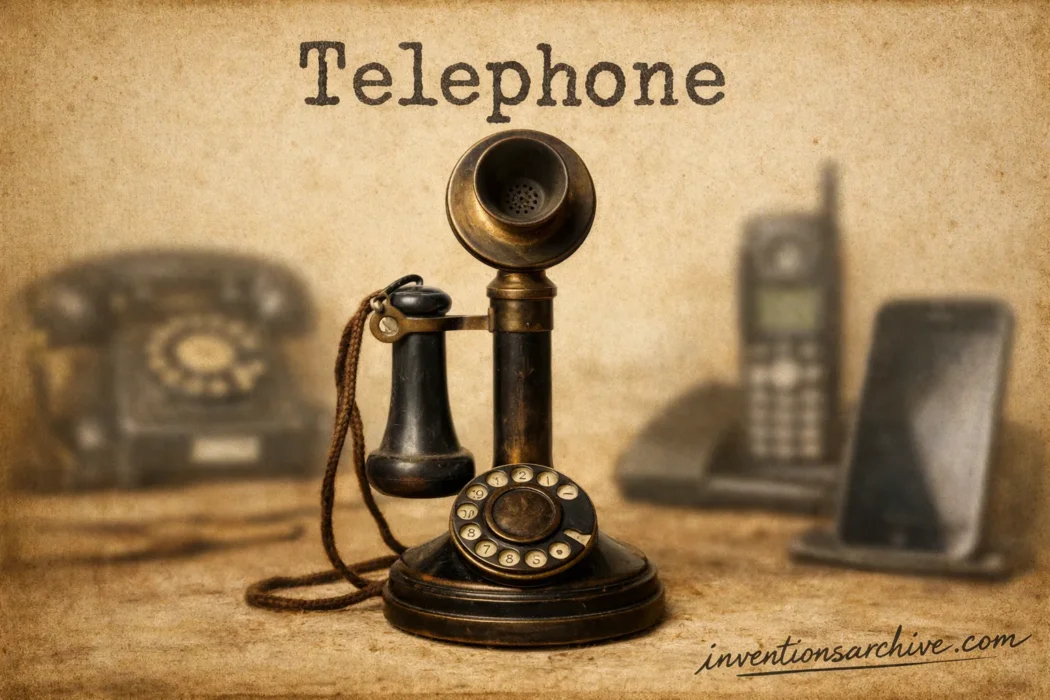
| Item | Details |
|---|---|
| Invention Name | Telephone |
| Short Definition | An electrical communication device that carries the human voice over distance in real time. |
| Approximate Date / Period | Mid-19th century experiments; 1876 for the first U.S. patent and first accepted successful speech transmission |
| Date Certainty | Patent date: Exact | earlier origins: Debated |
| Geography | United States, with earlier roots in Italy, Germany, Scotland, and Canada-linked Bell work |
| Credited Inventor / Source Culture | Alexander Graham Bell for the first patent; earlier work also linked to Antonio Meucci, Johann Philipp Reis, and Elisha Gray |
| Category | Communication, telecommunications, electrical engineering |
| Why It Mattered | Instant voice contact; faster business, home, medical, and public communication |
| Need Behind It | People wanted direct voice contact without telegraph code, messengers, or physical travel |
| How It Works | Voice vibrations move a diaphragm; the signal changes current; a receiver rebuilds sound |
| Material / Technology Base | Diaphragm, electromagnet, wire circuit, battery, switchboard; later carbon transmitter and electronic circuits |
| Earliest Uses | Laboratory trials, demonstrations, business connections, local office-to-office calls |
| Spread Path | From experimental U.S. systems to Britain and Europe, then to urban exchanges, homes, and global networks |
| Later Developments It Opened | Switchboards, long-distance calling, automatic dialing, cordless phones, mobile phones, smartphones, VoIP |
| Impact Areas | Business, education, household life, emergency response, science, logistics, media |
| Debates | Who should be called the first inventor; how much credit belongs to Bell versus earlier experimenters |
| Predecessors and Successors | Speaking tube, acoustic devices, telegraph → box telephone, candlestick phone, rotary desk set, push-button phone, cordless handset, mobile phone, smartphone |
| Leading People / Cultures | Bell, Watson, Gray, Meucci, Reis, Edison, Francis Blake, early Bell system engineers |
| Varieties Shaped by This Invention | Wall phones, desk sets, rotary models, push-button sets, conference phones, cordless phones, car phones, mobile handsets, smartphones |
The telephone did something earlier communication tools could not do with ease: it carried the living human voice across distance, at once, without code. That sounds ordinary now. In the 1870s, it was anything but ordinary. It changed the idea of distance itself, then kept changing as transmitters, switchboards, dials, cables, electronics, and later wireless systems pushed the same basic aim forward — let one person speak, and let another hear that voice far away.
Table of Contents
What the Telephone Is
A telephone is a device built for the simultaneous sending and receiving of voice. That phrase matters. The telegraph could move messages fast, yes, but not as speech. It relied on coded signals. The telephone removed that extra layer and let conversation move in a more direct, more human way.
Early telephones were not yet the familiar handsets of the twentieth century. They were awkward, sometimes faint, sometimes temperamental. Still, the leap was real: sound became electrical variation, traveled through a line, and returned as sound again. Small device, huge shift.
What set the telephone apart?
- Real-time voice, not coded text
- Two-way conversation without waiting for message decoding
- Immediate social contact for homes, offices, and institutions
Early Experiments Before Bell
The telephone did not appear out of nowhere. Several inventors were already chasing the same broad idea: move sound, or even speech, through electrical means. The names that come up most often are Antonio Meucci, Johann Philipp Reis, and Elisha Gray. Bell stands at the center of the accepted story, but the road leading to him was crowded.
That earlier work matters for one simple reason. It shows that the telephone was not only a single flash of genius. It was also a technical race shaped by telegraphy, acoustics, anatomy, materials, and trial-and-error bench work. Many inventors understood pieces of the problem. Bell managed to secure the patent position that history remembers most clearly.
- Meucci is often discussed as an early builder of voice-communication devices.
- Reis produced instruments in Germany that could transmit sound, though speech quality remained limited.
- Gray worked on variable-resistance ideas that became part of the famous 1876 dispute.
- Bell brought together speech study, electrical experimentation, and a patent outcome that gave his version lasting authority.
The result is a more honest picture: credit is layered, even though public memory usually reduces it to one man and one date.
Bell, Gray, and the 1876 Patent Race
Alexander Graham Bell is generally credited with inventing the telephone because he received U.S. Patent 174,465 on March 7, 1876, and his March 10 laboratory test produced the first widely accepted intelligible telephone call. The famous words to Thomas Watson entered the historical record almost immediately. (Details-1)
Yet the story turns sharper when Elisha Gray enters the frame. Bell’s application and Gray’s caveat reached the U.S. Patent Office on the same day, and that overlap has fueled debate ever since. Bell’s side won the legal and commercial ground; Gray’s presence kept the matter alive in technical history. National Museums Scotland also notes that Bell Telephone Company was established on July 9, 1877, just as the new device was moving out of the lab and into saleable form. (Details-2)
That is why the telephone sits in two histories at once. One is the history of patent credit. The other is the history of shared invention pressure, where several people reached toward similar answers at nearly the same moment. Both are true, in their own way.
One more thing, and it often gets skipped: Bell was not merely tinkering with a gadget. He was working out how voice could be modeled as a changing electrical phenomenon. That intellectual move was the real break.
How the Telephone Turned Voice Into Signal
The early telephone worked through a clean physical idea. A person spoke into a mouthpiece. The diaphragm vibrated. That motion changed the electrical behavior of the circuit, and the changing current moved through a wire to a receiver, where another diaphragm reproduced the sound. In the Smithsonian description of Bell’s 1876 experimental instrument, the device could serve as both transmitter and receiver and used a single electromagnet with a separate battery. (Details-3)
Put plainly, the telephone does not “send voice” as air. It sends an electrical pattern shaped by voice. The receiver then turns that pattern back into sound waves. Elegant, really. And once that principle was established, engineers could improve volume, clarity, distance, and convenience without changing the basic logic.
- Speaker side: voice creates air vibration
- Transmitter side: vibration becomes electrical variation
- Line side: the signal travels through a wired circuit
- Receiver side: vibration is recreated and heard again
Later sets became far better because transmitters improved. Carbon-based designs gave stronger output. Circuit design improved. Switches, ringers, and dials made the device easier to live with, not just possible to demonstrate.
The Network That Made the Telephone Useful
A telephone by itself is only half the story. The other half is the network. Without exchanges and switchboards, early users would have needed separate direct lines for every person they wanted to reach. That was never going to scale well.
On January 28, 1878, the first commercial telephone exchange opened in New Haven. George W. Coy built the first switchboard for commercial use there, and that move changed the telephone from a clever pair of instruments into a service. Businesses, police offices, post offices, doctors, and households could now join a shared communication web instead of existing as isolated endpoints. (Details-4)
Why the exchange mattered
The invention stopped being a one-line novelty and became a shared system. That shift opened the door to directories, local service, long-distance routing, operators, later automatic switching, and the public switched telephone network.
In other words, the telephone succeeded not only because someone built a speaking instrument, but because engineers and operators built a structure around it. The handset gets the fame. The network did the heavy lifting.
Related articles: Telegraph [Industrial Age Inventions Series]
Types and Variations
The telephone branched fast. Once the central principle worked, the invention split into many forms, each shaped by distance, sound quality, user comfort, and network design. Not one line of evolution — several.
Early Wired Sets
- Experimental telephones with simple diaphragms and electromagnets
- Box telephones used in early demonstrations and first sales
- Wall-mounted sets that placed the instrument in offices and homes
- Candlestick phones with separate transmitter and earpiece
These forms look odd to modern eyes, but they solved a real design problem: where should the mouth, ear, bell, and line connection sit? Designers kept rearranging the answer until use became more natural.
Transmitter and Dial Era
One of the earliest public showings of the telephone came at the June 1876 Centennial Exposition in Philadelphia, and later engineering changes pushed the instrument toward the practical form that most people now recognize in classic landlines. Britannica notes that within a relatively short time the device had been modified by figures such as Watson, Berliner, and Edison, while later systems added dials, ringers, and switching-office power. (Details-5)
- Carbon-transmitter telephones gave stronger voice output
- Rotary phones made number selection mechanical and standardized
- Push-button models simplified calling and sped up use
- Conference and desk sets adapted the telephone to office life
By then, the invention had become less about proving a principle and more about refining daily use. Better sound. Easier dialing. Cleaner signal. Fewer moving parts where possible.
Wireless Branches
Later branches kept the same social purpose while changing the physical path of the signal. Cordless phones removed the wire between handset and base. Mobile phones removed the fixed local loop altogether. Smartphones then folded the telephone into a handheld computer while still preserving the original promise: real-time voice connection.
That continuity is easy to miss. The shape changed. The network changed. The electronics changed. Yet the telephone’s central act stayed familiar — speak, send, hear.
What the Telephone Changed
The telephone did more than speed up conversation. It changed the rhythm of ordinary life. Offices could coordinate work in minutes. Families could stay in touch without letters or travel. Doctors, transport services, shops, schools, and public offices could answer needs with less delay. It shortened response time, yes, but also altered expectation. People began to expect immediate contact.
- Business: faster orders, scheduling, and customer contact
- Home life: direct family communication across distance
- Public services: quicker access to help and information
- Science and engineering: growth of switching, signal processing, and network design
- Media culture: new habits of presence, interruption, and live conversation
It also changed language. People developed new phone manners, new business phrases, new ways of opening and ending talk. Technology altered social behavior — quietly, almost invisibly, and then everywhere.
Predecessors, Successors, and Related Inventions
The telephone belongs to a family of communication inventions rather than a sealed box of its own. Before it came the speaking tube, the telegraph, acoustic signaling devices, and early experimental sound transmitters. After it came long-distance line systems, switchboard culture, automatic exchanges, answering devices, cordless calling, cellular networks, fiber-optic transport, and internet-based voice systems.
That genealogy matters because it shows how inventions actually live. They do not stand still. They branch, merge, borrow, and get rebuilt. The telephone is a textbook case of that process.
Line of development
Speaking tube and telegraph → experimental telephone → exchange-based landline → rotary and push-button sets → cordless telephony → mobile telephony → smartphone and VoIP communication.
Why Inventorship Is Still Debated
People keep returning to the question because “who invented the telephone?” sounds simpler than it is. Patent law rewards one kind of priority. Technical history reveals a broader field of experiments. Public memory prefers a single name. Historical records, meanwhile, show overlapping work, competing claims, and improvements made by others almost immediately after Bell’s breakthrough.
So the neatest answer is this: Bell holds the accepted patent-centered credit, while the developmental story includes other inventors whose work fed the same goal. Not everybody likes that answer. Still, it fits the evidence best.