
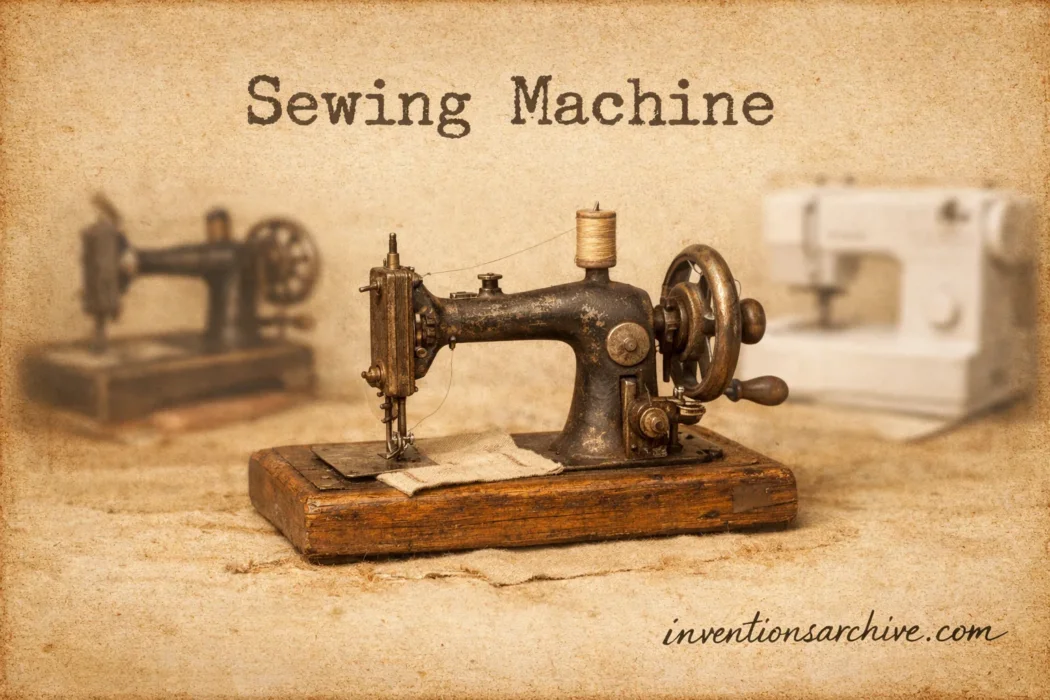
| Topic | Details |
|---|---|
| Invention Name | Sewing machine |
| Short Definition | A mechanical stitching device that joins fabric or other flexible material with thread. |
| Date / Period | 1790 design; 1830 early working machine; 1846 U.S. patent milestone; 1850s broad commercial spread |
| Date Certainty | Mixed — dates are clear, but the “first” depends on design, working model, patent, or market adoption |
| Geography | Britain; France; United States; later global |
| Inventor / Source Culture | Thomas Saint; Barthélemy Thimonnier; Elias Howe Jr.; Isaac M. Singer; Allen B. Wilson; collective improvement culture |
| Category | Textile technology; manufacturing; household machine |
| Need That Drove It | Faster seam making; steadier stitch quality; lower labor time in garment and leather work |
| How It Works | Needle carries upper thread; hook or shuttle catches the loop; lower thread locks the stitch; feed moves material forward |
| Material / Technical Basis | Steel needle, spool thread, shuttle or bobbin, tension control, presser foot, feed dogs, cams, cast-iron frame |
| First Known Uses | Leather and canvas proposals; straight seams; military clothing; workshop garment production |
| Spread Route | Britain and France to U.S. patent culture, then to factory floors and household markets across Europe and beyond |
| Why It Mattered |
|
| Derived Developments | Treadle machines, electric domestic models, zigzag systems, overlock machines, embroidery heads, computerized units |
| Impact Areas | Clothing, footwear, upholstery, luggage, sail and canvas work, household labor, technical textiles |
| Debates / Different Views | No single inventor claim fully holds; the machine emerged in stages |
| Predecessors | Hand sewing, awls, needles, hooks, saddle stitching, embroidery tools |
| Successors | Domestic electric machines, industrial lockstitch lines, sergers, coverstitch units, embroidery and digital sewing systems |
| Main People / Traditions | British patent culture, French tailoring, U.S. machine making, 19th-century textile manufacturing |
| Varieties Shaped by This Invention | Domestic straight-stitch, treadle, hand-crank, zigzag, quilting, buttonhole, industrial single-needle, overlock, embroidery |
Long before sewing became a quiet motor sound on a tabletop, it was hand work—slow, exact, and relentless. The sewing machine changed that rhythm. It turned stitching into a repeatable motion, made seams more uniform, and linked the household, the tailor’s bench, and the factory floor through one idea: thread could be guided by mechanism, not only by the human hand.
Table of Contents
What the Sewing Machine Is
A sewing machine is a thread-forming machine. That sounds dry. The real point is simpler: it makes one stitch after another at even spacing while holding the cloth under control. Hand sewing can do beautiful work, of course it can, yet a machine brings speed, repeatability, and tension that stays far more even across long seams.
Most people picture a domestic machine with a flat bed and a needle bar. Historically, though, the invention is wider than that. It includes early leather-sewing concepts, chain-stitch workshop machines, lockstitch machines for clothing, treadle cabinets, factory heads, and later electric and computerized versions.
- Chain stitch uses one thread looped through itself. It is fast, but the seam can open if the thread is pulled free.
- Lockstitch joins an upper and a lower thread. It holds better, looks cleaner, and became the standard for many domestic and industrial machines.
- Feed control matters as much as the stitch. A machine is only useful when the fabric moves in a measured way after each needle cycle.
Early Designs and the First Working Models
The history does not belong to one name. It arrives in steps, and that is the honest version. An early British design is usually tied to Thomas Saint. No confirmed 1790 production machine survives, yet the patent drawings are important because they show a real attempt to mechanize sewing for leather and canvas work (Details-1).
Then the story sharpens in France. Barthélemy Thimonnier produced an early working machine that made a chain stitch with a hooked needle. His 1830 model matters because it moved beyond concept and into real use, even if its stitch was not yet the strongest seam for every task (Details-2).
In the United States, Elias Howe Jr. gave the machine a form that proved far more durable in use. His 1846 patent model used an eye-pointed needle and a shuttle to lock two threads into a lockstitch, the stitch that pushed the invention toward dependable clothing production (Details-3).
A Short Timeline
- 1790 — Thomas Saint patents an early sewing design for heavy materials.
- 1830 — Thimonnier patents a working chain-stitch machine in France.
- 1846 — Elias Howe receives U.S. Patent No. 4,750 for a lockstitch system.
- 1851–1852 — Singer and Wilson refine layout, handling, and stitch mechanics.
- 1856 — leading firms pool patents, reducing legal friction and accelerating wider manufacture (Details-4).
By the early 1850s, the sewing machine was no longer one inventor’s experiment. It had become a fast-moving technical race—needle shape, shuttle motion, tension control, fabric feed, and frame stability all mattered. A machine that stitched well but handled cloth poorly was still awkward. A machine with good feed but a weak stitch was no answer either.
How the Stitching System Works
The sewing machine solves one hard problem: how to form a seam again and again without losing stitch order. In hand sewing, the fingers, needle, and thread all adjust in small ways from one stitch to the next. A machine cannot improvise like that. It needs a fixed path.
On a standard lockstitch machine, the upper thread passes through the needle. As the needle drops, it carries that thread through the fabric and forms a loop below. A shuttle or rotating hook catches the loop. The lower thread—on a bobbin or shuttle system—passes through it. Then the take-up motion tightens the knot inside the layers. Clean, tight, repeat. That is the basic trick.
One Stitch Cycle
- Needle descent — the upper thread enters the material.
- Loop capture — a shuttle or hook takes the loop below the cloth.
- Thread interlock — upper and lower threads tighten into the seam.
- Feed advance — the fabric moves one measured step for the next stitch.
Earlier chain-stitch machines simplified the mechanism by using one thread. That made the machine easier to conceive, but the seam could be less secure. So, when people ask why the lockstitch mattered so much, the answer is plain: it gave the machine a stitch that stayed put under normal wear.
Parts That Made It Practical
The invention did not mature because of one part alone. It matured when several parts finally worked together. That mix is what made the machine usable in real sewing rooms and real homes.
- Eye-Pointed Needle — placing the eye near the point let the thread travel through the fabric in a controlled way.
- Shuttle or Rotary Hook — this piece catches the upper-thread loop and forms the interlock below the material.
- Bobbin — a compact lower-thread supply made continuous lockstitch sewing practical.
- Presser Foot — holds the fabric flat so the stitch line stays steady.
- Feed Dogs — the small toothed bars under the needle plate move the cloth forward one step at a time.
- Tension System — without thread balance, the seam snarls, loosens, or puckers.
- Treadle, Hand Crank, Then Motor — power delivery changed comfort, speed, and consistency.
Allen B. Wilson’s rotary-hook ideas, Singer’s arm layout and handling improvements, and other mid-century refinements helped push the machine away from novelty and toward routine use. Small mechanical choices mattered—a lot more than they seem at first glance.
Machine Types and Their Jobs
“Sewing machine” is really a family name. Domestic and industrial models share a principle, yet they are built for different materials, seam speeds, and stitch needs. Some aim for flexibility. Others do one task all day, and do it very well.
Related articles: Pendulum-Driven Music Box [Renaissance Inventions Series], Textile Spinning Wheel [Medieval Inventions Series]
| Type | Usual Stitch / Motion | Typical Use | What Sets It Apart |
|---|---|---|---|
| Domestic straight-stitch | Lockstitch | General household sewing | Simple seam control; clean straight construction |
| Zigzag machine | Zigzag side motion | Stretch edges, appliqué, finishing | Needle swings left and right |
| Overlock / serger | Loopers + edge trim | Knitwear, seam finishing | Wraps thread around the cut edge at speed |
| Coverstitch | Parallel top stitches | Hems on knit garments | Flat, flexible finish |
| Industrial single-needle | High-speed lockstitch | Apparel assembly lines | Built for long runs and steady output |
| Walking-foot machine | Lockstitch with layered feed | Leather, upholstery, canvas | Feeds thick layers more evenly |
| Embroidery machine | Programmed needle paths | Decorative stitching and monograms | Focuses on motif placement, not only seam joining |
| Buttonhole / specialty units | Task-specific cycles | Closures, bartacks, niche finishing | Designed for one repeated operation |
That variety tells a bigger story. Once the basic stitch mechanism worked, inventors and manufacturers did not stop at “a machine that sews.” They split the job into many jobs—hemming, edge finishing, ornament, heavy layers, factory repetition. The sewing machine became a platform for specialized textile work.
How It Reshaped Clothing and Home Sewing
The sewing machine altered both production and daily life. It moved straight into factories because repeated seams are exactly what machines do well. Then, as prices eased and designs improved, it moved into homes. The shift was practical, not abstract: the time needed to make clothing dropped sharply. The Henry Ford notes that a man’s shirt that once took about 14 hours by hand could be sewn in about 1 hour by machine (Details-5).
That time saving mattered in several ways. Families could repair and make garments more efficiently. Workshops could keep seam quality steadier. Ready-made clothing expanded because machine stitching made large runs possible. Bit by bit, sewing shifted from a task that consumed long hours to one that could be planned, repeated, and scaled.
- Garment making became faster and more standardized.
- Footwear and leather goods benefited from stronger machine seams and specialized heavy-duty designs.
- Upholstery and household textiles gained from long, even seams on curtains, covers, and padded goods.
- Repair culture changed too: patching, shortening, and reworking garments became more feasible at home.
Not every effect landed in the same way everywhere. Some places adopted home machines quickly. Others saw factory sewing dominate first. Still, the broad pattern is clear enough: the machine linked textile skill to machinery without removing sewing from everyday life. It simply changed where and how the work happened.
Why the Invention Has More Than One Inventor
People usually want one inventor, one date, one clean answer. The sewing machine refuses that neat pattern. Fair enough—many inventions do. In this case, the machine grew through stacked improvements.
Thomas Saint is tied to the earliest known design concept in patent form. Barthélemy Thimonnier made an early working machine with real workshop use. Elias Howe Jr. gave the invention a powerful lockstitch patent model in the United States. Isaac M. Singer helped turn better layout and business reach into broader adoption. Allen B. Wilson improved stitch mechanics and machine smoothness. Others added feeding systems, attachments, specialty functions, and factory refinements.
So who invented the sewing machine? The best factual answer is this: no single figure completed it alone. The machine became what we recognize through a chain of design moves, patents, manufacturing improvements, and market adaptation. One person opened a door; another widened it; another put the hinge in the right place. Odd image, maybe, but true enough.
Why This Invention Lasted
- It solved a constant task — nearly every household and workshop needed seams.
- It adapted well — from hand crank to treadle to electric motor, the basic stitch logic stayed useful.
- It welcomed specialization — one core idea led to many machine families.
- It fit both home and factory use — rare for a 19th-century machine, and very powerful commercially.
FAQ
Who invented the sewing machine?
No single person can take the whole credit. Thomas Saint is linked to an early design, Barthélemy Thimonnier to an early working machine, Elias Howe Jr. to a strong lockstitch patent, and Singer and Wilson to later improvements that made the machine easier to use and easier to sell.
Why was the lockstitch so important?
Because it joined an upper and lower thread into a firmer seam. Early chain-stitch systems were clever and fast, yet lockstitch seams held up better for many garments and everyday stitched goods.
Was the sewing machine only for factories?
No. Factories adopted it quickly, but home use became just as important over time. Domestic machines changed family clothing repair, dressmaking, quilting, and household textile work.
What is the difference between a domestic and an industrial sewing machine?
A domestic machine aims to handle many common tasks in one compact unit. An industrial machine is usually built for speed, long operating hours, and one narrower class of work such as lockstitch garment seams, overlocking, or heavy layered material.
Did the sewing machine replace hand sewing?
Not fully. It reduced the time needed for long seams and repeated tasks, yet hand sewing stayed useful for finishing, repair, fine detail, tailoring adjustments, and decorative work.