
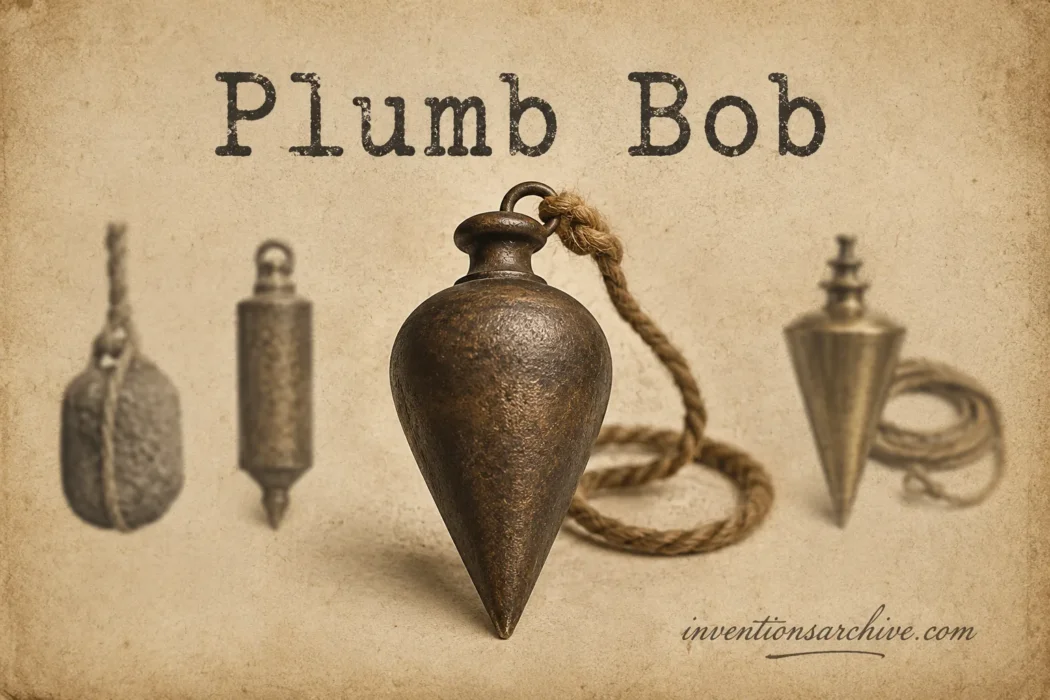
| Invention Name | Plumb bob, also called a plummet when referring to the suspended weight |
|---|---|
| Short Definition | A dense weight suspended from a cord to create a visible local vertical reference. |
| Approximate Date or Period | Documented by the Egyptian Middle Kingdom, including an object dated to about 1850–1700 BCE Based on surviving evidence |
| Geography | Secure early evidence from ancient Egypt; later forms are documented across many building and surveying traditions |
| Inventor or Source Culture | Anonymous / collective; no named inventor is supported by surviving evidence |
| Category | Measurement, construction, carpentry, surveying, architecture, and scientific observation |
| Main Problem Solved | Providing a repeatable vertical line without relying only on eyesight, surface shape, or a rigid tool |
| How It Works | Gravity pulls the suspended weight downward; after motion settles, the cord shows the local vertical direction |
| Technical Principle | Free suspension, gravity, tension in a flexible line, and alignment of the weight below the suspension point |
| Main Materials | Stone, travertine, hematite, limestone, bronze, lead, brass, iron, steel, cord, and later synthetic line |
| Early Documented Uses | Checking vertical alignment; combining with a frame to establish level; laying out building axes; observational timekeeping |
| Evidence Status | Confirmed objects Origin date approximate Inventor unknown |
| Surviving Evidence | Egyptian stone bobs, an Egyptian plumb-line level, a Roman bronze bob, museum records, and later surveying documents |
| Development Path | Suspended weight and cord → shaped plumb bob → framed plumb level and survey use → optical plummet → laser and electronic vertical alignment |
| Main Variations | Pointed bob, conical bob, cylindrical bob, masonry bob, surveyor’s bob, framed plumb level, instrument plummet |
| Related Inventions | Square, straightedge, plumb-line level, merkhet, spirit level, theodolite, optical plummet, laser level |
| Modern Descendants | Optical plummets, laser plummets, self-leveling laser instruments, total stations, and electronic inclinometers |
| Why It Matters |
|
A plumb bob turns gravity into a visible line. The device has only a few parts, yet it gave builders, carpenters, surveyors, astronomers, engineers, and archaeologists a shared reference for vertical alignment. Its lasting value comes from a direct physical relationship: a freely hanging mass settles below its point of suspension, and the cord between them marks the direction called plumb.
A Gravity-Based Vertical Reference
The plumb bob is the weight at the lower end of a flexible line. The full assembly is a plumb line. When the weight hangs freely, gravity places it below the suspension point and tension straightens the cord. The resulting line is used as a vertical datum against which a wall, column, shaft, instrument, drawing, or recorded point can be compared.
The tool does not create verticality. It reveals the local direction of gravity in a form that can be seen, marked, and measured. That distinction explains why the same principle could serve both a mason checking a wall and a surveyor centering an instrument.
The Bob, Cord, and Suspension Point
A traditional assembly contains three functional parts:
- The bob: a dense, balanced weight that keeps the line under tension.
- The cord: a flexible connection that shows the line between the fixed point and the hanging mass.
- The suspension point: the upper reference from which the line hangs.
Many bobs taper to a point so the axis of the cord can be transferred to a small mark below. Others are rounded, cylindrical, pear-shaped, or conical. The exact form varies, but the cord attachment, body, and lower reference should share a common axis.
Why the Line Settles Vertically
Once the swinging subsides, the bob settles into an equilibrium position with its mass hanging directly below the support. For ordinary construction work, this direction is treated as true vertical. In high-precision geodesy, the definition is more exact: the bob follows the local gravity field, which can differ slightly from the normal to an ideal reference ellipsoid. NOAA refers to this difference as the deflection of the vertical. [c]
This geodetic detail corrects a common oversimplification. A plumb line is not merely an imaginary radius drawn toward a perfectly uniform Earth. It responds to the real local gravity field, including small effects associated with Earth’s shape, rotation, and uneven mass distribution.
What It Measures and What It Does Not
A free plumb line provides one main result: a local vertical direction. It can help reveal whether another line or surface is parallel to that direction. By itself, it does not directly measure distance, horizontal level, slope angle, or a right angle.
Those other measurements become possible when the line is combined with a scale, frame, square, sight, or graduated instrument. The plumb-line level is one example: a suspended line within a symmetrical frame can indicate when the frame’s base is horizontal.
How the Origin Is Traced
No reliable record names a single inventor. The known history is reconstructed from objects, archaeological contexts, museum catalogues, depictions, and later technical records. Stone survives well, while cords, wooden supports, and worksite markings often decay. That survival pattern leaves historians with the weight but not always the full instrument.
Ancient Egypt supplies firm early evidence, including Middle Kingdom stone bobs and framed levels. The safest historical wording is therefore that plumb bobs were in established use in Egypt by that period, not that one known Egyptian created the device on a specific date.
Surviving Egyptian Objects
The Met’s Late Middle Kingdom example is made of travertine and stands 5.6 centimetres high. Other Egyptian examples were made from limestone or hematite. These materials show that lead was never the only possible choice. A suitable bob needed density, a reliable attachment point, and a shape that could hang on a stable central axis.
The framed Egyptian level adds another layer of evidence. It shows that the plumb line was not restricted to checking upright walls. When paired with geometry, the same gravity reference could test a horizontal base.
The Name Came Much Later
The English family of words plumb, plummet, and plumber is tied to Latin plumbum, meaning lead. Lead became closely associated with suspended weights because it is dense and easy to shape, but the tool itself predates its English name and was also made from stone and other metals. [d]
The term plumb later broadened from the object to the condition it indicated. A wall is plumb when it follows the vertical reference. “Out of plumb” means it departs from that line.
The Problem the Tool Answered
Builders needed a reference that did not depend on an irregular floor, a rough block, changing light, or visual judgment alone. Even a straight piece of wood cannot define vertical unless it is compared with another reference. Gravity offered that reference everywhere, and a suspended weight made it visible.
The device also separated two ideas that are often confused: straight and vertical. A timber can be straight but leaning. A wall face can be smooth but out of plumb. The cord gave craftspeople a line independent of the object being tested.
| Before the Plumb Reference | What Changed after Its Adoption |
|---|---|
| Vertical alignment relied more heavily on sighting, comparison with nearby features, or rigid tools whose own position had to be established. | A free-hanging line supplied an independent gravity reference. |
| A straight wall face could still lean without an obvious fixed datum. | Distances from the wall to the cord could reveal lean at several heights. |
| Transferring the same point between upper and lower levels was difficult when direct sight was blocked. | The hanging axis could carry a point vertically through openings, shafts, stairwells, or instrument stands. |
| Horizontal checking required a separate natural or geometric reference. | A plumb line placed in a symmetrical frame could indicate level when it met the frame’s center mark. |
| Survey instruments could be close to a station mark without being exactly centered. | Plumbing placed the instrument’s vertical axis over a defined ground point. |
| Measured drawings and excavation records could lose alignment between different heights. | A vertical datum helped relate points across floors, layers, and obstructed spaces. |
Earlier and Connected Tools
The deepest prehistory of vertical measurement is not documented. People could judge upright forms by sight, compare them with hanging natural objects, use water surfaces for horizontal reference, stretch cords for straight lines, and use set squares for right angles. The order in which these methods developed is uncertain.
What can be traced more clearly is the way the plumb line was combined with other devices. These combinations expanded a single vertical reference into horizontal, angular, astronomical, and surveying functions.
The Plumb-Line Level
A triangular or A-shaped frame turns the plumb line into a level indicator. When the feet of a symmetrical frame rest at the same height, the hanging line meets a central mark on the crosspiece. If the line falls to one side, the base is not level.
This is a clear example of gravity joined with geometry. The bob supplies vertical; the known shape of the frame converts that reference into information about horizontal position.
The Merkhet and Observational Alignment
Ancient Egyptian specialists also used a plumb-line principle in the merkhet, an instrument connected with timekeeping, meridian observation, and building layout. A Science Museum Group example dated to about 600 BCE is bronze with an inscription naming an astronomer-priest. Its current bob is a later replica, a museum detail that matters when separating the ancient object from modern restoration. [e]
The merkhet shows that the plumb line could act as a sighting reference rather than only a construction check. A vertical line helped define a meridian for observing stars and laying out axes.
Square, Straightedge, and Cord
A square establishes a right angle between rigid edges. A straightedge checks straightness. A stretched cord marks a line across distance. None of these, alone, guarantees that an edge is vertical. Pairing them with a plumb line allowed workers to connect geometric shape with the direction of gravity.
How People Used the Plumb Bob
The tool crossed trades because vertical reference is a shared need. Its form could remain simple while the surrounding work changed.
Construction and Carpentry
- Checking whether walls, posts, columns, door frames, and structural uprights followed a vertical line.
- Carrying a centerline upward or downward through several levels of a building.
- Combining the line with a frame to check horizontal work.
- Aligning shafts, towers, domes, machinery supports, and other features that needed a shared vertical axis.
The plumb line was especially useful when the tested object was much taller than a hand tool. A long cord could extend the reference beyond the length of a square or level.
Surveying and Instrument Centering
Surveyors used plumb bobs to place the vertical axis of a theodolite, transit, target, or stand over a station mark. A small centering error at the instrument could affect angular observations over long lines, so plumbing formed part of the setup rather than a separate craft.
Modern heritage-documentation guidance still describes the plumb bob as the simplest instrument for establishing a vertical reference line. It can also align with a feature when direct measurements are blocked by other parts of a structure. [f]
Related articles: Groma Surveying Instrument [Ancient Inventions Series], Sextant Precursor [Medieval Inventions Series]
Archaeology and Measured Recording
Archaeologists and building recorders use vertical references to relate upper points to lower plans, measure depth, and map features that cannot be reached by a direct horizontal measurement. Here the bob is less a test of workmanship than a way to place observations within a shared coordinate system.
Astronomy and Timekeeping
In observational instruments, the plumb line supplied a vertical sighting reference. Used with a sight or meridian device, it helped observers compare the movement of celestial objects with a stable local line. The same physical principle served a very different task because vertical direction was needed in both building layout and sky observation.
Development Path
| Stage | Form | What Changed |
|---|---|---|
| Earlier Idea | Dense object hanging from fiber or cord | Gravity became visible as a straight hanging line; the first date is unknown. |
| Surviving Ancient Form | Shaped stone bob with a cord attachment | A purpose-made, portable weight gave a repeatable central axis. |
| Combined Instrument | Triangular plumb-line level | A vertical reference was converted into a test for horizontal level. |
| Observational Form | Plumb line used with a merkhet or sighting device | The line supported meridian observation, timekeeping, and layout. |
| Metal Working Traditions | Bronze, lead, iron, and brass bobs in varied shapes | Metal allowed compact, durable, and finely pointed forms. |
| Surveying Instrument | Bob suspended beneath a tripod or target | The line centered an instrument’s vertical axis over a station mark. |
| Improved Centering | Optical plummet or vertical collimator | Optical sighting reduced dependence on a freely swinging external line. NOAA records such devices entering geodetic work around 1900. [g] |
| Modern Descendant | Laser plummet, self-leveling laser, and total station | Light and electronic sensing project or calculate vertical references, while the gravity-defined idea remains. |
Main Types and Variations
| Type | Typical Form | Main Role |
|---|---|---|
| Pointed Conical Bob | Axially balanced body tapering to a lower point | Transfers the cord’s axis to a small mark and checks vertical alignment. |
| Cylindrical or Barrel Bob | Longer body with a central line attachment and lower reference | Provides a compact hanging mass for general measuring work. |
| Masonry Bob | Heavier, durable metal body, often with a replaceable or defined point | Maintains a visible reference beside walls, columns, and tall work. |
| Surveyor’s Bob | Precisely centered body suspended beneath an instrument | Places a tripod or instrument axis over a station mark. |
| Plumb-Line Level | Bob and cord suspended within a triangular, A-shaped, or related frame | Uses vertical to test whether the frame’s base is horizontal. |
| Sighting Plumb Line | Suspended line paired with an observational or layout instrument | Defines a vertical plane or meridian for sighting. |
| Optical Plummet | Internal telescope or optical path aligned with an instrument’s vertical axis | Centers survey equipment without an exposed hanging bob. |
| Laser Plummet | Projected light point aligned with the instrument axis | Transfers or displays a vertical point using an optical-electronic system. |
Materials and Design Choices
Plumb bobs have been made from whatever offered enough mass, durability, and workable shape. Ancient examples include travertine, limestone, and hematite. Later metal forms used bronze, lead, brass, iron, and steel. The cord could be plant fiber, animal-derived fiber, woven textile, wire, or synthetic line.
Shape and Axis
The most useful design feature is not ornament but axial alignment. The cord attachment and the lower reference should lie on the same centerline. A symmetrical body reduces ambiguity about where that line passes through the weight.
A sharp tip can mark a small point, while a rounded or flat-ended body may suit a different reading method. Historical forms vary because the bob was adapted to available materials and local work rather than fixed by one universal design.
Mass and Motion
The bob must keep the cord taut, but more mass does not remove every source of error. Air movement, cord twist, vibration, contact with nearby surfaces, and continued swinging can shift the observed line. Some later arrangements damped motion with a surrounding liquid or protected the line inside a shaft or housing.
These limits explain why a plumb bob can be physically simple yet demand careful observation in precision work. The reference is clearest only after the hanging system reaches a stable position.
Cord and Attachment
The line must hang freely from a defined point. Stretch, thickness, knots, off-center attachment, and wear can affect where the visual axis appears. Surveying and instrument-making traditions therefore paid attention not only to the weight but also to the way the line connected with the bob and support.
How the Tool Spread and Changed
The evidence does not support a simple route from one inventor to every later culture. A hanging weight is easy to understand and may have been independently adopted in more than one place. Direct transfer also occurred as builders, surveyors, instruments, and written practices moved between workshops and regions, but many individual routes are not recorded.
By the Roman period, purpose-made metal examples were established. The British Museum holds a possibly first-century CE conical bronze plumb bob with grooved rings, showing both durable metal construction and a carefully shaped axial form. [h]
Later builders retained the suspended line while changing the frame, point, line material, and reading system. Surveyors connected it to tripods and instrument axes. Instrument makers then moved the reference inside optical devices, and modern systems replaced the visible cord with light or electronic sensing.
What Changed Because of the Plumb Bob
The main change was not speed alone. The plumb bob introduced a repeatable directional datum that could be shared across workers, stages, and instruments. A reference line could remain independent of the surface under construction.
Effects on Building
Vertical elements could be checked at more than one height. Centerlines could be carried through floors and shafts. Framed versions could test horizontal work. These uses supported more consistent walls, columns, openings, towers, and interior alignments.
Effects on Surveying
Instrument centering linked a point on the ground to the vertical axis of a theodolite or target. This connection helped make repeated observations refer to the same station rather than merely the same general area. Optical plummets later changed the method, not the need.
Effects on Science and Recording
The same vertical datum supported astronomical sighting, archaeological depth recording, architectural measured drawings, machinery alignment, and geodetic observation. These fields used different scales and instruments, but all benefited from a line tied to gravity rather than to the shape of a nearby object.
Limits and Sources of Error
A plumb line is often described as perfectly vertical, but any actual reading has conditions and tolerances. The underlying gravity reference is dependable; the physical assembly and observation can still introduce error.
- Swinging: the bob may pass repeatedly across the equilibrium point before settling.
- Air movement: wind or indoor drafts can displace the line.
- Vibration: moving floors, scaffolds, machinery, or nearby work can disturb the suspension point.
- Off-center attachment: the cord may not align with the body’s lower reference.
- Cord behavior: stretch, twist, thickness, or contact with another surface may alter the visible line.
- Reading scale: a long line is useful across height, but its position still has to be observed against a mark or measured feature.
- Local gravity: high-precision geodetic work distinguishes the actual local vertical from a mathematical reference surface.
These are not failures of the invention. They define the difference between the physical principle and a real tool used in a real environment.
Common Misunderstandings
A Named Person Invented It
No named inventor is supported by the surviving evidence. The plumb bob is better understood as a collective measuring idea refined across many workshops and periods.
The Oldest Surviving Bob Is the First Bob
An archaeological object gives a latest possible date by which the tool existed. Earlier examples may have been lost, made from perishable materials, reused, or not yet found.
The Bob and the Line Are the Same Part
The bob is the weight. The plumb line is the working assembly of weight, cord, and suspension. In ordinary speech, the terms are sometimes blended.
It Directly Finds Horizontal Level
A free plumb line finds vertical. Horizontal level appears only when the line is combined with a known frame, scale, or geometric relationship.
Modern Instruments Made It Meaningless
Optical and laser systems changed how vertical references are displayed and transferred. They continue the same need for an axis related to gravity, while the simple hanging bob remains useful in measured recording and other work.
Related Inventions
- Plumb-line level: combines a hanging line with a symmetrical frame to test horizontal level.
- Builder’s square: establishes right angles and works with a plumb reference to check upright construction.
- Merkhet: uses a vertical line in Egyptian astronomical observation, timekeeping, and layout.
- Spirit level: uses a bubble in liquid to indicate horizontal or vertical alignment within a rigid vial system.
- Theodolite: measures horizontal and vertical angles and historically required accurate plumbing over survey marks.
- Optical plummet: centers an instrument through an aligned optical path.
- Laser level and laser plummet: project light references for alignment and point transfer.
- Total station: combines angle and distance measurement with optical or electronic centering systems.
Frequently Asked Questions
When was the plumb bob invented?
No exact invention date is known. Secure museum evidence shows plumb bobs and plumb-line levels in use in Middle Kingdom Egypt, including objects dated to the second millennium BCE. The idea may be older than the surviving record.
Who invented the plumb bob?
The inventor is unknown. Surviving evidence points to long, collective development rather than a documented creation by one named person.
What is the difference between a plumb bob and a plumb line?
The plumb bob is the suspended weight. The plumb line is the full gravity-based reference formed by the bob, cord, and upper suspension point.
Does a plumb bob point to the exact center of Earth?
It aligns with the local direction of gravity. For ordinary construction this is treated as vertical. Precision geodesy accounts for small differences between that local direction and the normal to an ideal Earth reference surface.
Was every historical plumb bob made of lead?
No. Lead influenced the English name, but surviving bobs were also made from travertine, limestone, hematite, bronze, brass, iron, steel, and other dense materials.
Is the plumb bob still used?
Yes. It remains useful for vertical reference, point transfer, measured recording, and selected construction or surveying tasks. Optical and laser devices now handle many jobs that once depended on an exposed cord and weight.
Sources and Verification
- [a] Plumb bob — Late Middle Kingdom — Used to verify the date, material, dimensions, archaeological context, and museum identification of an Egyptian plumb bob. (Reliable because it is a direct Metropolitan Museum of Art collection record.)
- [b] Plumb Line Level — Used to verify the Dynasty 12 framed level, its component description, materials, and builder-carpenter context. (Reliable because it is a direct Grand Egyptian Museum object record.)
- [c] National Geodetic Survey DEFLEC18 — Used to verify the distinction between a plumb bob’s actual local direction and the ellipsoidal normal used in geodetic reference systems. (Reliable because it is an official NOAA geodesy resource.)
- [d] The History of “Aplomb” — Used to verify the word family connecting plumb, plummet, and Latin plumbum, meaning lead. (Reliable because Merriam-Webster is an established institutional dictionary and word-history source.)
- [e] Egyptian Merkhet — Used to verify the merkhet’s date, surveying and timekeeping roles, inscription, materials, and later replica plumb bob. (Reliable because it is a direct Science Museum Group collection record.)
- [f] Historic American Engineering Record Drawing Guidelines — Used to verify present-day use of plumb bobs for vertical reference planes, alignment, and measured documentation where direct measurement is obstructed. (Reliable because it is an official National Park Service technical publication.)
- [g] Geodetic Surveys — Used to verify the role of plumb bobs in centering geodetic instruments and the introduction of optical plummets or vertical collimators around 1900. (Reliable because it is an official history published by NOAA’s National Geodetic Survey.)
- [h] Plumb-bob — Used to verify a possibly first-century Roman conical bronze example, including form, material, and recorded dimensions. (Reliable because it is a direct British Museum collection record.)