
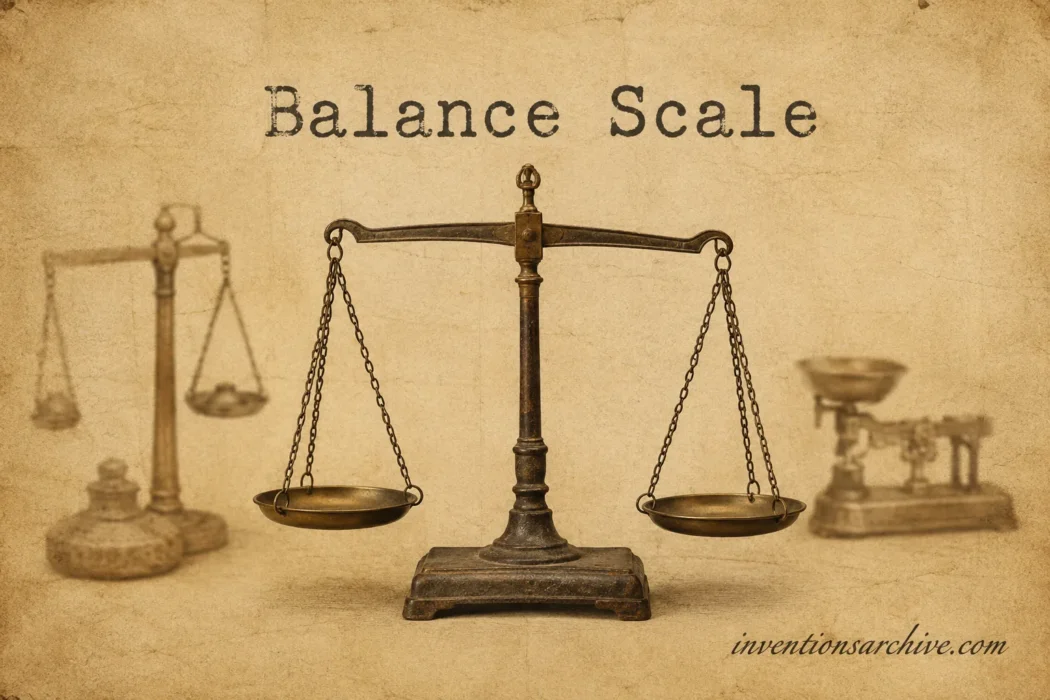
| Invention Name | Balance Scale |
|---|---|
| Short Definition | A measuring instrument that compares an unknown mass with a known mass by bringing a beam or linked mechanism into equilibrium. |
| Approximate Date / Period | Secure archaeological use by the early third millennium BCE; earlier proposals remain uncertain. Based on surviving evidence |
| Geography | Early evidence from Egypt, Mesopotamia, and the Levant; later traditions developed across Africa, Asia, Europe, and the Americas. |
| Inventor / Source Culture | Anonymous / collective development |
| Category | Measurement |
| Evidence Status | Approximate Attribution varies |
| Main Problem Solved | Comparing goods, metals, medicines, coins, and materials by mass rather than by appearance, volume, or guesswork. |
| How It Works | A suspended or supported beam responds to opposing turning forces until both sides reach equilibrium. |
| Technical Principle | Lever equilibrium: mass and distance from the fulcrum determine the turning effect on each side. |
| Main Parts | Beam, fulcrum or knife-edge, pointer or indicator, pans or load supports, suspension cords, and reference masses. |
| Typical Materials | Wood, bone, stone, cord, bronze, brass, iron, steel, glass, agate bearings, and calibrated metal masses. |
| Early Uses | Trade, bullion measurement, craft production, taxation, record keeping, coin checking, and the division of valuable materials. |
| Surviving Evidence | Balance beams, pans, standard masses, written records, workshop contexts, tomb scenes, and museum objects. |
| Development Path | Hand comparison and volume measures → suspended beam balance → standardized pan balance and steelyard → analytical and electronic balances. |
| Main Variations | Equal-arm balance, unequal-arm balance, steelyard, Roberval balance, assay balance, analytical balance, triple-beam balance, and electromagnetic balance. |
| Related Inventions | Standard masses, lever, steelyard, spring scale, analytical balance, metric system, electronic load cell, and Kibble balance. |
| Modern Descendants | Laboratory balances, retail scales, digital balances, mass comparators, microbalances, and Kibble balances. |
| Impact Areas | Commerce, science, medicine, education, manufacturing, metrology, administration, and craft production |
| Attribution Note | No surviving record identifies one inventor. The form was refined repeatedly in different regions. |
What A Balance Scale Is
A balance scale is a device for comparing mass. In its familiar equal-arm form, a beam rests on or hangs from a central fulcrum. A pan or load support sits at each end. The unknown object goes on one side, while known reference masses go on the other. When the beam returns to a defined level position, the two sides are in equilibrium.
The word scale is often used for many weighing devices, but a balance has a more specific idea behind it: one force is compared with another. A spring scale, for example, measures how far a spring stretches. A modern electronic scale may sense deformation in a load cell. These devices can report mass, yet their internal principle is not the same as a two-pan balance.
The balance was useful because it turned a judgment such as “this feels heavier” into a repeatable comparison. The result could be checked by another person using the same reference masses.
How The Mechanism Works
Equal Arms and Opposing Turning Forces
A balance beam acts as a lever. Each load creates a turning effect around the fulcrum. That effect depends on the load and its distance from the pivot. With equal arms, equal masses placed at equal distances create matching turning effects. The beam settles at its zero position.
If one side produces more turning force, that side descends. Small balances often include a pointer, index mark, or optical reading system so the user can see whether equilibrium has been reached. Precision instruments reduce friction at the pivot with hard, smooth bearings such as agate knife-edges.
Mass and Weight Are Related but Not Identical
Mass describes the quantity being compared. Weight is the force produced when gravity acts on that mass. On an equal-arm balance, both sides experience nearly the same local gravitational acceleration, so a change in local gravity affects both sides together. Very exact comparisons must also consider air buoyancy, because objects with the same mass but different volumes displace different amounts of air.[e]
The Problem It Answered
Before controlled weighing, people could count objects, compare their size, fill containers to a marked level, or judge heaviness by hand. These methods worked for some goods. They were weaker when density varied or when the material was valuable enough that a small difference mattered.
A jar filled to the same height might contain grain with a different moisture level. Two pieces of metal could have the same shape but different masses. Precious metal, pigments, spices, medicines, and small crafted parts called for a method that was repeatable and divisible.
The balance answered three practical needs:
- Comparison: deciding whether two quantities had the same mass.
- Quantification: matching an unknown object against recognized units.
- Verification: allowing buyers, sellers, officials, and craft workers to check a result.
Once reference masses became accepted within a workshop, market, palace, temple, or region, weighing could support records, payments, recipes, taxes, and exchange agreements.
Origins and Earliest Evidence
Evidence From The Early Bronze Age
The strongest early evidence does not point to one workshop or one named inventor. It appears across connected urban societies that were developing administration, long-distance exchange, metalworking, and written accounting.
A small bone balance beam from Tell Fadous-Kfarabida in present-day Lebanon was found in a securely dated early third-millennium BCE context. Its form shows that people in the Levant were using a delicate beam to compare valuable commodities. Because bone and wood can be mistaken for ordinary fragments, other early beams may remain unidentified in excavated collections.[b]
Standard Masses Made Weighing Numerical
A beam can show that one object is heavier than another. A set of reference masses makes the result numerical. In Mesopotamia, stone masses were produced in graded sizes and linked to units such as the shekel, mina, and talent. The British Museum records that these values could vary by city or region, while known equivalences helped users compare systems.[c]
This distinction matters. The beam is the comparison instrument; the reference masses form the measurement language. A balance without agreed units can compare. A balance used with standardized masses can assign a value.
Why One Inventor Cannot Be Named
The balance uses ideas that could develop gradually: suspending a bar, finding its center, observing tilt, and matching one load against another. None requires a written theory before practical use. Different communities could refine the device as trade and craft work created demand for finer comparisons.
Anonymous / collective development is therefore more accurate than attaching the invention to a ruler, philosopher, or later instrument maker.
Earlier Ideas, Parts, and Materials
The earliest balance depended on several older practices. People already used carrying poles, suspended containers, levers, cords, baskets, and stone counters. A weighing instrument brought these familiar elements into one controlled arrangement.
Beam
The beam had to be stiff enough to hold its shape and light enough to respond to small differences. Early beams could be made from wood or bone. Later instruments used bronze, brass, iron, and steel.
Fulcrum and Suspension
The central support established the turning point. A suspended balance could hang from a cord or ring. Bench balances rested on a knife-edge or bearing. Precision improved when the contact area became hard, smooth, and consistent.
Pans and Load Supports
Pans held loose goods, coins, powders, or reference masses. Cords needed equal effective lengths so that the pans hung evenly. Steelyards often replaced two equal pans with one load hook or pan and a sliding counterweight.
Reference Masses
Reference masses were made from stone, metal, glass, or other stable materials. Their value depended on preservation and trust. Chipping, corrosion, dirt, or deliberate alteration could change the result, which is why official inspection and protected sets became important in many societies.
Early Uses in Work and Exchange
The first balance scales were not general household gadgets. Their strongest value appeared where small differences carried economic or technical meaning.
- Metalworking: dividing gold, silver, copper alloys, and raw material for production.
- Trade: comparing goods with agreed masses during exchange.
- Administration: recording deliveries, dues, rations, or stored commodities.
- Coin and bullion checking: testing whether a piece matched an expected mass.
- Craft production: portioning pigments, glass ingredients, metals, and other costly materials.
- Medicine and pharmacy: preparing measured quantities as formal medical traditions developed.
A balance also created a visible procedure. The beam, pans, and reference masses could be observed by more than one participant. That visibility helped make measurement part of public and institutional trust.
Related articles: Cog Ship [Medieval Inventions Series], Pound Lock [Medieval Inventions Series]
Development Path
| Stage | Form | What Changed |
|---|---|---|
| Earlier Methods | Hand comparison, counting, container volume, and unstandardized stones | Useful for rough sorting but weak for dense or valuable materials. |
| Early Balance | Suspended beam with two pans | Made relative mass visible through equilibrium. |
| Standardized Balance | Equal-arm beam with graded reference masses | Turned comparison into numerical measurement. |
| Unequal-Arm Form | Steelyard with sliding counterweight | Extended range while using one movable counterpoise. |
| Counter Balance | Roberval and platform arrangements | Allowed goods to be placed on a stable platform above the mechanism. |
| Laboratory Refinement | Assay, analytical, and triple-beam balances | Improved sensitivity, repeatability, shielding, and direct reading. |
| Electronic Descendant | Electromagnetic force restoration and load-cell balances | Converted mechanical response into an electrical reading. |
| Primary Metrology | Kibble balance | Linked mass realization to electrical measurements and fixed physical constants. |
How The Design Spread and Changed
Weighing practices moved with merchants, administrators, craftspeople, coin systems, and scientific work. The exact units differed, but the visual logic of equilibrium was easy to recognize. Portable boxes protected delicate beams and small masses. Larger shop balances used stronger frames and platforms. Laboratory models placed sensitive mechanisms inside glass cases to reduce air movement and dust.
The Steelyard
The steelyard uses unequal arms. The object hangs from the short side, while a smaller counterweight moves along a graduated long arm. The beam balances when the turning effects match, and the counterweight position gives the reading. A Science Museum Group replica copied a Roman example excavated at Pompeii and shows the use of a movable counterpoise against marked divisions on the beam.[d]
This arrangement was compact and could weigh loads much heavier than the counterweight itself. It became useful for markets, workshops, agriculture, and transport.
The Roberval Balance
The Roberval arrangement places two platforms above a linked parallelogram mechanism. Loads can be positioned on the platforms without needing to hang directly below the beam ends. This made counter scales practical in shops and kitchens. The design also separated the visible platforms from much of the moving linkage.
Analytical and Assay Balances
Assay and laboratory balances aimed for smaller uncertainty. Makers refined beam geometry, knife-edges, pointers, damping, mass sets, and protective cases. Glass enclosures reduced drafts. Fine adjustment systems allowed the instrument to return to a repeatable zero.
The Triple-Beam Balance
A triple-beam balance places sliding riders on several graduated beams. The positions are added to obtain the measured mass. The Smithsonian traces the familiar laboratory form to Frank Aronson, whose 1906 patent described a simple, affordable, sensitive laboratory balance; later work by Paul Klopsteg refined the design.[f]
Main Types and Variations
| Type | Defining Form | Typical Context |
|---|---|---|
| Equal-Arm Balance | Two loads at equal distances from a central fulcrum | Trade, reference-mass comparison, teaching, and laboratory work |
| Unequal-Arm Balance | Different arm lengths with calibrated mass relationships | Compact weighing and extended range |
| Steelyard | Short load arm and long graduated arm with a sliding counterweight | Markets, transport, workshops, and agriculture |
| Roberval Balance | Parallel linkage with platforms above the mechanism | Retail counters, kitchens, and parcel handling |
| Assay Balance | Fine equal-arm balance for small valuable samples | Metallurgy, coinage, and precious-metal testing |
| Analytical Balance | High-sensitivity enclosed balance with fine adjustment | Chemistry, pharmacy, and standards laboratories |
| Triple-Beam Balance | Several graduated beams with movable riders | Schools, teaching laboratories, and routine bench work |
| Electromagnetic Balance | Electrical force restores the mechanism to a reference position | Modern laboratory and industrial measurement |
| Kibble Balance | Electromagnetic and mechanical power are compared | Primary realization of mass standards |
Before and After The Balance Scale
| Before The Invention | What Changed After It |
|---|---|
| Heaviness judged by hand | Mass differences became visible through beam movement. |
| Goods compared mainly by count or volume | Dense, irregular, or valuable materials could be compared by mass. |
| Local stones or objects used without stable values | Graded reference masses supported repeatable numerical units. |
| Small differences were hard to detect | Sensitive beams and pointers revealed finer differences. |
| Exchange depended heavily on personal judgment | A visible procedure allowed another person to check the comparison. |
| Craft portions varied more easily | Materials could be divided according to repeatable mass ratios. |
| Scientific mixtures lacked a mature mass-measurement tool | Chemistry, pharmacy, and assay work gained a repeatable comparison method. |
Accuracy, Error, and Calibration
A simple balance can be useful without being highly precise. Better instruments control several sources of error.
- Unequal arm length: even a small geometric difference can bias the comparison.
- Pivot friction: rough or worn bearings can stop the beam before true equilibrium.
- Zero error: the unloaded beam may not return to its reference position.
- Air movement: drafts disturb light pans and sensitive beams.
- Air buoyancy: objects of different volume experience different upward forces in air.
- Temperature: parts can expand, while samples may gain or lose moisture.
- Reference-mass condition: wear, corrosion, dirt, or damage changes the standard.
- Off-center loading: some platform mechanisms respond differently if the load is not placed as intended.
Calibration connects the instrument and its reference masses to a recognized standard. In trade, this supports fair transactions. In science, it allows measurements made in different laboratories to be compared.
What Changed In Science, Commerce, and Daily Work
Commerce and Administration
Balances made it easier to divide bullion, check coins, compare goods, and record deliveries. Standard masses supported agreements across workshops and markets, though local units still varied. Authorities could inspect masses and weighing devices rather than relying only on verbal claims.
Craft and Manufacturing
Metalworkers, glassmakers, dyers, and other craftspeople could divide costly ingredients more consistently. Repeatable mass ratios improved the transfer of workshop knowledge because a recipe could be expressed in quantities rather than only by visual judgment.
Medicine and Pharmacy
Small balances became associated with pharmacies and medical preparation because some ingredients required controlled portions. Later analytical balances offered finer readings and better protection from drafts and contamination.
Chemistry and Laboratory Science
Mass comparison became central to quantitative chemistry. Reactions could be studied by comparing materials before and after a process. Laboratories developed enclosed analytical instruments, calibrated mass sets, and formal procedures for uncertainty and traceability.
Education
School balances made equilibrium visible. A learner could see that moving a mass farther from the fulcrum changed its turning effect, or that equal masses balanced at equal arm lengths. Triple-beam balances later combined this visible mechanism with a direct numerical reading.
Modern Descendants
Many digital balances no longer display a long beam and two pans, but they preserve the older goal: compare an unknown load with a stable reference relation. Electronic laboratory balances often use electromagnetic force restoration. A sensor detects movement, and an electrical force returns the mechanism to a reference position. The required electrical signal becomes the measurement.
At the highest level of mass metrology, the Kibble balance compares mechanical and electrical effects. In one mode, electromagnetic force balances the downward force of a test mass. In another, motion through a magnetic field provides calibration data. The measurements link mass to fixed physical constants rather than to one metal kilogram artifact.[g]
The modern instrument is far more complex, but equilibrium remains the central idea.
Common Misunderstandings
One Person Invented The Balance Scale
No named inventor is supported by the surviving evidence. The device developed through repeated practical changes in several early measurement cultures.
The Oldest Surviving Object Marks The First Use
An archaeological object proves that a form existed by a certain date. It does not prove that no earlier wooden, fiber, or bone version existed.
Every Weighing Scale Is A Balance
Balances compare opposing forces. Spring scales and many electronic scales use different sensing methods, even when the display reports grams or kilograms.
Equal Pans Alone Guarantee Accuracy
Accuracy also depends on arm length, pivot condition, zero setting, air movement, buoyancy, reference masses, and loading position.
Related Inventions
- Lever: the mechanical principle behind beam equilibrium.
- Standard Masses: reference objects that turn comparison into numerical measurement.
- Steelyard: an unequal-arm balance with a sliding counterweight.
- Spring Scale: a later weighing device based on elastic deformation rather than opposing masses.
- Analytical Balance: a protected high-sensitivity instrument for laboratory work.
- Metric System: a shared unit system that improved comparison between regions and institutions.
- Electronic Load Cell: a sensor that converts deformation under load into an electrical signal.
- Kibble Balance: a metrology instrument linking mass to electrical measurements and fixed constants.
Frequently Asked Questions
Who Invented The Balance Scale?
No single inventor is known. Archaeological evidence points to collective development in early measurement cultures, with secure use in Egypt and Mesopotamia by the early third millennium BCE.
Does A Balance Measure Mass Or Weight?
An equal-arm balance compares mass. Both sides experience nearly the same local gravity, so the gravitational effect is shared. Everyday speech often calls the result weight.
Why Are Standard Masses Needed?
A beam can show whether two loads match. Standard masses let the user express the comparison as a recognized number, such as grams or an older regional unit.
What Is The Difference Between A Balance and A Steelyard?
A common equal-arm balance places loads at matching distances from the fulcrum. A steelyard uses unequal arms and a movable counterweight on a graduated beam.
Are Balance Scales Still Used?
Yes. Mechanical balances remain in education, field work, specialist crafts, and some laboratories. Electronic balances and Kibble balances continue the comparison principle with electrical sensing and force restoration.
Sources and Verification
- [a] The Use of Balances in Late Andean Prehistory (AD 1200–1650) — Used to verify the secure early-third-millennium BCE association of balance weights in Egypt and Mesopotamia. (Reliable because it is a peer-reviewed Cambridge Archaeological Journal article.)
- [b] Restoring The Balance: An Early Bronze Age Scale Beam From Tell Fadous-Kfarabida, Lebanon — Used to verify the early-third-millennium BCE bone balance beam and its archaeological context. (Reliable because it is a peer-reviewed Antiquity article published by Cambridge University Press.)
- [c] Weight — Used to verify Mesopotamian graded masses, sexagesimal divisions, and regional variation in the shekel, mina, and talent. (Reliable because it is a British Museum collection record for a documented measuring object.)
- [d] Replica Of Roman Steelyard, From Pompeii, 79 AD — Used to verify the steelyard lever principle, movable counterweight, and graduated beam reading. (Reliable because it is a Science Museum Group collection record based on an excavated Roman example.)
- [e] NIST Handbook 44, Appendix B: Units and Systems Of Measurement — Used to verify the distinction between mass and weight, equal-arm comparison, local gravity, and air-buoyancy effects. (Reliable because it is an official NIST metrology publication.)
- [f] Balance — Used to verify Frank Aronson’s 1906 triple-beam balance patent and later refinements by Paul Klopsteg. (Reliable because it is a National Museum of American History collection record.)
- [g] Kilogram: The Kibble Balance — Used to verify force mode, velocity mode, electromagnetic comparison, and the modern realization of mass. (Reliable because it is an official NIST technical explanation.)