
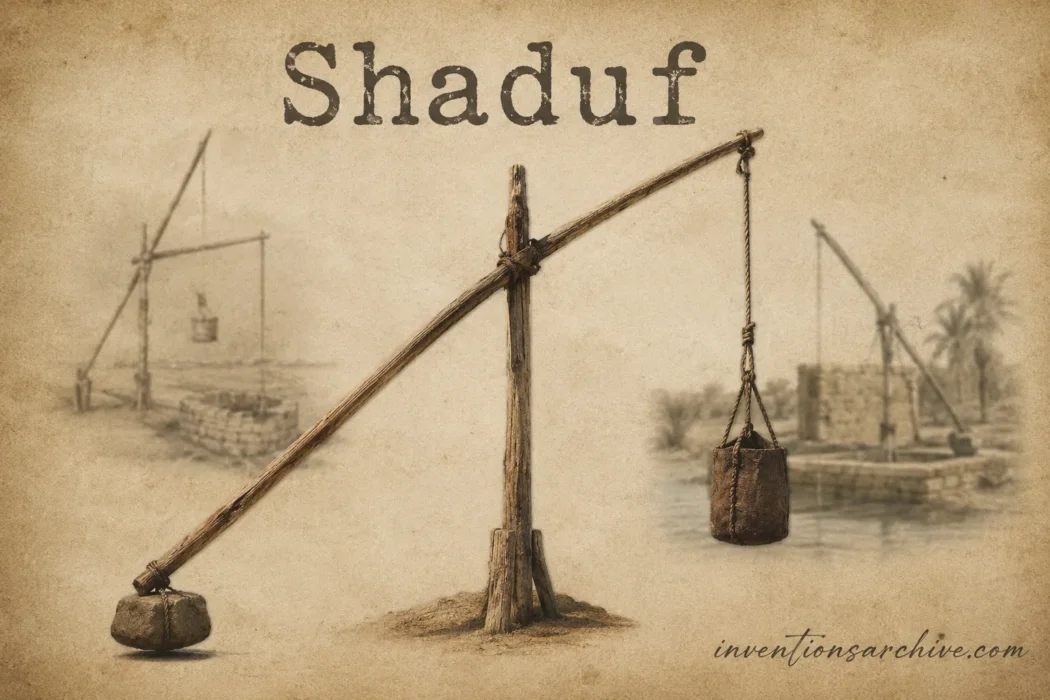
| Invention Name | Shaduf |
|---|---|
| Alternative Spellings and Names | Shadoof; counterpoise lift; water crane; well pole; well sweep |
| Short Definition | A hand-operated, counterweighted lever that raises water from a lower source to a higher channel, basin, or field. |
| Approximate Date or Period | Possible Mesopotamian use in the 3rd millennium BCE; securely attested in Egypt during the New Kingdom. Debated origin |
| Geography | Mesopotamia and the Nile Valley in early evidence; later forms across North Africa, the eastern Mediterranean, West Asia, and South Asia |
| Inventor or Source Culture | Anonymous / collective; no named inventor survives |
| Category | Agriculture; irrigation; water lifting; mechanical engineering |
| Evidence Status | Based on surviving evidence; Egyptian dating is firmer than claims about the absolute first example |
| Main Problem Solved | Raising water above a riverbank, canal edge, reservoir, or well rim with less lifting force than a free bucket required |
| How It Works | A pivoted beam carries a water container at one end and a counterweight at the other; the counterweight assists the upward return |
| Material and Technical Basis | Timber beam and support; rope; pottery, leather, basketry, or later metal container; stone, mud, or another compact counterweight |
| Early Use | Garden irrigation, small field channels, water transfer from canals, and lifting from shallow wells |
| Practical Strength | Low-cost, locally repairable, fuel-free operation for repeated low lifts |
| Main Limitation | Intermittent flow, repeated human labor, and limited lift height per unit |
| Development Path | Hand-carried vessel → suspended scoop → counterweighted shaduf → staged lifts and rotary water raisers → powered pumps |
| Predecessors | Hand-carried pots; rope-and-bucket lifting; scoops; swing baskets; short irrigation channels |
| Later Forms and Successors | Tiered shadufs; well sweeps; windlasses; bucket chains; saqiya; Persian wheel; noria; mechanical pumps |
| Surviving Evidence | New Kingdom garden scenes, later written and technical descriptions, ethnographic records, photographs, and museum models |
| Modern Descendants | Lever-assisted water lifts, hand pumps, motor pumps, solar irrigation pumps, and low-head water-transfer systems |
| Related Inventions | Lever; irrigation canal; windlass; bucket chain; saqiya; noria |
| Fields Affected | Agriculture, water management, horticulture, settlement support, mechanical design, and rural production |
What a Shaduf Is
A shaduf is a water-lifting device built around a lever. A long beam rests on a pivot. One end carries a rope and water container. The other carries a counterweight. The arrangement helps a person move a filled container upward from a river, canal, reservoir, or shallow well.
The device does not create water pressure and does not provide a continuous stream. It transfers separate loads. Its value lies in repeated low lifts made with a simple mechanism that can be built and repaired from local materials.
English sources also use shadoof, well sweep, well pole, counterpoise lift, and water crane. These names may describe close relatives rather than perfectly identical regional designs.
The Problem It Answered
Early irrigation did not begin with the shaduf. Communities already used natural flooding, basin irrigation, canals, dikes, hand-carried vessels, and direct bucket lifting. The difficulty appeared wherever useful water sat below the level of the soil or delivery channel.
A person lifting a filled pot or skin bag directly had to support its full weight through the whole upward movement. Repetition limited the volume that could be moved and placed strain on the body. Riverbanks and canal sides also changed height as water levels rose and fell.
The shaduf answered that narrow practical need. Its counterweight assisted the return of the loaded end, while the beam guided the container along a repeatable arc. It did not remove human work, but it made the work more controlled and better suited to regular irrigation cycles.
How the Mechanism Works
The shaduf is a first-class lever: the pivot sits between the water load and the counterweight. Beam length, pivot position, container mass, counterweight mass, and lift height shape how the device feels during use.
Main Working Parts
- Support frame: a forked post, paired uprights, or another stable support.
- Pivot: the turning point that allows the beam to rock.
- Lever beam: a long pole that carries the load and counterweight.
- Rope or hanging line: connects the beam to the container.
- Water container: commonly a pot, bucket, skin bag, basket-like vessel, or later metal container.
- Counterweight: a compact mass fixed to the short end of the beam.
- Receiving channel: the ditch, basin, trough, or raised watercourse that accepts the lifted water.
Food and Agriculture Organization material classifies the shadoof as a counterpoise lift. It describes a suspended bucket or scoop on a pivoted lever and notes that several units can be arranged in stages where a bank rises too far for one lift. [d]
Why the Flow Is Intermittent
Each cycle moves one container load. Water reaches the field in pulses rather than as a steady pumped stream. The receiving ditch smooths those pulses by holding and distributing water between cycles.
This is one reason the shaduf remained useful beside small plots, gardens, shallow wells, and low channels, while rotary devices and powered pumps became better suited to larger or higher-volume tasks.
Earlier Water-Lifting Methods
The shaduf joined an older water-management system. It did not replace canals, basins, field ridges, or hand tools. It worked with them.
- Hand-carried vessels moved water in pots, jars, baskets, or skin containers.
- Rope-and-bucket lifting reached below a well rim but offered little mechanical assistance.
- Scoops and bailers transferred water across a small rise.
- Swing baskets allowed two people to move water in a suspended container.
- Flood basins and canals moved water by gravity when terrain and river level allowed it.
The new element was the combination of a pivoted beam with a counterweight. That pairing turned a loose lifting task into a repeatable mechanical cycle.
Origin and Early Evidence
The shaduf is often labeled an Egyptian invention. That description is too certain. Some engineering histories place related counterweighted water lifts in Mesopotamia during the 3rd millennium BCE and cite a possible image on a cylinder seal around 2200 BCE. Other studies stress that the Egyptian device is securely visible only in New Kingdom evidence.
A careful archive entry therefore separates two questions:
- Where might the earliest form have appeared? Mesopotamia is a leading candidate, but the interpretation of early images and terminology is not beyond dispute.
- When is the device clearly documented in Egypt? New Kingdom scenes provide the strongest visual record, especially from the 18th and 19th Dynasties.
No single craftsperson can be named. The design likely emerged through collective testing, local adaptation, and transfer between irrigation cultures.
What Survives
Wood, fiber rope, leather, and unfired materials decay easily. Early working shadufs are therefore less likely to survive than stone monuments or ceramic vessels. Much of the record comes from:
- tomb and garden scenes;
- archaeological studies of irrigation landscapes;
- technical descriptions of water-lifting devices;
- later photographs and field notes;
- museum models documenting recent traditional use.
This evidence explains why the date of Egyptian adoption can be discussed more confidently than the identity of a first inventor.
Use in the Nile Landscape
Egyptian farming depended on the Nile, yet gravity did not place water everywhere it was needed. Fields and gardens on raised banks could sit above the water surface, especially outside the main flood period. A shaduf could move water from the river or a canal into a higher ditch and then toward a plot.
The device was especially suited to garden-scale and low-head irrigation. A worker could fill a small channel repeatedly, while ridges and basins guided the water across cultivated ground.
What It Changed in Practice
Research on Egyptian land use links the shaduf’s appearance in Upper Egypt during the 18th Dynasty with some summer cropping on levees and cultivation along valley margins. The same study treats later expansion estimates as reconstructions rather than direct measurements, so they should not be read as exact totals. [e]
The practical change was not a sudden replacement of flood irrigation. It was the ability to lift water into places and seasons where gravity alone was less useful.
- Garden plots could receive repeated watering.
- Higher banks became easier to serve.
- Small channels could be refilled after floodwater receded.
- Water transfer became more regular and less dependent on carrying vessels by hand.
- Later water-lifting systems had a familiar mechanical problem to solve at larger scale.
Before and After the Shaduf
| Before the Shaduf | What Changed After Its Adoption |
|---|---|
| Water was often carried in vessels or raised by a plain rope and bucket. | The counterweight assisted the upward part of repeated lifting. |
| The worker supported most of the water load directly. | The beam and pivot controlled the path of the load. |
| Low banks could still demand tiring, repeated carrying. | Water could be transferred into a raised ditch beside the source. |
| Gravity irrigation depended strongly on water level and terrain. | Selected gardens and field margins gained a simple lift option. |
| Greater height required more direct lifting effort. | Multiple shadufs could move water upward in stages. |
| Water delivery remained limited to human-scale containers. | Later rotary and powered systems addressed volume and continuous flow. |
Development Path
| Stage | Form | What Changed |
|---|---|---|
| Earlier Tool | Pot, bucket, scoop, swing basket | Water moved by direct human lifting or carrying |
| Lever Lift | Shaduf | A pivot and counterweight assisted repeated low lifts |
| Adapted Form | Tiered shadufs and regional well sweeps | Several lifts could overcome a taller bank or reach a receiving channel |
| Rotary Water Raiser | Saqiya, Persian wheel, noria, bucket chain | Rotation supported more regular or continuous delivery |
| Powered Pump | Mechanical, electric, and solar pumping systems | External power raised larger volumes and served wider networks |
This is a family history of water-lifting ideas, not a claim that every later pump descended through one direct line from the shaduf.
Main Forms and Variations
| Form | Defining Feature | Typical Use | Evidence Note |
|---|---|---|---|
| Single-Stage Shaduf | One pivoted beam with one water container and counterweight | Low riverbanks, canals, reservoirs, and shallow wells | The standard form shown in many Egyptian records |
| Tiered Shadufs | Two or more units placed at different heights | Moving water up a sloping bank in separate steps | Each unit performs only part of the total lift |
| Well Sweep or Well Pole | Long counterweighted pole positioned over a well | Domestic water, livestock water, and small irrigation | May use a bucket rather than a flexible bag |
| Suspended Scoop Relative | Scoop or vessel supported from a pivoted or suspended member | Very low water transfer | Related in principle; not every example is a full shaduf |
| Regional Counterpoise Lift | Local beam, container, support, and naming traditions | Small farms and shallow water sources | Attribution varies |
Materials and Local Adaptation
The shaduf’s form was shaped by materials close to the water source. A straight timber beam was useful, but the support could be a forked trunk, paired posts, masonry, or a built frame. Rope might be made from plant fiber. The water vessel could be pottery, leather, woven material coated to hold water, or metal in later examples.
Related articles: Elevator (Greek Water-powered Lifts) [Ancient Inventions Series], Lever [Ancient Inventions Series]
The counterweight did not need a refined shape. Stone, packed earth, mud, or another dense local mass could serve. What mattered was the balance between the empty container, the filled container, the beam, and the desired movement.
This material flexibility helped the device persist. A village carpenter or farm worker could understand its worn joints and replaceable parts without an industrial supply chain.
How the Design Spread and Changed
Counterweighted water lifts appear under many names across dry farming regions. Some may reflect diffusion from older irrigation centers; others may be local reinventions of an easily understood lever solution. Similarity alone does not prove a single route.
Across different regions, builders altered:
- beam length and taper;
- pivot height;
- container material and capacity;
- counterweight shape;
- support-frame construction;
- the number of lifting stages;
- the relation between the lift and nearby channels.
Rotary systems later offered steadier delivery. Windlasses improved deep bucket lifting. Bucket chains, Persian wheels, saqiyas, and norias moved repeated containers through a continuous path. Powered pumps then separated water lifting from direct human or animal cycles.
Why It Did Not Disappear
Newer machinery did not make every shaduf useless. On a small plot beside shallow water, a fuel-free lever could remain practical where a pump cost more to buy, repair, or power.
A British Museum model collected in Upper Egypt in the early 20th century records a wooden shaduf made by a local carpenter and described in field notes as equipment for supplying irrigation water. It documents continuity of the working form, not an ancient artifact. [f]
What Changed Because of the Shaduf
The shaduf’s effect is best understood at the scale of everyday work. It gave farmers and gardeners a dependable method for raising small amounts of water many times.
- Agriculture: selected plots above the immediate waterline became easier to irrigate.
- Horticulture: garden beds and tree plots could receive repeated watering.
- Water management: low channels could connect sources to raised basins.
- Mechanical knowledge: the lever, pivot, load, and counterweight became visible parts of ordinary work.
- Technology transfer: the same lifting problem encouraged well sweeps, staged devices, rotary raisers, and later pumps.
Its influence was not based on speed alone. The shaduf was understandable, repairable, and matched to small-scale water needs.
Common Misunderstandings
Related Inventions
- Lever: the mechanical principle that allows force and motion to be balanced around a pivot.
- Irrigation Canal: the gravity-fed watercourse that often received and distributed shaduf water.
- Windlass: a rotating drum that helps raise a rope and bucket from deeper wells.
- Bucket Chain: a loop of containers that raises water through repeated rotary motion.
- Saqiya: a rotary water-lifting system, often driven by animals in historical use.
- Persian Wheel: a wheel-and-container system for repeated lifting from wells or channels.
- Noria: a water-driven wheel fitted with containers or compartments.
- Mechanical Pump: a later family of machines that moves water through displacement or dynamic flow.
Frequently Asked Questions
Who invented the shaduf?
No named inventor is known. The shaduf is treated as a collective invention or a family of related water-lifting designs. Mesopotamian claims may be earlier, while Egyptian New Kingdom evidence is clearer and better dated.
Was the shaduf invented in ancient Egypt?
Egypt is strongly associated with the shaduf because New Kingdom scenes document it clearly and the device remained visible in Nile agriculture for centuries. Earlier Mesopotamian evidence has also been proposed, so an exclusively Egyptian origin cannot be stated with certainty.
What simple machine does a shaduf use?
It uses a lever with the pivot between the water load and the counterweight. This arrangement is commonly described as a first-class lever.
What was the shaduf used for?
Its main use was lifting water from a river, canal, reservoir, or shallow well into a higher ditch, basin, trough, or cultivated plot. It was well matched to gardens and small-scale irrigation.
Could a shaduf lift water up a tall bank?
A single unit was best for a limited vertical rise. Where terrain allowed, several shadufs could be set at different levels so that water moved upward in stages.
Is the shaduf still used?
Traditional counterweighted water lifts have continued in some rural settings because they need no fuel and can be repaired locally. Their use is now much narrower where motorized or solar pumps are affordable and serviceable.
Sources and Verification
- [a] Evolution of Water Lifting Devices (Pumps) over the Centuries Worldwide — Used to verify the debated Mesopotamian dating, early regional evidence, basic mechanism, and Egyptian New Kingdom chronology. (Reliable because it is a peer-reviewed academic journal article.)
- [b] People in Landscapes — The Archaeology of Pharaonic Egypt — Used to verify that Egyptian shaduf depictions first appear in known New Kingdom gardening scenes. (Reliable because it is an academic book chapter published by Cambridge University Press.)
- [c] Garden Scene, Tomb of Ipuy — Used to verify the Ramesside date, Dynasty 19 setting, and Deir el-Medina origin of the documented garden scene. (Reliable because it is a direct collection record from The Metropolitan Museum of Art.)
- [d] Water Lifting Devices: Review of Pumps and Water Lifting Devices — Used to verify the counterpoise-lift classification, pivoted bucket mechanism, low-lift role, and staged arrangement. (Reliable because it is a technical publication of the Food and Agriculture Organization of the United Nations.)
- [e] Early Hydraulic Civilization in Egypt: A Study in Cultural Ecology — Used to verify the 18th Dynasty Egyptian context and the cautiously reconstructed effects on summer cropping and valley-margin cultivation. (Reliable because it is a University of Chicago scholarly publication based on archaeological and environmental evidence.)
- [f] Model; Water-Hoist; Irrigation Equipment — Used to verify the early 20th-century Upper Egyptian museum model, its materials, collection history, and recorded irrigation purpose. (Reliable because it is a direct British Museum collection record.)