
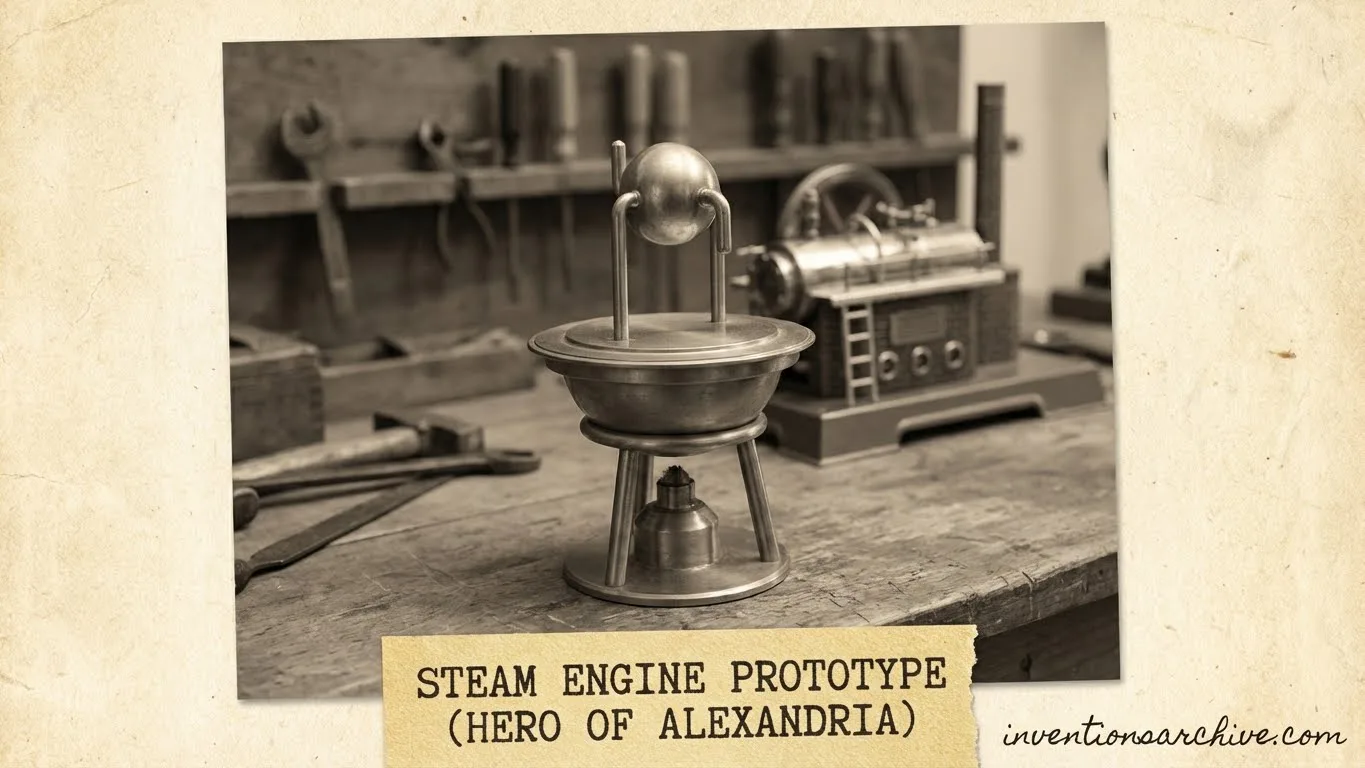
| Invention Name | Hero’s Aeolipile, also called Heron’s engine |
|---|---|
| Short Definition | A hollow rotating vessel driven by jets of steam escaping through bent nozzles. |
| Approximate Date / Period | 1st century CE Approximate |
| Geography | Alexandria, Roman Egypt |
| Inventor / Source Culture | Commonly attributed to Hero of Alexandria; rooted in Greco-Roman pneumatic experimentation. |
| Category | Energy, mechanics, steam power, scientific demonstration |
| Evidence Status | Based on surviving evidence Known mainly through written transmission and later models. |
| Main Problem Solved | Demonstrated that heated water could produce steam pressure and visible rotary motion. |
| How It Worked | Steam entered a hollow sphere and escaped through angled nozzles, making the sphere spin. |
| Material / Technology Basis | Metal vessel, boiler, hollow tubes, steam pressure, reaction force |
| Early Use Context | Likely demonstration, teaching, display, or temple-related mechanical spectacle; practical use is uncertain. |
| Development Path | Pneumatic devices → aeolipile → steam demonstrations → steam turbines and heat engines |
| Related Inventions | Water organ, automatic temple doors, steam turbine, steam engine, reaction turbine |
| Modern Descendants | Steam turbines, turbine demonstrations, educational reaction-force models |
| Historical Importance | One of the earliest recorded devices to turn steam pressure into rotary motion. |
What the Aeolipile Was
The aeolipile was a small steam-driven rotating device associated with Hero of Alexandria, a Greek mathematician and engineer active in Alexandria in Roman Egypt. Hero’s surviving works describe many mechanical devices involving air, water, pressure, valves, siphons, and motion. Britannica places him in Alexandria around the 1st century CE and identifies the aeolipile as the most famous steam-powered device described in his Pneumatica.[b]
The machine was simple in outline. A vessel of water was heated. Steam moved into a hollow sphere. The steam then escaped through small bent tubes. Because the tubes pointed sideways, the escaping steam made the sphere rotate.
That motion is why the aeolipile often appears in histories of the steam engine. It is not important because it changed ancient industry. It is important because it gives historians a clear early example of steam used to produce mechanical rotation.
How Its Origin Is Traced
The origin of the aeolipile is traced through classical mechanical writing, especially the tradition surrounding Hero’s Pneumatica. Hero worked in a technical culture that already knew water clocks, siphons, pumps, air pressure effects, automatic doors, and temple mechanisms. His aeolipile fits that world: a compact device built to show a physical principle in visible form.
There is no surviving ancient workshop model that can be pointed to as “the first aeolipile.” The record is instead built from:
- ancient and later transmitted descriptions of pneumatic devices;
- Renaissance and modern drawings based on classical texts;
- museum teaching models and reconstructions;
- modern technical interpretation of steam pressure and reaction motion.
This is why a careful article should not say that the aeolipile was the first practical steam engine. It is safer to call it one of the earliest recorded steam-powered devices and an early example of a steam-driven turbine principle.
The Problem It Answered
The aeolipile did not answer an industrial production problem. It answered a different kind of problem: how to make the invisible behavior of heated air, steam, and pressure visible.
Before devices like this, people could observe steam rising from hot water, but controlled steam motion was harder to demonstrate. The aeolipile gave a physical answer. A viewer could see heat turn water into steam, steam move through tubes, and escaping steam make a sphere rotate.
How It Worked in Simple Terms
The aeolipile worked through a chain of basic physical changes:
- Water was heated in a closed or partly closed vessel.
- The heated water produced steam.
- Steam moved into a hollow rotating chamber.
- The steam escaped through angled nozzles.
- The reaction from the escaping steam pushed the chamber in the opposite direction.
- The hollow chamber spun around its axis.
Britannica describes the aeolipile as a hollow sphere mounted on tubes that carried steam from a cauldron, with high-pressure steam escaping through bent tubes and causing the sphere to spin.[c]
The same broad physical idea is familiar in later propulsion: a jet of gas leaves in one direction, and the object receiving the reaction moves the other way. NASA explains thrust through Newton’s third law, where expelled gas creates a reaction force in the opposite direction.[e] The aeolipile is not a rocket, but its spinning motion can be understood through a related action-and-reaction principle.
Earlier Ideas and Tools Before It
The aeolipile did not appear in isolation. It belonged to a long Alexandrian and Greco-Roman interest in devices that used air, water, pressure, and hidden mechanical action.
Earlier and related ideas included:
- Pneumatic vessels that used trapped air and liquid movement.
- Siphons that controlled liquid flow through tubes.
- Water clocks that linked timekeeping with regulated flow.
- Pumps associated with Alexandrian mechanical traditions.
- Temple mechanisms that used heat, air pressure, weights, or liquid displacement to create motion.
These devices gave Hero’s world the technical language needed for the aeolipile: hollow vessels, pressure differences, tubes, pivots, valves, and controlled movement.
Main Materials, Mechanism, and Principle
The aeolipile’s early form is usually shown as a metal sphere above a heated vessel. A later working model in the Science Museum Group collection describes a hollow ball mounted between pivots, with one pivot serving as a steam pipe from a cauldron below; two bent nozzles release high-pressure steam and make the ball rotate.[d]
The device combined several simple parts:
- a heated water vessel or boiler;
- hollow tubes carrying steam upward;
- a rotating hollow sphere;
- two angled outlets or nozzles;
- a pivot or support that allowed rotation.
The essential principle was not complicated. The device turned steam pressure into rotary movement. What made it memorable was the clarity of the demonstration: heat created steam, steam escaped, and the sphere spun.
Before and After
| Before the Aeolipile | What Changed After It |
|---|---|
| Steam was visible as vapor, but its controlled mechanical effect was harder to show. | Steam could be shown producing rotation in a compact mechanical display. |
| Air and water devices often demonstrated pressure through lifting, flowing, or opening effects. | The aeolipile showed pressure creating continuous spinning motion. |
| Mechanical spectacle depended mainly on weights, water flow, hidden linkages, or animal and human force. | Heat and steam became part of the visible mechanical effect. |
| No known ancient steam device became a routine industrial power source. | The aeolipile later became a historical reference point for steam turbines and heat engines. |
| Motion from pressure was known in several forms, but not always easy to connect with later steam technology. | The aeolipile created a clear example of reaction-driven rotary motion. |
Development Path
| Stage | Form | What Changed |
|---|---|---|
| Earlier Tool | Siphons, water clocks, pumps, pneumatic vessels | Air and water pressure were used for controlled flow and small mechanical effects. |
| Ancient Device | Hero’s aeolipile | Steam pressure was used to create visible rotary motion. |
| Later Demonstration | Teaching models and experimental steam devices | The aeolipile became a model for explaining steam, pressure, and reaction force. |
| Improved Form | Practical steam engines | Steam was applied to pumping, transport, manufacturing, and mechanical work. |
| Modern Descendant | Steam turbines | High-speed steam flow drives turbine blades for power generation. |
Early Uses and Display Context
The original use of the aeolipile is not fully certain. It may have served as a teaching device, a mechanical curiosity, or part of a broader tradition of temple and demonstration mechanisms. Hero’s writings include many devices that seem designed to impress viewers by making movement appear automatic.
That does not make the aeolipile unimportant. A demonstration device can still matter in the history of invention. Many scientific instruments began as ways to show a principle clearly before they became linked to practical machines.
The aeolipile’s early value lay in visibility. It made an invisible force understandable. A viewer did not need equations to see that heated water could create pressure and motion.
Main Types and Variations
| Type or Variation | Description | Historical Role |
|---|---|---|
| Hero-Style Aeolipile | Rotating hollow sphere supplied with steam from a heated vessel. | Classical demonstration of steam-driven rotation. |
| Teaching Model | Later classroom or museum version used to show steam pressure and reaction force. | Educational explanation of early steam technology. |
| Steam Jet Demonstration | Device showing how directed steam can create movement. | Helps explain pressure, nozzle direction, and motion. |
| Reaction Turbine Principle | Rotary motion caused by fluid escaping from moving outlets. | Conceptually related to later turbine thinking. |
| Modern Steam Turbine | Engineered turbine using controlled steam flow over blades. | Practical power generation, far more advanced than the ancient device. |
What Changed Because of It
The aeolipile did not transform ancient transport or manufacturing. Its effect was intellectual and technical rather than economic. It showed that steam could be more than vapor rising from hot water. Steam could be directed. It could press against a surface. It could create motion.
Its long-term influence is mostly retrospective. Later inventors did not simply copy Hero’s device and build modern engines from it. The path from aeolipile to steam engine was not a straight line. Practical steam power required better metallurgy, pressure control, valves, cylinders, condensers, boilers, industrial demand, and economic reasons to replace older power sources.
Still, the aeolipile remains useful because it marks an early point in the history of heat converted into motion. It belongs near water wheels, pumps, automatic mechanisms, and later steam engines in the archive of energy technology.
Why It Did Not Become an Ancient Industrial Engine
A common question is why Hero’s aeolipile did not lead directly to ancient steam factories. The answer is not one single missing idea. Several conditions were not in place.
- Low practical output: the device could spin, but spinning a small sphere is not the same as driving heavy machinery.
- Control problems: useful engines need reliable pressure management, power transmission, and repeatable operation.
- Material limits: safe and durable pressure vessels require careful metalwork and engineering standards.
- Economic setting: ancient societies had other sources of labor, animal power, water power, and manual craft systems.
- No direct industrial chain: the device was not part of a workshop system built around steam power.
This is why calling it a “prototype” is helpful only if the word is used carefully. It was a prototype in the sense of a principle demonstration, not in the sense of a near-ready industrial machine.
Common Misunderstandings
It Was Not a Factory Steam Engine
The aeolipile used steam to create motion, but it did not perform the steady mechanical work expected from later steam engines used in mining, transport, or industry.
“First Steam Engine” Needs Care
It is often called the first known steam engine, but a safer wording is first recorded steam-powered rotating device or early steam turbine demonstration.
Hero Was Not Working in a Modern Engineering System
Hero’s work belonged to ancient mechanics, mathematics, display technology, and pneumatic experimentation. It was not industrial engineering in the modern sense.
Surviving Evidence Is Not the Same as First Use
The earliest written or reconstructed evidence shows what has survived. It does not always prove that no earlier similar device existed.
Related Inventions and Later Developments
The aeolipile sits in a wider family of inventions and technical ideas. These related entries help place it in the history of mechanics, pressure, and energy:
- Water Organ: a pressure-based musical device associated with ancient pneumatic engineering.
- Automatic Temple Doors: mechanisms linked to heat, air expansion, water movement, and hidden motion.
- Siphon: an earlier fluid-control device important in ancient hydraulic and pneumatic writing.
- Steam Engine: later practical heat engine used for pumping, transport, and manufacturing.
- Steam Turbine: a later machine that uses steam flow to produce useful rotary power.
- Reaction Turbine: a turbine type where motion is produced through reaction from moving fluid.
- Boiler Technology: pressure and heat-control systems that later made practical steam power possible.
Frequently Asked Questions
Was Hero’s aeolipile a real steam engine?
It was a real steam-powered rotating device, but it was not a practical engine in the later industrial sense. It is best understood as an early steam turbine demonstration or steam engine prototype in principle.
Who invented the aeolipile?
The aeolipile is commonly attributed to Hero, or Heron, of Alexandria. The attribution is based on the device’s description in the Heroic pneumatic tradition, although ancient technology often developed from earlier shared mechanical knowledge.
How did the aeolipile spin?
Steam entered a hollow sphere and escaped through angled nozzles. The escaping steam produced a reaction force, causing the sphere to rotate around its pivots.
Was the aeolipile used for work in ancient industry?
There is no strong evidence that it was used as a normal industrial power source in antiquity. It was more likely a demonstration, display device, or mechanical curiosity.
Why is the aeolipile important?
It is important because it is an early recorded example of steam producing rotary motion. Even if it was not a practical engine, it clearly connects heat, pressure, steam, and movement.
Sources and Verification
- [a] Aeolipile | National Museum of American History — Used to verify the Smithsonian description of the aeolipile as a first-century CE device associated with Hero and later viewed as a steam engine precursor. (Reliable because it is an official museum collection page.)
- [b] Heron of Alexandria | Ancient Greek Engineer & Mathematician | Britannica — Used to verify Hero’s historical setting in Alexandria, his surviving mechanical writings, and the aeolipile’s place among his pneumatic devices. (Reliable because it is an edited institutional reference source.)
- [c] Aeolipile | Steam Turbine, Invention, Purpose, & Usage | Britannica — Used to verify the general mechanism, 1st-century CE attribution, and the distinction between demonstration device and later practical steam power. (Reliable because it is an edited institutional reference source.)
- [d] Working model of Hero’s Aeolipile | Science Museum Group Collection — Used to verify the described form of a hollow ball, pivots, steam pipe, bent nozzles, and rotation by escaping steam. (Reliable because it is an official museum collection record.)
- [e] Rocket Thrust Equation | Glenn Research Center | NASA — Used to verify the action-and-reaction principle used to explain thrust from escaping gas in a safe conceptual way. (Reliable because it is an official NASA educational resource.)
- [f] The Pneumatics of Hero of Alexandria | Internet Archive — Used to verify the existence and bibliographic record of the translated Heroic pneumatic text tradition. (Reliable because it is a library/archive record for a historical text edition.)