
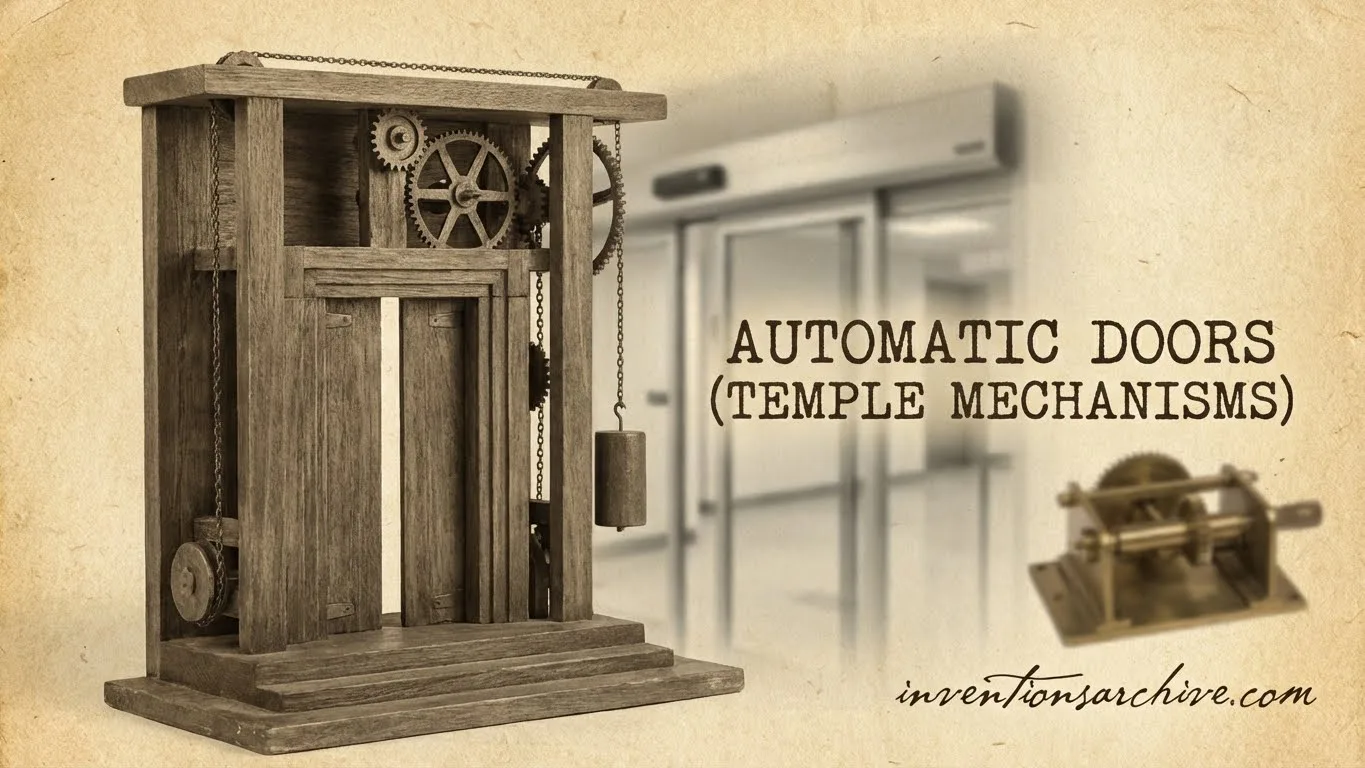
| Invention Name | Automatic Temple Doors (Hero of Alexandria’s temple mechanism) |
|---|---|
| Short Definition | A ritual automaton that used heated air, liquid displacement, ropes, pulleys, and weights to open and close temple doors. |
| Approximate Date / Period | Usually placed in the 1st century CE Approximate |
| Geography | Alexandria, Roman Egypt; Greek technical tradition |
| Inventor / Source Culture | Hero or Heron of Alexandria; attribution is based on surviving texts |
| Category | Mechanical automation; pneumatics; hydraulics; temple and theatrical mechanism |
| Evidence Status | Based on surviving evidence Written description survives; no original ancient device is known to survive. |
| Main Problem Solved | Created a controlled, apparently self-moving door effect for temple spectacle, ritual display, and mechanical demonstration. |
| How It Worked | Altar heat expanded air; pressure displaced liquid; the liquid changed the weight balance; chains and pulleys moved the doors. |
| Main Materials / Technical Base | Hollow altar, tube, sealed vessel, water, siphon, suspended container, chains, pulleys, hinges, counterweight |
| Earlier Ideas or Tools | Manual temple doors; siphons; pulleys; counterweights; water clocks; pneumatic demonstrations |
| Development Path | Manual ritual movement → pneumatic temple automaton → theatrical automata → later mechanical and sensor-driven doors |
| Known Variations | Water-and-siphon version; leather-bag air version; related door-sound mechanism |
| Modern Descendants | Automatic doors, theatrical stage mechanisms, museum automata, robotics demonstrations, pneumatic teaching models |
| Why It Matters | It shows that ancient engineers could link heat, air pressure, liquid movement, and mechanical transmission into a timed automatic effect. |
Automatic temple doors are among the most memorable devices linked with Hero of Alexandria. They were not electric doors, and they were not modern sensor doors. The surviving evidence points to a small temple mechanism described in The Pneumatics of Hero of Alexandria, known through later manuscript and printed transmission. The Library of Congress records the 1851 English edition translated from the Greek and edited by Bennet Woodcroft, which remains one of the accessible historical sources for the device.[a]
The mechanism matters because it joins several ideas that were usually studied separately: heat, air expansion, water displacement, siphons, pulleys, chains, counterweights, and hinges. In simple terms, a fire on an altar changed the pressure inside a hidden system. That change moved liquid into a hanging container. As the container became heavier, it pulled on the door mechanism and opened the doors. When the fire went out, the balance changed again, and the doors closed.
This was a mechanical display, not a practical entrance system for crowds. Its value was in controlled wonder: a door that seemed to respond to ritual action without a visible hand pushing it.
What Automatic Temple Doors Were
Hero’s automatic temple doors were an ancient automaton: a machine designed to perform an action by itself after an initial trigger. The trigger was the fire on the altar. The visible action was the opening and closing of the doors.
The system belongs to the wider world of pneumatics and hydraulics. Pneumatics deals with air and pressure. Hydraulics deals with liquid movement and force. Hero’s device used both. The hidden parts turned a change in heated air into a movement of water, then turned that change in weight into door movement.
The word “door” can make the invention sound familiar, but its ancient purpose was different from a shopping-mall sliding door. It was closer to a temple-stage mechanism: a controlled technical display designed to create a moment of surprise and order.
How the Origin Is Traced
The automatic temple door mechanism is traced mainly through Hero’s Pneumatics. The public-domain transcription of the Woodcroft edition places “Temple Doors opened by Fire on an Altar” and another related door-opening method in nearby sections of the text. In that description, a fire heats the air, the expanding air drives liquid through a siphon, and the added weight of the liquid opens the doors; when the fire is extinguished, the system reverses and the doors shut again.[b]
The date is less exact than the mechanism. Hero is generally placed around the first century CE, but his life is not documented in the modern biographical sense. The MacTutor History of Mathematics notes the dating problem and explains why a reference connected with a lunar eclipse has been used to support a first-century setting.[c]
For that reason, the fairest description is: attributed to Hero of Alexandria, probably 1st century CE, known from surviving textual evidence.
The Problem It Answered
The problem was not simply “how to open a door.” People already knew how to do that by hand. The deeper problem was how to create a self-acting ritual effect with the materials and power sources available at the time.
Before electric motors, sensors, and compact engines, ancient engineers could still work with:
- heat from a flame;
- the expansion and contraction of air;
- water moved by pressure;
- the pull of gravity on weights;
- ropes, chains, pulleys, and hinges;
- carefully hidden mechanical links.
Hero’s design answered a specific question: Can a ritual action at an altar cause a distant mechanical action at the temple doors? The answer was yes, at least as a described model or controlled mechanism.
| Before the Invention | What Changed After It |
|---|---|
| Doors were opened directly by hand, by attendants, or by simple mechanical assistance. | A visible ritual action could trigger hidden mechanical movement. |
| Heat, air pressure, and water movement were often observed as separate effects. | They were linked into one timed mechanical chain. |
| Temple spectacle depended mainly on visible human action, sound, lighting, and architecture. | Automation added a controlled moment of surprise without an obvious operator. |
| Pulleys and counterweights were useful mechanical aids. | They became part of a hidden response system driven by pressure and liquid weight. |
| Mechanical demonstrations could be isolated devices. | The mechanism connected engineering with ritual space, display, and later automata traditions. |
How It Worked in Simple Terms
The mechanism can be understood as a chain of cause and effect. This description is for historical understanding only, not for construction.
- A fire was lit on or near a hollow altar.
- The air inside the hidden system warmed and expanded.
- The expanded air pushed into a sealed vessel that held liquid.
- Liquid was forced through a siphon into a suspended container.
- The suspended container grew heavier as liquid entered it.
- That added weight pulled chains connected to the door hinges.
- The doors opened.
- When the fire went out, the pressure changed, liquid moved back, and a counterweight closed the doors.
The clever part is not one single piece. It is the sequence. Heat did not push the doors directly. Instead, heat changed air pressure; pressure moved water; water changed weight; weight moved chains; chains turned the door pivots.
Main Mechanism and Technical Principle
The temple door mechanism used a few simple physical ideas in a controlled order.
Heated Air
When air is heated, it expands. In Hero’s mechanism, this expansion created pressure inside a closed path. That pressure became the first hidden force in the system.
Liquid Displacement
The pressure did not move the doors directly. It displaced liquid from one vessel into another. This made the mechanism easier to control because liquid has weight, and weight can pull a chain.
Pulley and Counterweight Movement
The hanging container and counterweight formed a balance system. When the container became heavier, it moved downward and pulled the door chains. When the liquid left the container, the counterweight could take over and close the doors.
Reversibility
A useful detail is that the mechanism was designed to reverse. The same hidden system that opened the doors could allow them to close after the fire went out. That made the device more than a one-time trick.
Earlier Ideas and Tools Behind It
Hero’s door mechanism did not appear from nothing. It depended on a group of older tools and concepts.
- Pulleys and chains: already useful for lifting, pulling, and changing direction of force.
- Counterweights: used to balance loads and produce controlled movement.
- Siphons: used to move liquid through bent tubes under pressure and height differences.
- Sealed vessels: needed for controlled air pressure and liquid displacement.
- Water clocks and hydraulic devices: earlier examples of timed liquid movement.
- Temple and theatre effects: public settings where hidden mechanisms could create sound, motion, and surprise.
The invention is best seen as a combination device. Its originality lies in the way known principles were joined into one visible effect.
| Stage | Form | What Changed |
|---|---|---|
| Earlier Tool | Manual doors, ropes, pulleys, counterweights | Human force was helped by simple mechanical advantage. |
| Earlier Principle | Siphons, sealed vessels, water movement, air pressure | Liquid and air could transfer force through hidden paths. |
| Hero’s Mechanism | Fire-triggered temple door automaton | Heat, pressure, liquid weight, and door movement were linked in one sequence. |
| Related Ancient Forms | Temple sound devices, libation automata, theatrical automata | Automatic movement became part of spectacle and demonstration. |
| Later Forms | Renaissance automata, stage machines, clockwork displays | Hidden mechanical timing and controlled motion became more elaborate. |
| Modern Descendant | Powered and sensor-controlled automatic doors | Motors and sensors replaced altar heat and liquid-weight systems. |
Early Uses and Real Context
The most likely context was not everyday traffic control. The mechanism belongs to the world of temples, models, demonstrations, and learned mechanical writing.
Hero’s works often connected technical ideas with visible effects. A machine could pour liquid, make a sound, move a figure, rotate a sphere, or open a door. These devices were not only amusements. They were also ways to show that invisible forces, such as air pressure, could be made visible through motion.
The University of Glasgow’s research project on Hero’s automata describes Hero’s automata in relation to Greek theatre, technical writing, practical reconstruction, and later histories of automata and robotics.[d] That context helps explain why the temple doors should be read as part of a larger culture of controlled mechanical display.
Main Types and Variations
Hero’s temple door idea was not the only door-related mechanism in his mechanical world. The surviving descriptions show several nearby forms.
| Type or Variation | Main Principle | What It Did |
|---|---|---|
| Fire, Water, and Siphon Door Mechanism | Heated air displaced liquid into a suspended container. | Opened temple doors through added weight and chain movement. |
| Air Bag Door Mechanism | Heated air inflated an airtight bag connected to a weight system. | Opened and closed doors through changing air volume and weight balance. |
| Door-Triggered Sound Mechanism | Door movement caused air to be forced through a trumpet-like device. | Produced sound when a temple door opened. |
| Theatrical Door Automata | Hidden weights and timed movement inside model theatres. | Opened and closed doors as part of mechanical scenes. |
| Later Mechanical Doors | Clockwork, counterweights, springs, motors, or sensors. | Used automatic movement for performance, convenience, access, or safety. |
How It Spread and Changed Over Time
The ancient device did not spread in the same way as a mass-produced tool. Its main route was textual and scholarly. Hero’s writings were copied, studied, translated, edited, and reinterpreted. Later readers encountered the devices as examples of ancient mechanical skill.
The University of Glasgow Enlighten record for Francesco Grillo’s doctoral thesis describes Hero’s Automata as a two-book mechanical treatise from the first century CE and notes questions of chronology, manuscript tradition, mobile automata, stationary automata, and Hero’s relation to earlier sources such as Philo of Byzantium.[e]
This matters because Hero was not simply “the man who invented automatic doors.” He was part of a longer technical tradition. Some devices may have been his own. Others may have organized, adapted, or explained earlier ideas. The temple doors are still linked to his name because his text preserved the best-known ancient description.
What Changed Because of It
The automatic temple doors did not create a direct line to every modern automatic entrance. A modern automatic door uses a very different system: sensors, control circuits, motors, rails, safety standards, and electric power.
The older mechanism changed something more basic. It showed that a machine could respond to a trigger, run through a hidden sequence, and produce a visible result. That idea sits close to the history of:
- automatic religious and theatrical effects;
- stage machinery;
- hydraulic and pneumatic demonstrations;
- clockwork automata;
- early ideas of programmable or timed mechanical action;
- modern educational models of automation and feedback.
The temple door mechanism also helps correct a narrow view of ancient technology. Ancient machines were not only tools for farming, transport, and building. Some were designed for controlled motion, timed effects, and public display.
Common Misunderstandings
It Was Not a Modern Automatic Door
Hero’s device did not use electricity, sensors, motors, or sliding panels. It used heat, air pressure, water movement, and weights.
It Was Probably Not a Large Public Entrance System
The surviving description speaks in terms of a small temple mechanism. It is safer to treat it as a model, shrine mechanism, or controlled display rather than a proven full-size temple installation.
It Was Not Simply Steam Power
The door mechanism is sometimes grouped with Hero’s steam-related devices, but the door system itself is mainly about heated air, liquid displacement, siphons, weights, and pulleys.
Hero May Not Have Invented Every Part
Hero’s writings often preserve and arrange mechanical knowledge. The door mechanism is associated with him because his text gives the surviving description, not because every physical idea in it began with him alone.
Related Inventions
These related inventions and systems help place Hero’s automatic temple doors in a wider history of mechanical movement:
- Aeolipile: Hero’s steam-jet rotating sphere, often discussed with early steam demonstrations.
- Siphon: A bent tube principle used in many ancient hydraulic devices.
- Water Clock: A timing device that used controlled liquid flow.
- Pulley System: A simple machine used to redirect force and lift or pull loads.
- Counterweight Mechanism: A balancing method used in doors, lifts, stage devices, and clocks.
- Theatrical Automata: Mechanical figures and model theatres that moved through hidden systems.
- Hydraulic Organ: A musical instrument linked with ancient air and water pressure control.
- Modern Automatic Door: A later entrance technology based on sensors, motors, and control systems rather than heat-driven pneumatics.
Frequently Asked Questions
Who invented the automatic temple doors?
The mechanism is usually attributed to Hero, also called Heron of Alexandria. The attribution is based on the surviving written description in works associated with him, not on a surviving original door machine.
When were Hero’s automatic temple doors created?
They are usually placed in the 1st century CE because Hero of Alexandria is commonly dated to that period. The exact date of the device is not certain.
Did the doors use electricity?
No. The ancient mechanism used heat, air expansion, liquid displacement, chains, pulleys, and counterweights. Electricity and electronic sensors belong to much later automatic door technology.
Were Hero’s temple doors the first automatic doors?
They are among the earliest well-known written descriptions of automatic door movement. It is safer to call them an early documented automatic door mechanism rather than claim they were the absolute first in all history.
Did the original ancient door machine survive?
No original ancient mechanism is known to survive. The invention is known through written descriptions and later manuscript and printed transmission.
Sources and Verification
- [a] The pneumatics of Hero of Alexandria, from the original Greek. | Library of Congress — Used to verify the 1851 Woodcroft edition, title, contributors, publication data, and official library record for the translated source text. (Reliable because it is an official Library of Congress rare book record.)
- [b] The Pneumatics of Hero of Alexandria from the orginal Greek | Project Gutenberg — Used to verify the described temple-door mechanisms, including the fire-on-altar system, heated air, liquid displacement, siphon, suspended vessel, chains, weights, and closing action. (Reliable because it provides a public-domain transcription of the historical translation used for direct text verification.)
- [c] Heron of Alexandria – MacTutor History of Mathematics — Used to verify Hero’s approximate first-century dating, the uncertainty around his biography, and the scholarly dating discussion connected with the eclipse evidence. (Reliable because it is a university-hosted history of mathematics resource.)
- [d] Hero of Alexandria and his Theatrical Automata — Used to verify the research context of Hero’s automata, their relation to theatre, reconstruction, later automata, and early robotics discussions. (Reliable because it is an official University of Glasgow research project page.)
- [e] Hero of Alexandria’s Automata: a critical edition and translation, including a commentary on Book One — Used to verify the academic treatment of Hero’s Automata as a mechanical treatise, including mobile and stationary automata, chronology, manuscript tradition, and relation to earlier sources. (Reliable because it is an official University of Glasgow doctoral thesis record.)