
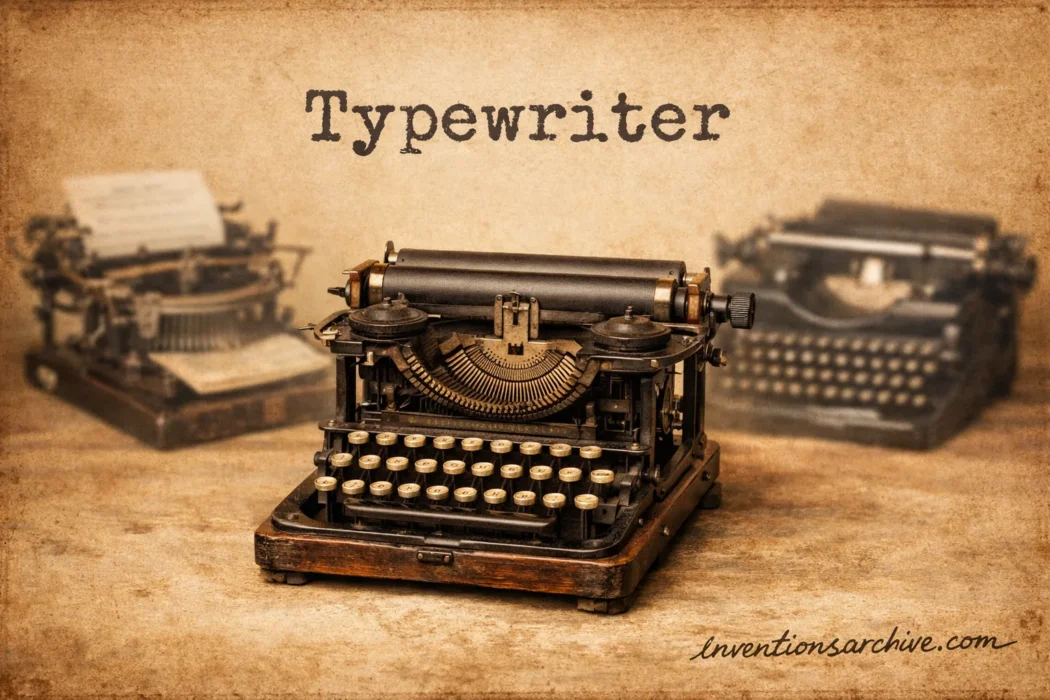
| Typewriter Profile | Verified Details |
|---|---|
| Invention Name | Typewriter |
| Short Definition | A machine that prints characters onto paper one strike at a time by linking keys to a printing element. |
| Approximate Date / Era | 1714 patent idea; c. 1808 working machine; 1870 commercially produced model; 1874 market breakthrough Layered / debated |
| Geography | Britain, Italy, Denmark, United States; later worldwide |
| Inventor / Source Culture | Multiple inventors: Henry Mill, Pellegrino Turri, Rasmus Malling-Hansen, Christopher L. Sholes, Carlos Glidden, Samuel Soule; later industrialized by E. Remington & Sons |
| Category | Writing technology, communication, office machinery, assistive technology |
| Why It Mattered |
|
| Need Behind It | Faster records, cleaner manuscripts, easier correspondence, wider access to written communication |
| How It Works | Key → type element → ribbon → paper on platen → carriage advance |
| Material / Technology Base | Metal levers, steel types, springs, escapement, inked fabric ribbon, rubber platen; later motors and electronics |
| First Use Areas | Business letters, administrative records, manuscripts, legal papers, classroom exercises |
| Spread Route | Britain / Italy / Denmark / United States → Europe and North America → global offices, schools, newsrooms, government desks |
| Derived Developments | Touch typing, typing classes, portable machines, electric models, word processing, keyboard computing |
| Effect Areas | Business, publishing, law, journalism, education, accessibility, administration, design |
| Debates / Different Views | Who counts as first inventor; what counts as the first working model; when QWERTY became fixed; how much anti-jam logic shaped the layout |
| Precursors and Successors | Handwriting, copying press, print culture, shorthand → word processor, computer keyboard, printer |
| Key People and Cultures | British patent culture, Italian experimenters, Danish inventors, U.S. office manufacturing, later global language engineers |
| Varieties Shaped by This Invention | Blind writers, visible-writing standards, portables, noiseless models, index machines, electric and electronic models, Braille-adapted machines, Chinese and Japanese variants |
Long before digital text filled screens, the typewriter turned writing into a repeatable machine action: a finger pressed a key, a mechanism swung, ink met paper, the carriage moved, and a line of text appeared. That sequence made records cleaner, manuscripts easier to read, office work faster, and the keyboard into a lasting human tool.
Table of Contents
What the Typewriter Is
A typewriter is a machine that prints characters onto paper one strike at a time. In a manual model, each key drives a type element toward an inked ribbon and a sheet wrapped around a platen. In electric and electronic forms, the source of motion changed, yet the logic stayed familiar: discrete keystrokes, a fixed printing element, and controlled paper advance.
Simple on the outside. Quite intricate inside.
Origins and the Long Road to a Practical Machine
The typewriter does not have one neat birthday. It arrived in layers. One inventor patented the idea. Another built an early working device. Another made a machine that people could actually buy. Then a manufacturing line pushed the machine into offices, schools, and print culture.
That layered record matters. Popular summaries often flatten it.
- 1714: Henry Mill patented a writing-machine concept in Britain.
- Around 1808: Pellegrino Turri is often linked to a working machine made for Countess Carolina Fantoni.
- 1865–1870: Rasmus Malling-Hansen developed the Hansen Writing Ball, usually treated as the first commercially produced typewriter.
- 1868–1874: Sholes, Glidden, and Soule patented a practical design, and Remington manufacturing turned it into a market product.
The safest way to read the timeline is this: the typewriter was a layered invention. “First” can mean first patent, first working machine, first commercially produced model, or first commercially successful machine. (Details-1) (Details-2)
Why There Is No Single Inventor
If “first” means patent, Henry Mill enters the story. If it means an early documented working example, Turri is often named. If it means a machine sold as a real product, Malling-Hansen usually leads. If it means the design that built a lasting office market, the Sholes-Remington line takes center stage. So, yes—the typewriter has inventors, plural.
How the Typewriter Works
Every manual typewriter depends on a timed chain of parts. Press a key and the machine converts finger force into order. The type element strikes the ribbon, the ribbon transfers ink to the paper, the escapement shifts the carriage, and the page waits for the next mark. Near the margin, a bell warns the typist. Then comes the carriage return. Again and again, line after line.
- Keyboard: receives the operator’s input.
- Type Element: a typebar, typewheel, or later a typeball carrying the character.
- Ribbon: an inked strip that transfers the mark.
- Platen and Carriage: support the paper and move it across the line.
- Margin, Tab, and Return Controls: manage spacing, tabs, and line reset.
The material base was blunt and clever at once: metal levers, springs, a rubber platen, an inked fabric ribbon, and tightly timed movement. Later machines added motors, correction systems, and electronic memory. The principle still felt familiar. One keystroke, one chosen mark.
QWERTY and Other Keyboard Layouts
The keyboard was not fixed on day one. Early experiments used alphabetical or near-alphabetical orders, and Christopher Latham Sholes revised layouts more than once before the familiar pattern settled. That is why the history of QWERTY is a story of revision, not a single flash of design.
One tidy story says QWERTY existed only to stop jams. That is too neat. Mechanical clashes mattered, yet historians also point to telegraph practice, prototype revision, and production choices. QWERTY looks less like one brilliant decision and more like an evolving compromise. (Details-3)
Later models added the shift key, which let one key print upper- and lower-case forms by changing the striking position. That reduced the number of type elements and pushed the keyboard toward the form people still know. Touch typing, keyboard drills, and later computer input all grew from that settling process.
Major Typewriter Families
The label typewriter hides a broad family of machines. They were not all built the same way, and they did not serve the same users in the same setting.
Early Blind Writers and Index Machines
Many early machines were blind writers: the typist could not see the line while typing because the type struck the underside or hidden side of the platen. Correction was awkward, and the user often had to wait for the carriage return to inspect the line. Index typewriters took another route. Instead of a full keyboard, they used a pointer or selector to choose characters. They could be smaller or cheaper, but usually slower.
Standard Manual and Visible-Writing Machines
The great step in usability came with visible writing. Front-strike machines let the typist see the text as it appeared. That cut errors, sped correction, and changed what “normal typing” felt like. By the early 20th century, visible-writing office models had become the dominant form.
Portable, Noiseless, and Office Models
Heavy office standards offered durability, broader carriages, and long daily service. Portable machines traded some width and weight for mobility; journalists, travelers, students, and fiction writers valued that freedom. Noiseless models softened the impact of the strike and reduced office clatter, though “noiseless” was always a relative term.
Electric and Electronic Machines
Electric models added motor assistance, which reduced finger strain and raised speed over long sessions. Later electronic machines brought correction features, small memory functions, and displays. IBM’s Selectric line replaced individual typebars with a movable typeball, changing maintenance, typing feel, and typeface flexibility in one stroke.
Language-Specific and Specialized Forms
Not every script fit the Latin keyboard model. Arabic and Hebrew layouts needed different spatial logic. East Asian machines faced a much harder problem because they had to manage far more symbols. Specialized machines also appeared for stenography, tactile use, and teaching. Same broad invention. Very different engineering paths.
The Typewriter in Offices, Publishing, and Daily Records
Once the machine settled into office life, it changed more than speed. It changed the shape of paperwork itself. Typed documents offered a cleaner visual rhythm than hurried handwriting, which mattered in business letters, legal records, edited manuscripts, catalog cards, invoices, and routine filing.
- Business Correspondence: more regular and easier to read.
- Publishing: clearer copy for editors and typesetters.
- Administration: faster filing, carbon copies, and standard forms.
- Education: typing classes and office-skill training.
- Journalism and Law: quicker preparation of drafts, letters, and records.
The machine also helped define the secretary and typist as standard office roles. It opened many white-collar jobs to women and pushed office furniture, workflow, and paper handling into a more systematized form. Not glamorous, maybe. It remade routine office practice. (Details-4)
Assistive and Global Adaptations
One part of the story is often left out: accessibility was present very early. Tactile systems, raised markings, and Braille-adapted machines widened access to written communication for blind and partially sighted users. In that sense, the typewriter was never only an office tool. It was also a tool of access, schooling, and self-expression.
The machine changed shape again when it met non-Latin scripts. A Latin alphabet can map neatly onto a keyboard. Chinese writing cannot. Chinese typewriters relied on character trays, lookup systems, selectors, and trained retrieval methods rather than a one-key-to-one-letter pattern. That pressure pushed engineers and typists toward new forms of indexing and character prediction. (Details-5)
This global branch of the story matters because it shows what the typewriter really was: not one fixed machine, but a family of writing systems made mechanical.
What Came Before and What Came After
Before the typewriter, most routine writing depended on the hand, the pen, the clerk, and the patience of anyone forced to read the result. Copying presses, shorthand, and print culture solved parts of the problem, yet none gave ordinary offices a direct way to produce neat, standardized pages on demand. The typewriter did.
After it came the word processor, daisy-wheel and impact printers, the personal computer, and the modern keyboard screen. Even so, the typewriter did not vanish in one clean moment. It lingered in schools, small offices, government desks, and form-filling tasks because it was durable, direct, and honest about what it did.
Why the Typewriter Still Matters
The clearest heir is the computer keyboard. Yet the legacy runs farther than that. The terms shift, tab, backspace, and carriage return came out of typewriter practice. Fixed-pitch typing habits shaped forms, code, and office layouts. Typewritten pages also carried tiny mechanical fingerprints; worn letters and alignment flaws could help identify a machine.
There is also the tactile lesson. The typewriter made writing visible as labor. Every page recorded pressure, rhythm, spacing, and error. You can almost hear the mechanism in the document.
FAQ About the Typewriter
Who invented the typewriter?
No single person owns the whole story. Henry Mill is tied to the 1714 patent idea, Pellegrino Turri to an early working device, Rasmus Malling-Hansen to a commercially produced model, and the Sholes-Glidden-Soule team to the design that entered large-scale manufacture through Remington.
Was the first typewriter already QWERTY?
Not in any simple sense. Early layouts changed several times, and the route to standard QWERTY ran through prototype revision rather than one fixed starting point.
How did a manual typewriter print letters?
A key moved a type element toward an inked ribbon and paper on a platen. The ribbon transferred ink, and the escapement advanced the carriage to the next space.
What is a blind writer?
A blind writer is a typewriter on which the typist cannot see the typed line as each character is struck. Early upstrike machines often worked this way.
Why were Chinese typewriters so different?
Because thousands of characters cannot fit neatly into the one-key-per-letter model used for alphabetic scripts. Chinese machines needed selection and retrieval systems instead of a simple alphabet keyboard.
When did computers replace typewriters?
The shift was gradual. Word processors and personal computers displaced typewriters across the late 20th century, yet many typewriters remained in use for years in offices, schools, and form-filling work.