
| Topic | Details |
|---|---|
| Invention Name | Power loom |
| Short Definition | A mechanized loom that weaves cloth by driving the main weaving motions with external power rather than steady hand action. |
| Approximate Date / Period | 1785 patent; earlier experiments in loom automation came before it Exact for Cartwright’s patent, older precursors remain debated (Details-1) |
| Date Certainty | Mixed — exact for the famous patent, approximate when discussing earlier automatic-loom roots. |
| Geography | Britain first; then the United States and other textile regions. |
| Inventor / Source Culture | Edmund Cartwright for the famous early power-loom patent; later engineers improved it in factory use. |
| Category | Textile machinery, mechanized weaving, factory production. |
| Importance |
|
| Need It Answered | Spinning speeds had risen fast; weaving lagged behind and became the production bottleneck. |
| How It Works | Shedding, picking, beat-up, take-up, and let-off are timed mechanically through cams, levers, gears, heddles, reeds, and shuttle motion (Details-2) |
| Material / Technology Base | Warp and weft yarn, wooden or iron frames, cams, shafts, belts, water or steam power, later electric drive. |
| First Main Use | Cotton weaving in mill production; later adapted more widely for patterned and specialty cloth. |
| Spread Route | Britain → New England → wider industrial textile regions. |
| Derived Developments | Dobby control, Jacquard patterning, automatic bobbin-changing looms, later shuttleless looms. |
| Impact Areas | Industry, trade, design, education in mechanics, factory planning, machine-tool development. |
| Debates or Different Views | The title of “first” depends on whether one means the best-known patent, the first workable mill loom, or earlier European attempts at automated weaving. |
| Precursors and Successors | Hand looms, drawlooms, the flying shuttle before it; automatic and shuttleless looms after it. |
| Main People and Centers | Edmund Cartwright, Paul Moody, Francis Cabot Lowell, William Crompton, Lancashire, Waltham, Lowell. |
| Varieties It Shaped | Shuttle looms, dobby looms, Jacquard-equipped looms, automatic looms, and later rapier and air-jet descendants. |
Weaving was the stubborn bottleneck in early textile manufacture. Spinning had already sped up, yet cloth still depended on repeated hand motions done in exact order. The power loom changed that rhythm. It turned weaving into a timed mechanical sequence, and that shift reached far beyond cloth output: mill design changed, pattern systems changed, and so did the very idea of what a factory could coordinate in one place.
Contents on This Page
What the Power Loom Changed
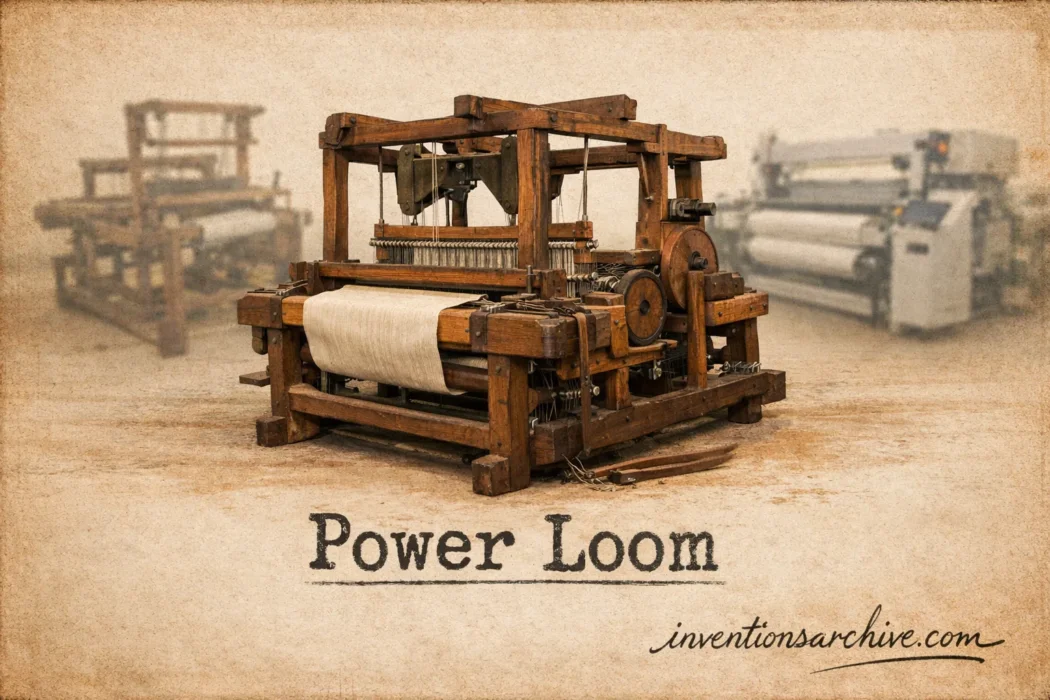
The power loom did not invent weaving. It mechanized timing. That is the real story. A hand loom already had warp, weft, heddles, reed, and shuttle. What the powered version added was a way to repeat those actions with far more regularity and far less dependence on the weaver’s muscle for each pass.
That sounds simple. It was not. Once the machine could keep tension steady, open the shed cleanly, drive the shuttle across, beat the weft into place, and wind the cloth forward without losing rhythm, weaving could sit beside spinning in a single production system. Mill weaving became scalable. Pattern control became more systematic. Fabric output stopped being tied to the pace of one person at one frame.
- Before the power loom: weaving remained slower, more local, and harder to fold neatly into mechanized mill flow.
- After the power loom: cloth making could be planned around machine cycles, shift routines, and beam-to-beam production.
- Long-term effect: the loom became a platform for later add-ons such as dobby, Jacquard, stop motions, and automatic replenishment.
Origins and Early Development
The name most closely tied to the early power loom is Edmund Cartwright. His 1785 patent fixed the invention in the historical record, even though the machine in that first form was still rough and not yet the settled factory loom later readers often imagine. Cartwright’s early versions were improved again by the late 1780s, and the idea kept moving even when his own commercial attempts did not fully settle the matter (Details-1).
That nuance matters. The power loom was not a single finished leap. It was a chain of refinements. Early designers had to solve warp preparation, cloth take-up, frame stability, shedding control, and the hard little timing problems that make weaving either smooth or maddeningly unreliable. Bit by bit, those fixes turned a bold patent idea into a dependable mill machine.
A small but important distinction: “first power loom” often means Cartwright’s famous patent. “First dependable mill loom” usually points to later improved designs. Those are not the same thing.
How the Machine Works
A power loom still performs the old weaving sequence. The difference is that the sequence is driven by power and regulated by linked parts rather than repeated hand effort. In plain terms, the loom must do five things again and again: separate selected warp threads, pass the weft through, press that weft into the growing cloth, release more warp, and wind finished fabric forward.
Main Motions
- Shedding — raising and lowering warp threads to open the shed.
- Picking — sending the shuttle or other weft carrier across.
- Beat-up — pushing the fresh weft into place with the reed.
- Take-up — winding the woven cloth onto the cloth beam.
- Let-off — feeding more warp from the warp beam.
Control Parts
- Heddles and harnesses choose which warp ends rise.
- Cams, tappets, and gears keep motions in order.
- Reed sets pick spacing.
- Shuttle, pirn, or later carriers move the weft.
- Stop motions halt the loom when thread fails.
When these motions stay in step, the cloth forms evenly. When one slips, faults appear fast. That is why the loom became such a rich site for later invention: tiny corrections in tension, take-up, or shuttle timing could transform output, fabric quality, and the number of looms one operator could oversee.
Why Weaving Was Hard to Mechanize
Weaving demands exact motion in a very small working zone. It is not just rotation. It mixes back-and-forth movement with circular drive, and each step must land at the right moment. The National Park Service puts the point neatly: in a power loom, motions once coordinated by hand and eye had to be reproduced through levers, cams, gears, and springs; that is one reason weaving was the last main textile step to mechanize well (Details-2).
Put another way, spinning could accelerate before weaving could catch up. A loom had to manage sequence, tension, and fabric geometry at once. Early inventors did not just need power. They needed dependable order.
- Warp tension had to stay even across the width.
- Shuttle travel had to cross the shed cleanly.
- Beat-up force had to pack the pick without bruising the yarn.
- Take-up and let-off had to remain balanced from first yard to last.
- Pattern changes had to be controlled without disturbing the cycle.
Main Types and Technical Branches
The term power loom often gets used too broadly. For clear reading, it helps to separate the main branches. One is the basic shuttle power loom. Another adds pattern control. Another automates the weft supply. Later descendants remove the shuttle altogether. Same family, different mechanical logic.
Shuttle Power Loom
This is the classic 19th-century form. A shuttle carries the weft through the shed. Cams or similar motion devices govern harness movement, while the reed beats each pick into the cloth. Early mill weaving was built on this arrangement. It was best suited to repeated production of plain and moderately varied fabrics, especially cotton goods.
Fancy and Pattern-Controlled Looms
As fabric demand widened, builders pushed beyond plain weave. One telling marker is William Crompton’s 1837 patent model, described by the Smithsonian as a change from cam-controlled harnesses toward a more capable fancy power loom arrangement (Details-3). In plain language, that means more flexible control over what the warp does, which opens the door to richer figured cloth.
There is a quiet technical lesson here: loom history is not only about speed. It is also about control. A faster plain loom and a more adaptable figured loom solve different problems.
Dobby and Jacquard-Equipped Looms
A dobby controls a limited set of harness combinations for repeating woven structures. A Jacquard system goes much further by selecting warp threads in highly detailed combinations. That is why readers should not treat “Jacquard loom” as a totally separate species of weaving machine in every case; very often it is better understood as a pattern-control system attached to a loom.
Related articles: Cotton gin [Industrial Age Inventions Series], Modern piano (Cristofori) [Renaissance Inventions Series]
The National Museum of Scotland notes that Jacquard punch cards laid groundwork later echoed in computing. Mechanically, the gain was direct and practical: pattern information could be stored in a card sequence and reproduced with unusual consistency (Details-4). For textile history, that matters as much as the computing afterlife.
Automatic Looms
The next major step was not merely faster weaving but less interruption. Automatic looms reduced stops for weft replenishment and thread monitoring. A good example is the Northrop system. The Science Museum Group describes a Northrop single-shuttle loom in which a full bobbin is inserted automatically when the shuttle runs short of weft (Details-5).
That sounds like a small convenience. It was not small at all. Every avoided stop meant steadier output, cleaner labor allocation, and a different economic life for the loom floor.
Shuttleless Descendants
Later looms used rapiers, projectiles, water jets, or air jets to carry the weft. Strictly speaking, these are later descendants rather than the classic shuttle power loom itself. Still, they belong in the same lineage because they pursue the same goal: faster, cleaner, more controlled insertion of weft with less wasted motion.
Materials and Production Range
Early power-loom history is tightly tied to cotton, and for good reason. Cotton yarn and cotton mill organization matched the first strong phase of factory weaving. Yet the machine’s later reach spread well beyond cotton. Wools, mixed fabrics, patterned goods, towelling, pile fabrics, and many specialty cloths all entered the orbit of powered weaving once the control systems matured.
- Plain woven cottons were among the earliest strong fits for power-loom production.
- Patterned textiles grew with dobby and Jacquard control.
- Heavier or specialty fabrics demanded changes in shuttle handling, shedding, beat-up force, and take-up systems.
- Fine figured cloth relied less on brute speed and more on accurate warp selection.
This is easy to miss when the topic is reduced to a single invention date. The power loom was not one frozen machine. It was a mechanical platform that kept absorbing new control methods, new fabric needs, and new shop-floor expectations.
Spread and Industrial Use
Britain gave the power loom its best-known early form. New England then became one of its most visible development zones in the United States. The American story matters because it was not a simple copy. Mill builders and mechanics adapted loom design to local production goals, available skill, power systems, and factory architecture. The result was a machine that fit into an integrated mill routine rather than standing alone as an isolated invention.
Once weaving could keep pace with spinning, the logic of the textile mill sharpened. Yarn preparation, warping, weaving, inspection, and finishing could be managed as a linked industrial sequence. That linkage — more than the loom by itself — explains why the machine holds such a large place in manufacturing history.
Why Mills Wanted It
- Steadier output across long production runs.
- Better coordination between spinning and weaving rooms.
- More predictable cloth structure when settings were well maintained.
- Room for later upgrades without abandoning the loom principle itself.
Why It Still Matters
The power loom still matters for three reasons. First, it shows how a mature craft can be translated into machine logic without changing the basic geometry of the craft itself. Second, it reveals that factory history is often a story of coordination, not mere force. Third, it sits on a direct line to later programmable and automatic systems, especially in patterned weaving.
Even now, when modern mills use electronics, sensors, and shuttleless insertion, the old questions remain familiar: How do you control thread tension? How do you keep timing exact? How do you scale output without losing fabric quality? The old loom asked those questions early — and loudly.
Power Loom FAQ
Who invented the power loom?
The name most often attached to the invention is Edmund Cartwright, whose 1785 patent fixed the power loom in the historical record. Earlier experiments in automated weaving existed, which is why some discussions separate the best-known patent from older precursors.
Why was weaving harder to mechanize than spinning?
Weaving requires a tightly ordered cycle in a very small working zone. The machine must control shed formation, weft insertion, beat-up, warp release, and cloth take-up in exact sequence, while also keeping tension stable across the fabric width.
Is a Jacquard loom the same as a power loom?
Not exactly. In many cases, Jacquard refers to a pattern-control mechanism fitted to a loom. A loom can be powered and also Jacquard-equipped. The two terms describe related but different parts of the weaving system.
What fabrics did power looms make?
Early factory use centered on cotton cloth, yet power-loom systems later handled patterned goods, wools, mixed fabrics, towelling, and many specialty textiles as control systems improved.
What came after the classic power loom?
Later branches included automatic shuttle looms with replenishment systems and, after that, shuttleless looms such as rapier, projectile, water-jet, and air-jet machines.