
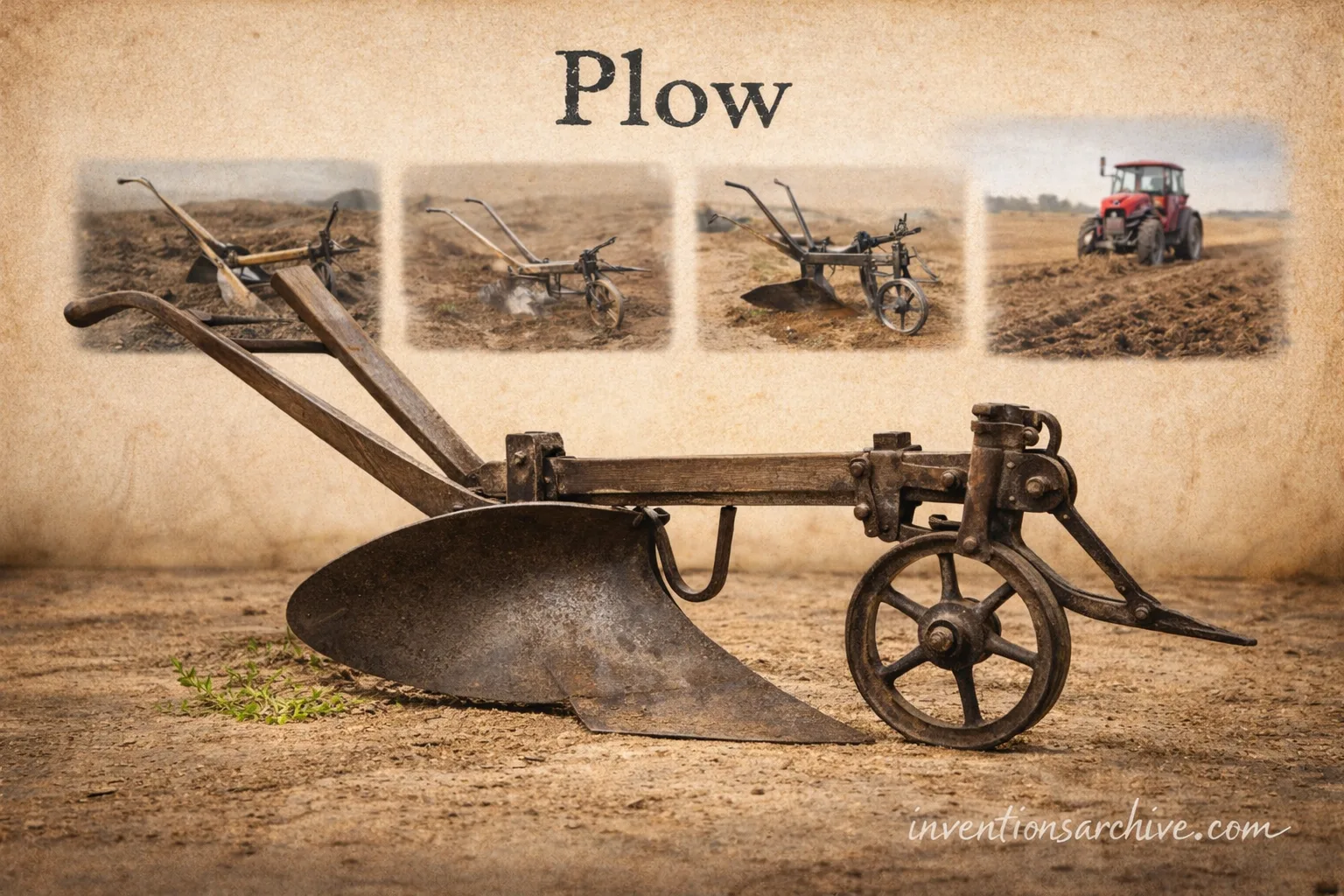
| Invention Name | Plow / plough |
|---|---|
| Short Definition | A soil-working implement used to cut, loosen, break, or turn earth before planting. |
| Approximate Date / Period | Early plow forms: prehistoric to early agricultural societies Approximate; documented seeder-plough use in Sumerian agricultural texts Based on surviving evidence |
| Geography | Early use associated with West Asia, Mesopotamia, Egypt, Europe, and other farming regions; exact first location is not certain. |
| Inventor / Source Culture | Anonymous / collective; developed through farming practice rather than a single named inventor. |
| Category | Agriculture; soil preparation; animal traction; later mechanized farming. |
| Evidence Status | Attribution varies for origin; Confirmed for many later archaeological, textual, museum, and patent-era examples. |
| Main Problem Solved | Preparing larger fields more efficiently than hand digging, hoeing, or using simple digging sticks. |
| How It Works | A blade, point, or share enters the soil; later forms lift, fracture, or turn the soil as the implement is pulled forward. |
| Main Materials | Wood in early forms; later stone, bronze, iron, steel, and modern engineered metal assemblies. |
| Early Use | Field preparation, furrow making, seed placement, cereal farming, and weed disturbance. |
| Development Path | Digging stick → ard / scratch plow → mouldboard plow → steel plow → tractor-drawn and conservation tillage tools. |
| Important Variations | Ard, seeder-plough, mouldboard plow, heavy plow, iron-share plow, steel plow, chisel plow, subsoiler, disc plow. |
| Surviving Evidence | Ancient texts, plow marks, museum objects, iron plough-share fragments, artistic scenes, and later industrial plows. |
| Modern Descendants | Tractor-drawn plows, chisel plows, subsoilers, variable-depth tillage equipment, seed drills, and no-till planting systems. |
| Related Inventions | Digging stick, hoe, yoke, harrow, seed drill, tractor, cultivator, combine harvester. |
| Impact Areas | Agriculture, food production, settlement growth, animal traction, land management, and farm machinery. |
The plow is one of the most important soil-working inventions in farming history, but it should not be treated as a sudden discovery by one person. It grew from older hand tools, animal traction, local soil problems, and repeated changes in materials. A simple early plow could scratch a furrow. A later mouldboard plow could lift and turn a slice of soil. A steel plow could move through sticky prairie soil more easily than earlier iron forms. Each stage answered a practical farming problem.
In its broadest sense, a plow is a tool for preparing land before sowing. It may cut a shallow line, loosen a compacted surface, bury plant residue, disturb weeds, or turn soil over. Its exact action depends on the form. An ard scratches. A mouldboard plow cuts and turns. A chisel plow loosens without full inversion. This difference matters because “the plow” is not one fixed object. It is a family of related tools.
What the Plow Is
A plow is a field implement pulled by people, animals, or machines to prepare soil for crops. In early agriculture, the main need was simple: open the ground enough for seed and moisture to meet. Hand digging could do this in gardens or small plots. Larger fields needed a tool that could cover more ground with less human labor.
The basic idea is direct. A working point enters the soil. A draft force pulls it forward. The soil is cut, lifted, loosened, or turned. Early versions were mostly wood and worked best in lighter soils. Later metal shares improved cutting. Mouldboards changed the movement of soil. Modern tractor-drawn systems added power, depth control, and specialized shapes.
The plow’s value came from scale. It helped farming move beyond hand-worked plots toward larger fields, repeated crop cycles, and more organized land preparation. That did not make farming easy. It made certain field tasks more manageable.
Origin and Early Development
The earliest plows likely developed from digging sticks and hoes. Farmers already knew that soil had to be opened, broken, and sometimes cleared of weeds. The step from a hand tool to a drawn implement was a practical change: instead of pushing or striking the soil by hand, the tool could be pulled across the field.
Animal traction was a major part of that change. Oxen, donkeys, and later horses gave farmers more pulling force than human labor alone. Once animals were used to pull sledges, carts, or other loads, a drawn soil tool became more useful and more repeatable.
Mesopotamian evidence is especially valuable because it includes written agricultural instruction. The Sumerian text known as The Farmer’s Instructions, preserved in the Electronic Text Corpus of Sumerian Literature at the University of Oxford, refers to the seeder-plough, furrows, plough oxen, plough shares, and related field work. This does not prove the world’s first plow, but it shows that specialized plowing knowledge was already part of recorded farming practice in ancient Mesopotamian tradition.[b]
The Problem It Answered
Before the plow, farmers used hand tools such as digging sticks, hoes, and spades. These tools worked, but they limited the amount of land that could be prepared within the right season. Soil preparation is time-sensitive. If the field is not ready when moisture, seed, and weather align, planting can suffer.
The plow answered several linked problems:
- Labor: it reduced the amount of hand digging needed across larger fields.
- Speed: it allowed repeated furrows to be made more quickly than hoe work alone.
- Seed placement: some forms helped create clearer furrows for sowing.
- Weed disturbance: turning or loosening soil could help reduce competition from unwanted plants.
- Soil handling: later forms worked heavier soils that simple ards could not manage well.
The plow did not remove the need for knowledge. Farmers still had to understand season, moisture, soil type, draft animals, field layout, and crop behavior. The tool worked well only when it matched the field.
How It Worked in Simple Terms
The working principle of a plow depends on its form. A scratch plow or ard opens a line in the soil but does not fully turn the ground over. It is useful where soil is lighter or where deep inversion is not needed. A mouldboard plow adds a curved surface that lifts and rolls the furrow slice. This makes it better for burying residue and working heavier ground.
The main parts of many traditional plows include:
- Share: the cutting edge that enters the soil.
- Beam: the long structural part connected to the draft animal or pulling force.
- Handle or stilt: the part used to guide the implement.
- Mouldboard: the curved surface that turns soil in later plow forms.
- Coulter: a cutting blade used in some later designs to slice the soil ahead of the share.
Early plows were often light. Their purpose was not always to invert soil deeply. In many cases, the goal was to open the field surface, form furrows, and prepare a seedbed. Heavy plows and mouldboard forms changed that by making deeper turning possible in more difficult soils.
Earlier Tools Before the Plow
The plow belongs to a wider family of agricultural tools. Its ancestors and neighbors include the digging stick, hoe, mattock, spade, and harrow. These tools were not replaced everywhere at once. In many places they continued alongside plows because different tasks required different motions.
A digging stick could open planting holes. A hoe could break clods or work small plots. A harrow could smooth and break soil after plowing. The plow’s strength was different: it could make repeated lines or turn strips across a field when pulled by steady draft power.
This explains why the plow spread unevenly. It was most useful where field size, crop choice, animals, and soil conditions justified it. In gardens, terraces, wet fields, or very small plots, hand tools could remain more practical.
Before and After the Plow
| Before the Invention | What Changed After It |
|---|---|
| Soil was opened mainly with digging sticks, hoes, or spades. | Drawn tools could prepare longer furrows and larger field areas. |
| Human effort limited how much land could be prepared in a short planting window. | Animal traction made field preparation faster and more repeatable. |
| Seed placement could be uneven, especially across larger cereal fields. | Furrows gave sowing a more regular field pattern. |
| Light soils could be handled, but heavier soils were difficult with simple tools. | Iron shares, mouldboards, and heavy plows helped work stronger or wetter soils. |
| Weed control depended heavily on hand labor and repeated hoeing. | Plowing could disturb weeds and bury surface growth, though it also changed soil structure. |
| Farm tools were mostly local, hand-shaped, and made for small-scale use. | Later plows became specialized machines connected to metalworking, animal harnessing, and tractors. |
Development Path
| Stage | Form | What Changed |
|---|---|---|
| Earlier Tool | Digging stick and hoe | Soil was opened by hand for small plots and planting holes. |
| Early Drawn Form | Ard / scratch plow | A pointed tool scratched furrows when pulled across the field. |
| Specialized Ancient Form | Seeder-plough | Plowing and seed placement could be linked in cereal farming systems. |
| Metal Improvement | Iron share | The cutting edge became stronger and better suited to harder soils. |
| Soil-Turning Form | Mouldboard plow | A curved surface lifted and rolled the furrow slice. |
| Industrial Improvement | Steel plow | Polished steel or steel working surfaces helped soil slide more cleanly in some conditions. |
| Modern Descendant | Tractor-drawn tillage tools | Power, depth control, multiple bottoms, and specialized soil actions changed field scale. |
Early Uses and Surviving Clues
Early plows were mainly used in cereal agriculture. They opened furrows, helped prepare seedbeds, and supported repeated field routines. Their use was often tied to oxen or other draft animals, because the tool needed steady pulling force.
Images and objects help confirm that plowing was not only described in texts but also represented in material culture. A bronze statuette in The Metropolitan Museum of Art, dated to the first half of the 6th century BCE, depicts a plowing scene with oxen and a man plowing. The museum notes that it likely came from the area around Smyrna in present-day Turkey and may have been connected with agriculture and fertility offerings.[c]
Metal fragments also matter. The British Museum records an iron tip of a plough-share from Romano-British Camerton, describing it as a fragmentary flanged tip for the wooden fore-share of a bow ard. This kind of object shows how wooden soil tools could be strengthened with iron at the cutting point.[d]
Related articles: Anchor [Ancient Inventions Series], Horse Collar [Medieval Inventions Series]
Main Types and Variations
| Type or Variation | Main Soil Action | Historical or Practical Context |
|---|---|---|
| Digging Stick | Opens holes or small breaks in soil. | Pre-plow hand tool; useful in gardens, small plots, and early cultivation. |
| Ard / Scratch Plow | Scratches a shallow furrow without full soil inversion. | Early animal-drawn field implement; effective in lighter soils. |
| Seeder-Plough | Forms furrows and helps guide seed placement. | Known from Mesopotamian agricultural instruction and cereal farming practice. |
| Iron-Share Plow | Cuts more strongly than a wooden point alone. | Used where a tougher cutting edge improved durability and field performance. |
| Heavy Plow | Works deeper and heavier soils with stronger traction. | Important in regions where light ards were not enough for damp or dense soil. |
| Mouldboard Plow | Cuts, lifts, and turns the furrow slice. | Useful for burying residue, turning sod, and creating a worked seedbed. |
| Steel Plow | Uses smoother, harder metal surfaces to cut and shed soil. | Associated with 19th-century prairie farming improvements and industrial manufacturing. |
| Chisel Plow | Loosens soil without full inversion. | Modern conservation-minded tillage option in some field systems. |
| Subsoiler | Breaks compacted layers below the usual working depth. | Used to relieve compaction in specific field conditions. |
| Disc Plow | Uses angled discs to cut and move soil. | Useful in some hard, sticky, dry, or trashy field conditions. |
The Steel Plow and a Common Attribution Problem
John Deere is strongly associated with the steel plow, but the wording needs care. He did not invent the plow itself. He also did not create soil-working tools from nothing. His importance lies in the development, improvement, and production of steel plows suited to sticky prairie soil.
The National Museum of American History records an early 1838 John Deere plow and explains that the steel blades of Deere plows slid more easily through sticky prairie soil, making farmers more efficient. The object is linked to Grand Detour, Illinois, and to John Deere as maker.[e]
A Smithsonian discussion of Deere’s reputation adds an important correction: Deere was one of several plow makers experimenting with new technologies, and his lasting importance came from perfecting and scaling production rather than being the single originator of the steel plow idea.[g]
What Changed Because of the Plow
The plow changed farming by altering the relationship between people, animals, soil, and field size. It allowed more land to be prepared during the right season. It made furrowed cereal farming more systematic. Later, stronger plows helped farmers work soils that lighter tools could not handle well.
Its effects were not only technical. Plowing influenced settlement, labor organization, animal use, land ownership, crop planning, and eventually industrial farm machinery. The plow also connected farming to other inventions: yokes, harnesses, ironworking, wheel systems, seed drills, tractors, and harvest machines.
The impact was not entirely simple. Plowing can help prepare land, but repeated aggressive tillage can damage soil structure. University of Minnesota Extension notes that full-width systems such as mouldboard and chisel plowing can disrupt earthworm channels, and that aggressive systems can increase erosion risk, reduce soil structure, and raise fuel and machinery costs compared with lower-disturbance systems.[f]
Common Misunderstandings
It Was Not a Single Moment
The plow developed over many periods. A wooden ard, an iron-share plow, and a tractor-drawn mouldboard plow are related, but they are not the same invention in a narrow sense.
Oldest Evidence Is Not Always First Use
Surviving texts, objects, or field marks show what has lasted. Earlier examples may have disappeared, especially if they were made of wood.
Plowing Is Not One Soil Action
Some plows scratch, some turn, some loosen, and some cut deeply. The word “plow” covers several different soil-working principles.
Improvement Is Not the Same as Origin
A famous inventor may improve or commercialize a type of plow without being the first person to invent plowing itself.
Related Inventions
The plow fits into a wider chain of agricultural and mechanical inventions. These related tools help place it in technology history:
- Digging stick: a simple hand tool for opening soil before drawn plows.
- Hoe: a close soil-working tool used for digging, weeding, and breaking ground.
- Yoke: a traction device that helped animals pull plows and carts.
- Harrow: a field tool used after plowing to break clods and smooth soil.
- Seed drill: a later planting invention that improved regular seed placement.
- Tractor: a power source that transformed plows into large mechanized implements.
- Cultivator: a tool used for soil disturbance and weed control between crop rows.
- Combine harvester: a later farm machine from the same broad path of agricultural mechanization.
Frequently Asked Questions
Who invented the plow?
The plow does not have one confirmed inventor. Early plows developed among farming communities over long periods. Later versions, such as iron-share, mouldboard, and steel plows, had many regional makers and improvers.
Is a plow the same as an ard?
An ard is an early type of scratch plow. It usually opens a shallow furrow without fully turning the soil. A mouldboard plow, by contrast, cuts, lifts, and turns the furrow slice.
Why was the mouldboard plow important?
The mouldboard plow was important because it could turn soil rather than simply scratch it. This helped farmers bury surface growth, work heavier soils, and prepare a more controlled seedbed in suitable field conditions.
Did John Deere invent the plow?
No. John Deere did not invent the ancient plow. He is associated with improvements to the steel plow in the 19th century, especially plows suited to sticky prairie soils and later commercial manufacturing.
Are plows still used today?
Yes. Plows and related tillage tools are still used, but many farms also use reduced-tillage or no-till systems where soil conservation, fuel cost, erosion risk, and field conditions make less disturbance preferable.
Sources and Verification
- [a] Plow | Description, History, Types, & Facts | Britannica — Used to verify the general definition of the plow, its link to the prehistoric digging stick, and the broad development sequence from early forms to metal, mouldboard, steel, and tractor-drawn plows. (Reliable because it is a long-standing edited reference source.)
- [b] The farmer’s instructions: translation — Used to verify ancient Mesopotamian references to plough oxen, seeder-ploughs, furrows, plough shares, and field work in a Sumerian agricultural text. (Reliable because it is part of the Electronic Text Corpus of Sumerian Literature at the University of Oxford.)
- [c] Bronze statuette of a plowing scene – East Greek – Archaic – The Metropolitan Museum of Art — Used to verify an ancient visual object showing plowing with oxen and its date, culture, and likely regional context. (Reliable because it is an official museum collection record.)
- [d] agricultural tool/implement | British Museum — Used to verify a Romano-British iron plough-share tip and its identification as a fragment for a wooden fore-share of a bow ard. (Reliable because it is an official British Museum collection record.)
- [e] John Deere Plow | National Museum of American History — Used to verify the 1838 John Deere plow object, its association with Grand Detour, Illinois, and the museum’s explanation of steel blades sliding through sticky prairie soil. (Reliable because it is an official Smithsonian museum collection record.)
- [f] Tillage implements | UMN Extension — Used to verify modern tillage effects, including the soil impacts of mouldboard and chisel plowing and the role of newer tillage technologies. (Reliable because it is a university extension source.)
- [g] Did John Deere’s Best Invention Spark a Revolution or an Environmental Disaster? — Used to verify the careful attribution that John Deere was one of several plow makers experimenting with steel plow improvements rather than the sole inventor of the plow or steel plow concept. (Reliable because it is a Smithsonian institutional publication with museum curator context.)