
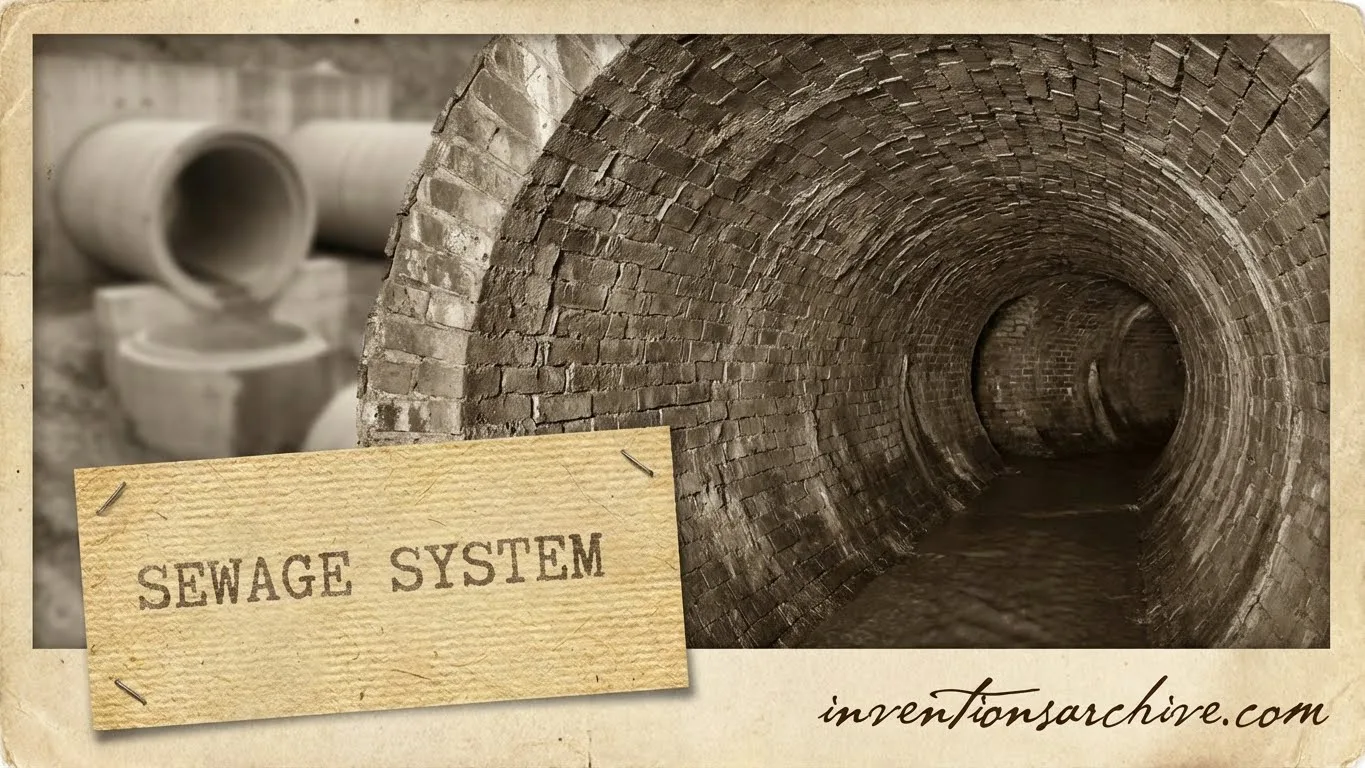
| Invention Name | Sewage System |
|---|---|
| Short Definition | A planned network for collecting and carrying wastewater, sewage, and sometimes stormwater away from buildings and streets. |
| Approximate Date / Period | Early urban forms before 2000 BCE; major surviving evidence from Mature Harappan cities, Mesopotamia, and later Rome Based on surviving evidence |
| Geography | South Asia, Mesopotamia, Mediterranean cities, later industrial Europe and global cities |
| Inventor / Source Culture | Anonymous / collective urban development Attribution varies |
| Category | Sanitation, urban infrastructure, public health, civil engineering, water management |
| Main Problem Solved | Wastewater and sewage collecting near homes, streets, wells, rivers, and public spaces |
| How It Works | Sloped drains, channels, pipes, outlets, and later pumps move wastewater to a discharge or treatment point |
| Material / Technology Base | Baked brick, stone, clay pipes, mortar, masonry vaults, later iron, concrete, pumps, sensors, and treatment plants |
| Early Use | Household drainage, street drainage, baths, latrines, stormwater removal, and city sanitation |
| Evidence Status | Physical drains, excavated streets, written terms, Roman structures, engineering records Confirmed |
| Surviving Evidence | Harappan brick drains, Mesopotamian foul-water drain evidence, Cloaca Maxima remains, Victorian London sewer records |
| Development Path | Open gutter → covered drain → urban sewer network → intercepting sewer → treated wastewater system |
| Related Inventions | Drainage canal, latrine, flush toilet, aqueduct, cesspit, pumping station, wastewater treatment plant |
| Modern Descendants | Sanitary sewer, combined sewer, storm sewer, wastewater treatment, smart sewer monitoring |
| Importance |
|
A sewage system is one of the oldest signs that a settlement had become a planned city rather than a loose group of houses. It is not just a pipe under a street. A working system joins drains, channels, household outlets, street sewers, gradients, inspection access, discharge points, and later treatment works into one managed network. The invention matters because it turned waste removal from a private household problem into a shared urban service.
What the Sewage System Is
A sewage system is a city’s hidden removal network for used water and human waste. In its simplest historical form, it used gravity: liquid waste moved downhill through a channel. In later systems, especially in flat or crowded cities, pumping stations lifted wastewater so it could keep moving through the network.
The term can refer to several related parts:
- House drains: small outlets from bathrooms, latrines, courtyards, washing areas, or kitchens.
- Street drains: channels that collect wastewater or stormwater from many houses.
- Main sewers: larger conduits that carry flows away from dense districts.
- Outfalls: discharge points where wastewater leaves the system.
- Treatment works: later facilities that remove solids, reduce pollution, and process wastewater before release or reuse.
The early invention was not a clean, sealed system in the modern sense. Many ancient sewers removed waste from streets and buildings but still sent it into rivers, fields, or low-lying channels. That difference matters. Sewerage and sewage treatment are related, but they are not the same invention.
Why Cities Needed It
Small villages could manage wastewater through distance, soil absorption, pits, open drains, or nearby fields. Larger towns created a harder problem. People lived closer together. Streets were narrower. Wells, baths, workshops, animal areas, and food markets shared the same urban space.
Without planned drains, three problems appeared again and again:
- Standing wastewater near houses and streets
- Flooding and mud after rainfall in low areas
- Waste mixing with clean water sources, especially in crowded districts
The sewage system answered this by making movement part of the city plan. Wastewater did not have to remain where it was produced. It could be directed away through a designed route. This was a simple idea with a large effect: the city itself became part of the machine.
Before and After the Sewage System
| Before the Invention | What Changed After It |
|---|---|
| Wastewater often stayed close to houses, courtyards, alleys, pits, or open ground. | Wastewater could be directed into drains and carried away from daily living spaces. |
| Rainwater and household wastewater could mix in streets without a planned route. | Street drains and main channels gave water a controlled path through the city. |
| Individual households had limited ways to remove used water from bathing or washing areas. | House drains connected private spaces to public drainage networks. |
| Low-lying urban land could remain wet, muddy, or difficult to build on. | Drainage made some areas more usable for roads, markets, forums, or housing. |
| Waste removal depended more on manual carrying, pits, or local disposal. | Gravity-fed channels, masonry sewers, and later pumps moved waste at a city scale. |
| There was little separation between household convenience and public sanitation. | Sewage became part of civic planning, engineering, maintenance, and regulation. |
How Its Origin Is Traced
The sewage system is traced through material remains more than inventor stories. Archaeologists look for covered drains, brick channels, street layouts, bathrooms, latrines, soakage jars, outfalls, maintenance openings, and signs of repeated repair. Historians also study words used for drains in ancient texts.
This is why the origin remains approximate. The earliest surviving drain is not always the first drain ever built. It is only the oldest evidence that has lasted, been excavated, and been correctly identified. In wet soil, fragile drains may disappear. In cities rebuilt many times, early channels may be cut away or reused.
Several regions contributed different parts of the story:
- Harappan cities show planned street drainage and house-to-street wastewater links.
- Mesopotamian houses provide evidence for lavatories, foul-water drains, and drain terminology.
- Roman cities show large masonry works that combined drainage, stormwater control, public baths, and latrine outflow.
- Industrial cities created large integrated sewer networks tied to public health policy and civil engineering.
How It Worked in Simple Terms
The basic principle is controlled flow. Wastewater moves from a smaller source to a larger route. A house drain may enter a street drain. A street drain may enter a larger sewer. A larger sewer may carry the flow toward a river, lowland, outfall, pumping station, or treatment plant.
Three technical ideas made this possible:
- Slope: the channel must guide water in the intended direction.
- Surface material: brick, stone, clay, or later concrete helps keep the channel open and shaped.
- Access and maintenance: covers, openings, and removable slabs allow cleaning or repair.
Ancient systems could be open, partly covered, or fully covered. Covered drains helped protect the channel from street traffic and reduced direct contact with wastewater. They also made urban streets easier to use. The hidden nature of sewers came later than the basic idea of drainage.
Earlier Ideas and Tools Before Sewage Systems
The sewage system did not appear from nothing. It grew from older water-management habits. People had already learned how to move water for fields, wells, houses, and flood control. Sewage networks adapted those ideas to a harder urban problem: waste mixed with water.
Predecessors That Made It Possible
- Open drainage channels: simple routes for rainwater and runoff.
- Irrigation canals: proof that water could be guided by slope and earthworks.
- Wells and bathing areas: household water use created the need for wastewater removal.
- Cesspits and soakage pits: local waste storage before wider sewer networks.
- Brick and stone masonry: durable materials for channels, covers, and retaining walls.
The step from a drain to a sewage system happened when many small drains were linked to a planned route. That required more than tools. It required urban coordination: streets had to align, houses needed access, channels needed slope, and someone had to maintain the network.
Development Path
| Stage | Form | What Changed |
|---|---|---|
| Earlier Tool | Open gutter, drainage ditch, soakage pit | Moved water locally but did not always form a connected city network |
| Early Urban System | House drains linked to street drains | Wastewater removal became part of settlement planning |
| Monumental Sewer | Large masonry drain or covered sewer | Served public spaces, stormwater, baths, latrines, and lowland drainage |
| Industrial Sewer Network | Interconnected underground sewers with intercepting routes | Served dense cities through planned civil engineering and public works |
| Treatment-Based System | Sewers connected to wastewater treatment plants | Shifted attention from removal alone to safer discharge and pollution control |
| Modern Descendant | Monitored sanitary, storm, combined, and smart sewer systems | Uses sensors, regulation, maintenance planning, and treatment capacity management |
Main Materials and Technical Principles
Early sewage systems depended on materials that were local, strong, and workable. Baked brick was useful where clay and firing skills were available. Stone worked well for covers, walls, and large channels. Clay pipes could move wastewater through walls or under streets. Mortar helped seal joints, though early systems were not always watertight by modern standards.
Core Technical Principles
- Gravity flow: most sewers move liquid by a gentle downward route.
- Channel shape: a channel must keep enough flow to reduce deposits.
- Durable lining: brick, stone, or concrete helps a drain hold its form.
- Capacity: a sewer must be large enough for expected wastewater and sometimes rainwater.
- Maintenance access: a drain that cannot be cleaned will eventually fail.
The visible invention is the drain, but the deeper invention is planned conveyance. Sewage systems turned water movement into a public design problem.
Early Uses in Daily Life
In daily life, a sewage system changed ordinary routines. A household could bathe, wash, cook, or clean without leaving all wastewater in the courtyard or street. Workshops could remove used water. Public baths and latrines could serve more people when connected to larger drains.
Its value was not only comfort. The system also shaped how cities were built. Streets, house walls, floor levels, courtyards, and public spaces had to respect the direction of drainage. In some ancient cities, drainage was not an afterthought. It was part of the plan.
Where People Used It
- Homes: bathroom floors, washing spaces, courtyards, and drains through walls
- Streets: covered or open drains along lanes and main roads
- Public buildings: baths, latrines, markets, and administrative areas
- Low-lying districts: channels to keep land usable after rain or flooding
- Industrial cities: large sewers carrying waste from homes, businesses, and public buildings
Main Types and Variations
| Type or Variation | Main Form | Typical Role |
|---|---|---|
| Open Drain | Uncovered channel | Early rainwater and wastewater removal, often visible at street level |
| Covered Drain | Brick, stone, or slab-covered channel | Moved wastewater while keeping streets more usable |
| House Drain | Small channel or pipe from a private building | Linked bathrooms, courtyards, or latrines to a larger drain |
| Sanitary Sewer | Pipe network for domestic, commercial, and industrial wastewater | Transports wastewater toward treatment facilities |
| Storm Sewer | Drainage network for rainfall runoff | Reduces flooding by carrying stormwater away from streets and land |
| Combined Sewer | One pipe for sewage, industrial wastewater, and stormwater | Older urban design that can overflow when rainfall exceeds system capacity |
| Intercepting Sewer | Large main sewer collecting flows from smaller sewers | Diverts wastewater away from dense districts toward outfalls or treatment |
| Smart Sewer | Monitored system with sensors or controls | Helps manage capacity, flow timing, overflow risk, and maintenance |
How It Spread and Changed over Time
Sewage systems spread through a mix of local need and borrowed engineering. Dense cities had similar pressures: more people, more water use, more waste, and tighter streets. Yet each region solved the problem with its own materials and geography.
Related articles: Public Baths [Ancient Inventions Series]
Harappan planners used baked brick drains and street layouts. Mesopotamian houses used foul-water drains and related terms in written records. Roman engineers built large masonry drainage works and connected public water culture with urban drainage. Later European cities inherited both older drainage ideas and new pressures from population growth, flush toilets, and industrial pollution.
The most important change was the move from removal to treatment. Early systems were often judged successful if they moved waste away from people. Modern systems are judged by a stricter question: what happens to wastewater after it leaves the street?
Modern Sewers and Public Health
Modern sewer systems are more regulated and more specialized than ancient drains. A sanitary sewer is designed to collect and transport domestic, commercial, and industrial wastewater, with only limited stormwater or groundwater entering the system. The U.S. Environmental Protection Agency distinguishes sanitary sewers from combined sewers because combined systems are designed to carry much larger stormwater flows along with sewage and industrial wastewater.[e]
A combined sewer system collects rainwater runoff, domestic sewage, and industrial wastewater in one pipe. During dry weather it may carry flow to a treatment plant, but heavy rain can exceed capacity and cause untreated wastewater and stormwater to enter nearby waterbodies through overflow points.[f]
Public health agencies connect adequate sewer systems with sanitation and disease prevention because wastewater containing fecal waste can contaminate the local environment and drinking water supplies. Modern sanitation therefore depends not only on toilets, but on the safe management, transport, and treatment of waste after it leaves the user’s view.[g]
Common Misunderstandings
One Person Did Not Invent It
The sewage system is a collective urban invention. Named engineers such as Bazalgette improved and organized later systems, but drains and sewers existed long before modern London.
The Oldest Evidence Is Not Always the First Use
Surviving drains show what has been preserved and excavated. Earlier examples may have been destroyed, rebuilt, or made from materials that did not survive.
Drainage Is Not the Same as Treatment
Many early sewers moved waste away from people but still released it into rivers or low areas. Wastewater treatment is a later and more controlled development.
Hidden Pipes Were Not the First Form
Some early systems were open channels. Others were partly covered. Fully buried sewer networks became more common as cities grew denser and engineering methods changed.
What Changed Because of It
The sewage system changed the relationship between people and the city. Waste was no longer only a household matter. It became a shared service that needed planning, labor, inspection, and repair.
Several long-term changes followed:
- Urban density became easier to manage: more people could live near one another without every household relying only on local disposal.
- Street design changed: roads, drains, house walls, and public spaces had to work together.
- Water use expanded: bathing, washing, public fountains, and flush toilets all created more wastewater to remove.
- Civil engineering became more public: sewers required city-wide planning, not just private building skill.
- Public health policy gained infrastructure: sanitation moved from advice and cleanup into built systems.
- Later treatment industries developed: sewerage created the need for wastewater treatment, sludge handling, monitoring, and water-quality regulation.
The invention did not solve every sanitation problem by itself. Poorly designed or overloaded sewers can move pollution from one place to another. The lasting importance of the sewage system is that it created a technical path for managing waste at city scale.
Related Inventions
These related inventions and systems help place the sewage system within the wider history of urban technology:
- Drainage canal: an earlier water-control method that helped shape sewer design.
- Latrine: a sanitation fixture often linked to drains or pits.
- Cesspit: a local waste-storage method used before or alongside sewer networks.
- Aqueduct: a water-supply system that increased urban water flow and wastewater volume.
- Flush toilet: a later fixture that increased the need for reliable sewer capacity.
- Pumping station: a machine-based solution for moving wastewater where gravity alone is not enough.
- Wastewater treatment plant: the later system that changed sewerage from simple removal to safer processing.
- Stormwater system: a related network for managing rainfall and flood risk.
Frequently Asked Questions
Who invented the sewage system?
No single person invented the sewage system. It developed through many ancient and later urban societies that created drains, covered channels, house connections, public sewers, and eventually treatment-based networks.
What is the earliest known evidence of sewage systems?
Some of the strongest early evidence comes from planned urban drainage in Mature Harappan cities such as Mohenjodaro, along with Mesopotamian evidence for foul-water drains and later Roman masonry sewers. These are surviving examples, not proof of the absolute first use.
Is a sewer the same as a sewage treatment plant?
No. A sewer mainly collects and transports wastewater. A sewage or wastewater treatment plant processes that wastewater before it is discharged or reused. Many ancient sewers moved waste away without modern treatment.
Why were many early sewers connected to rainwater drainage?
Early cities often had to manage both wastewater and stormwater in the same low streets and channels. Large drainage works could remove floodwater, household wastewater, and waste from public spaces through the same route.
Why was the modern sewage system important for cities?
Modern sewage systems allowed dense cities to move wastewater away from homes and streets through planned underground networks. When connected to treatment and maintenance systems, they became a major part of urban sanitation and public health infrastructure.
Sources and Verification
- [a] Bricks, Beads and Bones — Used to verify the Mature Harappan date range, Mohenjodaro drainage planning, and house-to-street drain evidence. (Reliable because it is an official educational publication from NCERT.)
- [b] Cloaca Massima — Used to verify the Cloaca Maxima’s origin as a major Roman hydraulic work connected with drainage of the Velabrum and later urban functions. (Reliable because it is an official Rome heritage authority page.)
- [c] On Babylonian Lavatories and Sewers — Used to verify Mesopotamian evidence for lavatories, foul-water drains, and the Akkadian term linked to sewers. (Reliable because it is an academic journal article hosted by Cambridge Core.)
- [d] Flushed Away: Sewers Through History — Used to verify the Victorian London sewer project, Joseph Bazalgette’s role, 1859 construction start, and the scale of new sewers and intercepting sewers. (Reliable because it is a Science Museum institutional history resource.)
- [e] Sanitary Sewer Overflows (SSOs) — Used to verify the distinction between sanitary sewer systems and combined sewers. (Reliable because it is an official U.S. Environmental Protection Agency page.)
- [f] Combined Sewer Overflows (CSOs) — Used to verify how combined sewer systems collect rainwater runoff, domestic sewage, and industrial wastewater, and why overflows can occur. (Reliable because it is an official U.S. Environmental Protection Agency page.)
- [g] Global Sanitation — Used to verify the connection between wastewater management, sewer systems, sanitation, and disease prevention. (Reliable because it is an official CDC public health resource.)