
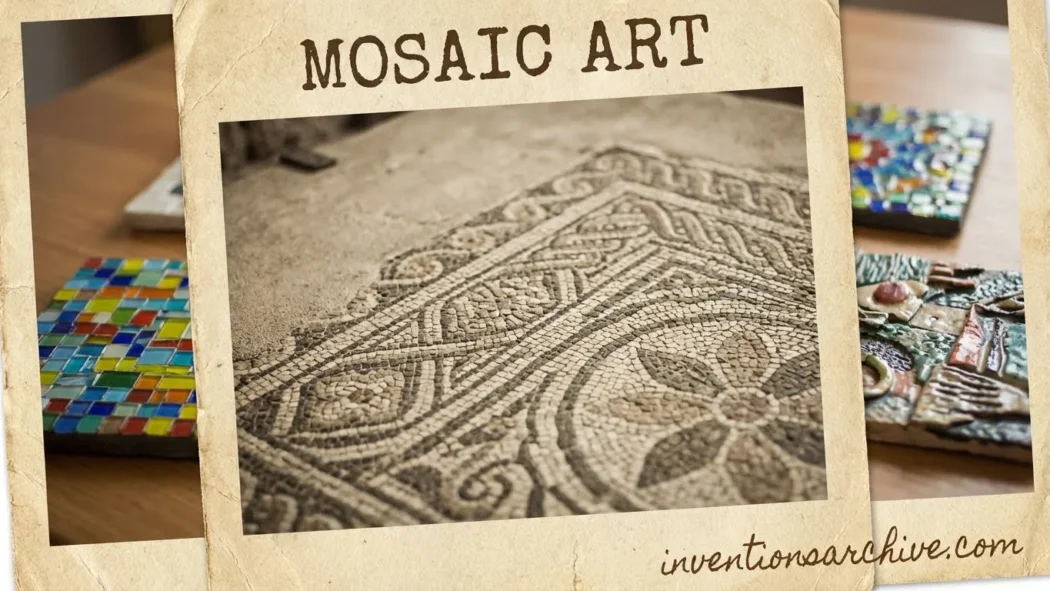
| Invention Name | Mosaic art |
|---|---|
| Short Definition | A surface decoration method that forms images or patterns from many small pieces of stone, glass, shell, ceramic, or other colored material. |
| Approximate Date / Period | Architectural cone mosaics: ca. 3500–3100 BCE Based on surviving evidence; refined pebble and tessellated mosaics developed later in Greek and Roman contexts. |
| Geography | Early evidence in Southern Mesopotamia; later major development in Greek, Roman, Byzantine, and regional Mediterranean traditions. |
| Inventor / Source Culture | Anonymous / collective; developed through workshop traditions rather than a single named inventor. |
| Category | Art, architecture, material craft, visual communication, surface design. |
| Main Problem Solved | Created durable decoration for floors, walls, objects, and architectural spaces where paint, plain plaster, or bare masonry had limits. |
| How It Works | Small colored pieces are set into a prepared bed or adhesive surface so their combined colors and shapes form a pattern or image. |
| Material / Technology Base | Stone, limestone, marble, shell, glass, ceramic, gold-backed glass, mortar, plaster, bitumen, and prepared surface beds. |
| Early Use Area | Architectural decoration, ritual or elite objects, domestic floors, public buildings, villas, baths, churches, and civic interiors. |
| Evidence Status | Attribution varies The technique has early surviving examples, but no single first inventor is known. |
| Development Path | Colored architectural inserts → inlaid objects → pebble floors → cut tesserae → Roman pavement mosaics → Byzantine wall and vault mosaics → modern mosaic design. |
| Surviving Evidence | Museum objects, excavated floor panels, architectural fragments, tesserae, inlaid objects, written architectural references, and archaeological contexts. |
| Related Inventions | Mortar, tile, glassmaking, opus sectile, fresco painting, pavement design, stained glass, ceramic tilework. |
| Modern Descendants | Public art mosaics, tile murals, glass mosaic panels, restoration practice, digital pixel art, architectural surface design. |
| Why It Matters | It turned small fragments into durable images, allowing architecture to carry color, pattern, narrative, and identity for centuries. |
Mosaic art is one of the oldest ways people turned fragments into lasting images. It uses small pieces of colored material, often called tesserae, to build a surface that can be walked on, viewed on a wall, fitted into an object, or placed inside a public space. The idea is simple. The result can be plain, geometric, symbolic, pictorial, or highly detailed.
Its strength is not only visual. A mosaic can survive where paint fades, where plaster cracks, and where a floor receives daily use. That is why mosaics are so important to the history of architecture, craft, and visual communication. They show how people used material, color, pattern, and durability to make spaces speak.
What Mosaic Art Is
Mosaic art is a method of making images or patterns by setting many small pieces into a surface. These pieces may be natural pebbles, cut stone, marble, colored glass, shell, ceramic, or gold-backed glass. In older mosaics, the pieces were often pressed into mortar, plaster, bitumen, or another prepared bed.
The invention is better described as a surface technology than as a single object. A wheel, a lamp, or a compass can be held in the hand. Mosaic art is different. It is a method that can appear on floors, walls, ceilings, furniture, panels, and ritual or decorative objects.
Three features define the technique:
- Fragmented material: the image is made from separate pieces, not from continuous paint.
- Prepared support: the pieces need a surface bed, backing, or adhesive material.
- Optical assembly: the full image appears when the small parts are seen together.
This is why mosaic often feels close to painting, tilework, and inlay at the same time. It borrows from all three but remains its own craft.
How Its Origin Is Traced
The origin of mosaic art is traced through physical evidence: excavated architectural fragments, museum objects, floor panels, and loose tesserae. The record is uneven. Many early surfaces were damaged by weather, rebuilding, fire, reuse of stone, or later excavation. Some early mosaics survive only as fragments.
One of the clearest early forms is the use of colored cones in Mesopotamian architecture. These cones were not picture mosaics in the later Roman sense, but they show the same basic idea: repeated pieces forming a patterned surface. Later, inlaid works from Mesopotamia show that small colored pieces could also build figural scenes. The British Museum’s Standard of Ur, dated 2550–2400 BCE, is decorated with mosaic imagery made from shell, red limestone, and lapis lazuli set into bitumen on a reconstructed wooden form.[b]
Greek and Roman evidence tells a later part of the story. The Getty’s Roman mosaic catalogue explains that Greek makers used pebbles set into mortar, while Roman workshops developed the use of cut tesserae, especially in architectural settings.[c] This shift made mosaics more precise, more pictorial, and easier to adapt to large floors and walls.
The Problem It Answered
Before mosaic art became common, decorated surfaces depended heavily on painting, carved relief, plain plaster, woven hangings, or shaped stone. Each had limits. Paint could fade or flake. Textiles were portable but fragile. Carved stone was durable but costly and slow. Plain floors and walls were functional, yet visually limited.
Mosaic answered a practical need: it made surfaces durable, decorative, and readable. A floor could carry a geometric pattern. A wall could hold a luminous image. A doorway, courtyard, bath, or reception room could signal taste, wealth, belief, or public identity without relying only on painted decoration.
| Before Mosaic Art Became Widespread | What Changed After Mosaic Art Developed |
|---|---|
| Plain floors, plaster, painted walls, woven hangings, and carved surfaces carried most decoration. | Floors, walls, panels, and objects could hold lasting images made from stone, glass, shell, or ceramic pieces. |
| Painted decoration could be damaged by moisture, abrasion, or repeated use. | Stone and glass tesserae made many decorative surfaces more resistant to wear. |
| Large architectural decoration often required expensive carving or repeated repainting. | Mosaic workshops could combine repeated patterns with figural scenes across wide surfaces. |
| Visual storytelling was often placed on portable objects, reliefs, painted walls, or manuscripts. | Images and symbols could become part of the building itself, especially in villas, baths, churches, and civic spaces. |
| Color depended on pigment, textile, or natural stone blocks. | Cut stone, glass, shell, and gold-backed tesserae expanded the range of color and reflected light. |
How Mosaic Art Worked in Simple Terms
A mosaic worked by arranging many small pieces so that each piece acted like a tiny unit of color. The surface could be geometric, like a border pattern, or pictorial, like a figure, animal, plant, symbol, or architectural scene.
The process varied by period and place, but the basic principle stayed stable:
- A surface was prepared with a bed such as mortar, plaster, bitumen, or another binding material.
- Small colored pieces were selected by size, shape, and color.
- The pieces were placed close together to form lines, shading, borders, or figures.
- The finished surface became both decoration and part of the object or building.
In more refined mosaics, the maker controlled the direction of the pieces. This flow of tesserae is called andamento in later mosaic vocabulary. It affects how the eye reads a contour, a fold of clothing, a face, a wave, or a patterned border.
Earlier Ideas and Tools Before It
Mosaic art did not appear from nowhere. Several earlier or related practices helped make it possible.
Colored Surface Decoration
Ancient builders already understood that walls and floors could carry repeated patterns. Painted plaster, colored stone, and patterned brickwork created visual order before cut tesserae became common.
Inlay and Small-Piece Assembly
Inlay was a close relative of mosaic. Craftspeople set small pieces of shell, stone, lapis lazuli, ivory, or other materials into wood, bitumen, or prepared surfaces. This taught makers how separate pieces could form figures and scenes.
Mortar, Plaster, and Prepared Beds
A mosaic needed a stable bed. Without a workable binding layer, the pieces would shift or fall away. This makes mosaic art closely connected to building materials, not only to image-making.
Main Materials and Technical Principles
The materials shaped the look of the mosaic. Pebbles gave rounded, natural forms. Cut stone gave sharper edges. Glass added color and shine. Gold-backed glass changed the way light moved across walls and vaults.
| Type or Variation | Main Material | Typical Use |
|---|---|---|
| Cone Mosaic | Clay, limestone, or stone cones | Early architectural surface patterning, especially in Mesopotamian contexts. |
| Inlaid Mosaic | Shell, limestone, lapis lazuli, bitumen, wood support | Decorated objects and narrative panels. |
| Pebble Mosaic | Natural pebbles set into mortar | Early floors, geometric patterns, and later figural designs. |
| Opus Tessellatum | Cut stone, marble, tile, or glass tesserae | Roman floors, borders, room decoration, and architectural ornament. |
| Opus Vermiculatum | Very small tesserae | Detailed pictorial panels, faces, shading, and painterly effects. |
| Glass and Gold Tesserae | Colored glass, gold leaf, silver leaf | Wall and vault mosaics, especially in Late Antique and Byzantine settings. |
| Modern Mosaic | Stone, glass, ceramic, tile, found material, manufactured tesserae | Public art, murals, garden design, restoration, and architectural surfaces. |
The technical idea behind all of them is the same: small hard units build a larger image. The more regular the units, the easier it becomes to control lines and repeated patterns. The smaller the units, the more detail becomes possible.
Early Uses
Early mosaic-like techniques had several uses. They could protect and decorate architectural surfaces. They could add status to objects. They could carry stories, symbols, or orderly patterns.
In the Roman world, mosaics became strongly connected with homes, villas, baths, and public interiors. The Met’s essay on Roman housing notes that Roman floors were often decorated with cut marble or tessellated mosaics, ranging from simple geometric designs to complex figural scenes; it also notes that wall and ceiling mosaics, often made of glass, were used in some settings.[d]
Related articles: Glassblowing [Ancient Inventions Series], Glass [Ancient Inventions Series]
This matters because mosaic was not only museum art. It was part of lived architecture. People walked across it, gathered around it, entertained guests near it, and used it to shape the mood of a room.
How It Spread and Changed Over Time
Mosaic art spread through builders, patrons, trade, workshops, empire, religion, and urban taste. It moved because buildings moved ideas. Craftspeople carried methods from one site to another. Patrons asked for designs they had seen elsewhere. Materials traveled through trade networks.
| Stage | Form | What Changed |
|---|---|---|
| Earlier Surface Idea | Colored cones, inlay, patterned stone, painted plaster | Small pieces and colored surfaces were used to enrich buildings and objects. |
| Early Mosaic Practice | Pebbles and inserted pieces | Patterns and images began to form from many separate units. |
| Improved Form | Cut tesserae in stone, marble, tile, and glass | Sharper lines, greater detail, and wider architectural use became possible. |
| Roman Expansion | Floor mosaics, room borders, figural scenes, regional workshops | Mosaics became common in domestic, public, and leisure architecture across many provinces. |
| Byzantine and Late Antique Form | Glass and gold wall mosaics | Light reflection became a major part of the visual effect, especially on walls and vaults. |
| Modern Descendant | Public murals, tile panels, conservation, pixel-based visual thinking | The fragment-to-image principle continued in architecture, art, design, and digital culture. |
Roman mosaic floors are among the richest surviving bodies of evidence because stone and glass often lasted better than wall painting. A 2nd-century CE Roman mosaic floor panel at The Met, found at Daphne-Harbiye near Antioch, shows how such works could belong to well-appointed villas and decorated spaces associated with elite leisure and display.[e]
What Changed Because of Mosaic Art
Mosaic art changed the relationship between image and architecture. A painting could hang on a wall or cover plaster. A mosaic could become the wall, floor, vault, threshold, or object surface itself.
Several changes followed:
- Architecture became more image-rich. Floors and walls could carry borders, symbols, scenes, and patterns.
- Durability improved. Stone and glass pieces often survived where paint did not.
- Workshops specialized. Mosaic demanded planning, cutting, color selection, surface preparation, and installation.
- Regional styles appeared. Local materials, tastes, and patrons shaped different approaches.
- Light became part of the design. Glass and gold tesserae reflected light in ways paint could not.
The last point became especially important in Byzantine mosaic. The Met records Byzantine tesserae made of glass with gold and silver leaf, dated broadly from the 6th to the 15th century, showing how small reflective pieces became central to later wall and sacred-space mosaics.[f]
Common Misunderstandings About Mosaic Art
Mosaic Art Was Not Invented by One Named Person
Many inventions have famous names attached to them. Mosaic art does not. It grew through collective craft knowledge, building practice, material skill, and local workshop traditions.
The Earliest Surviving Evidence Is Not Always the First Use
A museum object dated to an early period shows what has survived and been identified. It does not prove that no earlier example existed. For mosaic art, the phrase based on surviving evidence is more accurate than a bold “first invented” claim.
Mosaics Are Not Only Roman Floors
Roman floor mosaics are famous because many survived, but mosaic art also includes architectural cone patterns, inlaid objects, pebble mosaics, wall mosaics, vault mosaics, glass tesserae, and modern public works.
Small Pieces Do Not Mean Simple Work
The pieces may be small, but the planning can be highly skilled. A mosaic maker had to think about line, rhythm, color, spacing, surface strength, and how the image would be seen in real space.
Main Types and Variations
Mosaic art changed because makers adapted it to different surfaces and needs. A floor needed strength. A wall needed stability and visibility. A vault or sacred interior often used reflective glass. An object might use inlay rather than pavement technique.
Floor Mosaics
Floor mosaics were made to be seen from above and to withstand movement. Their designs often included borders, repeated patterns, central panels, animals, plants, mythological subjects, or signs of social identity.
Wall and Vault Mosaics
Wall and vault mosaics could use glass and gold-backed tesserae to catch light. The goal was not only to make a picture but to make the surface respond to candles, daylight, and movement.
Object and Inlay Mosaics
Some early mosaic-like works are better understood as inlaid objects. They still matter because they show the same fragment-based image logic: many small colored pieces forming a unified scene.
Modern Architectural Mosaics
Modern mosaics appear in subway stations, schools, public squares, memorial spaces, private homes, gardens, and contemporary art. The materials have changed, but the principle remains recognizable.
Related Inventions and Later Developments
Connected Inventions and Techniques
- Mortar and plaster beds: essential for holding tesserae in architectural surfaces.
- Tilemaking: closely related to cut, fired, and repeated surface units.
- Glassmaking: expanded the color and reflective range of mosaics.
- Opus sectile: a related Roman method using shaped stone pieces, often larger than tesserae.
- Fresco painting: often shared the same architectural spaces as mosaics.
- Stained glass: another light-based image technology using colored glass pieces.
- Pixel art: a modern digital parallel in which small units build a larger image.
- Architectural tile murals: a later public-facing descendant of durable surface image-making.
Frequently Asked Questions
Who invented mosaic art?
Mosaic art has no single known inventor. The technique developed through many cultures and workshops, with early surviving evidence in Mesopotamian architectural decoration and later major development in Greek, Roman, and Byzantine traditions.
What are tesserae in mosaic art?
Tesserae are the small pieces used to make a mosaic. They may be stone, marble, glass, ceramic, shell, or other colored material. Their shape, color, and placement create the larger design.
Are mosaics only used on floors?
No. Mosaics can be used on floors, walls, ceilings, vaults, panels, objects, public spaces, and modern murals. Roman floor mosaics are famous, but they are only one part of the wider history of mosaic art.
Why did many ancient mosaics survive?
Many mosaics survived because they were made from durable materials such as stone, marble, and glass. Buried floors and architectural fragments could remain in place long after paint, wood, or textiles disappeared.
Sources and Verification
- [a] Mosaic cone – Late Uruk – The Metropolitan Museum of Art — Used to verify the Late Uruk mosaic cone date, geography, material, and evidence status for early architectural mosaic practice. (Reliable because it is an official museum collection record.)
- [b] box (?) | British Museum — Used to verify the Standard of Ur date range, inlaid mosaic imagery, materials, and reconstruction uncertainty. (Reliable because it is an official British Museum collection record.)
- [c] Introduction | Roman Mosaics — Used to verify Greek pebble mosaic development, Roman tesserae use, opus tessellatum, and Roman architectural spread. (Reliable because it is a J. Paul Getty Museum scholarly publication.)
- [d] Roman Housing – The Metropolitan Museum of Art — Used to verify the role of mosaics in Roman domestic floors, walls, ceilings, and architectural decoration. (Reliable because it is an institutional art history essay from The Metropolitan Museum of Art.)
- [e] Mosaic floor panel – Roman – Imperial – The Metropolitan Museum of Art — Used to verify a Roman 2nd-century CE floor mosaic from Daphne-Harbiye, its material, context, and domestic display role. (Reliable because it is an official museum object record.)
- [f] Mosaic Tesserae – Byzantine – The Metropolitan Museum of Art — Used to verify Byzantine glass, gold, and silver leaf tesserae as later mosaic materials. (Reliable because it is an official museum collection record.)