
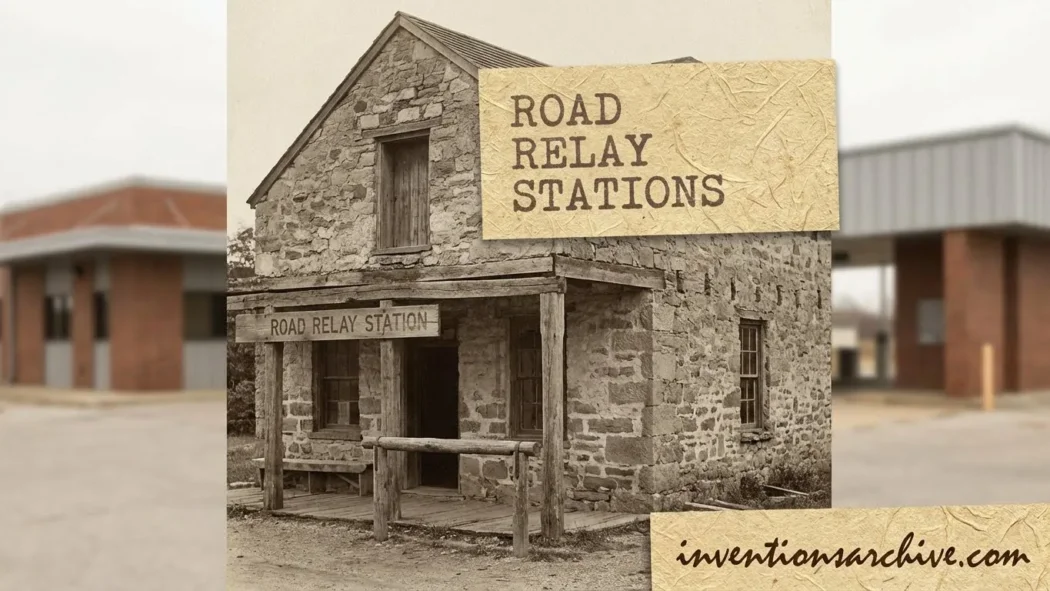
| Invention Name | Road Relay Stations |
|---|---|
| Short Definition | Planned stopping points on roads where messengers, animals, documents, or travelers could be transferred, rested, supplied, or recorded. |
| Approximate Date / Period | Documented by the Achaemenid Persian period, especially the 6th–5th century BCE Based on surviving evidence |
| Geography | Persia and western Asia; later adapted across Roman, Islamic, Mongol, Chinese, European, and American road systems |
| Inventor / Source Culture | Anonymous / collective state infrastructure Attribution varies |
| Category | Transport, communication, administration, postal infrastructure |
| Main Problem Solved | Slow long-distance communication caused by tired couriers, tired animals, unsafe roads, and lack of fixed supply points |
| Basic Working Principle | One route divided into stages; each station supplied fresh animals, staff, lodging, records, or message transfer |
| Evidence Status | Achaemenid and later systems are supported by historical writing and institutional records; physical station evidence varies by region Approximate |
| Surviving Evidence | Classical references, institutional histories, route descriptions, later maps, post-road records |
| Development Path | Foot courier routes → horse relay stations → state post roads → stagecoach and mail stations → telegraph and transport hubs |
| Related Inventions | Royal roads, postal service, courier bags, stagecoach stations, post roads, telegraph relay networks |
| Modern Descendants | Postal logistics hubs, rest areas, transport depots, railway stations, courier sorting centers, network relay nodes |
| Why It Matters | It turned long roads into managed communication routes and made distance more governable, measurable, and usable |
Road relay stations were one of the earliest ways to make a long road behave like a communication system. A single rider, runner, cart, or pack animal could only travel so far before fatigue, weather, hunger, and terrain slowed the journey. A relay station changed that pattern. It gave the route fixed points where the message, mount, document bag, or traveler could continue with less delay.
The idea seems simple now: divide the road into shorter stages. Yet that small change made a large difference. A road was no longer just a path across land. It became a managed chain of stations, staff, animals, records, supplies, and authority.
For this reason, road relay stations belong to the history of transport, postal service, administration, trade, and information. They were not only places to stop. In many systems, they were the reason a message could cross mountains, deserts, plains, and borders at a speed that seemed impossible for ordinary travel.
What Road Relay Stations Were
A road relay station was a planned stop on a route. Its purpose was to keep movement going. The exact form changed by culture and period, but the core function stayed similar: a messenger or traveler reached the station, received help, and the journey continued.
Some stations were simple. They might have offered water, fodder, and a fresh horse. Others were more developed, with lodging, stables, clerks, guards, storehouses, or official recordkeeping. In Roman usage, for example, changing stations and lodging stations were not always the same thing.
The relay principle mattered more than the building. A relay station could be a built post house, a stable beside a road, a fortified stop, a road ranch, a government inn, or a marked station in a larger courier network.
The Basic Parts of the System
- Route: a recognized road or track between important places.
- Stations: fixed stopping points set at practical intervals.
- Couriers: riders, runners, drivers, or official messengers.
- Fresh animals: horses, mules, camels, or other local transport animals.
- Supplies: water, food, fodder, shelter, and sometimes repair materials.
- Records: logs, permissions, travel orders, or marks proving official status.
The Problem It Answered
Before relay stations, long-distance communication depended heavily on the endurance of one person or one animal. A messenger might carry a spoken message, a written order, a sealed letter, or an official report. The farther the message had to travel, the more fragile the system became.
The main limits were practical:
- Animals tired quickly when forced to cover long distances without rest.
- Messages slowed when travelers had to search for food, water, or shelter.
- Officials could not easily track when a courier arrived or left.
- Weather and terrain made travel times uncertain.
- Remote provinces could feel far from the center of government.
Road relay stations did not remove distance. They made distance more manageable. By preparing the next stage in advance, the system reduced idle time and made communication less dependent on chance.
| Before Road Relay Stations | What Changed After Relay Stations |
|---|---|
| One courier or animal often had to cover a long route with limited support. | The route was divided into stages with prepared stopping points. |
| Messages slowed when riders searched for rest, water, food, or replacement animals. | Stations supplied fresh mounts, food, water, and controlled handoffs. |
| Arrival times were hard to estimate and harder to record. | Stations could record arrivals, departures, and the movement of official dispatches. |
| Long roads served travelers, but not always fast communication. | Roads became organized communication corridors. |
| Remote regions could be slow to report events to a capital or authority. | Governments could receive reports and send orders with greater regularity. |
Early Origins and Evidence
The best-known early model is usually linked with the Achaemenid Persian Empire. Ancient sources describe a system in which riders and horses stood along the road at intervals, allowing messages to pass from one stage to the next. This was not a public mail service in the modern sense. It was mainly an official communication system.
Encyclopaedia Iranica’s article on čāpār discusses Herodotus’ description of Persian messengers, way stations, fresh horses, and the Persian riding post known as angareion. It also notes that in later Islamic-period Persian sections, relay stations could be spaced at practical intervals where fresh riding animals were obtained and arrivals could be noted.[b]
This matters because it shows more than a fast rider. It shows organized support: people, animals, stations, distances, and records. That is the difference between a courier journey and a relay infrastructure.
How Relay Stations Worked in Simple Terms
The working idea was direct. A route was divided into stages. Each station handled one part of the journey. When a courier arrived, the message could continue in one of several ways.
Message Transfer
In some systems, the message itself moved from one courier to the next. This worked especially well for written dispatches, sealed orders, or official packets. The first courier did not have to finish the entire journey. The message did.
Animal Change
In other systems, the same rider continued, but changed to a fresh animal. This was useful when a trusted courier, messenger, or official had to remain with the dispatch. The station’s value came from prepared mounts and fast exchange.
Rest and Supply
Some stations were not only for speed. They offered food, water, shelter, fodder, and sometimes administrative checking. This made difficult routes more reliable for officials, travelers, and transport animals.
The system’s strength was not one heroic ride. It was the planned repetition of small transfers across a long distance.
Earlier Ideas Before Road Relay Stations
Relay stations grew from older ways of carrying messages. Long before formal post roads, societies used runners, mounted messengers, caravan tracks, river transport, signal fires, and trusted travelers. These could work well over short or familiar distances.
The limitation appeared when distance became administrative. A palace, court, market center, military office, or regional governor needed regular contact with faraway places. At that point, informal travel was not enough.
Road relay stations answered a new kind of need: not simply “send a message,” but send messages often, across known routes, with predictable support.
| Stage | Form | What Changed |
|---|---|---|
| Earlier Method | Runners, individual couriers, caravan travelers, local messengers | Messages moved, but timing and support were uneven. |
| Early Relay Idea | Prepared road stops with fresh animals or new couriers | The journey was divided into stages. |
| State Road System | Royal roads, post roads, official courier routes | Governments linked stations to administration and reporting. |
| Improved Form | Roman mutationes and mansiones; Islamic barīd; Mongol yām | Stations became part of larger official networks. |
| Later Descendant | Stagecoach stops, Pony Express stations, postal depots, transport hubs | The relay idea continued in mail, travel, logistics, and communication networks. |
Materials, Layout and Technical Principle
Road relay stations were not defined by one material. Their design followed local geography. A station on a dry plain needed water and animal shelter. A station in a wooded region might use timber. A desert stop might use stone, adobe, or dugout structures. A mountain route needed safe staging more than grand architecture.
The technical principle was interval planning. Stations had to be close enough for a courier, horse, mule, or camel to reach the next point without exhausting the system. The spacing could change with terrain, climate, road quality, and the kind of animals used.
Good relay networks had three quiet strengths:
- Predictability: couriers knew where the next station should be.
- Readiness: animals, supplies, and staff were prepared before arrival.
- Continuity: the message could move even when one animal or rider stopped.
Roman Road Relay Stations
The Roman Empire developed one of the best-known official road communication systems, often called the cursus publicus. It used the empire’s road network for official communication and transport. Roman sources and later scholarship distinguish between mutationes, where animals could be changed, and mansiones, which provided lodging and wider support for travelers.
A dictionary entry preserved through the Perseus Digital Library explains that the Roman system under Augustus involved mounted couriers on principal roads and changing-stations, while larger postal stations known as mansiones supplied lodging and support for people and animals.[c]
This Roman distinction is useful because it prevents a common mistake. Not every relay station was a hotel, and not every road inn was a high-speed courier point. Some stations were built for changing animals quickly. Others were built for rest, lodging, and transport services.
Related articles: Morse code [Industrial Age Inventions Series], Telegraph [Industrial Age Inventions Series]
Islamic and Mongol Relay Networks
Later Islamic postal and intelligence systems, often discussed under the name barīd, inherited and adapted older Near Eastern and Iranian communication practices. These systems carried official letters, reports, and administrative messages between capitals and provinces.
The Mongol yām or relay-post system became another major form. Its stations supported mounted couriers and official travelers across large distances. The system depended on stocked stations, station masters, animals, provisions, and rules about who could use the network.
These later systems show that road relay stations were not a one-time invention that disappeared. They were a repeatable answer to a recurring problem: how to keep authority, information, and transport moving across distance.
Main Types and Variations
| Type or Variation | Main Form | Typical Purpose |
|---|---|---|
| Courier Relay Station | Small post with fresh animals or a new messenger | Fast official dispatch transfer |
| Animal-Change Station | Stable-focused stop along a road | Replace tired horses, mules, or camels |
| Lodging Station | Station with rooms, food, and animal care | Rest for travelers, officials, and transport staff |
| Administrative Post Station | Officially supervised station with records | Track arrivals, permissions, and dispatch movement |
| Stagecoach or Mail Station | Roadside stop serving coaches, riders, or mail bags | Support scheduled transport and mail routes |
| Emergency or Seasonal Station | Temporary or alternate stop | Adjust to weather, terrain, risk, or route changes |
Early Uses in Daily and Official Life
In early state systems, road relay stations mainly served officials. They carried royal orders, military reports, tax information, legal notices, administrative letters, and urgent political messages. Private letters were often not the main purpose.
Even so, the stations affected daily life around them. A relay stop needed workers, animals, fodder, water, buildings, maintenance, and sometimes protection. Villages, inns, markets, and workshops could grow near important road stops.
For travelers, the presence of stations could make a route feel less uncertain. For governments, it created a road-based memory of movement: who arrived, when they left, what they carried, and which direction they went.
How Road Relay Stations Spread and Changed
The relay idea spread because it solved a basic problem shared by many large territories. Persia, Rome, Islamic caliphates, Mongol states, imperial China, European post roads, and later American mail routes all used some version of staged movement.
They did not copy one identical design. Each system adapted the idea to its own roads, animals, climate, administrative habits, and political needs. In one place, the station might be a formal post house. In another, it might be a stable beside a rough trail.
That is why road relay stations are better understood as an infrastructure concept than as one fixed object. The invention was the organized chain, not a single building shape.
The Pony Express as a Later Relay Example
The Pony Express is a useful later example because it shows the older relay idea in a well-documented 19th-century mail route. A Library of Congress map of the Pony Express route notes that it shows the route with names and locations of relay stations.[d]
The National Park Service explains that Pony Express stations were generally placed 5 to 20 miles apart, depending on terrain and horse travel, and that riders exchanged tired horses for fresh ones at relay stations. It also notes that the system used existing stagecoach stations, road ranches, and newly added stations where needed.[e]
This later case helps explain the older principle without pretending all systems were the same. The Pony Express was short-lived, privately operated, and tied to a specific American mail need. Yet its station logic was ancient: keep the message moving by changing the support system before the journey fails.
What Changed Because of Road Relay Stations
Road relay stations changed the meaning of distance. A long road could now carry information in a staged and planned way. This helped states govern, merchants plan, armies receive orders, and travelers move through known corridors.
The change was practical, not magical. Messages still faced weather, damaged roads, animals, illness, conflict, and poor maintenance. Yet the route had a structure. A station chain gave long-distance movement a rhythm.
- Communication became faster because tired animals or couriers did not always carry the full burden.
- Travel became more predictable where stations offered food, water, lodging, or animal care.
- Administration became more connected because distant officials could send and receive messages through known routes.
- Roads gained economic value as stations attracted supplies, labor, inns, repair work, and local services.
- Later transport systems borrowed the idea through stagecoach stops, rail stations, postal hubs, and communication relays.
Common Misunderstandings
“They Were Invented by One Person”
Road relay stations were not the work of one known inventor. They were a collective infrastructure response to distance, administration, animal fatigue, and communication needs.
“The Earliest Record Means the First Ever Use”
The earliest surviving written evidence does not prove the first human use. It only shows the earliest evidence historians can currently discuss with care.
“They Were Only for Mail”
Many relay stations carried official letters, but they also supported travelers, animals, government agents, records, transport, and sometimes intelligence gathering.
“Every Station Looked the Same”
Station design depended on terrain, building materials, route purpose, and local conditions. A desert station, Roman lodging stop, Mongol yām, and Pony Express station could look very different.
Related Inventions
- Royal Roads: long-distance routes that made planned relay movement possible.
- Postal Service: the organized carrying of official or private letters through managed networks.
- Courier Bags and Dispatch Pouches: portable containers used to protect written messages during travel.
- Stagecoach Stations: later road stops that served passengers, mail, horses, and vehicles.
- Caravanserai: roadside lodging and supply structures that supported travelers and trade routes.
- Telegraph Relay Systems: electrical communication networks that kept the relay idea but replaced horses with signal transmission.
- Railway Stations: fixed transport nodes that continued the idea of scheduled movement through planned stops.
- Postal Sorting Centers: modern descendants that move messages and parcels through staged transfer points.
Frequently Asked Questions
What were road relay stations used for?
Road relay stations were used to support long-distance movement. They provided fresh animals, new couriers, food, water, lodging, records, or official checking so that messages and travelers could continue along a route more reliably.
Who invented road relay stations?
No single inventor can be named with confidence. Road relay stations developed as collective state infrastructure. Achaemenid Persia provides one of the clearest early historical examples, but the broader idea grew from older courier and road systems.
How did a relay station make messages faster?
A relay station reduced delay by dividing a long route into shorter stages. A courier could change horses, hand off a message, receive supplies, or rest while the message continued through the next part of the route.
Were road relay stations the same as inns?
Not always. Some stations acted like inns with lodging and food. Others were mainly animal-change points, official checkpoints, courier posts, or supply stations. Their function depended on the road system and the period.
What are modern descendants of road relay stations?
Modern descendants include postal sorting centers, logistics hubs, transport depots, railway stations, highway rest areas, courier transfer points, and communication relay nodes. They continue the same basic idea of staged movement through fixed points.
Sources and Verification
- [a] BARĪD – Encyclopaedia Iranica — Used to verify the Achaemenid connection, Royal Roads context, and later official postal-intelligence role. (Reliable because it is a scholarly encyclopaedia entry published by Encyclopaedia Iranica.)
- [b] ČĀPĀR – Encyclopaedia Iranica — Used to verify Persian post-rider terminology, Herodotus-related evidence, way stations, fresh horses, and later relay spacing details. (Reliable because it is a scholarly institutional reference on Iranian history and terminology.)
- [c] A Dictionary of Greek and Roman Antiquities (1890), CURSUS PUBLICUS — Used to verify Roman cursus publicus details, including mutationes, mansiones, and official courier infrastructure. (Reliable because it is preserved through the Perseus Digital Library at Tufts University.)
- [d] Pony express route April 3, 1860 – October 24, 1861 | Library of Congress — Used to verify that the Pony Express route was mapped with named relay station locations. (Reliable because it is an official Library of Congress map record.)
- [e] Pony Express Stations (U.S. National Park Service) — Used to verify Pony Express station spacing, horse exchange, station types, materials, and route variation. (Reliable because it is an official U.S. National Park Service historical resource.)