
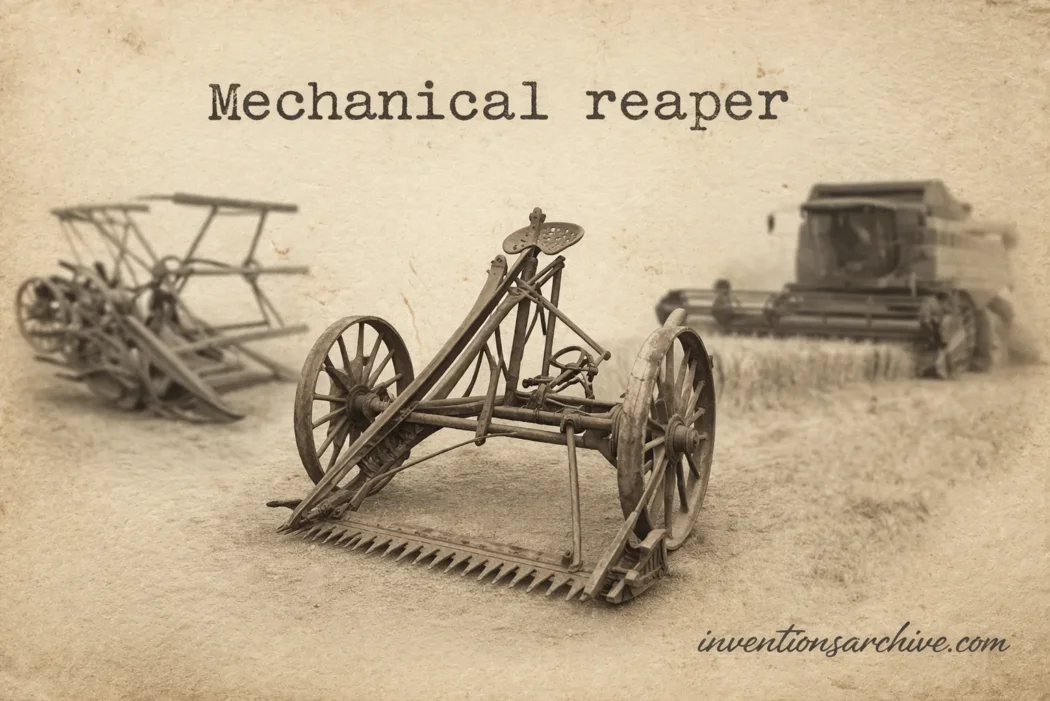
| Topic | Details |
|---|---|
| Invention Name | Mechanical reaper |
| Short Definition | A horse-drawn machine that cut grain stalks faster than hand tools. |
| Approximate Date / Period | 1826–28 antecedent field design; 1831 public field trial; 1834 U.S. patent (Details-1) (Details-2) |
| Date Certainty | Mixed: exact for patent year; approximate for some early development phases |
| Geography | Scotland; United States; later grain regions of the Midwest and Europe |
| Inventor / Source Culture | Rev. Patrick Bell; Obed Hussey; Cyrus H. McCormick; 19th-century British and American farm engineering |
| Category | Agricultural harvesting machinery |
| Importance | Faster grain cutting; smaller harvest labor bottleneck; wider path to larger cereal acreage |
| Need Behind It | Hand harvesting was slow, seasonal, and labor-heavy. |
| How It Worked | Divider; reel; reciprocating blade; platform; hand-rake discharge (Details-3) |
| Material / Technology Base | Wood and iron; horse draft; geared motion; cutting bar mechanics |
| Early Use | Wheat, oats, barley, and other small grains |
| Spread Route | Britain and the eastern U.S. to the Midwest grain belt; wider notice after the 1851 London Exhibition (Details-4) |
| Derived Developments | Self-rake reaper; binder; combine harvester |
| Impact Areas | Agriculture; farm labor; machine manufacturing; milling and grain trade |
| Different Views | “First” depends on the yardstick: earliest workable design, first patent, or first wide commercial success |
| Precursors and Successors | Sickle; scythe; cradle scythe → reaper → binder → combine |
| Main People and Traditions | Bell; Hussey; McCormick; 19th-century workshop farming culture |
| Varieties Influenced by This Invention | Hand-rake reaper; self-rake reaper; mower-reaper; binder; combine harvester (Details-5) |
Harvest used to be the hard limit on grain farming. A field could be sown, fenced, and tended well enough, yet the crop still depended on one narrow season when stalks had to be cut fast, gathered, and tied before weather or delay spoiled the effort. The mechanical reaper changed that pressure point. It did not appear fully formed in a single moment; rather, it grew through trial, field use, and redesign until machine cutting became more dependable than sheer muscle.
Contents of This Article
Origins and Early Path
No one sensible reduces the mechanical reaper to a single name and stops there. Earlier grain-cutting ideas already existed, and workable steps appeared in more than one place. Patrick Bell belongs in the story because his late-1820s machine showed that field reaping by horse power could move beyond paper sketches. Obed Hussey belongs in it too, because his 1830s work pushed the reaper closer to broad farm use. Then came Cyrus H. McCormick, whose design, patents, and selling system gave the reaper its best-known American identity.
That is why the word “first” causes trouble here. First patent? First workable field machine? First version sold in large numbers? Those are not the same question. The cleaner reading is this: the mechanical reaper family formed through several linked steps, while McCormick’s name rose because his machine proved marketable, improvable, and easier to spread across grain regions.
Before It Became a Famous Machine
- Hand tools ruled the harvest: sickles, scythes, and cradle scythes.
- Small grains set the problem: wheat, oats, rye, and barley had to be cut within a tight window.
- Early machine ideas varied: some pressed grain into cutters, some used reels, some solved cutting better than gathering.
- Commercial success lagged: a field test alone was never enough; reliability, repairs, and cost mattered just as much.
So the reaper’s story is not merely about invention. It is also about adoption—a quieter subject, maybe, but the one that decided whether farmers trusted steel and timber more than a row of hands.
Why Harvesting Needed a Machine
Sowing could be spread over days. Harvest could not. Grain ripened, lodged, shed seed, and waited for no one. A farmer might manage more acreage in spring, yet still lose the advantage in late summer because cutting capacity stayed trapped in the pace of human arms. That was the snag. A bad one.
The mechanical reaper answered a very plain farm problem: too much crop, too little time. Its value sat in timing as much as speed. It let one team cut more ground in the same weather window, and that changed the arithmetic of grain farming. Labor still mattered—the cut grain had to be raked, tied, shocked, hauled, and threshed—but the first choke point eased.
Where the Bottleneck Sat
- Peak-season labor was hard to expand exactly when needed.
- Ripening fields demanded fast, even cutting.
- Rain, wind, and delay could turn standing grain into loss.
- Larger acreage made little sense without faster harvesting.
The reaper did not finish the whole harvest cycle by itself. That is worth stressing because people often blur the terms. A reaper cuts. A binder ties. A combine cuts, threshes, and cleans. Those are related machines, yes, though not the same machine.
How the Mechanical Reaper Worked
The classic mechanical reaper solved one task cleanly: it cut standing grain and laid it where workers could gather it. Early successful versions used a few parts that now seem obvious, though they took years to settle into a dependable arrangement. Reel, divider, blade, platform—simple words, hard-won design.
- Divider: separated the standing grain from the strip already cut.
- Reel: pushed or guided stalks toward the cutter in a controlled way.
- Reciprocating Blade: moved back and forth to shear the stalks.
- Platform: caught the cut grain instead of letting it scatter badly.
- Raker: pulled the grain from the platform into bundles or swaths for later binding.
That arrangement mattered more than any single part. A blade alone was not enough. The machine also had to present the stalks to the blade, keep cut grain from tangling, and leave the crop in a form workers could still manage. When those steps lined up, the reaper became useful rather than merely clever.
Early reapers were not threshers, and they were not automatic binders. They sat earlier in the harvest chain. Even so, once the cutting stage sped up, the rest of the chain began to change around it—bundle handling, threshing schedules, barn planning, wagon use, and later machine design.
Why This Layout Endured
Because it matched field reality. Grain does not stand in perfect rows. It leans, catches, tangles, and varies by height. The reaper’s working parts had to deal with that messiness. A machine that looked neat in a shop but balked in lodged wheat was no farm tool at all. The better reapers handled uneven stalks, rougher ground, and long hours with fewer stoppages. That won trust.
Main Designs and Later Variants
The term mechanical reaper often gets used loosely, but the machine family branched quickly. That branching tells the real story: once farmers accepted machine cutting, they wanted the next delay removed too.
Hand-Rake Reaper
This was the early pattern most people picture. The machine cut grain and laid it onto a platform. A worker then raked the cut stalks off by hand. It saved labor at the cutting stage, though it still needed people alongside the machine.
Self-Rake Reaper
Here the machine took over more of the handling step. Mechanical arms or raking devices moved the cut grain from the platform in repeated cycles. That extra motion may sound modest, but on a long harvest day it reduced fatigue, sped the flow, and cut down the need for constant hand raking.
Binder
The binder pushed the process further by tying cut grain into sheaves. Now the machine did more than cut and deposit; it prepared bundles for field drying and later threshing. This was a large step because binding had consumed labor almost as stubbornly as cutting.
Combine Harvester
The combine folded several stages into one machine: cutting, threshing, and cleaning. In that sense, the combine did not erase the reaper’s place in history. It grew out of it. The reaper solved the first hard part of mechanized grain harvest; later machines absorbed the rest.
- Reaper: cuts.
- Self-rake reaper: cuts and mechanically sheds the cut grain.
- Binder: cuts and ties sheaves.
- Combine: cuts, threshes, and cleans in one pass.
Why the Reaper Spread Across Grain Regions
Farm conditions chose the winners. The reaper made the most sense where small grains covered broad fields, where harvest labor strained to keep up, and where the land let horse-drawn machinery move without too much interruption. Flat or gently rolling grain country favored it. Large cereal acreage favored it even more.
Yet field shape was only one part of the story. Sales methods mattered too. Public demonstrations, repair parts, repeatable manufacturing, and the confidence that a machine could be fixed after a breakdown—those things helped move the reaper from curiosity to farm purchase. McCormick’s later success came not merely from designing a machine, but from building a way to distribute one.
The 1851 London Exhibition gave the reaper wider notice and helped push it beyond a local American farm invention into an international talking point. That kind of exposure mattered. Buyers, makers, and rivals all saw the same thing: harvesting could be mechanized on a larger scale, and grain farming would not look quite the same afterward.
Why the Midwest Mattered
Once production shifted toward the American Midwest, the reaper found a natural home. Big wheat acreage, seasonal urgency, transport links, and factory output all pulled in the same direction. Good soil alone never explains that shift. Neither does one machine by itself. Still, the mechanical reaper fit the grain belt’s needs so well that it became part of the region’s operating logic.
What the Mechanical Reaper Changed
The reaper did more than save time in one field. It altered how farmers thought about acreage, timing, and labor. A larger crop became less risky when the harvest window could be handled with more confidence. That shift sounds dry on the page. In practice, it changed farm planning from the ground up.
- Harvest pace changed: more land could be cut within the same season.
- Labor use changed: effort moved away from pure hand cutting and toward machine operation, raking, binding, hauling, and repair.
- Machine chains formed: reapers worked beside threshers, wagons, barns, and later binders and combines.
- Manufacturing grew: farm machinery became a larger industrial business, not just a local blacksmith’s sideline.
- Crop geography shifted: broad grain regions gained an advantage where machine harvesting paid off.
Its larger historical place is clear enough: the mechanical reaper stands near the center of 19th-century harvest mechanization. Not alone, mind you. Better transport, grain markets, mills, metalworking, and other machines all shared the job. Even so, machine cutting changed the flow of farm work in a direct, visible way. People could see it in one pass across a field.
There is another reason the reaper still matters as a subject. It shows how inventions spread in real life. Rarely through a single flash of genius, and rarely through design alone. They spread when a tool meets a stubborn problem, fits daily work, survives repair, and keeps proving itself season after season.
Common Questions About the Mechanical Reaper
Who invented the mechanical reaper?
No single answer covers every stage. Patrick Bell, Obed Hussey, and Cyrus H. McCormick all belong in the history. McCormick became the best-known American figure because his reaper was patented, improved, and sold widely.
Was McCormick the first person to make one?
That depends on what “first” means. Earlier workable reaping machines and rival designs existed. McCormick’s place rests on development, patenting, manufacturing, and spread, not on a simple one-line claim.
What did a mechanical reaper replace?
It replaced the slowest part of hand grain cutting done with sickles, scythes, and cradle scythes. It did not replace every harvest task at once.
Did the reaper thresh grain too?
No. A reaper cut grain and laid it for gathering. Threshing came later in the chain, whether by hand, by separate machine, or by later combined equipment.
How is a reaper different from a binder or a combine?
A reaper cuts. A binder cuts and ties sheaves. A combine cuts, threshes, and cleans in one machine. The later machines grew from the same harvesting line but handled more stages.