
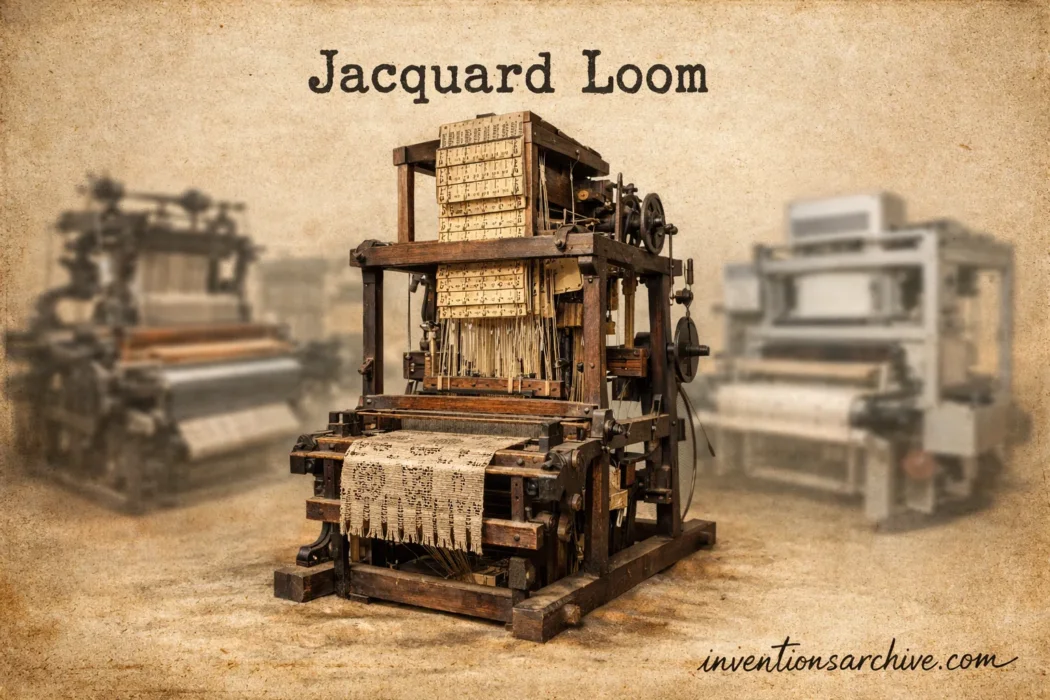
| Aspect | Details |
|---|---|
| Invention Name | Jacquard Loom |
| Short Definition | Programmable weaving system; punched-card control for patterned cloth |
| Approximate Date / Period | 1801 public demonstration; 1804–1805 working system widely accepted dating |
| Geography | Lyon, France |
| Inventor / Source Culture | Joseph-Marie Jacquard; French silk-weaving culture; earlier French groundwork also mattered |
| Also Called | Jacquard attachment; Jacquard mechanism |
| Category | Textile machinery; figured weaving; mechanical pattern control |
| Why It Mattered | Repeatable complex motifs Stored pattern instructions Bridge between textiles and later machine logic |
| Need Behind It | Reduce slow drawloom assistance; scale figured silk production |
| How It Worked | Card chain → needles and hooks → selected warp lifted → weft passed through shed |
| Material / Technology Base | Punched cards; hooks; harness cords; heddles; warp and weft control |
| Early Use | Figured silks; brocade; damask; ribbons; furnishing textiles |
| Spread Route | Lyon → Britain → wider European and North American weaving centers |
| Developments It Opened | Automatic figured weaving; card-based pattern storage; later punch-card thinking |
| Impact Areas | Textiles, manufacturing, design, computing history, education |
| Debates / Alternate Views | Whole loom vs attachment; single inventor story vs longer development path |
| Precursors and Successors | Drawloom → mechanical Jacquard → electronic Jacquard |
| Key People and Cultures | Joseph-Marie Jacquard; Lyon silk trade; Charles Babbage; later punch-card engineers |
| Influenced Fabric Types | Brocade; damask; matelassé; figured cloth; knitted jacquard |
“Jacquard loom” sounds like one neat invention with one neat date. It was not that tidy. The system joined figured weaving, mechanical selection, and punched-card control into a method that let complex patterns be stored, repeated, and changed with unusual precision for its time. In Lyon, that changed patterned cloth production; outside textiles, it offered later engineers a clear model for machine instructions (Details-1).
Contents on This Page
What the Jacquard Loom Is
The Jacquard loom is best understood as a pattern-control system for weaving. Many people use the name for the whole machine, yet the working heart was often the Jacquard attachment mounted above a loom. That distinction matters. It explains why the invention changed so many different weaving setups instead of staying tied to one single loom body.
Its task was exact: decide which warp threads rise for each pass of the weft. That allowed the loom to produce cloth with woven motifs built into the structure itself, not added later as surface decoration. Printed fabric could imitate the look. A true jacquard fabric carried the pattern inside the weave.
- Brocade used the system for dense decorative motifs.
- Damask relied on weave contrast rather than printed color.
- Matelassé and figured furnishing cloth drew on the same pattern logic.
- Later, the idea was adapted beyond classic woven silk, including patterned knitted goods.
Origins and Timeline
Before the Jacquard system, figured weaving often depended on the drawloom. A helper had to raise selected warps by hand while the weaver worked below. Slow work. Skilled work too. Patterned silk could be beautiful, but repeating it at scale was hard, and every change in design demanded more labour than workshops wanted to spend.
Joseph-Marie Jacquard did not appear out of nowhere. He turned earlier work on mechanized pattern selection into a version manufacturers could actually use. He demonstrated an improved drawloom in 1801, refined the system in the first years that followed, and the Jacquard method spread into British weaving during the 1820s (Details-5).
- Before Jacquard: drawloom patterning with manual assistance
- 1801: improved drawloom demonstrated in Paris
- 1804–1805: the card-driven system took the form most closely tied to his name
- 1820s onward: broader industrial adoption outside France
How the Mechanism Worked
The process began before any thread moved. A designer mapped the motif onto squared paper. Then a card maker translated that design, row by row, into a laced chain of punched cards. Each card represented one step in the pattern sequence. Tiny decisions, repeated thousands of times.
When a card pressed against the pin matrix, a hole let a pin pass; solid card blocked it. That small yes-or-no event determined which hooks engaged, which harness cords lifted, and which warp ends opened the shed for the shuttle. So the pattern did not sit in the weaver’s memory alone. It sat in the card chain—a physical store of instructions (Details-3).
- Warp: the lengthwise threads held under tension
- Weft: the crosswise thread carried through the shed
- Punched cards: the pattern sequence, one step after another
- Pins, hooks, and harness cords: the selection and lifting system
- Shuttle passage: the moment when the chosen pattern became cloth
Effects on Weaving
The Jacquard system did not erase human skill. It relocated skill. Pattern drawing, card cutting, loom dressing, thread control, repair, and quality judgment all stayed vital. Still, once the setup was ready, the loom could repeat ornate woven motifs with a steadiness older figured weaving could not match so easily.
That changed the economics of patterned cloth. Workshops could switch designs by replacing cards rather than rebuilding the whole patterning process. Figured silks, ribbons, shawls, labels, upholstery fabrics—many sectors felt the difference, and patterned cloth moved into a broader market rather than staying tied so closely to rare luxury production.
- More reliable repeats across long lengths of cloth
- Quicker design changes through new card sets
- Less dependence on manual pattern lifting
- Better fit for complex floral, geometric, emblematic, and text-based motifs
From Silk to Computing
This is where the Jacquard loom leaves textile history and enters machine history. Each punched card carried instructions. Change the card chain, and the machine behaved differently. That idea drew attention from Charles Babbage, and punch cards later became a practical medium for tabulation and early data processing, including the line that led to Herman Hollerith’s census machinery (Details-2).
Related articles: Power loom [Industrial Age Inventions Series], Mechanical Loom Prototype [Renaissance Inventions Series]
A striking artifact makes the point almost too well: a silk portrait of Jacquard, woven in 1839, required 24,000 punched cards. It is art, yes. It is also a programmed image in thread, one of the clearest objects linking textile machinery to later information systems (Details-4).
Types and Later Forms
The Jacquard idea did not stay frozen in the nineteenth century. It branched. The logic stayed familiar even when the hardware changed.
- Handloom Jacquard — used in workshops, schools, and smaller specialty production
- Power-Loom Jacquard — fitted to factory weaving for higher output
- Mechanical Jacquard — the classic card-driven version
- Electronic Jacquard — digital control replaced physical card chains, but thread selection remained the basic job
The word jacquard widened too. Today it can refer to the mechanism itself, to woven fabrics whose motifs are built into the structure, and to later patterned knits shaped by the same selection principle. People mix those meanings all the time. Fair enough. The safest reading is simple: jacquard means pattern created during production by controlled thread selection, not decoration added afterward.
That is why the Jacquard loom still matters on two tracks at once. In textile history, it changed how figured cloth was made. In machine history, it made stored instructions feel practical—almost ordinary, really—long before ordinary people ever saw a computer.
Questions Readers Often Have
Did Joseph-Marie Jacquard invent an entirely new loom?
Not in the narrowest sense. He is linked most closely to a pattern-control attachment that transformed existing weaving practice. That is why many textile historians also use the terms Jacquard attachment or Jacquard mechanism.
How did punched cards control the woven pattern?
Each card represented one step in the design sequence. The holes and uncut areas told the mechanism which warp threads should rise for the next pass of the weft. In effect, the pattern was stored outside the cloth maker’s memory and inside the card chain.
Why does the Jacquard loom appear so often in computing history?
Because it demonstrated that a machine could follow interchangeable stored instructions. That idea influenced Charles Babbage and later punch-card systems used in tabulation and computing.
What kinds of textiles are most closely tied to Jacquard weaving?
Brocade, damask, figured silks, ribbons, labels, furnishing textiles, and many decorative woven fabrics are closely associated with Jacquard production.
Is the Jacquard system still in use today?
Yes. Modern versions often use electronic control instead of physical card chains, but they still perform the same central task: selecting threads so a stored pattern becomes cloth.