
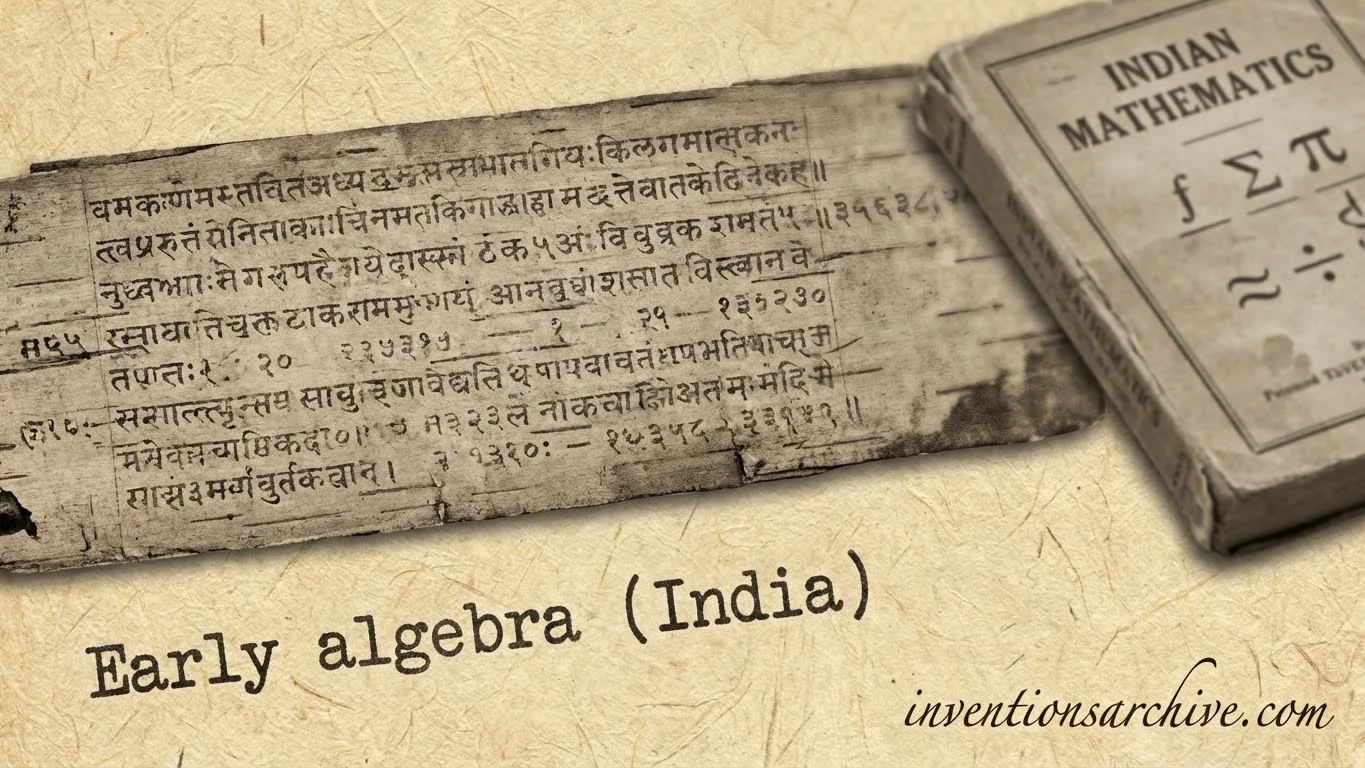
| Invention Name | Early Algebra in India |
|---|---|
| Short Definition | Rule-based methods for working with unknown quantities, equations, zero, negative values and indeterminate problems in the Indian mathematical tradition. |
| Approximate Date or Period | c. 5th–12th century CE Approximate |
| Geography | Indian subcontinent; major centers included Kusumapura, Bhillamala and Ujjain. |
| Inventor or Source Culture | Anonymous and cumulative; associated with Aryabhata, Brahmagupta and Bhāskara II. |
| Category | Science, education, measurement, astronomy, calculation. |
| Evidence Status | Textual tradition supported by surviving treatises and manuscript evidence Based on surviving evidence |
| Main Problem Solved | How to solve numerical problems when one or more quantities were unknown. |
| How It Worked | Verbal rules, examples, place-value numerals, operations with zero and signs, equation-solving procedures. |
| Core Mathematical Ideas | Unknown quantity, square of the unknown, linear equations, quadratic equations, negative values, zero, indeterminate equations. |
| Surviving Evidence | Preserved Sanskrit mathematical astronomy texts; Bakhshali manuscript folios; later translations and commentaries. |
| Development Path | Counting and geometry → equation rules → algebraic treatises → later symbolic algebra. |
| Related Inventions | Zero, decimal place-value numerals, algorithms, astronomical tables, written numerals, manuscript culture. |
| Modern Descendants | School algebra, equation solving, number theory, computational algorithms, mathematical notation. |
| Main Importance |
|
Early algebra in India was not algebra in the modern classroom sense, with neat symbols such as x, y and equals signs. It was a set of verbal mathematical methods for finding unknown quantities, balancing values, handling positive and negative numbers, and solving problems that could not be answered by simple counting. Its early forms grew inside astronomy, commerce, measurement, education and manuscript culture.
The most important point is simple: Indian algebra developed as a practical and theoretical language for calculation. It helped scholars move from asking “what is this number?” to asking “what unknown number would make this relation true?”
What Early Algebra in India Was
Early Indian algebra was a method of reasoning with unknowns. It used rules written in compact verse, then explained through examples and commentary. A student or scholar would read a rule, apply it to a problem, and check whether the computed value satisfied the condition.
This is different from modern symbolic algebra, but the underlying aim was familiar: find a hidden quantity from known relations.
Several ideas made this possible:
- Unknown quantities could be named and treated as values to be found.
- Positive and negative values could be handled through ideas such as fortune and debt.
- Zero could be treated as more than an empty place in a numeral.
- Quadratic and indeterminate problems could be approached by repeatable rules.
- Problems could be taught through examples rather than only through geometric diagrams.
The result was a mathematical practice that was both educational and technical. It served astronomers, teachers, commentators and calculators who needed reliable procedures.
How the Origin Is Traced
The origin of early algebra in India is traced through texts, not through a single artifact. No surviving object says, “this is the first Indian algebra.” Instead, historians compare manuscripts, treatises, commentaries, terminology and later translations.
The classical period of Indian mathematics gives the clearest evidence. Aryabhata’s work shows advanced calculation before Brahmagupta. Brahmagupta’s 628 text gives a more explicit algebraic record. Later, Bhāskara II’s works show a mature tradition in which algebra had become a recognized subject, especially through Bījagaṇita, a title often translated as algebra.
The Problem It Answered
Before algebraic methods became well developed, many numerical problems had to be solved by arithmetic trial, geometric construction, or special-case reasoning. These approaches worked for some tasks but became harder when a problem included hidden quantities, opposing values or repeated conditions.
Early Indian algebra answered practical questions such as:
- What number satisfies a relation between two quantities?
- How can a debt and a fortune be combined in calculation?
- How can an unknown square or root be found from given values?
- How can astronomical cycles be compared when the numbers do not divide neatly?
- How can a problem be taught as a rule that works beyond one example?
This made algebra useful beyond abstract study. It supported calendars, astronomy, measurement, teaching and numerical problem solving.
| Before the Invention | What Changed After It |
|---|---|
| Unknown quantities were often handled through specific examples, trial or geometric reasoning. | Rules allowed unknown values to be treated as calculable quantities. |
| Negative values were difficult to fit into geometry-based thinking. | Debt-and-fortune language made negative and positive values easier to calculate with. |
| Zero could mark an empty position in place-value notation. | Zero became part of arithmetic rules, especially in Brahmagupta’s tradition. |
| Quadratic and indeterminate problems were harder to generalize. | Repeated procedures made equation solving more teachable and transferable. |
| Mathematical knowledge often depended on local instruction. | Verse rules and commentaries helped preserve and transmit methods across generations. |
How It Worked in Simple Terms
Early Indian algebra worked by turning a word problem into a relation among quantities. The known values were placed into a rule. The unknown was then found by operations such as addition, subtraction, multiplication, division, extraction of roots or repeated reduction.
The notation was not the same as modern algebra. A rule might speak of the unknown, its square, a remainder, a debt, a fortune, a root or a coefficient. The mathematical structure was still present, but it was carried by language rather than by symbols on a line.
Brahmagupta is especially important here. He wrote the Brahma-sphuta-siddhanta in 628 CE and worked within the mathematical astronomy culture of Bhillamala and Ujjain. MacTutor notes his work on number systems, square roots and quadratic equations, and identifies Ujjain as a major mathematical center of the period.[c]
The Role of Zero and Negative Values
Zero and negative values mattered because algebra often requires movement in both directions. A balance may be above or below zero. A number may be added, removed, owed or gained. Without a workable language for these cases, equation solving remains limited.
Brahmagupta’s tradition used ideas like fortune and debt to express positive and negative values. This did not make ancient rules identical to modern arithmetic, especially around division by zero, but it gave algebra a wider numerical field than systems that avoided negative results.
Earlier Ideas and Tools Before It
Early Indian algebra did not appear from empty space. It depended on older and nearby practices:
- Counting and arithmetic for trade, land, ritual and administration.
- Geometry and measurement for lengths, areas, volumes and constructions.
- Astronomical calculation for cycles, positions, calendars and tables.
- Place-value numerals that made large computations more compact.
- Manuscript culture that preserved rules in verse and commentary.
These earlier tools gave algebra its working materials. Algebra then changed the way those materials were used. It made hidden quantities easier to reason about.
| Stage | Form | What Changed |
|---|---|---|
| Earlier Tool | Arithmetic, geometry, measurement and astronomical computation. | Problems could be solved, but many methods remained tied to special cases. |
| Early Textual Form | Verse rules and worked examples in Sanskrit mathematical texts. | Rules became easier to memorize, teach and comment on. |
| Clear Algebraic Layer | Brahmagupta’s treatment of zero, signs, equations and indeterminate problems. | Unknowns and signed quantities became part of a more systematic calculation tradition. |
| Later Improved Form | Bhāskara II’s algebraic work, including Bījagaṇita. | Algebra became more visibly organized as a subject of study. |
| Modern Descendant | Symbolic algebra, number theory and algorithmic computation. | Verbal rules were later replaced or supplemented by compact notation and formal proof systems. |
Main Principles and Working Materials
The “materials” of early algebra were not metal, stone or wood. They were mathematical objects and writing practices.
Unknowns
The unknown was the quantity to be found. In later Indian algebra, unknowns could be represented with words, abbreviations, colors or letters, depending on the text and tradition. This allowed a problem to be solved without knowing the answer at the start.
The Square and the Root
Quadratic problems depend on the square of an unknown. Indian mathematical texts treated square roots, squares and equations as part of a shared problem-solving culture. This made algebra useful for geometry, astronomy and numerical puzzles.
Related articles: Decimal System (India) [Ancient Inventions Series]
Zero and Place Value
Place-value numerals made calculation more efficient. Zero made the system more powerful. In algebra, zero also marked balance, absence and the boundary between positive and negative values.
Signs and Opposing Values
Positive and negative values were often explained through everyday ideas such as gain and debt. This gave abstract number rules a practical language.
Rules and Commentaries
Many Sanskrit mathematical works used compact verse. The verse preserved the rule. The commentary explained how to use it. This teaching style helped algebra travel through time even when notation was still limited.
Early Uses
Early Indian algebra served several real contexts. It was not only a classroom exercise.
- Astronomy: comparing cycles, calculating positions and organizing numerical tables.
- Education: training students to solve structured numerical problems.
- Measurement: working with lengths, areas and quantities in rule-based ways.
- Calendar calculation: handling repeated cycles and remainders.
- Number theory: solving indeterminate problems where whole-number solutions were needed.
Britannica notes that both Aryabhata’s and Brahmagupta’s works belonged to mathematical astronomy lineages, and that Indian mathematical material entered the Muslim world and was translated into Arabic near the end of the 8th century.[d]
Main Types and Variations
| Type or Practice | Basic Meaning | Historical Role |
|---|---|---|
| Linear Equations | Problems involving an unknown to the first power. | Useful for proportional and balance-style problems. |
| Quadratic Equations | Problems involving the square of an unknown. | Important for geometry, numerical problems and later algebra teaching. |
| Indeterminate Equations | Equations with more than one possible solution, often seeking whole numbers. | Central to advanced Indian number problems. |
| Kuṭṭaka Method | A “pulverizer” style method for certain indeterminate equations. | Used to reduce difficult numerical relations step by step. |
| Cakravāla Method | A cyclic method linked with later solutions of certain quadratic indeterminate equations. | Associated with a mature stage of Indian algebraic number work. |
| Bījagaṇita | Later Sanskrit term often translated as algebra. | Shows algebra becoming a named and organized subject. |
Bhāskara II is a major figure in this later organization. Britannica states that he used letters to represent unknown quantities, solved indeterminate equations of the first and second degrees, and reduced quadratic equations to a single type.[e]
How It Spread and Changed
Indian algebra changed through copying, teaching, commentary and translation. Within India, mathematical astronomy created a strong need for calculation. That need supported texts, lineages and specialized methods.
Outside India, some mathematical material moved through translation into Arabic. This mattered because the Islamic mathematical world became a major center of algebra, astronomy and numerical calculation. Later, these ideas interacted with Greek, Persian, Arabic and European traditions.
This spread should not be simplified into a straight line. Mathematical ideas often moved through translation, adaptation and reworking. A method could change form while keeping part of its older structure.
What Changed Because of It
Early algebra in India changed calculation in several concrete ways.
- Unknowns became workable. A hidden value could be named, related to other values and solved by a rule.
- Negative numbers gained practical meaning. Debt-and-fortune language helped make signed calculation teachable.
- Zero entered deeper calculation. It was not only a blank place; it became part of arithmetic reasoning.
- Equation solving became more portable. A rule could be copied, memorized, commented on and reused.
- Astronomy gained stronger numerical tools. Cycles, remainders and unknown quantities could be handled more efficiently.
The long-term effect was not that modern algebra appeared fully formed. Rather, Indian algebra helped create a stronger culture of algorithmic equation solving. That culture later connected with Arabic and European mathematical developments.
Bakhshali Manuscript and the Limits of Certainty
The Bakhshali manuscript is often mentioned in discussions of Indian mathematics because it contains numerical and algebraic material and uses a dot associated with zero notation. Yet its date and interpretation need care.
A 2017 Bodleian announcement drew attention to radiocarbon dating and the history of zero, but later academic discussion questioned how the dates should be interpreted. A response published in History of Science in South Asia argued that the earliest dated folio should not automatically be treated as the date of the whole text, and that the manuscript’s zeros should be considered within a wider mathematical context.[f]
This matters for algebra because manuscript evidence does not always equal first invention. A surviving manuscript may copy older material. It may also combine layers from different moments. The safe conclusion is that the Bakhshali evidence is important, but it should not be used to force a single neat origin story.
Common Misunderstandings
“One Person Invented Indian Algebra”
No single person invented the whole tradition. Brahmagupta is a central figure because his surviving text is clear and influential, but early algebra in India grew through many authors, teachers, copyists and commentators.
“It Used Modern Symbols”
Early Indian algebra did not look like modern symbolic algebra. It used verbal rules, terms for unknowns and examples. The ideas could be algebraic even when the notation was not modern.
“The Earliest Surviving Evidence Proves the First Use”
Surviving evidence proves what has survived, not everything that once existed. A manuscript may preserve older rules, or it may reflect a later copy of earlier material.
“Zero as an Empty-Place Marker and Zero as a Number Are the Same Thing”
They are related but not identical. An empty-place marker keeps digit positions clear. A number can be used in arithmetic rules. The Indian tradition is important because it helped move zero into deeper calculation.
Related Inventions
These related inventions and systems help place early Indian algebra in a wider history of calculation:
- Zero — essential for place-value notation and later arithmetic rules.
- Decimal Place-Value Numerals — made compact written calculation possible.
- Algorithms — repeatable rule-based procedures for solving problems.
- Writing — preserved rules, examples and commentary across generations.
- Astronomical Tables — created a strong demand for advanced calculation.
- Quadratic Equation Methods — one of the main areas where algebraic reasoning became visible.
- Manuscript Books — carried mathematical traditions before print.
- Indo-Arabic Numerals — later spread numerical notation across regions and languages.
Frequently Asked Questions
Was algebra invented in India?
India was one of the major early centers of algebraic thinking, especially in rules for zero, negative values, equations and indeterminate problems. It is safer to say that algebra developed across several cultures, with India making major early contributions.
Who was the most important figure in early Indian algebra?
Brahmagupta is often treated as the central figure because his 628 CE work gives clear rules involving zero, signs, linear equations, quadratic equations and indeterminate equations. Aryabhata and Bhāskara II are also essential to the wider tradition.
Did early Indian algebra use x and y?
No. The familiar x and y notation belongs to later symbolic algebra. Early Indian algebra usually used verbal rules, terms for unknown quantities, examples and commentary. Later writers used more developed naming systems for unknowns.
Why is zero important for early algebra in India?
Zero helped make place-value calculation more powerful and later became part of arithmetic rules. This mattered for algebra because equations often depend on balance, absence, positive values and negative values.
Is the Bakhshali manuscript proof of the first Indian algebra?
No. It is important evidence for Indian mathematical practice, but its dating and interpretation are complex. A surviving manuscript can preserve older material without proving the exact first use of every idea it contains.
Sources and Verification
- [a] Indian mathematics – Vedic, Algebra, Geometry | Britannica — Used to verify Aryabhata’s and Brahmagupta’s early mathematical topics, including quadratic equations, indeterminate equations, algebra techniques, sign manipulation and zero arithmetic. (Reliable because it is an established editorial reference source with subject review.)
- [b] Radiocarbon dating of the Bakhshālī manuscript – ORA – Oxford University Research Archive — Used to verify the 2024 Oxford radiocarbon report and the specific folios tested from the Bakhshali manuscript. (Reliable because it is an official University of Oxford research archive record.)
- [c] Brahmagupta (598 – 670) – Biography – MacTutor History of Mathematics — Used to verify Brahmagupta’s dates, his 628 work, and his association with Bhillamala and Ujjain’s mathematical astronomy tradition. (Reliable because it is a university-hosted history of mathematics resource.)
- [d] Indian mathematics – Vedic, Algebra, Geometry | Britannica — Used to verify the transmission of Indian mathematical astronomy material into Arabic near the end of the 8th century and the wider context of Indian computation. (Reliable because it is an established editorial reference source with subject review.)
- [e] Bhāskara II | 12th Century Indian Mathematician & Astronomer | Britannica — Used to verify Bhāskara II’s use of letters for unknown quantities and his work on indeterminate and quadratic equations. (Reliable because it is an established editorial reference source with subject review.)
- [f] The Bakhshālī Manuscript: A Response to the Bodleian Library’s Radiocarbon Dating — Used to verify the academic caution around interpreting the Bakhshali manuscript’s radiocarbon dates and mathematical content. (Reliable because it indexes a scholarly article published in an academic journal.)