
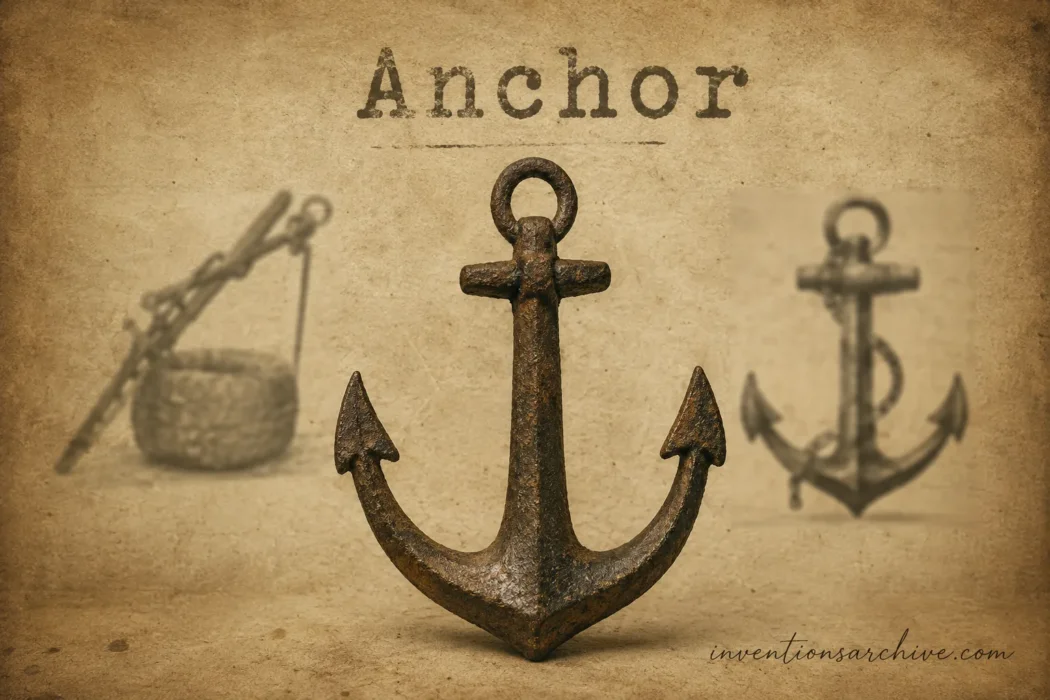
| Invention Name | Anchor |
|---|---|
| Short Definition | A device connected to a vessel by rope, chain, or cable that limits drift through weight, friction, seabed penetration, or a combination of these effects. |
| Approximate Date or Period | Prehistoric origin; securely studied examples survive from the Bronze Age onward Based on surviving evidence |
| Geography | Developed in many maritime regions; early archaeological evidence is especially well documented around the Mediterranean and eastern Mediterranean. |
| Inventor or Source Culture | Anonymous / collective development; no single inventor can be established. |
| Category | Navigation; maritime engineering; transport |
| Main Problem Solved | Keeping a vessel near a chosen position despite wind, current, waves, or river flow. |
| Simple Working Principle | The anchor and its connecting line oppose movement by resting on, gripping, or penetrating the bed below the water. |
| Material and Technology Base | Stone; plant-fiber rope; wood; lead; iron; forged steel; cast steel; chain cable |
| Early Use | Vessel positioning, fishing, sheltered anchorage, loading, unloading, and temporary stopping near coasts or riverbanks |
| Evidence Status | Approximate origin Archaeological evidence confirmed Attribution varies |
| Surviving Evidence | Pierced stone anchors; stone stocks; lead stocks; iron anchors; shipwreck finds; harbor deposits; painted ship scenes; patent models; museum objects |
| Development Path | Heavy object or stone → pierced stone anchor → composite anchor → stocked iron anchor → patent and stockless forms → specialized ship, small-craft, mooring, and offshore anchors |
| Main Historical Change | Design shifted from relying mainly on mass to using shape, orientation, and seabed engagement for greater holding effect. |
| Main Parts in Fluked Forms | Shank; crown; arms; flukes or palms; bills; stock where fitted; ring or shackle; connecting rode or chain |
| Impact Areas | Navigation; fishing; trade; harbor work; ship design; marine construction; offshore engineering; scientific moorings |
| Related Inventions | Rope; chain cable; capstan; windlass; hawsepipe; mooring buoy; sea anchor; helical anchor |
| Modern Descendants | Stockless ship anchors; fluke anchors; plow, claw, and scoop anchors; mushroom moorings; deadweight systems; drag-embedment and suction anchors |
| Historical Importance |
|
An anchor turns a moving vessel into a temporarily fixed one without requiring a pier, beach, post, or line ashore. That ability supported fishing, waiting for a tide, handling cargo, sheltering near a coast, and stopping in water too deep for a person to stand. The device may look simple, yet its history links rope-making, stoneworking, woodworking, metallurgy, ship design, chain manufacture, and seabed mechanics.
What An Anchor Is
A maritime anchor works as part of a larger holding system. The anchor rests on or penetrates the seabed, while a rode—made of rope, chain, wire, or a combination of these—connects it to the vessel. Larger ships also rely on fittings such as shackles, hawsepipes, chain stoppers, and windlasses to handle, retrieve, and secure the anchoring equipment.
A shipboard anchor differs from a fixed harbor mooring. It is normally carried aboard the vessel, deployed when needed, and recovered before departure. A permanent mooring, by contrast, may use a mushroom anchor, concrete mass, screw anchor, pile, or another foundation designed to remain in the same location for long periods.
A sea anchor is also different. It works in the water rather than gripping the bottom. It creates drag and reduces a vessel’s movement relative to the surrounding water. The shared word reflects a related purpose, but the physical principle is not the same.
Main Parts Of A Fluked Anchor
- Shank: the long central member that carries tension from the connecting line toward the crown.
- Crown: the lower junction where the shank meets the arms or rotating head.
- Arms: the curved or angled members that extend from the crown.
- Flukes or palms: broad surfaces intended to enter or press against the seabed.
- Bills: pointed ends that help begin engagement with the bottom.
- Stock: a crossbar on stocked anchors that turns the anchor so one fluke can meet the seabed at a useful angle.
- Ring or shackle: the upper connection for rope, chain, or cable.
How The Origin Is Traced
The earliest anchor concept was probably a portable weight attached to a line. A natural rock, a pierced stone, a basket filled with stones, or a weighted wooden object could resist drift through mass and friction. Such devices did not need a complex workshop, which explains why the idea could emerge independently in many boating communities.
Researchers face a basic identification problem: a pierced stone may also have served as a net weight, press weight, building weight, or tethering stone. Archaeological context matters. An object found in an anchorage, beside ship remains, or among other maritime gear provides stronger evidence than an isolated stone without a clear find history.
Visual evidence adds another layer. A Cypriot Bichrome Ware jug dated to about 750–600 BC shows a merchant ship scene in which a sailor handles what the British Museum describes as an apparent round anchor. The image does not identify the first anchor, but it records how anchoring had entered the visible equipment of Iron Age seafaring. [b]
Why There Is No Single Inventor
The anchor was not one finished object that appeared all at once. It changed through many small solutions:
- Choosing a dense object that could be carried aboard
- Making a secure opening or attachment point for rope
- Adding wooden projections that could catch the bottom
- Using a stock to control orientation
- Replacing vulnerable wood with metal
- Changing the crown, arms, and flukes for stronger seabed engagement
- Adapting the shape for chain handling and hull stowage
Each step could be copied, altered, and rediscovered. Named designers become easier to identify only when drawings, patents, industrial records, and museum models survive.
The Problem It Answered
Water continually moves a floating vessel. Wind pushes the exposed hull, mast, rigging, and cargo. Current carries the submerged hull. Waves add repeated changes in load. Before reliable anchors, crews had fewer choices: beach the craft, tie it to the shore, use poles in shallow water, hold position with oars, or accept drift.
Those methods had limits. Beaching could damage a hull or make departure dependent on tide and labor. A shore line needed a suitable bank, rock, tree, post, or harbor fitting. Poles worked only in shallow water. Oars required people and could not provide a steady hold for long periods.
The anchor gave the vessel an attachment to the ground below the water. That made it possible to wait offshore, fish over a chosen area, pause before entering a harbor, handle sails or cargo, and use sheltered water without a built quay.
How An Anchor Works In Simple Terms
An anchor opposes vessel movement in one or more of three ways: mass, friction, and soil engagement. A deadweight anchor relies mainly on its weight and resistance against the bottom. A fluked anchor uses its shape to enter sand, mud, clay, or another seabed material. A permanent screw or pile anchor transfers load deeper into the ground.
The connecting rode also matters. Chain adds weight near the bottom, resists abrasion, and changes the direction in which force reaches the anchor. The curved suspended shape of a rode can reduce sudden changes in tension. These effects explain why an anchor is better understood as one part of a system rather than an isolated piece of metal.
The U.S. Patent and Trademark Office defines a fluke as a flat anchor blade made to penetrate and grip the seabed. Its classification guidance also describes drag embedment as burial produced by the combined effect of line pull, fluke shape, and fluke orientation. [c]
What The Stock Changed
A stock is a crossbar set roughly at right angles to the plane of the arms. When a stocked anchor lands, the stock prevents both flukes from lying flat. It rolls the body so one fluke points toward the seabed and can enter it. This allowed the anchor to use shape rather than weight alone.
The trade-off was bulk. A long stock took deck space and complicated handling. Folding or removable stocks eased storage, but large ships still needed cranes, catheads, beds, and labor to bring the anchor aboard.
What The Stockless Form Changed
Stockless anchors replaced the long crossbar with a heavy head whose flukes pivot around the crown. Projections on the crown help turn the flukes toward the seabed when the anchor is drawn along the bottom. The shape can be pulled into a hawsepipe or recess at the bow, which suits mechanized handling on large ships.
The change did not make every stockless anchor better in every condition. It solved a ship-design and handling problem: how to carry, lower, recover, and stow a large anchor without a projecting stock.
Earlier Ideas and Tools
The anchor drew on technologies that already existed. Rope-making was essential because even the heaviest stone was useless to a vessel without a reliable line. Stone drilling and chiseling created secure holes. Woodworking made stocks, arms, and composite bodies. Lead casting supplied dense stocks and reinforcement. Iron forging later produced thinner, stronger arms and flukes.
Portable Weights
A plain stone tied within rope or fiber netting could slow drift. A pierced stone improved the attachment because the line passed through the object rather than depending only on a wrapping that might slip. Some anchors had one hole for the rope; others had extra holes that may have carried wooden stakes or projections.
Composite Anchors
Composite designs combined different materials for different jobs. Stone or lead supplied mass. Wood formed a shank, stock, or arms. A metal tip resisted wear. This approach used scarce metal only where it added the most value.
Excavation at Dor on the Carmel Coast has documented a wood-and-lead anchor stock associated with Iron Age cargo deposits. The preserved stock is more than two metres long, contains lead-filled chambers, and produced a radiocarbon result with higher probability before about 550 BC. The find shows that anchor construction could already combine shaped timber and cast metal rather than rely on a single stone. [d]
Materials and Technical Principles
Stone
Stone offered density, local availability, and resistance to decay. Its disadvantages were brittleness, limited shape, and the amount of mass needed when holding depended mainly on weight. Piercing a hole also demanded labor and could weaken the stone.
Wood and Lead
Wood made long structural members possible without the full weight of metal. Lead added compact mass and could be cast into stocks or cavities. Waterlogged wood may survive in buried or low-oxygen conditions, but exposed wood decays, so many composite anchors are known from stone or lead parts after the timber has disappeared.
Iron
Iron allowed arms, shanks, and flukes to become one durable assembly. Early forged anchors were limited by the quality of the metal and by the difficulty of welding large sections. Weak points often occurred where the arms met the shank.
A surviving Admiralty Pattern anchor at Royal Museums Greenwich shows how construction can help date an object. Its sharp arm angle and pointed crown indicate manufacture before stronger anchor-forging iron became common around 1800 and before steam-hammer welding spread around 1830. The museum also notes that anchors of this form could break at the throat. [e]
Steel, Chain, and Machinery
Improved iron and steel supported larger cast or forged parts with more controlled shapes. Chain cable resisted abrasion and fire better than natural-fiber rope and worked well with mechanical handling equipment. Windlasses, chain lockers, hawsepipes, and powered deck machinery changed the anchor from a loose object handled mainly by muscle into an integrated ship system.
Development Path
| Stage | Form | What Changed |
|---|---|---|
| Earlier Method | Beaching, shore lines, poles, oars, or loose weights | Position depended on the shore, shallow water, or continuous labor. |
| Weight Anchor | Stone, basket of stones, or weighted object tied to rope | Created a portable connection to the bottom through mass and friction. |
| Pierced Stone | Shaped or natural stone with one or more holes | Improved line attachment and sometimes accepted wooden gripping pieces. |
| Composite Form | Stone or lead combined with wood | Separated the jobs of weight, orientation, and seabed grip. |
| Stocked Metal Anchor | Iron shank, arms, flukes, and a wood or metal stock | The stock turned a fluke toward the seabed; metal improved durability. |
| Improved Forged Forms | Curved arms, stronger crowns, better welds, standardized patterns | Reduced weak points and adapted anchors to larger sailing and steam vessels. |
| Early Stockless Patent Form | Pivoting arms or flukes without a long cross-stock | Targeted easier handling and compact stowage. |
| Industrial Ship Anchor | Cast or forged steel stockless anchor with chain cable | Worked with hawsepipes, windlasses, and large steel hulls. |
| Specialized Modern Forms | Fluke, plow, claw, scoop, mushroom, screw, drag-embedment, and suction types | Matched different vessel sizes, seabeds, mooring periods, and offshore loads. |
The Nineteenth-Century Shift
The nineteenth century brought a dense period of anchor experimentation. Larger ships, iron hulls, chain cable, steam power, and mechanical deck equipment created pressure for anchors that were strong, compact, and easier to stow.
Related articles: Caravel [Medieval Inventions Series], Shaduf [Ancient Inventions Series]
A Royal Museums Greenwich model records R. F. Hawkins’s patent stockless anchor of about 1822. Its brass model has a rectangular shank, swivelling arms, flat triangular palms, and stops that limit movement. The model shows that the stockless principle appeared early in the century, even though later designs were needed before the form became normal on large ships. [f]
Hall-type stockless anchors later used a pivoting crown, arms, and broad flukes arranged as a compact head. A museum model made for Joseph Wright & Co. records the industrial form in iron and shows the cast head, bolts, square shank, and swivelling shackle. [g]
Early Uses and Everyday Maritime Work
Anchors were not only emergency equipment. They supported ordinary work:
- Fishing: keeping a boat near a productive area or holding fishing gear in position
- Trade: waiting near a landing place while cargo moved by smaller craft
- Harbor use: holding outside a crowded quay or in a roadstead
- River travel: resisting current while loading, unloading, or waiting
- Sail handling: keeping the vessel from drifting while crews changed rig or prepared for departure
- Construction: positioning work boats, floating cranes, dredges, and later offshore equipment
- Scientific work: holding buoys, instruments, and observation platforms at selected locations
Large vessels often carried several anchors for different roles. Historical terms such as bower anchor, sheet anchor, stream anchor, and kedge anchor described differences in size, location, and intended task. The exact arrangement changed with ship type and period.
How The Anchor Spread and Changed
Anchors traveled with ships, sailors, merchants, shipwrights, and metalworkers. A useful form could be observed in a harbor, copied in another workshop, and adjusted to local stone, timber, iron, rope, vessel shape, and seabed. This makes a simple one-way diffusion story unlikely.
Mediterranean finds show long use of stone, composite, lead-stock, and iron forms. Northern European ship traditions developed their own stocked iron anchors. Asian, African, Pacific, and American boating communities also used local weight anchors, stone forms, wood, fiber, and later imported or locally forged metal anchors.
Industrial production changed the scale of exchange. Patent drawings, naval trials, classification rules, catalogs, foundries, and shipyards spread named designs far beyond the workshop where they began. Standardization also made anchors easier to compare, order, inspect, and fit to chain and deck machinery.
Before and After The Anchor Developed
| Before or Earlier Method | What Changed After Anchor Development |
|---|---|
| Boat pulled onto a beach | The vessel could remain afloat while held near a chosen position. |
| Line tied to a tree, rock, post, or quay | The vessel gained a connection to the submerged ground without reaching the shore. |
| Pole pushed into shallow water | Holding became possible in deeper water where a pole could not reach. |
| Oars used to resist drift | Crews could hold position without continuous rowing. |
| Plain stone relying mostly on mass | Stocks, arms, and flukes used orientation and seabed grip to increase holding effect. |
| Wooden or composite parts vulnerable to decay | Iron and steel improved durability and allowed stronger, thinner shapes. |
| Large stocked anchor difficult to bring aboard | Stockless heads could be drawn into a hawsepipe and handled by a windlass. |
| One general form used for many bottoms | Specialized anchors were developed for temporary anchoring, permanent mooring, soft soil, hard ground, and offshore foundations. |
Main Types and Variations
| Type | Defining Form | Main Principle or Historical Role |
|---|---|---|
| Stone or Deadweight Anchor | Dense mass attached to a line | Relies mainly on weight and friction; among the earliest forms and still used in some moorings. |
| Composite Stone Anchor | Pierced stone with holes for rope and wooden gripping pieces | Combines mass with projections that can catch or enter the bottom. |
| Admiralty or Fisherman Type | Fixed arms and flukes with a long stock | The stock turns one fluke toward the seabed; strong grip but bulky stowage. |
| Stockless Ship Anchor | Pivoting flukes in a heavy head without a cross-stock | Compact bow stowage and mechanical handling on large vessels. |
| Lightweight Fluke Anchor | Wide flat flukes and a stock near the crown | Uses broad surface area to enter suitable soft bottoms with less mass. |
| Plow Anchor | Single plow-shaped fluke, sometimes hinged | Designed to turn and enter the bottom through a plowing action. |
| Claw Anchor | Curved one-piece claw-like body | Uses a weighted curved shape to seek an engaging position. |
| Scoop Anchor | Broad concave fluke | Uses a scoop-like surface to bury and retain seabed material. |
| Grapnel | Several narrow hooks around a central shank | Catches irregular ground or objects; also used in small craft and recovery work. |
| Mushroom Anchor | Dish or mushroom-shaped head | Used mainly for permanent moorings where the head can settle into soft sediment. |
| Screw or Helical Anchor | Central shaft with one or more helical plates | Transfers load into seabed soil through an installed foundation. |
| Drag-Embedment Anchor | Large fluked plate drawn into seabed soil | Used for offshore moorings where the anchor develops resistance after burial. |
| Suction Anchor | Large open-ended steel cylinder | Forms a deep offshore foundation in suitable seabed soils. |
Temporary and Permanent Anchors
Temporary anchors travel with a vessel and are expected to be recovered. Permanent anchors belong to a mooring or offshore system and may remain embedded for years. Their shapes differ because recovery, installation, load direction, inspection, and seabed depth differ.
Anchor, Mooring, and Ground Tackle
Ground tackle is the wider set of equipment used to connect a vessel or floating structure to the bottom. It can include the anchor, chain, rope, shackles, swivels, connectors, stoppers, and handling machinery. A mooring may use one anchor or several anchors arranged around a fixed point.
What Changed Because Of The Anchor
Navigation and Harbors
Anchors made waiting a planned part of navigation. A vessel could pause outside a harbor, remain in a roadstead, wait for daylight or tide, and avoid occupying a quay when no cargo work was needed. Harbor development later added mooring buoys, chains, piles, bollards, breakwaters, and dredged anchorages.
Trade and Fishing
Coastal trade often depended on places without built docks. Anchoring allowed larger vessels to remain offshore while smaller boats carried goods and people between ship and land. Fishing crews could hold over a location rather than drift away from it.
Ship Design
The anchor influenced bow shape, deck layout, cable storage, handling machinery, and crew work. Stocked anchors needed room outside the hull and special supports. Stockless anchors encouraged hawsepipe stowage. Chain lockers and windlasses became part of the vessel’s internal arrangement.
Offshore Engineering
The same physical need—resisting movement relative to the seabed—appears in floating docks, dredges, navigation buoys, research stations, aquaculture systems, construction barges, offshore platforms, and renewable-energy equipment. Modern offshore anchors may bear little visual resemblance to the familiar ship anchor, yet they descend from the same idea of transferring load from a floating object into the ground below.
Common Misunderstandings
“The Anchor Was Invented By One Person”
No reliable evidence supports a single inventor. Early weight anchors, pierced stones, composite forms, stocked anchors, and stockless anchors belong to different periods. Named patent holders improved particular designs rather than creating the entire idea.
“The Oldest Surviving Anchor Was The First Anchor”
Survival is selective. Rope decays, wood disappears, metal corrodes, stone objects are reused, and many early boats leave no wreck. Archaeologists can identify the earliest known evidence, not the absolute first use.
“An Anchor Holds Only Because It Is Heavy”
Mass matters, but many fluked anchors depend more on orientation, penetration, soil resistance, and the direction of pull. The rode and seabed are part of the holding system.
“A Sea Anchor Grips The Seabed”
A sea anchor works through water drag and normally does not touch the bottom. A conventional anchor transfers load to the seabed.
“One Shape Works The Same Everywhere”
Anchor behavior changes with sand, mud, clay, gravel, rock, vegetation, and layered soil. Vessel size, load direction, rode, and anchor geometry also matter.
Related Inventions
- Rope: made the earliest portable anchors usable by connecting vessel and weight.
- Chain Cable: improved wear resistance and supported heavy ship anchors.
- Capstan: provided mechanical advantage for hauling lines and cables.
- Windlass: became the main deck machine for handling anchor cable on many vessels.
- Hawsepipe: guided chain through the bow and allowed stockless anchors to stow against the hull.
- Mooring Buoy: gave vessels a reusable connection to a fixed seabed system.
- Sea Anchor and Drogue: reduced movement through water drag rather than seabed grip.
- Helical Foundation: extended the anchoring principle into marine construction and offshore moorings.
Frequently Asked Questions
Who invented the anchor?
No single inventor is known. The anchor developed collectively from heavy objects and pierced stones into composite, stocked, metal, patent, and stockless forms. Named designers are linked to later variations rather than the original concept.
What were the earliest anchors made from?
The earliest known forms used stone and fiber rope. Later composite anchors combined stone, wood, and lead before iron and steel became common.
How does a ship anchor hold a vessel?
It resists movement through weight, friction, and seabed engagement. Fluked anchors are shaped to enter or press against bottom material, while the rode carries load between the vessel and anchor.
What is the difference between a stocked and stockless anchor?
A stocked anchor uses a crossbar to turn one fluke toward the seabed. A stockless anchor uses pivoting flukes and a shaped crown, allowing a more compact form that can be drawn into a ship’s bow.
Is a sea anchor the same as a seabed anchor?
No. A sea anchor creates drag in the water and normally does not touch the bottom. A conventional anchor transfers force to the seabed.
Why did stockless anchors become common on large ships?
Their compact head and lack of a long stock suited hawsepipe stowage, chain cable, and windlass handling. This reduced deck obstruction and simplified recovery on large vessels.
Sources and Verification
- [a] Use of Photogrammetry for Non-Disturbance Underwater Survey — Used to verify Bronze Age stone-anchor evidence and the archaeological methods used to record such objects. (Reliable because it is a peer-reviewed Cambridge University Press journal article by university-affiliated researchers.)
- [b] British Museum Collection Object: Cypriot Bichrome Ware Jug — Used to verify the 750–600 BC vessel scene and the museum’s identification of an apparent round anchor. (Reliable because it is a direct British Museum collection record.)
- [c] CPC Definition—B63B Ships or Other Waterborne Vessels — Used to verify the technical definitions of an anchor fluke and drag embedment. (Reliable because it is an official U.S. Patent and Trademark Office classification page.)
- [d] Iron Age Ship Cargoes from the Harbour of Dor (Israel) — Used to verify the excavated wood-and-lead anchor stock, its dimensions, context, and dating evidence. (Reliable because it is a peer-reviewed archaeological study published by Cambridge University Press.)
- [e] Admiralty Pattern Anchor — Used to verify features of an early Admiralty-pattern object, the role of its stock, and evidence from iron forging and welding history. (Reliable because it is a direct Royal Museums Greenwich collection record.)
- [f] Hawkins Patent Stockless Anchor Model — Used to verify the circa-1822 patent model and its pivoting stockless structure. (Reliable because it is a direct National Maritime Museum collection record.)
- [g] Halls Stockless Anchor — Used to verify the construction details of a later industrial stockless anchor model. (Reliable because it is a direct Royal Museums Greenwich collection record.)