
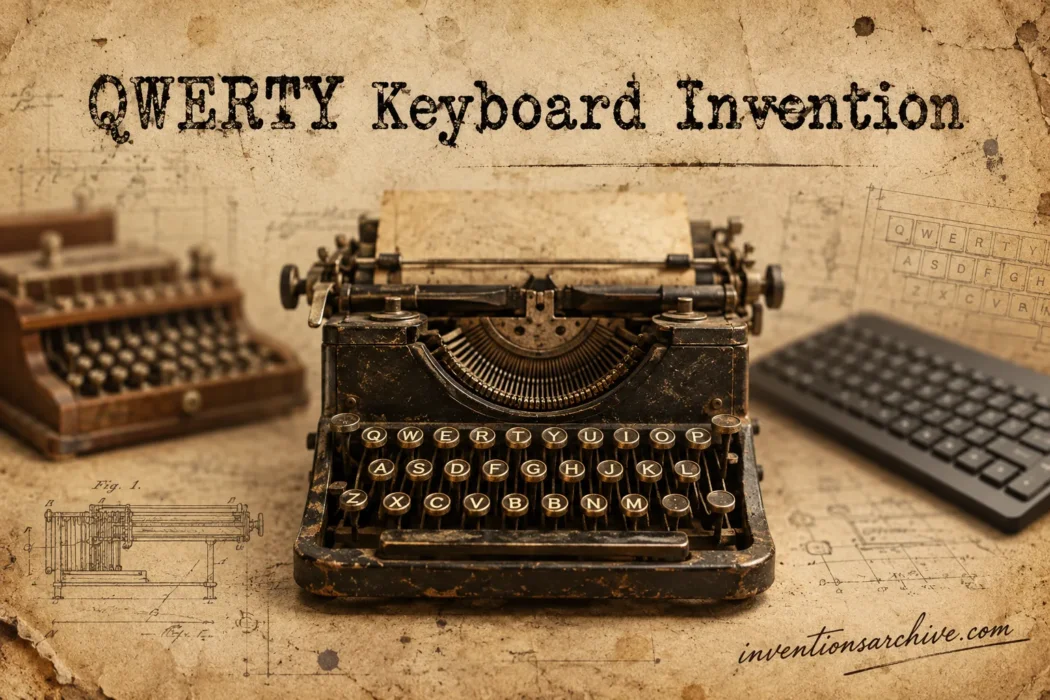
| Invention Name | QWERTY Keyboard Layout |
|---|---|
| Short Definition | A letter arrangement for typewriter and later computer keyboards, named for the first six alphabetic keys in its upper-left row: Q-W-E-R-T-Y. |
| Approximate Date or Period | Developed through the early 1870s; commercial QWERTY typewriter released in 1874; modern letter arrangement established by the 1880s. |
| Geography | Milwaukee, Wisconsin, and Ilion, New York, United States |
| Inventor or Source Culture | Commonly attributed to Christopher Latham Sholes, with contributions from Carlos Glidden, James Densmore, Remington engineers, and later typewriter manufacturers. |
| Category | Writing technology, typewriter keyboard, text-input interface |
| Importance | Became the dominant English-language typewriter layout and was later carried into teleprinters, computer terminals, personal computers, laptops, and touchscreen keyboards. |
| Evidence Status | Based on surviving evidence Attribution varies Design rationale debated |
| Main Problem Solved | Provided a workable keyboard arrangement for evolving mechanical typewriters; the precise reason for the final letter order remains debated. |
| Development Path | Alphabetic and piano-like keys → repeated telegraph-era rearrangements → Sholes & Glidden QWERTY → Remington adoption → industry standardization → computer keyboards |
| Early Use Context | Telegraph transcription, business correspondence, shorthand work, and office typing |
| Patent Record | U.S. Patent 79,265 in 1868 covered early typewriter improvements; Sholes’s U.S. Patent 207,559 of 1878 included a keyboard view but focused its legal claims on machine mechanisms. |
| Main Historical Debate | Mechanical typebar interference versus telegraph-operating requirements and repeated practical revisions; deliberate slowing of typists is not supported by strong surviving evidence. |
Who Invented the QWERTY Keyboard?
Christopher Latham Sholes receives the primary credit for QWERTY, but the familiar layout did not appear as a finished design on a single invention date. It emerged from several years of experiments with typewriters, changing keyboard arrangements, customer feedback, telegraph work, mechanical limitations, and manufacturing decisions.
Sholes was part of a Milwaukee group that included Carlos Glidden and Samuel W. Soule. Their 1868 typewriter patent documents an early stage of the project, long before the keyboard had settled into the arrangement familiar today. James Densmore supplied money, pressed for further improvements, and later helped move the machine toward industrial production. When E. Remington & Sons entered the project, its engineers also altered the machine and its keyboard.
The most accurate attribution is therefore narrower than saying that one person invented a finished modern keyboard. Sholes was the central designer in the sequence that produced QWERTY, while several other people helped shape the machine on which the layout developed and the commercial system that made it dominant.
| Person or Organization | Role in the QWERTY Story |
|---|---|
| Christopher Latham Sholes | Principal designer associated with the evolving keyboard arrangement and the typewriter that carried it into commercial use. |
| Carlos Glidden | Early co-inventor and patent partner in the Milwaukee typewriter project. |
| Samuel W. Soule | Co-inventor named with Sholes and Glidden on the 1868 typewriter patent. |
| James Densmore | Investor and development partner who pushed for further refinement and helped connect the project with Remington. |
| William K. Jenne and Jefferson M. Clough | Remington engineers involved in revising the machine and keyboard during the transition to manufacture. |
| E. Remington & Sons | Turned the experimental machine into a manufactured product and helped establish QWERTY in the market. |
| Wyckoff, Seamans & Benedict | Later altered Remington keyboard details and helped carry the arrangement toward the modern form. |
The First Sholes Keyboard Was Nearly Alphabetical
Modern QWERTY makes little sense if its history begins with the assumption that Sholes deliberately placed twenty-six letters into their present positions all at once. The earliest documented keyboards were much closer to alphabetical order.
The 1868 Sholes, Glidden, and Soule patent model preserved by the Smithsonian shows the experimental nature of the machine. Its keys followed the piano-like approach found on several early writing machines. Research by Koichi Yasuoka and Motoko Yasuoka traces another 1868 machine sent from Milwaukee to Edward Payson Porter, principal of Porter’s Telegraph College in Chicago. That machine had 28 keys and an alphabetic arrangement: A through N ran in one direction and O through Z in the other.
This matters because QWERTY was not a rejection of an established modern keyboard. It grew out of machines whose inventors were still deciding how many keys were needed, where numerals belonged, how punctuation should be entered, and how the operator’s fingers should interact with the internal type mechanism.
Porter’s work also tied the machine to telegraphy very early. He wanted numerals so incoming Morse messages containing numbers could be transcribed directly. By April 1870, Sholes had produced a 38-key machine containing capital letters, the numerals 2 through 9, and several punctuation marks. Its four-row layout was still largely alphabetical.
How an Alphabetic Keyboard Became QWERTY
The letter arrangement changed repeatedly between 1868 and the early 1880s. Surviving documents and reconstructed keyboard diagrams show a development process rather than one decisive redesign.
| Stage | Keyboard or Machine | What Changed |
|---|---|---|
| 1868 | Early Sholes, Glidden & Soule Type-Writer | Piano-like and largely alphabetic keyboard arrangements were still being tested. |
| April 1870 | 38-key Type-Writer | Four rows combined letters, numerals, and punctuation while preserving much of the earlier alphabetic logic. |
| July 1872 | 42-key Type-Writer | Many letters had moved, producing a layout much closer to later QWERTY but still not identical to it. |
| February–March 1873 | Machine presented to Remington | Densmore and George W. N. Yost brought a 43-key machine to Ilion; a manufacturing contract followed on March 1. |
| Autumn 1873 | Remington trial model | Jenne and Clough revised the keyboard; Sholes requested another change that moved Y beside T. |
| 1874 | Sholes & Glidden Type Writer | Remington released the commercial machine with the recognizable QWERTY sequence. |
| 1878 | Remington Type-Writer No. 2 | QWERTY continued on a more successful machine capable of producing both upper- and lower-case letters. |
| 1882 | Remington Standard Type-Writer No. 2 | Further letter changes, including movement of M and an exchange involving C and X, produced the arrangement described by researchers as the modern QWERTY order. |
| 1890s | Multi-manufacturer adoption | QWERTY spread across leading typewriter brands and became the de facto industry standard. |
One revealing detail comes from the period immediately before commercial manufacture. An earlier arrangement placed a period where the letter R later appeared. Remington engineers Jenne and Clough moved R beside E while shifting the period elsewhere. Sholes then requested another change involving Y. Even the six letters that gave QWERTY its name were therefore the result of late-stage revision.
Why Is QWERTY Not in Alphabetical Order?
The traditional explanation begins inside the typewriter. In an early upstrike machine, pressing a key did much more than register an electronic signal. The key moved a lever connected to a metal typebar carrying a character. That bar swung toward a common printing point, struck an inked ribbon against the paper, and then had to return before another movement interfered with it.
Many typebars approached the same small area from different angles. If two bars moved through conflicting paths in rapid succession, they could clash or become entangled. The Smithsonian’s description of the Sholes & Glidden machine states that the keyboard arrangement was adopted to reduce clashes among the typebars arranged inside the machine.
That explanation is mechanically plausible and is supported by museum interpretation. It should not, however, be converted into the much broader claim that every QWERTY letter was positioned according to one carefully calculated anti-jamming formula.
Research on surviving Sholes & Glidden machines complicates that idea. Yasuoka and Yasuoka compared common English letter pairs with the actual positions of typebars in the machine’s basket. Some frequent pairs were widely separated, but others were not. The common E-R pairing, for example, remained close in the typebar mechanism after R had deliberately been moved next to E on the keyboard.
This suggests a less tidy history. Mechanical interference was a real engineering problem, but QWERTY also absorbed decisions made for operating habits, telegraph work, punctuation, manufacturing, patent considerations, and later revisions.
The Telegraph Theory Changes the QWERTY Story
The connection between early typewriters and telegraph operators is one of the most useful clues to the layout’s development. The first documented customer identified by Yasuoka and Yasuoka was the head of a telegraph college. The researchers also trace later demonstrations to telegraph professionals and argue that keyboard changes reflected problems encountered while receiving Morse messages.
American Morse code did not always divide characters in ways that were immediately obvious to an operator listening to a sounder. Certain signals could be interpreted in more than one way until additional characters arrived. Yasuoka and Yasuoka use the relationship among Z, S, and E as an example: a Morse receiver might need to decide whether a signal represented Z or a sequence involving S and E. Keeping relevant keys conveniently positioned could help the operator transcribe the message while the transmission continued.
Other details point in the same direction. Numerals were added after a telegraph user requested them. Researchers also identify a paragraph-separator key on a 1873 keyboard associated with the way newspaper material was transmitted over Western Union lines.
This does not prove that Morse code alone produced QWERTY. The academic reconstruction instead presents a sequence in which telegraph needs repeatedly influenced keyboard changes alongside other demands. Its broader value is that it shows why a purely mechanical explanation does not account for every letter position.
The Mechanical-Jamming Theory and Telegraph Theory Are Not the Same Claim
Two historical explanations are often collapsed into one story even though they make different arguments.
The mechanical explanation says that the internal arrangement of typebars constrained how letters could be placed because rapid sequences could make parts interfere with one another. Museum descriptions of early Remington machines support this interpretation.
The telegraph explanation argues that the layout evolved through use by Morse receivers and through repeated changes requested by early operators, manufacturers, and engineers. The Kyoto University research stresses that the surviving typebar basket does not show a consistent pattern of separating every frequent English letter pair.
Both can be considered without pretending the evidence is stronger than it is. Typebar collisions existed. Telegraphers were early users. Keyboard positions changed several times. What does not survive is a statement from Sholes explaining the final QWERTY arrangement according to a single rule.
The “TYPEWRITER on One Row” Story
The word TYPEWRITER can be typed using only the upper alphabetic row of a QWERTY keyboard. That has produced a popular story that the R was moved into place so salesmen could impress customers by rapidly typing the product name during demonstrations.
The coincidence is real. The proposed explanation is much weaker.
Yasuoka and Yasuoka point out that the commercial name had been established as Sholes & Glidden Type-Writer, not simply TYPEWRITER, before some of the final rearrangements. They also note that documented demonstrations involved telegraph reception or dictation rather than a one-row sales trick. The fact that TYPEWRITER fits on one row therefore does not establish why R was moved beside E.
This distinction is useful throughout QWERTY history: a later pattern visible in the finished keyboard should not automatically be treated as the original design purpose.
The 1868 Patent Was Not a QWERTY Patent
U.S. Patent No. 79,265, issued on June 23, 1868 to Christopher Latham Sholes, Carlos Glidden, and Samuel W. Soule, is an important typewriter document. It is sometimes treated as though it marks the invention of the modern QWERTY layout. It does not.
The patent covers improvements to the type-writing machine, including the action of the typebars, carriage movement, paper handling, ribbon use, platen arrangement, and related mechanisms. The Smithsonian’s surviving patent model also shows how experimental the keyboard still was. QWERTY developed afterward.
The distinction between a typewriter patent date and a keyboard-layout development date is therefore essential. June 1868 is firmly documented for the Sholes-Glidden-Soule machine, but it should not be presented as the day QWERTY appeared in its modern form.
What Sholes’s 1878 Patent Actually Proves
Christopher Latham Sholes received U.S. Patent No. 207,559 on August 27, 1878 for improvements in type-writing machines. The document includes a view of the keyboard, making it valuable evidence for the form of the machine by that stage.
Its legal claims, however, concern mechanical features such as the paper carriage, platen movement, adjustable stops, bell mechanism, ribbon system, spacing mechanism, and related components. The claims do not set out a theory explaining why Q, W, E, R, T, and Y—or the remaining letters—were placed in their particular positions.
Calling No. 207,559 simply “the QWERTY patent” can therefore give the wrong impression. It documents a typewriter carrying the arrangement, but it does not provide a surviving design manifesto for the letter order.
Remington Turned QWERTY Into a Commercial System
Densmore and George W. N. Yost took a 43-key Type-Writer to E. Remington & Sons in Ilion, New York, in February 1873. A manufacturing contract followed on March 1. Remington had the equipment and industrial experience needed to turn a workshop invention into a repeatable manufactured product.
The Sholes & Glidden Type Writer reached the market in 1874. The Smithsonian records a price of $125. Its appearance still showed Remington’s manufacturing background: the machine was mounted on a stand resembling a sewing machine and even used a treadle in its carriage system.
The first model typed capital letters only. Its typebars struck upward against the underside of the paper, so the operator could not simply look at the line while characters were being entered. Yet the machine carried the recognizable QWERTY arrangement into commercial use.
Remington’s role should therefore be separated from Sholes’s. Remington did not originate the whole keyboard experiment, but its manufacturing network converted that experiment into a product that could establish habits among real users.
The Remington No. 2 Made QWERTY Harder to Displace
The 1878 Remington Type-Writer No. 2 retained QWERTY while adding the ability to produce both capital and lower-case letters. This was accomplished through a shifting mechanism that changed the relationship between the platen and the typebars so one keyboard could select two sets of characters.
This mattered for the keyboard’s survival because QWERTY was now attached to a more capable commercial machine rather than an isolated first-generation design. Users learned its key positions, shorthand schools taught methods for operating it, employers bought compatible machines, and later manufacturers entered a market in which keyboard familiarity had value.
The letter arrangement was still capable of change. Yasuoka and Yasuoka report that in 1882 Wyckoff, Seamans & Benedict modified the Remington Standard Type-Writer No. 2, moving M beside N and exchanging the positions of C and X. Their reconstruction identifies this stage with the QWERTY letter order familiar today.
When Did QWERTY Become the Standard?
There is no single moment when every typewriter manufacturer formally accepted one universal keyboard. Standardization developed through market adoption.
Remington’s commercially successful machines gave QWERTY an early installed base. Other companies competed with their own mechanisms and keyboard arrangements, but compatibility with trained users became more valuable as typing entered offices and schools.
In 1893, Wyckoff, Seamans & Benedict and partners organized the Union Typewriter Company around five leading firms: Remington, Caligraph, Yost, Densmore, and Smith-Premier. Research by Yasuoka and Yasuoka concludes that adoption across these makers helped QWERTY become a de facto standard by the end of the 1890s.
This is an important difference between invention and standardization. Sholes and his collaborators developed the arrangement through experimentation. Remington commercialized it. Later manufacturers, schools, employers, and trained operators made switching away from it progressively less attractive.
Why QWERTY Survived After Mechanical Typebars Disappeared
QWERTY outlived the mechanism that gave birth to it. Electric typewriters could reduce some of the constraints of early manual machines. Teleprinters transformed keystrokes into electrical signals. Computer terminals had no circular basket of typebars to jam. Modern laptops and phones have no mechanical reason to arrange letters as a nineteenth-century upstrike typewriter did.
By then, however, the layout had become a learned interface. Typists had invested years in memorizing key positions. Typing schools trained students on it. Offices bought machines that matched those skills. Manufacturers had little reason to require customers to relearn basic text entry when the familiar arrangement already worked well enough.
The layout also moved into telecommunications. Yasuoka and Yasuoka trace QWERTY adoption by Teletype equipment in the 1910s and note that teleprinters later served as computer terminals from the mid-twentieth century onward. That provided another bridge from mechanical typewriters to electronic data entry.
Alternatives such as the Dvorak layout later proposed different distributions of letters and finger movement. They did not erase the advantage of an already familiar standard. By the computer era, QWERTY was no longer surviving because a typebar basket demanded it. It survived because users, training systems, manufacturers, and software had already converged on the same map of the alphabet.
What Can Be Said With Confidence About Why QWERTY Exists?
The surviving record supports several statements more strongly than the familiar one-line origin stories.
- QWERTY developed from earlier keyboards that were much closer to alphabetical order.
- Christopher Latham Sholes was the central inventor associated with the evolving arrangement, but he was not working alone.
- The keyboard changed repeatedly between the late 1860s and the early 1880s.
- Mechanical typebar interference was a real problem in early typewriters and influenced how manufacturers thought about keyboard operation.
- Early users included telegraph operators, and surviving evidence connects several keyboard changes with telegraph transcription requirements.
- There is no good evidence that the purpose of QWERTY was simply to make people type slowly.
- The fact that TYPEWRITER fits on one row does not prove that the row was designed as a sales demonstration.
- The 1868 typewriter patent predates the settled QWERTY layout, while the 1878 Sholes patent documents a later machine without legally claiming the letter order itself.
- Remington manufacturing and later industry adoption mattered as much to QWERTY’s survival as the original keyboard experiments did.
The familiar keyboard is therefore best understood as an evolving nineteenth-century typewriter interface, shaped by several people and several kinds of pressure. Its most unusual achievement came later: a layout developed while engineers were still struggling with metal levers and telegraph transcription remained recognizable when text entry moved to electronic terminals, personal computers, and glass touchscreens.
Sources and Verification
- Sholes, Glidden, & Soule Typewriter Patent Model — National Museum of American History collection record documenting U.S. Patent No. 79,265, its June 23, 1868 date, the named inventors, the piano-key approach, and the mechanical improvements covered by the early typewriter patent.
- Sholes & Glidden Type Writer — Smithsonian museum record for the Remington-made 1874–1878 machine, including its QWERTY keyboard, uppercase-only first model, $125 market price, and museum explanation of typebar-clash reduction.
- Remington Standard No. 2 Typewriter — National Museum of American History record documenting the 1878 Remington No. 2, its QWERTY keyboard, upstrike mechanism, and role in wider commercial adoption.
- Production on the Sholes and Glidden Type-Writer Began — Library of Congress research guide confirming the 1868 patent, Remington’s March 1, 1873 production agreement, and the later spread of the Sholes and Glidden machine.
- First Practical Typewriter — Wisconsin Historical Society account documenting Sholes’s Milwaukee work, James Densmore’s financing and pressure for improvement, and the transition to Remington production.
- On the Prehistory of QWERTY — Research by Koichi Yasuoka and Motoko Yasuoka tracing the evolving keyboard from telegraph practice through the 1870s, examining typebar positions, challenging the deliberate-slowing story, and documenting later standardization.
- US207559A – Improvement in type-writing machines — Digitized record of Christopher Latham Sholes’s August 27, 1878 patent, including its keyboard figure and fourteen claims concerning the typewriter’s mechanical systems.