
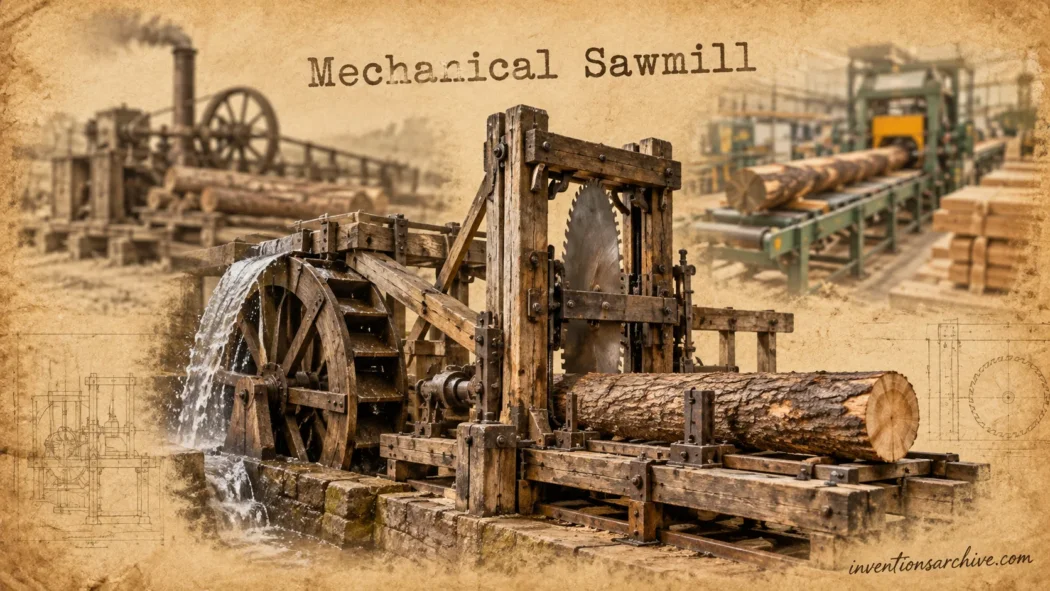
| Invention Name | Mechanical Sawmill |
|---|---|
| Short Definition | A powered cutting system that mechanically moves a saw, and in timber mills often the workpiece, instead of relying on human force for every cutting stroke. |
| Approximate Date or Period | Based on surviving evidence Mechanical stone sawing by the second half of the 3rd century CE; documented medieval timber sawmills from the early 13th century. |
| Geography | Roman Asia Minor for the earliest known mechanical evidence; later medieval and early modern development across Europe. |
| Inventor or Source Culture | No single inventor is known. Roman engineers provide the earliest surviving mechanical evidence; Cornelis Corneliszoon later developed an important wind-powered timber sawmill in the Netherlands. |
| Category | Mechanical engineering, water power, wind power, woodworking, industrial production |
| Importance | Transferred repeated sawing motion from human muscle to external power and supported faster, more controlled processing of stone and timber. |
| Evidence Status | Confirmed evidence, interpreted mechanism Archaeological, pictorial, documentary, and patent evidence survives from different stages of development. |
| Main Problem Solved | Producing repeated cutting motion and controlled material feed without workers supplying every saw stroke by hand. |
| How It Works | A power source drives mechanical transmission that moves a reciprocating or rotating saw while the stone, log, or board is positioned and advanced through the cut. |
| Early Use Context | Water-powered stone cutting in the Roman world; later water-powered timber processing in medieval Europe. |
| Development Path | Manual sawing → powered reciprocating saws → controlled timber feed → wind-powered sawmills → multiple-blade and circular systems → steam and motor-driven mills |
| Surviving Evidence | Hierapolis sarcophagus relief, later stone-sawing workshops, medieval manuscript imagery, historic records, patent material, and preserved sawmill machinery. |
The Mechanical Sawmill Began as a Motion-Conversion Problem
A hand saw already performed the action needed to divide wood or stone: repeated movement of a blade across the material. Mechanizing that task required something different. Waterwheels and windmills naturally produced rotary motion, while the long blades used in early powered sawing usually needed to travel back and forth.
The defining mechanical problem was therefore how to convert continuous rotation into a controlled reciprocating stroke. A crank and connecting rod could make that conversion: the rotating shaft drove an offset connection, and the attached rod translated the rotation into repeated linear movement. Once the same mill could also control the movement of the material being cut, sawing became a machine process rather than simply a powered version of a hand tool.
This distinction matters because the history of the mechanical sawmill does not begin with one inventor or one lumber mill. The surviving record contains an earlier branch of water-powered stone sawing, followed centuries later by clearer evidence for mechanized timber production.
Hierapolis Preserves the Earliest Known Mechanical Evidence
The best-known early evidence comes from Hierapolis in Phrygia, near modern Pamukkale in Türkiye. A relief on the sarcophagus of M. Aurelius Ammianos, dated to the second half of the 3rd century CE, depicts a water-powered machine operating two stone saws. Researchers Tullia Ritti, Klaus Grewe, and Paul Kessener interpreted the arrangement as a twin stone-sawing mill in which the turning waterwheel ultimately produced reciprocating movement at the saw frames.[a]
The relief is especially informative because it records a machine rather than merely mentioning that powered cutting occurred. The represented system includes a large waterwheel, shafting, transmission elements, connecting members, saw frames, and rectangular stone blocks undergoing cutting. Mechanical reconstruction indicates the use of a crank-and-connecting-rod principle to change rotation into the alternating linear motion required by the saws.
Ammianos should not automatically be described as the sole inventor of the mechanical sawmill. His inscription and monument associate him with the machine, and the relief demonstrates that the mechanism was known during his lifetime. It does not preserve the complete history of experimentation that led to it. The careful claim is that Hierapolis provides the earliest currently known evidence for this type of water-powered sawing mechanism, not that one surviving relief identifies the absolute first moment of invention.
Ancient Stone Sawing Worked Differently from Timber Sawing
A modern toothed wood saw cuts because its teeth remove material as the blade passes through the wood. Ancient powered stone sawing could operate on a different principle. The metal blade could be toothless, with water and abrasive material helping wear a narrow path through marble or other stone.
This distinction is visible in later archaeological evidence from Tripolis ad Maeandrum in western Türkiye. A stone-cutting workshop uncovered during the 2022 excavation season was active in the 6th–7th centuries CE. Pamukkale University’s Tripolis excavation project describes a water-powered machine with a wooden wheel about 2.5 meters in diameter. A crank converted the wheel’s circular movement into horizontal reciprocating motion directed to a toothless iron saw.[b]
The excavation project estimates mechanical power at about 1 kW and reports that approximately one square meter of stone could require about 20 hours of cutting. Water and quartz sand were continuously supplied during the operation. The workshop processed marble and travertine, including architectural stone recovered from older Roman public buildings, into smaller paving elements.[b]
The Tripolis find is valuable because it adds workshop context to the earlier Hierapolis image. Instead of a carved representation alone, it documents the setting in which powered stone processing took place: water supply, cutting areas, reused architectural blocks, abrasive material, and finishing activity.
| Feature | Powered Stone Saw | Timber Frame Saw |
|---|---|---|
| Material | Marble, travertine, and other workable stone | Logs, beams, and boards |
| Saw Action | Reciprocating blade associated with abrasive cutting | Reciprocating toothed blade removes wood fibers |
| Cutting Medium | Water and abrasive such as quartz sand could assist cutting | The teeth of the saw perform the cutting |
| Power Conversion | Waterwheel rotation converted into repeated linear motion | Water or wind rotation converted into repeated saw-frame motion |
| Production Goal | Stone slabs and shaped architectural material | Boards, planks, beams, and other lumber |
Timber Milling Added a Second Problem: Moving the Log
Powering the blade solved only half of the timber-sawing problem. A useful lumber mill also had to hold a long, irregular log on a predictable line and advance it through successive cuts.
Manual sawyers could adjust the workpiece by eye and muscle. A mechanized mill needed a carriage or feed system. The log had to remain stable while the blade moved, then advance by a controlled amount so that another portion entered the cutting path. If boards of similar thickness were required, the position of the log also had to be reset in a repeatable way between cuts.
This is why the history of sawmilling is better understood as the development of a powered cutting-and-feed system. The saw provided the stroke; the carriage and feed mechanism converted that stroke into useful production.
Medieval Records Show Mechanical Timber Sawing Re-Emerging Clearly
The evidence becomes clearer for European timber sawmills during the Middle Ages. A Historic American Engineering Record study produced through the National Park Service and Library of Congress cites a clear reference to a sawmill in Normandy in 1204 and identifies the sketchbook of Villard de Honnecourt, around 1235, as the earliest known pictorial representation of a medieval sawmill.[c]
Villard’s drawing is mechanically revealing. The account describes a waterwheel whose axle operated the saw while also contributing to the timber-feed mechanism. The blade was pulled through its working movement and returned for another stroke, while the material could advance through the machine. The drawing therefore records something beyond a waterwheel attached to a saw: it shows an attempt to coordinate cutting motion and workpiece movement.
Medieval timber sawmills did not need to be direct descendants of the Roman stone-sawing installations for the machines to share mechanical ideas. The evidence gap between the ancient and medieval records is too large to prove an uninterrupted transmission line. Similar mechanical requirements can also lead engineers in different periods to related solutions.
The Frame Saw Turned Repeated Strokes into Lumber Production
One of the enduring forms of early lumber machinery was the frame saw, also called a gate saw or sash saw in different historical settings. A long saw blade was held within a moving frame while the log or timber advanced along a carriage.
The arrangement gave the blade guidance that a freely held saw did not have. It also allowed the mill’s power train to deliver regular repeated strokes. Once the feed mechanism was linked to mill motion, the operator no longer had to push the full log continuously by hand.
Several separate mechanical tasks were now working together:
- Power capture: a waterwheel or another prime mover supplied rotary motion.
- Motion conversion: cams, cranks, connecting rods, or related mechanisms turned rotation into the required saw movement.
- Blade guidance: a frame helped keep the cutting path controlled.
- Material feed: the carriage moved the timber through the cutting line at a controlled rate.
- Positioning: the log could be shifted between passes to determine the next board or beam.
The exact mechanical arrangement varied by place and period. What remained constant was the need to coordinate power, blade movement, guidance, and feed.
Water Power Shaped Where Early Timber Mills Could Operate
Water-powered sawmills reduced dependence on human muscle but created a geographical constraint. A mill needed a usable water source and a site where water could be directed through a wheel or related hydraulic installation.
That encouraged the placement of mills where several conditions met: forests or transported logs, suitable streams, workable mill sites, and routes for moving finished lumber. Rivers could serve two roles at once. They supplied mechanical energy and, in many timber regions, helped transport logs or sawn material.
The watermill therefore changed the energy source without making location irrelevant. A mill could process timber faster than teams of hand sawyers, but its machinery had to remain tied to the hydraulic landscape.
Related articles: Watermill [Ancient Inventions Series]
Cornelis Corneliszoon Applied Wind Power to Timber Sawing
A major early modern change came in the Netherlands. Cornelis Corneliszoon of Uitgeest developed a wind-powered timber sawmill near the end of the 16th century. Dutch heritage records document a patent granted by the States of Holland on 15 December 1593 for his wind-driven sawmill.[d]
The achievement is sometimes compressed into the claim that Corneliszoon “invented the sawmill.” That description ignores the much older evidence for powered sawing and the medieval record of water-driven timber mills. His place in the history is narrower and more defensible: he developed and patented an influential method of using wind power for mechanical timber sawing.
Windmill sails produced rotation. Mechanical transmission converted that rotation into the repeated movement of the saw frame, while a feed arrangement advanced the timber. The concept was especially useful in the Dutch environment, where wind power, navigable waterways, imported timber, shipyards, and a large demand for sawn wood existed in close proximity.
Wind power also relaxed one constraint of hydraulic mills. A timber operation no longer required a suitable stream gradient to drive its machinery. It still depended on environmental energy, but the choice of mill location could respond to a different set of conditions.
Multiple Blades Changed Output Without Changing the Basic Principle
A single reciprocating blade divides the material along one cutting line. Mounting several parallel blades in a frame changes the economics of the same stroke: one passage of the log can create several cuts rather than one.
This gang-saw principle became an important route to greater sawmill output. The mill did not necessarily need a radically different prime mover. Instead, more useful cutting work could be extracted from each cycle of the machinery.
Multiple blades also placed higher demands on the rest of the system. The frame had to hold the blades in controlled positions, the log had to travel steadily, and the power train had to handle the combined cutting resistance. The sawmill was becoming an integrated machine in which production depended on coordination rather than blade speed alone.
The Circular Saw Removed the Return Stroke
Reciprocating saws repeatedly reverse direction. A circular saw uses another motion architecture: the shaft rotates and the blade rotates with it. Cutting teeth repeatedly enter the work without requiring the entire blade to stop, reverse, and return to its starting position.
This made the circular saw well suited to powered machinery, but its invention history is less tidy than many popular accounts suggest. Tabitha Babbitt, a member of the Shaker community in Massachusetts, is often credited with devising a circular saw for sawmill use between about 1810 and 1813. The Mills Archive Trust notes that this attribution has been strongly challenged and that earlier circular-saw evidence existed, including Samuel Miller’s British patent of 1777, where such a saw appears in connection with a sawmill.[e]
Babbitt is therefore better described as traditionally associated with an early American circular saw for mill use rather than as the uncontested inventor of the circular saw itself.
The mechanical change is clearer than the attribution. Earlier reciprocating mills had to transform rotary power into back-and-forth blade movement. A circular saw could use rotary shaft motion directly. That simplified the motion path between prime mover and cutting edge, although practical circular sawing introduced its own engineering requirements for blade support, material feed, and power transmission.
Steam Power Changed the Geography of the Mill Again
Water and wind supplied energy without fuel, but both linked production to local environmental conditions. Steam engines altered that relationship. A steam-powered sawmill could operate where waterwheel power or dependable wind was unavailable, provided fuel, water, timber, labor, and transport could be supplied.
During the industrial period, this made it easier to combine sawing with larger material-handling systems and other woodworking machinery. Rotary engine power could drive shafts, belts, circular saws, frame saws, conveyors, and auxiliary equipment from a common power system.
The prime mover had changed, but the sawmill’s deeper mechanical problem remained familiar: move the cutting element predictably, control the workpiece, and coordinate both motions through repeated production cycles.
From Powered Blade to Integrated Mill
The mature sawmill became more than a mechanism for moving a blade. Logs had to be handled before the first cut, positioned for breakdown, moved between machines, edged, trimmed, sorted, and prepared for later processing. Mechanical handling gradually joined mechanical cutting as part of the production system.
Later mills adopted combinations of circular saws, band saws, gang saws, powered carriages, rollers, conveyors, hydraulic positioning, electric motors, electronic measurement, and computerized optimization. The exact equipment differs according to log size, species, intended products, mill scale, and production method.
The long development can be summarized without assigning the entire invention to one moment or person:
| Stage | Documented Form | What Changed |
|---|---|---|
| Manual Sawing | Hand saws, two-person saws, splitting and hewing | Workers supplied both cutting force and material control. |
| Roman Mechanical Stone Sawing | Water-powered reciprocating stone saws | Rotary waterwheel motion was converted into repeated mechanical saw movement. |
| Medieval Timber Sawmill | Water-powered saw with timber feed | Powered cutting and controlled log movement were combined for lumber production. |
| Early Modern Wind Sawmill | Corneliszoon’s wind-powered timber mill | Wind rotation powered reciprocating timber-sawing machinery in the Dutch milling environment. |
| Multiple-Blade Milling | Gang or multi-blade frame saw | Several cuts could be produced during the same passage of timber. |
| Rotary Cutting | Circular saw machinery | The cutting blade itself rotated continuously instead of reversing direction after every stroke. |
| Industrial Power | Steam-powered and later motor-driven mills | Mill placement became less dependent on suitable waterwheel or windmill conditions. |
| Integrated Sawmilling | Powered handling, band and circular saws, conveyors, scanners, automated positioning | Cutting became one stage in a coordinated material-processing system. |
What the Evidence Allows Historians to Claim
The phrase “mechanical sawmill” covers machines that belong to different materials, periods, and engineering traditions. Keeping those categories separate prevents several common attribution errors.
Hierapolis is evidence for early mechanical sawing, not proof of the first lumber mill. Its saws worked stone. The relief nevertheless shows that water power and reciprocating sawing had been combined by the later 3rd century CE.
The medieval timber-sawmill record should not automatically be presented as an uninterrupted continuation of Roman technology. Medieval documents and drawings show that powered timber sawing was established again in Europe, but surviving evidence does not provide a complete transmission history between every ancient and medieval stage.
Cornelis Corneliszoon did not originate mechanical sawing as a whole. His documented contribution belongs to the adaptation and development of wind-powered timber sawmilling in the late 16th-century Netherlands.
The circular saw also resists a one-name origin story. Babbitt’s place in American sawmill tradition is well known, but earlier records prevent a secure claim that she created the circular saw from nothing.
The mechanical sawmill is therefore best understood as a sequence of inventions within one production problem. Engineers learned to capture external energy, change one type of motion into another, guide a cutting element, feed heavy material at a controlled rate, multiply the number of cuts, and eventually coordinate the entire movement of material through a mill. The enduring invention was the conversion of sawing from repeated human motion into a controlled mechanical process.
Sources and Verification
- [a] A relief of a water-powered stone saw mill on a sarcophagus at Hierapolis and its implications — Verifies the Hierapolis sarcophagus relief, its Roman dating, the twin stone-saw interpretation, and the crank-and-connecting-rod reconstruction. Published in the Journal of Roman Archaeology by Cambridge University Press.
- [b] STONE CUTTING WORKSHOP — Documents the excavated Tripolis workshop, its 6th–7th-century use, waterwheel, crank mechanism, toothless iron saw, estimated power, quartz-sand abrasive, and stone-cutting context. Published by Pamukkale University’s Tripolis excavation project.
- [c] SILAS C. READ SAWMILL — Historic American Engineering Record documentation used to verify the medieval sawmill record, the 1204 Normandy reference, Villard de Honnecourt’s circa-1235 representation, and the combined saw-and-feed mechanism. Preserved by the Library of Congress and prepared through the National Park Service’s engineering-record program.
- [d] Boer ontwerpt houtzaagmolen — Documents Cornelis Corneliszoon’s wind-powered timber sawmill, the conversion of windmill rotation into saw movement, and the patent granted by the States of Holland on 15 December 1593. The page forms part of a Dutch collection-based cultural heritage archive.
- [e] Tabitha Babbitt (1779-1853) — Used to verify the traditional Babbitt attribution, the dispute surrounding that claim, and the existence of earlier circular-saw evidence associated with Samuel Miller’s 1777 British patent. Published by The Mills Archive Trust, an archive devoted to milling history and records.