
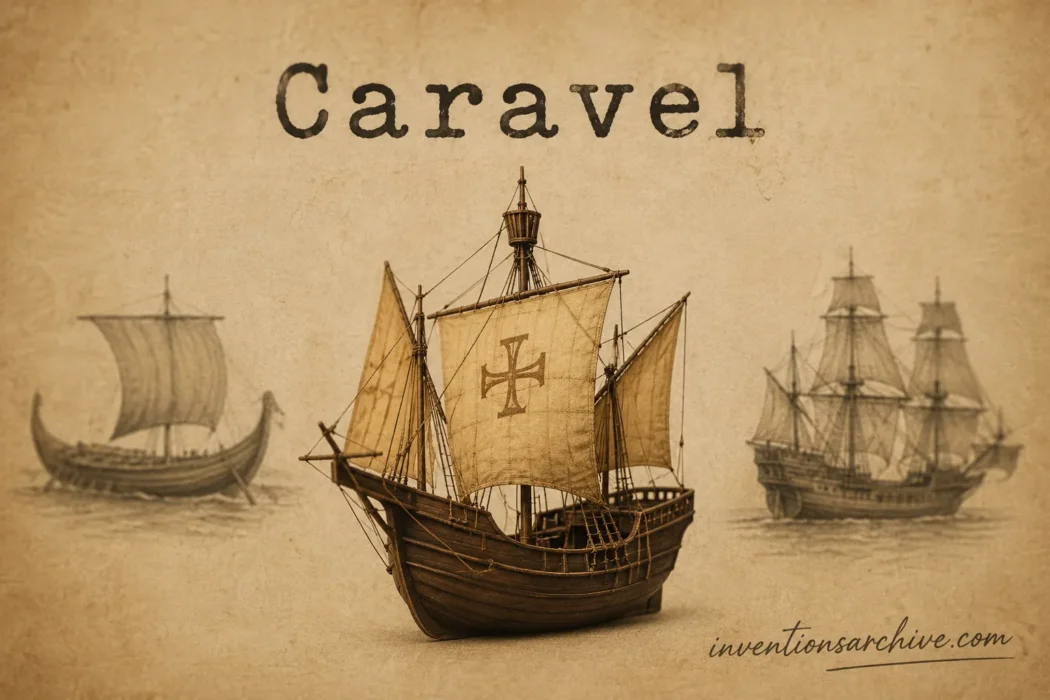
| Invention Name | Caravel |
|---|---|
| Short Definition | A small to medium Iberian sailing vessel valued for speed, shallow draught, maneuverability, and adaptable rigging. |
| Approximate Date or Period | Mid-fifteenth century references; development continued through the sixteenth century. |
| Geography | Portugal and Spain, with early use along the Atlantic coast of Africa and later service across the Atlantic and Indian Ocean routes. |
| Inventor or Source Culture | No single inventor confirmed Iberian shipwrights and mariners working within Atlantic and Mediterranean traditions. |
| Category | Sailing ship, maritime transport, exploration technology, and naval support vessel. |
| Importance | Combined coastal access, windward sailing, and flexible rigging in a vessel suited to reconnaissance and route finding. |
| Evidence Status | Based on written, visual, model, and archaeological evidence |
| Main Problem Solved | Exploring unfamiliar coasts and returning through difficult wind conditions without relying on a large cargo ship. |
| Development Path | Small coastal craft → lateen-rigged exploration caravel → mixed-rigged and larger armed forms → specialist scout and support roles. |
| Technical Basis | Shallow hull, sternpost rudder, one sterncastle, and either lateen sails or a combination of square and lateen sails. |
| Main Forms | Caravela latina and mixed-rigged forms often described as caravela redonda. |
| Early Use Context | Coastal survey, fishing and trade traditions, reconnaissance, dispatch carrying, and support for longer voyages. |
| Modern Descendants | No direct modern ship class; its functions continued in survey vessels, cutters, tenders, scouts, and other specialist craft. |
The Coastal Problem Behind the Caravel
Early Atlantic exploration demanded a different balance from ordinary bulk transport. A vessel had to approach an unfamiliar shore, turn within limited sea room, examine river mouths, search for anchorages, carry messages, and withdraw when currents or winds became unsafe. Large merchant ships could carry more provisions and cargo, yet their size and draught made close coastal work harder.
The return journey created another problem. Sailing southward beside the West African coast did not guarantee an easy passage home. Wind direction, coastal currents, seasonal weather, and the shape of the shoreline could make a direct reversal slow or impossible. A useful exploration vessel therefore needed to work across the wind, change tack, and survive voyages that moved between sheltered coastal water and open sea.
| Earlier or Less Suitable Arrangement | Caravel-Based Arrangement |
|---|---|
| Small square-rigged barques were useful with a following wind but less capable when a route required close-hauled sailing. | Lateen-rigged caravels could work toward the wind by sailing a series of angled courses. |
| A large cargo vessel carried supplies well but required more depth and room to maneuver near an unknown coast. | A shallower vessel could inspect bays, islands, and river approaches before larger ships entered. |
| One ship had to combine transport, navigation, reconnaissance, and contact with shore. | Mixed fleets could assign scouting and dispatch work to caravels while larger vessels carried the main stores and cargo. |
| Fixed rigging favored a narrower range of wind conditions. | Caravels could be built or refitted with lateen, square, or mixed sail plans according to the expected route. |
How the Hull and Rig Worked as One System
A caravel’s reputation did not come from a triangular sail in isolation. The hull, rudder, mast arrangement, sail shape, ballast, and crew had to work together. Alter one part and the sailing behavior changed.
A Hull Suited to Reconnaissance
Caravels were generally smaller and lower than the large naus used for heavy transport. Their relatively shallow draught allowed closer access to coastlines and anchorages. A lower profile reduced the amount of high structure exposed to the wind, while a sterncastle provided working and command space without turning the vessel into a high-sided carrier.
Shallow draught did not mean that every caravel could enter any creek or survive any reef. Coastal access remained dependent on local depth, tide, swell, ballast, loading, and the judgment of the pilot. The same compact hull that helped reconnaissance also restricted storage, living space, water, and provisions.
Lateen Sails and Windward Progress
A lateen sail is set on a long angled yard. Its shape and position allow the sail to generate useful force while the vessel points partly toward the direction from which the wind is blowing. The ship cannot sail straight into the wind. It advances by alternating between one angled course and another, a process called tacking.
The Portuguese Maritime Museum dates the first references to the lateen caravel to the middle of the fifteenth century and describes two- or three-masted vessels with triangular sails capable of sailing close to the wind. The museum places this change against the limits of earlier single-masted craft with fixed square sails during movement along the African coast.[b]
Windward progress depended on resistance below the water as well as force in the sail. The hull had to limit sideways drift, the rudder had to hold the chosen heading, and the crew had to trim the sail correctly. A poorly balanced vessel could lose speed, slide to leeward, or fail to complete a turn.
The Cost of Handling Long Lateen Yards
Lateen rigging gave the vessel useful control near a coast, but it imposed work on the crew. During some maneuvers, the long yard and sail had to be shifted in relation to the mast. Strong wind made this harder and raised the risk of damaged gear, lost control, or an incomplete turn. Rig choice was therefore a trade between windward ability, course stability, crew effort, and expected weather.
From Coastal Craft to an Adaptable Ship Family
The word caravel did not identify one universal set of measurements. Surviving references describe vessels with different tonnages, mast counts, sail plans, and duties. A fishing or coastal trading craft, an exploration caravel, and a later armed fleet vessel could share the name while differing in scale and arrangement.
| Stage | Form | What Changed |
|---|---|---|
| Coastal Background | Small Iberian fishing, trading, and service craft | Provided local knowledge of light hulls, coastal handling, rigging, and construction practice. |
| Fifteenth-Century Exploration | Two- or three-masted lateen caravel | Combined coastal access with better performance when the route required sailing toward the wind. |
| Mixed-Rigged Form | Square sails forward and lateen sails farther aft | Improved performance with following winds while retaining steering and sail-control options associated with lateen rigging. |
| Larger Fleet Caravel | Three- or four-masted cargo, escort, or armed vessel | Added carrying capacity and military utility, though the vessel moved closer to roles also served by larger ship types. |
| Specialist Continuation | Scout, dispatch, patrol, and support vessel | Caravels remained useful after larger ocean carriers became the main ships of long-distance imperial trade. |
Caravela Latina and Mixed-Rigged Caravels
The two best-known configurations reflect different sailing needs. Their names should not be treated as factory model labels. Period vocabulary varied, and vessels could be altered during their working lives.
| Feature | Caravela Latina | Mixed-Rigged or Caravela Redonda |
|---|---|---|
| Typical Sail Plan | Lateen sails on the main masts | Square sails on the forward mast or masts, with lateen sails aft |
| Best-Suited Work | Coastal survey, maneuvering, and routes that demanded close-hauled sailing | Longer open-water passages, fleet service, and routes with extended following or quartering winds |
| Handling | Required skilled management of long yards during turns | Offered a different balance of course stability, crew effort, and windward performance |
| Scale | Often associated with smaller exploration vessels | Included larger three- and four-masted examples |
| Main Limitation | Demanding maneuvers and restricted cargo space | Could surrender some of the close-wind behavior associated with a fully lateen rig |
A Royal Museums Greenwich model represents a larger Portuguese caravel of about 1490 with four masts, square sails on the foremast, a spritsail over the bow, and lateen sails farther aft. The model is a later reconstruction rather than a surviving fifteenth-century ship, yet it illustrates how far the term could extend beyond the familiar image of a small vessel with two or three triangular sails.[d]
Why Rigging Could Change During a Voyage
A sail plan was a route decision. Lateen sails helped when a vessel needed to work close to the wind or maneuver around a coast. Square sails performed well when wind came from behind or over the quarter, and they could provide steadier behavior on a long ocean course.
Spanish naval historical research describes the Pinta as a square-rigged caravel and the smaller Niña as initially lateen-rigged. During the 1492 expedition, the Niña was converted to square rig in the Canary Islands. The change involved more than replacing triangular cloth with rectangular sails; mast position, angle, and deck openings could also require alteration. The source also distinguishes the two caravels from the larger cargo nao Santa María.[c]
This example shows why a caravel should be understood as an adaptable platform. A captain and shipwright could favor coastal maneuvering for one phase and downwind ocean performance for another. Such conversion required labor, materials, and knowledge. It was not a casual adjustment made by exchanging one sail in a few minutes.
Caravel and Nau Served Different Fleet Tasks
The caravel is often presented as the universal ship of early Atlantic voyages. In practice, fleets benefited from combining vessels with different strengths. A nau or carrack offered deeper holds, more provisions, heavier cargo capacity, and space for a larger crew. A caravel offered faster reconnaissance, shallower access, and easier communication between ships and shore.
| Design Priority | Caravel | Nau or Carrack |
|---|---|---|
| Primary Strength | Reconnaissance, maneuverability, and adaptable rigging | Cargo, provisions, endurance, and heavy transport |
| Coastal Access | Generally better suited to shallow or uncertain approaches | Required more depth and room, especially when heavily loaded |
| Living and Storage Space | Restricted | Greater hold volume and accommodation |
| Fleet Function | Scout, messenger, escort, patrol, and survey ship | Main carrier, supply ship, flagship, or long-distance merchant vessel |
| Historical Example | Niña and Pinta | Santa María |
The distinction also explains why larger carriers did not make the caravel immediately obsolete. A fleet still needed vessels that could test an entrance, carry orders, pursue another ship, inspect a coastline, or reach a location where a heavily loaded carrier faced greater risk.
Navigation Knowledge Was Part of the Technology
No hull could solve Atlantic navigation by itself. Caravels operated within a system of pilots, sounding leads, compasses, celestial observation, written sailing knowledge, remembered landmarks, current patterns, and seasonal winds.
Close to land, crews watched water depth and bottom type, compared visible headlands with prior descriptions, and searched for safe holding ground. Offshore, they estimated direction and distance, observed latitude when conditions allowed, and adjusted the route around broad wind systems. The Portuguese practice later called volta do mar used open-ocean arcs to find favorable winds rather than forcing a direct return beside the coast.
The caravel supported this route strategy because it could change course readily and operate with a smaller crew and cargo than a large carrier. Yet wind knowledge, pilot experience, and provisioning set the real limits. A maneuverable ship sent onto a poorly understood route could still be lost through reef contact, storm damage, navigation error, structural failure, or lack of water.
Life and Work Aboard a Small Exploration Vessel
Compact dimensions affected every task. Fresh water, food, spare rope, sailcloth, tools, ballast, weapons, trade goods, and personal belongings competed for limited space. The crew worked, ate, rested, repaired gear, and handled boats on decks that could become crowded during poor weather.
Tacking demanded coordination. Sail handlers managed sheets and yards while the helmsman brought the bow through the wind. Other crew members watched depth, maintained pumps, checked rigging, shifted small items, or prepared anchors. A failed maneuver near a lee shore could leave little time for recovery.
Small crews reduced the quantity of provisions consumed each day, but they created vulnerability. Illness, injury, fatigue, or the loss of experienced hands could weaken the vessel’s ability to reef sails, repair damage, navigate, and maintain watches. The caravel’s efficiency depended on practiced labor rather than mechanical simplicity.
Trade, Armed Service, and Atlantic Expansion
Caravels carried out peaceful and coercive assignments. They surveyed coastlines, transported messages, moved goods, supported fishing and trade, and served as escorts. Some carried light artillery and armed parties. Their speed and access to coastal waters also made them useful in raiding, forced seizure, and the early maritime traffic in enslaved people.
As routes became repeatable, caravels helped connect reconnaissance with permanent commercial and military networks. Larger vessels later moved most bulk cargo, settlers, provisions, and valuable commodities. The smaller ships continued to patrol, scout, communicate, and support shore operations.
The vessel therefore belongs to both engineering history and the history of European expansion. Its design widened the range of coastlines that an organized fleet could examine and revisit. The results included improved charts and route knowledge, as well as conquest, colonial occupation, armed commerce, and forced movement of people.
What Shipwrecks Reveal About the Caravel
No complete fifteenth-century caravel survives. Wooden hulls were repaired, rebuilt, broken up, burned, salvaged, or destroyed by marine organisms. Shallow wrecks were especially exposed to storms, reef action, treasure hunting, and the removal of anchors, guns, fasteners, and ballast.
The Highbourne Cay wreck in the Bahamas shows both the value and the limits of underwater evidence. The site was found in 1965 and heavily salvaged before controlled archaeological work. Later investigation recorded remains including the keel, keelson, garboard planks, hull strakes, floor timbers, internal planking, and a reinforced mast step. Ceramics and comparisons with the Molasses Reef wreck support an early sixteenth-century date, but the ship’s identity and exact type remain uncertain.[f]
A 2025 Texas A&M study returned to the Highbourne Cay material to assess past work, the present state of the evidence, and directions for future study. Its existence matters because caravel research is still being refined through renewed documentation and comparison. A wreck that resembles a small Iberian exploration vessel is not automatically a securely identified caravel.[g]
Why Reconstructions Look Different
Museum models and full-scale replicas translate incomplete evidence into a visible ship. Researchers compare period paintings, engravings, written descriptions, account records, shipbuilding texts, archaeological remains, and later traditional craft. Gaps have to be filled by reasoned choices.
The Spanish Navy’s Maritime Digital Library explains that historical ship models are reconstructions based on two-dimensional representations, construction treatises, written descriptions, plans, engravings, reliefs, paintings, and underwater archaeology. Its collections distinguish models of the caravel Niña, the caravel Pinta, and the nao Santa María.[e]
A reconstruction is therefore an evidence-based proposal, not a preserved original. Two responsible models may differ in hull fullness, stern shape, mast position, deck arrangement, or rigging because the source record does not resolve every detail. Replicas may also include modern safety equipment, hidden engines, altered materials, or strengthened structures that separate them further from a fifteenth-century working vessel.
What the Popular Caravel Story Leaves Out
It Was Not the Work of One Named Inventor
The available record supports gradual development among shipwrights and mariners. Patronage and voyage planning influenced demand, but they are not proof of personal invention.
It Was Not One Fixed Three-Sail Design
Two-, three-, and four-masted examples appear in the historical and reconstructed record. Some were fully lateen-rigged. Others combined square and lateen sails.
It Did Not Sail Directly Into the Wind
A caravel made progress toward the wind by sailing at an angle and tacking. Sideways drift, sea state, hull balance, sail trim, and crew skill affected the result.
It Was Not a Better Cargo Ship Than a Nau
The caravel traded storage and accommodation for access and maneuverability. Heavy transport remained the work of larger vessels.
The Three Ships of 1492 Were Not All the Same Type
Niña and Pinta were caravels. Santa María was a larger nao. Their combination demonstrates division of labor within a fleet.
A Replica Is Not a Surviving Blueprint Made Full-Size
Every reconstruction includes inference. The most reliable examples state which features come from records or archaeology and which were chosen to complete missing parts.
Why the Caravel’s Main Role Declined
Long-distance routes soon demanded more cargo, water, replacement gear, passengers, troops, and artillery. Larger naus, carracks, and later galleons offered the hold volume and deck strength required by regular oceanic trade and organized naval power.
The caravel did not disappear at once. Its assignments narrowed. It remained useful where speed, scouting, dispatch carrying, patrol, escort, or shallow access mattered more than bulk capacity. This transition followed a recurring pattern in transport history: a versatile exploratory design opens routes, then specialist carriers take over the heaviest traffic.
Technologies That Extended the Caravel’s Role
Sources and Verification
- [a] The History and Development of Caravels — Used to verify the gradual development, documented date range, hull profile, rigging families, and sailing characteristics of the caravel. (Reliable because it is a Texas A&M University graduate research record in nautical archaeology.)
- [b] Lateen Caravel — Used to verify the mid-fifteenth-century references, two- or three-masted lateen arrangement, and close-wind purpose described by Portugal’s Maritime Museum. (Reliable because it is a direct collection page maintained by the Portuguese Navy’s cultural directorate.)
- [c] Colón Como Navegante — Used to verify the rigging distinctions among Pinta, Niña, and Santa María, along with the described conversion of Niña from lateen to square rig. (Reliable because it is a historical study published through the Spanish Navy’s official maritime archive.)
- [d] Portuguese Caravel — Used to verify the details of a museum model representing a larger four-masted caravel with combined square and lateen rigging. (Reliable because it is a direct Royal Museums Greenwich collection record.)
- [e] Reconstrucciones Históricas — Used to verify the evidence types behind historical ship reconstructions and the Spanish Naval Museum’s separate classifications of the caravels and the nao Santa María. (Reliable because it is an official Spanish Navy museum and digital library page.)
- [f] Highborne Cay Iberian Shipwreck Survey — Used to verify the wreck’s excavation history, surviving hull structures, early sixteenth-century evidence, and uncertain identification. (Reliable because it is the direct project record of the Institute of Nautical Archaeology.)
- [g] The Highbourne Cay Shipwreck: Past, Present, and Future — Used to verify the 2025 reassessment of the Highbourne Cay wreck and the continuing research context around early Iberian ship identification. (Reliable because it is a Texas A&M University nautical archaeology research record.)