
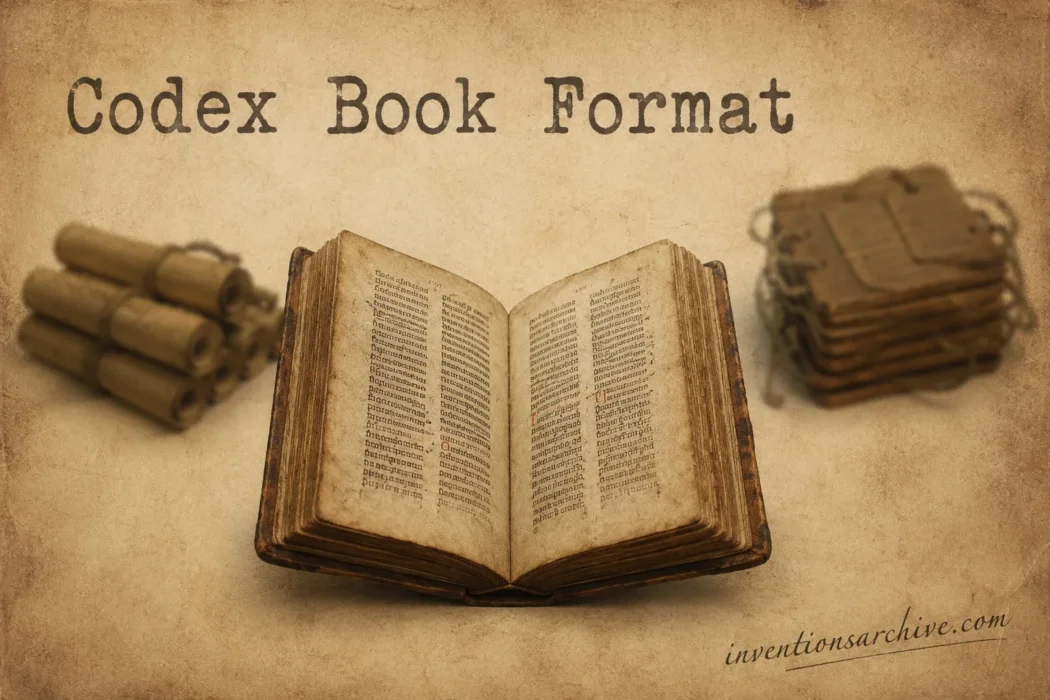
| Invention Name | Codex Book Format |
|---|---|
| Short Definition | A book made from separate leaves or folded sheets gathered and bound along one edge, allowing pages to be turned individually. |
| Approximate Date or Period | Late 1st to early 2nd century CE for the earliest surviving Latin example; wider adoption during the 2nd–4th centuries. Approximate |
| Geography | Roman Mediterranean, with major surviving evidence from Egypt and later production across Europe, North Africa, and West Asia. |
| Inventor or Source Culture | Anonymous and collective; associated with Roman-era scribes, stationers, readers, and book makers rather than one named inventor. |
| Category | Communication, education, recordkeeping, literature, and book production. |
| Evidence Status | Based on surviving evidence Attribution varies |
| Main Problem Solved | Made long texts easier to open, navigate, compare, protect, annotate, and carry than a continuous roll. |
| How It Works | Sheets are folded into bifolia, grouped into one or more quires, joined at the fold, and protected by outer covers. |
| Material and Technical Basis | Papyrus, parchment, paper, bark in some traditions, ink, thread or cords, and covers made from materials such as wood, leather, cloth, or layered papyrus. The presence of folded and joined gatherings is a defining feature in many scholarly descriptions.[a] |
| Earlier Forms | Wax-tablet sets, parchment notebooks, papyrus rolls, and parchment rolls. |
| Early Written Reference | The Roman poet Martial referred to literary works in a compact parchment book form near the end of the 1st century CE. Textual evidence |
| Earliest Surviving Latin Evidence | Papyrus 745, also known as P. Oxy. I 30, dated by handwriting to the late 1st or early 2nd century CE; its exact date and original dimensions remain uncertain.[b] |
| Development Path | Joined writing tablets and parchment notebooks → early single-quire codices → multi-quire manuscript books → printed bound books. |
| Early Uses | Literary texts, notebooks, travel copies, religious writings, study texts, and records. |
| Main Variations | Single-quire papyrus codex, multi-quire parchment codex, pocket codex, large-format manuscript, paper codex, and printed codex-form book. |
| Surviving Evidence | Fragments, complete and partial manuscript books, sewing traces, gutters, covers, page numbers, corrections, ownership notes, and palaeographic dating. |
| Why It Matters |
|
| Modern Descendants | Hardcover books, paperbacks, notebooks, printed reference works, bound ledgers, and page-based digital interfaces that imitate codex navigation. |
| Related Inventions | Wax tablet, papyrus scroll, parchment, paper, sewn binding, woodblock printing, movable type, and the printing press. |
What the Codex Book Format Is
A codex is the physical ancestor of the familiar bound book. Instead of one long writing surface that must be rolled and unrolled, it presents text on a sequence of leaves attached at one side. A reader can open the volume near the desired passage, turn backward or forward, and keep a selected opening visible.
The parts of a codex have their own vocabulary. A leaf has two written surfaces, usually called recto and verso. A sheet folded once creates a bifolium, or two joined leaves. Several bifolia nested together form a quire or gathering. One or more gatherings make the text block, which may be joined to protective covers.
The word is now often reserved for handwritten books from antiquity and the medieval period, even though most present-day bound books retain the same page-and-spine form. The academic study of a manuscript as a physical object—including its gatherings, materials, ruling, sewing, alterations, and binding—is called codicology.
How Its Origin Is Traced
No patent, workshop account, or ancient statement records the first codex. Historians instead follow a chain of related objects. Roman writing tablets could be hinged or tied into sets. Parchment notebooks offered flexible leaves. Early codices then arranged papyrus or parchment sheets into folded gatherings sewn at the fold.
A standard history of Latin manuscript production identifies wax-tablet diptychs and parchment notebooks as close predecessors. It also notes that Martial is the first surviving writer to mention a parchment codex used for a literary work, while the normal codex structure consisted of folded sheets sewn into gatherings.[c]
This development was probably gradual. Craftspeople did not need to abandon rolls before experimenting with leaf books. Rolls, tablets, notebooks, and codices coexisted for centuries, each serving different reading, writing, ceremonial, and administrative needs.
Why the Earliest Date Remains Approximate
Papyrus 745 from Oxyrhynchus is especially informative because the same Latin text appears in the correct orientation on both sides of a parchment leaf. That arrangement shows that it belonged to a codex rather than a reused roll. Yet only a small fragment survives, so its full page size, gathering structure, binding, and place of production cannot be recovered with certainty.
The fragment is generally assigned to the late 1st or early 2nd century CE through handwriting analysis. This fits near-contemporary references to portable parchment books, but it does not prove that the codex began at that moment. Earlier forms may have disappeared without leaving recoverable evidence.
The Problem It Answered
The scroll was an effective book form for a very long time. It could hold extended texts, travel between readers, and be copied in columns. Its limitations appeared most clearly when a reader needed repeated access to separated passages.
Finding a distant section meant rolling through the text. Comparing two passages within the same work was awkward. A long roll occupied both hands and could expose a wide area to wear. Writing normally followed one principal side, while a codex made regular use of both sides of its leaves.
The codex changed these actions rather than merely changing appearance. It allowed non-sequential access, easier return to an earlier page, a stable opening for study or public reading, and more text within a compact object. Covers also protected the outer leaves and edges.
How the Format Worked
The simplest codex could consist of a single gathering. A stack of sheets was folded through the center, producing a group of leaves joined at one fold. Text was copied before or after assembly, depending on the workshop and period. Holes or sewing stations along the fold allowed thread or cord to hold the gathering together.
Larger books worked better when divided into several gatherings. This reduced the swelling and distortion created by placing too many sheets inside one fold. Separate quires could be copied, checked, reordered, repaired, or replaced before they were joined into a larger volume.
The form also introduced a new physical reading zone: the gutter. Text had to be planned around the inner fold so letters would not disappear into the binding. Outer, upper, and lower margins offered space for notes, corrections, reference marks, decorative initials, or later additions.
Leaves, Openings, and Sequence
A codex is experienced through openings rather than isolated sheets. When open, a left-hand page and right-hand page appear together. Scribes and readers could therefore arrange paired text, parallel passages, commentary around a central text, or visual elements that occupied both pages.
Numbering systems evolved over time. Some manuscripts numbered leaves rather than pages. Others used quire signatures, catchwords, or short guide marks to help binders preserve the correct sequence. These devices show that the codex was not only a container for writing; it was a system for controlling order.
Materials and Book Structure
Early codices were made from both papyrus and parchment. The rise of the codex and the shift toward parchment overlapped, but they were not the same change. A papyrus sheet could be folded and bound, while parchment could also be made into a roll.
Papyrus was formed from layered strips of plant material. Its directional fibres affected folding, writing, and durability. Parchment was prepared animal skin. It could be written on both sides, scraped or corrected, and folded into durable gatherings. Paper later became a major writing support for manuscript and printed codices.
Covers ranged from simple wrappers to boards covered with leather or cloth. Some early bindings used layered papyrus boards. Later traditions added wooden boards, leather sewing supports, clasps, straps, bosses, decorated covers, or protective cases. These features varied by place, period, function, cost, and available materials.
| Stage | Form | What Changed |
|---|---|---|
| Earlier Tool | Single or joined wax tablets | Rigid writing surfaces could be grouped, opened, closed, erased, and reused. |
| Intermediate Form | Parchment notebook | Flexible leaves made a lighter, more portable multi-page object. |
| Early Codex | Single-quire papyrus or parchment book | Folded sheets created leaves that could carry text on both sides. |
| Improved Form | Multi-quire manuscript codex | Several gatherings allowed longer texts, easier assembly, repair, and stronger bindings. |
| Later Form | Paper manuscript and printed codex | Lower-cost writing support and mechanical reproduction expanded book production while retaining the bound-page form. |
| Modern Descendant | Hardcover, paperback, notebook, and bound reference work | The spine, page sequence, opening, margins, and cover remain familiar. |
Early Uses and Adoption
Early codices held many kinds of writing. Surviving examples include literary works, school texts, notes, religious writings, and records. Small parchment books were suited to travel, while larger volumes could gather texts that would otherwise occupy several rolls.
Early Christian communities showed a marked preference for the codex, but they did not invent the form. One surviving example, the papyrus manuscript known as P46, originally contained about 104 leaves of Pauline letters. The remaining leaves preserve page sequence, reading marks, binding wear, corrections, and evidence of repeated handling.[d]
Several explanations have been proposed for Christian adoption: multiple related texts could be collected together; passages were easier to locate during study or communal reading; the format was compact; and a codex could distinguish a new collection from established roll traditions. No single explanation accounts for every early book.
How the Codex Spread and Changed
The shift from roll to codex took centuries. In some settings, rolls retained ceremonial, legal, or religious value even after codices became normal for many literary and study texts. The change was therefore uneven across languages, communities, regions, and types of writing.
Princeton University Library describes the practical gains clearly: codices could use both sides of a sheet, provide easier access to desired passages, avoid repeated unrolling, and protect contents with covers. Its third-century Greek Ezekiel manuscript also preserves page numbers and the remains of an early papyrus codex form.[e]
By late antiquity and the medieval period, the multi-quire codex supported large scriptural collections, legal compilations, medical texts, scientific works, schoolbooks, literary anthologies, and administrative registers. Pages developed structured margins, headings, initials, reference systems, commentary zones, and visual navigation.
Egyptian and Coptic Book Production
Egypt provides unusually rich evidence because its dry climate preserved papyrus, parchment, bindings, and fragments that would have decayed elsewhere. Coptic manuscripts show how codex construction developed through sewn gatherings, layered boards, leather covers, wrapping bands, and local workshop practices.
The Morgan Library & Museum holds Coptic manuscript books, covers, binding fragments, and scribal tools, including examples from the 5th century and a large group connected with the Monastery of St. Michael in the Fayum. These objects preserve the codex as a material structure, not merely as a carrier of text.[f]
Large-Scale Manuscript Books
The codex could grow from a pocket-sized object into a large multi-text volume. Codex Sinaiticus, generally dated by handwriting to the middle of the 4th century, demonstrates the scale that parchment codex production could reach. Earlier Christian manuscripts survive, but they usually preserve smaller portions rather than a nearly complete Bible.[g]
Such volumes required planned gatherings, division of scribal labor, correction, sequence control, and durable assembly. They also show that the codex could carry a library-like collection within one physical object.
From Manuscript to Print
Mechanical printing transformed how text was reproduced, yet it retained the codex shape. Printed sheets were arranged, folded into gatherings, sewn or otherwise bound, trimmed, and covered. Readers continued to use openings, margins, page sequences, headings, indexes, and tables.
This continuity matters. The printing press changed copying speed and scale, but the interface of the book remained recognizable. Even many digital reading systems imitate the codex through page turns, bookmarks, facing pages, and numbered locations.
Main Forms and Variations
| Form | Typical Structure | Common Use or Advantage |
|---|---|---|
| Single-Quire Papyrus Codex | Many papyrus sheets stacked and folded together once | Simple assembly for a self-contained work; very thick examples could strain the inner and outer leaves. |
| Single-Quire Parchment Codex | Folded parchment sheets forming one gathering | Portable notebooks, school texts, and short works; durable but limited in comfortable thickness. |
| Multi-Quire Parchment Codex | Several gatherings sewn into one text block | Long works and collected texts; easier to assemble, inspect, repair, and bind. |
| Pocket Codex | Small leaves, compact writing, light covers | Travel, private reading, memorization, and personal reference. |
| Large-Format Codex | Large parchment leaves, multiple columns, substantial gatherings | Public reading, institutional use, collected works, display, and long texts. |
| Paper Manuscript Codex | Paper gatherings with sewn binding and protective covers | Expanded manuscript production where paper became available and economical. |
| Printed Codex | Mechanically printed sheets folded, gathered, and bound | Reproducible editions using the inherited page, gathering, spine, and cover system. |
What Changed Before and After
| Before the Codex | What Changed With the Codex |
|---|---|
| Long literary texts were commonly stored on rolls. | Texts could be divided among leaves and gathered into a compact volume. |
| Finding a distant passage required rolling through intervening text. | A reader could open near a target section and move in either direction. |
| Comparison of separated passages was physically awkward. | Pages, bookmarks, reference marks, and later indexes supported repeated comparison. |
| The principal writing sequence usually occupied one side of a roll. | Recto and verso were regularly used as consecutive pages. |
| A roll had to be held and managed while open. | A bound volume could rest open on a surface for copying, reading, or annotation. |
| Outer sections and exposed edges could suffer handling wear. | Covers and boards offered added protection to the text block. |
| Several related works often required several separate rolls. | Multiple works could be collected in one volume and placed in a chosen sequence. |
| Text layout followed the continuous movement of a roll. | The opening became a designed unit with margins, columns, headings, notes, and visual relationships. |
What Changed in Reading and Knowledge Work
The codex did not simply make books smaller. It altered how a reader could work with text. A passage could be marked, revisited, corrected, cross-referenced, or compared with another page. A teacher could point to a fixed opening. A scribe could copy while keeping the source open. A reader could add notes without repeatedly rerolling the object.
Long collections also became easier to organize. Separate works could be arranged in one sequence, supplied with titles, divided into sections, and linked through tables or indexes. These habits helped shape legal compilations, dictionaries, scriptural collections, scientific reference works, and later printed manuals.
The page created a stable visual field. Columns, initials, paragraph marks, glosses, diagrams, and marginal references could be positioned in relation to a fixed rectangle. That stability became central to manuscript design and later typography.
Repair, Replacement, and Rebinding
A multi-quire codex was modular. Individual gatherings could be recopied, moved, lost, replaced, combined with other units, or rebound under new covers. This flexibility helped books survive, but it also means that a manuscript’s present structure may differ from its earliest form.
Conservators therefore examine sewing holes, thread paths, stains, trimmed margins, quire signatures, pastedowns, guards, and changes in handwriting. A codex can preserve several moments of use: original production, correction, later ownership, repair, rebinding, and library storage.
Common Misunderstandings
Related Inventions
- Wax Tablet: A reusable writing surface that could be joined into multi-panel sets and opened like a small book.
- Papyrus Scroll: The leading long-text format in much of the ancient Mediterranean before codices became common.
- Parchment: A foldable, durable writing support used for notebooks, rolls, and codices.
- Paper: A later writing and printing support that made manuscript and printed codices easier to produce in many regions.
- Sewn Bookbinding: The joining of folded gatherings into a stable text block.
- Woodblock Printing: A method for reproducing text and images that could be assembled into bound books.
- Movable Type: Reusable individual characters that accelerated the production of printed pages.
- Printing Press: A reproduction system that expanded book output while preserving the codex form.
Frequently Asked Questions
Who invented the codex book format?
No single inventor is known. The codex developed collectively from joined writing tablets, parchment notebooks, and experiments with folded sheets and sewn gatherings in the Roman-period Mediterranean.
When did the codex first appear?
Written references and surviving fragments place early codex use around the late 1st and early 2nd centuries CE. The date remains approximate because the earliest physical examples are fragmentary and often dated by handwriting.
Why was the codex easier to use than a scroll?
A codex allowed readers to open near a chosen passage, turn backward or forward, use both sides of a leaf, keep an opening visible, add notes, and protect the text with covers.
Were early codices made only from parchment?
No. Early codices survive in both papyrus and parchment. Paper later became a major material for handwritten and printed codex-form books.
Did early Christians invent the codex?
No. Early Christian communities adopted the codex unusually often and helped spread it, but Roman literary references and non-Christian fragments show that the format was not created solely within Christianity.
Are modern books still codices?
Structurally, most hardcovers, paperbacks, and notebooks use the codex form: ordered leaves joined at one side and protected by covers. Scholars usually reserve the word codex for older handwritten books.
Sources and Verification
- [a] Codex: Written Artefact Profiling Guide — Used to verify the codex definition, quire structure, materials, terminology, geographic spread, and continuity into printed books. (Reliable because it is a specialist resource of the University of Hamburg’s Centre for the Study of Manuscript Cultures.)
- [b] The Beginnings of the Codex — Used to verify Papyrus 745, its late 1st- to early 2nd-century dating, the limits of the fragment, and the caution required when interpreting early evidence. (Reliable because it is written by a British Library manuscript curator and discusses a collection object directly.)
- [c] The External Characteristics of the Written Heritage — Used to verify the relationship to wax tablets and parchment notebooks, Martial’s reference, and the folded-sheet quire structure. (Reliable because it is an academic book chapter published by Cambridge University Press.)
- [d] Sacred Hands: The Greek Bible — Used to verify early Christian codex use, the structure and surviving leaves of P46, binding wear, page sequence, and reader marks. (Reliable because it is a University of Michigan Library exhibition describing manuscripts in its papyrology collection.)
- [e] From Papyrus Scroll to Codex — Used to verify practical differences between rolls and codices and the third-century Greek Ezekiel codex example. (Reliable because it is a curated Princeton University Library exhibition based on collection objects.)
- [f] Coptic Manuscripts at the Morgan Library & Museum — Used to verify the Morgan’s Coptic manuscripts, early examples, binding fragments, scribal tools, and the Monastery of St. Michael collection context. (Reliable because it is an official museum program led by manuscript curators and conservators.)
- [g] Codex Sinaiticus: Date — Used to verify the 4th-century dating of Codex Sinaiticus and the palaeographic basis for that date. (Reliable because it is the institutional Codex Sinaiticus research and digitisation project.)