
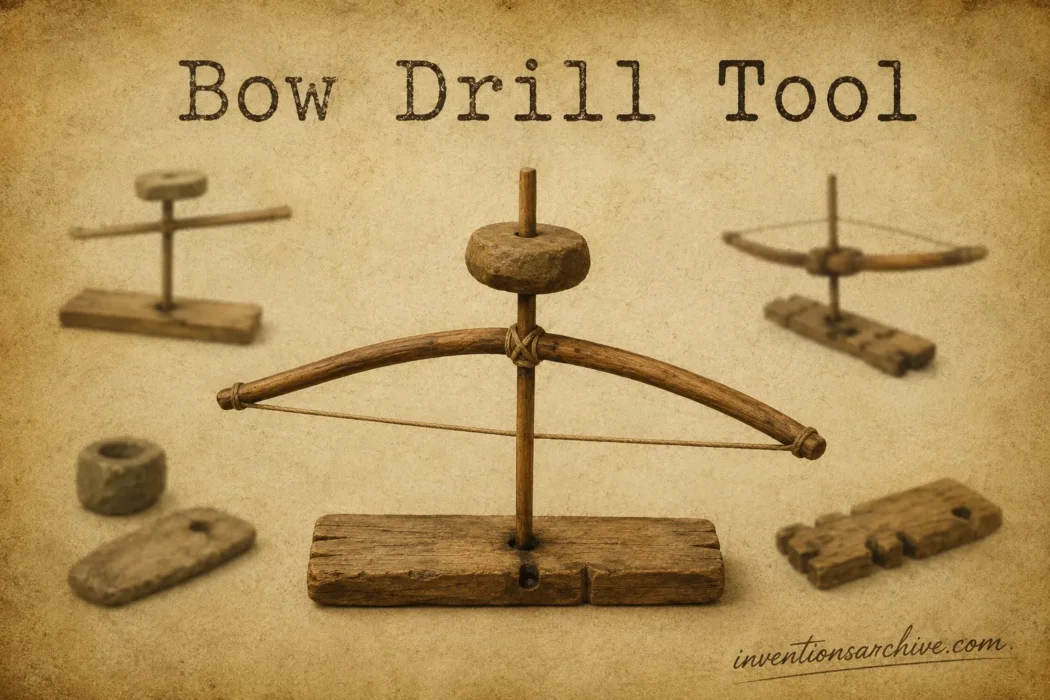
| Invention Name | Bow Drill Tool |
|---|---|
| Short Definition | A hand-powered tool that uses a cord and bow to turn a spindle rapidly in alternating directions. |
| Approximate Date or Period | Exact origin uncertain Predynastic Egyptian metal evidence survives from Naqada IID in the late fourth millennium BCE. |
| Geography | Early evidence is scattered; well-documented examples and depictions survive from Egypt, with later forms recorded across Africa, Asia, Europe, and the Arctic. |
| Inventor or Source Culture | No named inventor; the earliest currently documented Egyptian metal example is associated with Badari and the Naqada culture. |
| Category | Mechanical hand tool; rotary drilling and friction technology. |
| Importance | It produced fast, controlled rotation while leaving one hand available to apply pressure and keep the spindle centered. |
| Evidence Status | Based on surviving evidence Complete early sets are rare because bows, cords, and wooden shafts decay. |
| Main Problem Solved | Drilling small, repeatable holes in wood, bone, shell, beads, and stone without relying only on slow palm-rolling or direct twisting. |
| How It Works | A cord loops around the spindle. Each bow stroke turns the spindle one way; the return stroke reverses it. |
| Material or Technical Basis | Bow, cord or leather thong, spindle, upper bearing, and a working end shaped for cutting, abrading, or friction. |
| Early Use Context | Woodworking, bead production, ornament making, drilling bone and shell, stone working, and a related fire-making form. |
| Development Path | Earlier hand-rotated spindles and cord methods were followed by bow-driven drills, pump drills, braces, crank drills, and other controlled rotary tools. |
| Main Historical Caution | The earliest surviving object is not necessarily the place or moment where the bow drill was first invented. |
The Badari Drill Reidentified in 2026
A small object excavated from Grave 3932 at Badari in Upper Egypt was long catalogued as a copper awl with leather wrapped around it. The Museum of Archaeology and Anthropology at the University of Cambridge records it as accession 1924.948 A, from a Predynastic burial excavated by Guy Brunton. The collection entry preserves the older identification, the Badari findspot, the grave number, and the presence of copper and leather.[a]
Martin Odler and Jiří Kmošek re-examined the object through microscopy and compositional analysis. Their study identified fine wear associated with rotary motion and remnants of a leather thong around the shaft. They interpret the piece as the earliest known metal drill from Egypt and date it to Naqada IID. The article was published online in January 2026 in Ägypten und Levante / Egypt and the Levant.[b]
This reassessment changes the documented history of metal rotary drilling in Egypt. It does not establish the world’s first bow drill, nor does it identify a named inventor. Its value lies in the combination of use-wear and surviving organic material. A pointed metal object can resemble an awl when viewed alone; the leather coils and rotary marks connect this specimen to a larger mechanical system.
How the Bow Converts Hand Motion into Rotation
The bow drill turns a repeated sideways stroke into rapid spindle rotation. Its cord is wrapped around the spindle rather than attached as a permanent drive belt. Moving the bow in one direction pulls one side of the cord and turns the spindle. Reversing the bow reverses the spindle.
The rotation is therefore alternating, not continuously one-way. That difference matters when comparing the tool with a modern electric drill. A cutting edge or abrasive surface can still remove material during both halves of the cycle, so the reversal does not return the work to its starting condition.
The Main Mechanical Roles
- Bow: extends a short hand movement into a longer, more even cord stroke.
- Cord or thong: transfers the bow’s movement to the spindle through friction.
- Spindle: carries the rotation to the working point and keeps the tool aligned with the hole.
- Upper bearing: allows downward pressure while holding the spindle near its axis.
- Working end: may cut directly, carry loose abrasive, or create frictional heat, depending on the task.
The arrangement separates jobs that are difficult to control with a palm-rolled shaft. One hand moves the bow. The other can press on the bearing and stabilize the spindle. The operator can therefore regulate rotation, pressure, and alignment as related but separate actions.
Spindle diameter affects how much the shaft turns during a bow stroke. A narrower shaft generally completes more rotations for the same cord travel, while a thicker one trades some speed for a broader, stronger working body. These are mechanical relationships rather than evidence for one universal ancient design. Surviving tools vary in material, size, bearing shape, and point type.
Drilling and Fire-Making Use the Same Drive Differently
| Drilling Form | Fire-Making Form |
|---|---|
| Uses a cutting point, shaped drill, tubular end, or abrasive-carrying spindle. | Uses a blunt wooden spindle against a prepared wooden surface. |
| The intended result is a hole, recess, or worked channel. | The intended result is heated, carbonized wood dust that can form an ember. |
| Friction at the upper bearing is an unwanted loss and is reduced where possible. | Upper-bearing friction is also reduced; useful heat is concentrated at the lower contact. |
| Cutting geometry and abrasive behavior determine how material is removed. | Wood pairing, dryness, pressure, and heat concentration determine whether an ember forms. |
| Used in craft production, repair, joinery, bead making, and lapidary work. | Used as one historical method of producing an ember rather than a direct flame. |
Calling both devices bow drills can hide the engineering difference. In drilling, friction is useful only where it contributes to cutting or abrasion. In fire-making, the lower contact is arranged to turn friction into heat. Designs that reduced friction at the upper bearing lost less energy and exposed the spindle to less heat.
How a Soft Spindle Could Work Hard Stone
Ancient drilling did not always depend on a point harder than the material being pierced. In lapidary work, a wooden, reed, stone, or copper tool could act as a carrier for loose abrasive. Hard mineral grains trapped between the moving tool and the workpiece scratched away tiny particles. The carrier guided those grains and kept them at the contact surface.
Related articles: Crank Handle [Medieval Inventions Series], Button and Buttonhole [Medieval Inventions Series]
This explains how relatively soft materials could participate in drilling harder stone. The spindle or tube supplied motion and pressure; the abrasive performed much of the cutting. Experiments and microscopic studies reported by the Penn Museum found that wood could be used with abrasive on early seals, while copper tools with suitable abrasive produced marks resembling those found in harder stones. The same research describes concentric lines, bore shape, and tool wear as evidence that can help distinguish drilling methods.[d]
Why Holes Were Often Started from Both Sides
Many ancient beads and seals have biconical holes: a taper enters from each face and the two bores meet near the center. Drilling from both sides shortened the depth required from either direction. It could also reduce the chance of splitting the object when the drill emerged through a fragile surface.
The meeting point is not always exact. A slight offset records the difficulty of aligning two small starting points without modern measuring equipment. That imperfection is useful evidence. It can reveal the sequence of work even when the drill itself has disappeared.
Concentric grooves alone do not identify a bow drill with certainty. Other oscillating or rotary systems may leave related marks. Archaeologists compare hole geometry, wall texture, residues, unfinished pieces, known tool forms, and experimental replicas before assigning a particular drive mechanism.
Workshop Uses Beyond Making Fire
The bow drill solved a recurring craft problem: making a narrow hole while keeping the tool centered and applying steady pressure. That capability supported several kinds of production.
- Beads and pendants: small holes allowed stone, faience, shell, and other ornaments to be strung.
- Wooden construction: drilled holes accepted pegs, dowels, pins, and fitted components in furniture and tools.
- Bone, antler, and shell work: controlled rotation reduced the need to force a point straight through brittle material.
- Stone working: solid or tubular tools, often paired with abrasive, produced bores, recesses, and vessel interiors.
- Fine craft work: interchangeable points allowed one drive system to serve several workshop tasks.
A scene from the tomb chapel of the vizier Rekhmire at Thebes shows a craftsman using a bow drill to pierce disks for stone beads while another worker strings a collar. The surviving image is known through a facsimile by Nina de Garis Davies and is dated to about 1504–1425 BCE. It places the tool inside an organized temple workshop rather than an isolated survival setting.[e]
Physical tools support the pictorial evidence. The British Museum holds a wooden bow drill from a New Kingdom tomb at Thebes. Such later Egyptian examples are far better preserved than the Predynastic system represented by the Badari metal point, but they demonstrate that the cord-driven arrangement remained useful over a long period.[f]
What Surviving Evidence Can and Cannot Establish
Different evidence types answer different questions. A drill point may preserve rotary wear. A bearing block may show repeated pressure and polished contact. A drilled bead records the path of the tool through the material. A painted workshop scene shows posture, tool arrangement, and social context, though artists may simplify scale or detail.
Organic survival is especially important. The leather on object 1924.948 A carries mechanical information that the metal point alone could not provide. Without it, the specimen might remain classified as a small awl. The case also shows why older museum collections can change the history of technology when they are re-examined with microscopy and material analysis.
From Hand-Rotated Spindles to Later Rotary Tools
The bow drill belongs to a wider history of controlling rotary motion. The stages below describe related mechanical solutions, not a proven straight line followed by every society.
| Stage | Form | What Changed |
|---|---|---|
| Earlier Rotary Method | Hand-rolled spindle | The shaft turns between the palms, but the same hands must create rotation, pressure, and alignment. |
| Cord-Assisted Rotation | Strap or cord-driven spindle | A cord increases rotational travel and separates some of the drive motion from direct contact with the shaft. |
| Bow-Driven Tool | Bow drill | The bow manages the cord with one hand while the other controls pressure through a bearing. |
| Reciprocating Development | Pump drill | A crossbar, twisted cord, and weighted flywheel store and return motion through repeated vertical strokes. |
| One-Way Hand Rotation | Brace and crank drill | A bent or cranked handle provides stronger rotation in a chosen direction and can deliver more torque. |
| Workshop Adaptation | Bow lathe or horizontal spindle | The cord-driven idea is turned sideways so that a tool or workpiece rotates along a horizontal axis. |
The bow drill did not contain gears, a motor, or a continuous crank. Its mechanical contribution was control: a simple flexible cord converted repeated linear motion into fast alternating rotation, while an upper bearing allowed force to be directed along the spindle. Later drills solved the problem differently, yet they retained the same basic needs—rotation, pressure, alignment, and a working edge suited to the material.
Technologies That Extended the Same Mechanical Idea
- Pump drill: added a flywheel and self-reversing cord arrangement.
- Bow lathe: applied cord-driven alternating rotation to horizontal turning and shaping.
- Brace: replaced reciprocating cord motion with a crank-like hand path.
- Hand-cranked drill: used gearing to raise spindle speed or torque.
- Tubular drill: concentrated abrasive around a ring-shaped cutting edge and could leave a central core.
- Modern rotary drill: supplies continuous powered rotation while preserving the older requirements of axial pressure, centered motion, and material-specific bits.
Sources and Verification
- [a] Museum of Archaeology and Anthropology Collection Record 1924.948 A — Used to verify the accession number, Badari provenance, Predynastic classification, Grave 3932 context, excavator, and recorded copper and leather materials. Reliable because it is the official museum collection record.
- [b] The Earliest Metal Drill of Naqada IID Dating — Used to verify the Naqada IID date, rotary wear, leather thong interpretation, alloy analysis, and identification as the earliest known metal drill from Egypt. Reliable because it is the direct academic publication in an archaeological journal.
- [c] Ancient Egyptian Drill Bit — Used to verify the reported dimensions, weight, microscopic wear features, six leather coils, and portable X-ray fluorescence findings. Reliable because it is an official Newcastle University account of the research led by one of the study authors.
- [d] Ancient Lapidary — Used to verify experimental and microscopic evidence for abrasive drilling, wooden drill carriers, concentric tool marks, and the drilling of harder stones. Reliable because it is a research publication hosted by the Penn Museum.
- [e] Stringing and Drilling Beads, Tomb of Rekhmire — Used to verify the New Kingdom workshop scene, its approximate date, and the depiction of a craftsman drilling stone bead disks with a bow drill. Reliable because it is the official Metropolitan Museum of Art object record.
- [f] Bow Drill, Museum Number EA6040 — Used to verify a surviving wooden bow drill from a New Kingdom tomb at Thebes. Reliable because it is the official British Museum object record.