
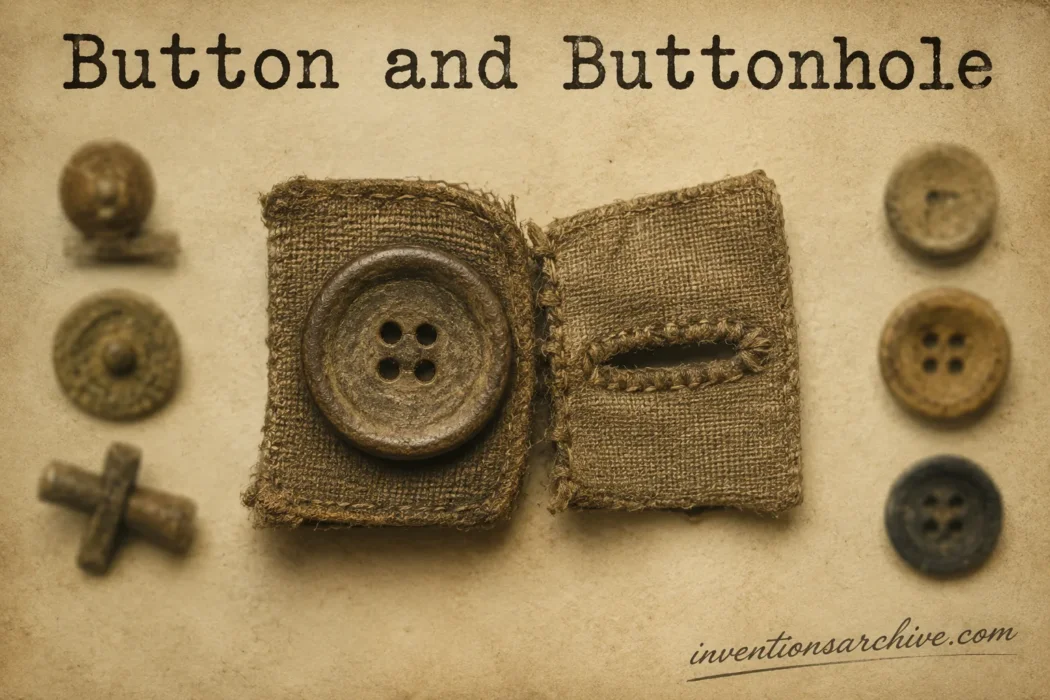
| Button and Buttonhole | |
| Short Definition | A reusable closure in which a fixed button passes through a reinforced opening or loop to join overlapping parts of a garment. |
| Approximate Date or Period | Perforated button-like dress fittings survive from Bronze Age contexts; functional buttons paired with cut buttonholes are securely documented in medieval Europe by the 14th century. |
| Geography | Ancient examples occur in several regions; the cut-and-reinforced buttonhole became prominent in later medieval European tailoring. |
| Inventor or Source Culture | Attribution varies No single inventor is known. |
| Category | Clothing fastener and textile engineering |
| Importance | It allowed fabric edges to be opened and closed repeatedly at many controlled points while becoming part of the garment’s structure and appearance. |
| Evidence Status | Based on surviving evidence Ancient buttons, medieval garments and records, patent models, industrial archives and later clothing collections. |
| Main Problem Solved | Closing fitted or overlapping fabric without relying solely on pins, belts, knots, lacing or detachable clasps. |
| How It Works | The button turns and passes through an opening that is narrower than its broad face. Once released, the button lies across the opening and resists withdrawal. |
| Material or Technical Basis | A rigid or semi-rigid button, a thread or integral shank, an overlapping placket and a stitched or otherwise reinforced opening. |
| Development Path | Decorative or dress-mounted perforated objects → button-and-loop closures → reinforced cut buttonholes → specialized sewing machines → standardized ready-to-wear fastenings. |
| Modern Descendants | Shirt buttons, coat buttons, keyhole buttonholes, bound buttonholes, fabric-covered buttons and machine-programmed buttonhole systems. |
Clothing Closures Before the Cut Buttonhole
Garments had been secured for centuries before the reinforced buttonhole became common. Fibulae and other pins could hold the corners of a cloak. Belts gathered loose fabric around the waist. Cords and laces drew two edges together, while hooks, buckles and toggles served particular materials and garment shapes.
Each method controlled fabric differently. A belt tightened a broad area but could not shape a long front opening point by point. Lacing offered close adjustment, though opening a long row could take time. A brooch or fibula concentrated the load at one attachment point and was best suited to draped cloth. Toggles worked well with loops, especially where thick material made a narrow slit impractical.
| Earlier Method | Practical Limitation | Change Introduced by Buttons and Buttonholes |
|---|---|---|
| Pin or fibula | Concentrated pressure at one point and included a projecting metal part. | Several small closures could spread the load along an opening. |
| Belt | Controlled the garment mainly around the waist or another encircling line. | Separate parts such as fronts, cuffs, collars and pockets could be closed independently. |
| Lacing | Allowed adjustment but could be slow to thread, tighten or release. | Closures could be opened individually without unthreading the whole fastening line. |
| Hook and eye | Small metal parts could bend, pull away or remain visible where decoration was unwanted. | The working opening could be integrated into the fabric itself. |
| Toggle and loop | Well suited to thick garments but less discreet on fine, closely fitted clothing. | Small buttons and narrow openings permitted denser spacing and finer control. |
These earlier devices did not disappear. They remained useful because different fabrics place different demands on a closure. The buttonhole added another option: a fastening point could be built directly into an overlapping textile edge without permanently joining the two sides.
The Invention Was a Four-Part System
A working garment closure requires more than a disk with holes. Four elements must cooperate:
- The button must be large and firm enough to resist pulling back through the opening.
- The attachment must connect the button to the garment while leaving enough movement for fabric to pass beneath it.
- The buttonhole or loop must admit the button in one orientation and restrain it in another.
- The fabric overlap must bring the garment edges across one another so the closed surface does not leave an uncontrolled gap.
Why a Plain Slit Is Not Enough
Cutting woven fabric interrupts threads that carry tension through the cloth. Without reinforcement, the cut edges can fray, stretch and lengthen. The ends of the slit are especially vulnerable because force becomes concentrated where the cut stops.
Buttonhole stitching binds the exposed edges and helps stop the opening from growing. End bars can strengthen the terminal points. Interfacing or additional cloth can spread force into the surrounding garment. On tailored outerwear, a cord known as gimp may sit beneath dense stitching to give the opening a firmer edge.
The reinforcement does not make the opening rigid. A buttonhole must still flex enough for the button to turn and pass through. Its engineering problem is therefore a balance: the slit must deform temporarily without losing its intended shape.
How the Button Locks Across the Opening
The broad face of a button is larger than the relaxed width of the buttonhole. During fastening, the button is angled so its narrow edge enters first. The slit spreads along its length while the button passes through. Once the button clears the opening, it lies flatter against the outer fabric.
Pulling the garment edges apart then rotates or seats the button across the slit. The load passes from the fabric surrounding the buttonhole to the button, through its shank or attachment threads, and into the opposite garment panel.
A functional shank creates space between the button and the cloth. That space receives the thickness of the overlapping fabric. If the button sits too tightly against the garment, the closed edge may pucker. If it sits too far away, the closure can feel loose and place more leverage on the attachment thread.
Why Tailored Clothing Increased the Value of Buttons
Rows of buttons became especially useful when European clothing moved toward shaped bodices, narrow sleeves and fitted upper garments. A loose tunic could be pulled over the head or gathered with a belt. A closely tailored garment needed an opening large enough for dressing, followed by a fastening that restored its fitted shape.
Several small buttons could control the opening at short intervals. This reduced the distance that unsupported fabric could gap between fastening points. Buttons at a cuff allowed a narrow sleeve to pass over the hand and then close around the wrist. A buttoned front let a fitted torso open without sacrificing its cut when closed.
Surviving images, garments and written records show that buttons and laces coexisted rather than forming a simple replacement sequence. The Fashion History Timeline of the Fashion Institute of Technology notes that fitted doublets had replaced looser upper-class tunics by the mid-14th century. It also records that early 15th-century doublets could shift between buttons and lacing as fashions changed.[c]
Closely spaced buttons also became decoration. A row could display metalwork, covered cloth, carved material or heraldic imagery. Some garments carried false or uncut buttonholes beside working ones. The closure line therefore became both a mechanical seam and a designed surface.
Buttonhole Shapes Follow Fabric and Load
Buttonholes are not interchangeable openings. Their direction, end shape and construction respond to the button, the cloth and the direction of pull.
| Form | Construction | Typical Use | Mechanical Reason |
|---|---|---|---|
| Straight Buttonhole | A narrow reinforced slit with squared or rounded ends. | Shirts, blouses, waistcoats and many light garments. | Provides a compact opening for relatively flat buttons and moderate fabric thickness. |
| Keyhole Buttonhole | A straight slit ending in a rounded eye. | Coats, jackets, jeans and other medium-to-heavy garments. | The rounded end gives a thicker shank room to settle without forcing the slit apart. |
| Bound Buttonhole | The raw opening is faced with narrow folded fabric lips. | Tailored jackets, coats and formal garments. | The facing encloses the cut edges and integrates the opening with the garment’s outer fabric. |
| Corded Buttonhole | Dense stitching is worked over an added supporting cord. | Tailored outerwear and areas exposed to repeated stress. | The cord gives the stitched edge body and helps it retain a defined outline. |
| Fabric or Cord Loop | A separate loop replaces the cut slit. | Decorative closures, thick garments and edge-to-edge fronts. | The garment fabric does not need to be cut, and the loop can accept a bulky or elongated button. |
Direction matters as well. A vertical buttonhole occupies little width and suits a placket where the button line runs along the grain. A horizontal buttonhole gives the button room to move toward the closed edge under tension. New Mexico State University’s textile guidance places keyhole openings with thick buttons and heavier fabrics, while distinguishing horizontal openings used where a fitted garment pulls across the closure.[d]
The button must match the opening. A flat, thin button can pass through a compact slit. A domed or shanked button needs added length or a widened end. Changing the button without reconsidering the opening can produce a closure that slips open, distorts the placket or becomes difficult to operate.
From Hand-Worked Openings to Specialized Machines
Hand-worked buttonholes required several controlled operations. The position had to be marked, the opening cut or prepared, the edges stitched closely, and the ends reinforced. Variations in thread tension or stitch spacing could change the size and durability of each opening.
The industrial challenge was not merely to sew faster. A machine had to guide fabric around a narrow opening, form stitches on both sides, handle the ends and repeat the result at a consistent length.
Related articles: Sewing Machine [Industrial Age Inventions Series]
| Stage | Form | What Changed |
|---|---|---|
| Hand Production | Cut and reinforced openings worked by a tailor or sewer. | Each buttonhole depended heavily on individual control of placement, edge stitching and end reinforcement. |
| 1852 Patent Model | Charles Miller’s buttonhole-stitching sewing machine. | A patented machine was designed specifically to perform several stitches around buttonholes. |
| 1873 Patent Model | Helen A. Blanchard’s improvement in sewing machinery. | A machine stitch associated with edge finishing and buttonhole reinforcement expanded factory sewing capabilities. |
| Specialized Factory Machines | Dedicated straight and keyhole buttonhole machines. | Clamping, cutting, stitching and end finishing became repeatable production operations. |
| Programmed Sewing | Automatic domestic and industrial buttonhole cycles. | Machines could repeat preset shapes and adjust the opening to the selected button or garment program. |
The Smithsonian identifies Charles Miller’s 1852 patent model as the first sewing machine patented to stitch buttonholes. Its historical value lies in the mechanization of an existing textile operation, not in the invention of the buttonhole itself.[e]
A later Smithsonian patent model records Helen A. Blanchard’s 1873 improvement in sewing machines and describes it as introducing a buttonhole stitch. Blanchard’s work belongs to the industrial development of buttonhole production and edge finishing. It should not be confused with the much older garment closure.[f]
Button Materials Changed With Production
The fastening principle permits wide material choice. A button needs enough stiffness to resist folding through the opening, enough strength at its attachment point and a surface that will tolerate repeated handling.
Early and pre-industrial buttons were made from locally available or traded materials such as jet, shell, bone, horn, wood, metal, glass and fabric-covered cores. These materials behaved differently. Horn could be heated and shaped. Metal supported fine cast or stamped detail but could add weight or corrode. Shell offered a polished surface and natural variation, though its curved and layered structure limited where blanks could be cut.
Fabric-covered buttons separated the visible surface from the load-bearing core. A tailor could match the garment while retaining a firm internal form. Shank buttons moved the attachment point behind the visible face, leaving the front uninterrupted and creating space for thick cloth.
Industrial production favored materials that could be cut, pressed or moulded repeatedly. Corozo, produced from the hard endosperm of certain palm seeds, could be turned and dyed. Early synthetic materials offered new colours and repeatable shapes. Thermoplastics later allowed large batches of nearly identical buttons to be moulded with holes, shanks, logos or textured surfaces already formed.
Muscatine and the Shift From River Shell to Plastic
Muscatine, Iowa, became a major American centre for buttons cut from freshwater mussel shells taken from the Mississippi River system. Shell blanks could be drilled, shaped, polished and pierced before entering the clothing trade.
The industry connected a small garment component to river ecology and mass-produced clothing. Large-scale harvesting reduced the supply of suitable shellfish. Manufacturers also faced natural limits in shell thickness, colour and usable surface area.
The Smithsonian’s archival guide to the Iowa Button Industry Collection places Muscatine’s mother-of-pearl production mainly from the 1890s through the 1960s. It records about 53 small firms during the industry’s peak and notes that some companies began experimenting with plastics in the 1930s as shellfish supplies declined. Several businesses converted successfully to plastic production.[g]
This transition changed more than the raw material. Shell cutting began with an irregular biological form. Plastic moulding could produce a finished shape with controlled dimensions, attachment holes and surface detail. Uniform batches made it easier for ready-to-wear manufacturers to plan button size, spacing and replacement stock.
Why Standard Buttons Supported Ready-to-Wear Clothing
A handmade garment could be adjusted around the exact buttons available to its maker. Factory production required the relationship between garment pattern, overlap, button diameter and buttonhole length to be repeated across many units.
Standardized components supported that repetition. A cutting pattern could include fixed placket width and buttonhole positions. Specialized machines could repeat the same opening. Buttons could be supplied in measured sizes and matched batches.
The system also separated different stages of manufacture. One workstation could prepare the placket, another could make the buttonholes, and another could attach the buttons. Inspection could check whether the two sides aligned and whether each button passed through its intended opening.
Repair remained relatively local. A lost sew-through button did not normally require replacement of the whole fastening line. A spare button could restore the garment while preserving the existing buttonhole. This gave the system a practical advantage over closures whose teeth, tapes or interlocking components form one continuous assembly.
What the Popular Origin Story Leaves Out
No Confirmed Single Inventor
The button-and-buttonhole closure is a cumulative textile system. Different communities could produce perforated objects, loops, cloth ties and reinforced openings without following one traceable line of transmission. No surviving patent, workshop record or named biography identifies the person who first combined every element.
The Earliest Preserved Object Is Not the First Use
Textiles decay more readily than stone, metal, shell or jet. A durable button may survive after the fabric, attachment thread and loop have disappeared. Archaeology therefore preserves the rigid part of the closure more often than the complete system.
Machine Patents Belong to a Later Stage
Nineteenth-century patents document attempts to mechanize buttonhole stitching. They provide clear names and dates because patent systems recorded them. Those records concern production machinery, not the original concept of passing a button through a reinforced textile opening.
Buttons Did Not Simply Replace Every Earlier Fastener
Lacing remained useful where adjustable tension was required. Hooks and eyes provided discreet closures. Toggles worked with heavy layers. Snaps, zippers and hook-and-loop systems later addressed other needs. Clothing design continued to select fasteners according to fabric, movement, manufacturing cost and intended appearance.
Why Buttons Remain in Use
| Fastener | Closure Pattern | Repair Character | Design Limitation |
|---|---|---|---|
| Button and Buttonhole | Separate fastening points can be opened individually. | A lost button is often replaceable without rebuilding the whole opening. | Small buttons may require fine hand control and can allow gaps between widely spaced points. |
| Zipper | A slider joins a continuous line of interlocking elements. | Damage to the slider, teeth or tape can affect the full closure. | The opening generally follows one fixed path. |
| Snap Fastener | Paired parts press together at separate points. | A damaged half may require tools or fabric reinforcement to replace. | The receiving parts must align closely and may pull out under concentrated force. |
| Hook-and-Loop | Two surfaces engage across a broad strip or patch. | Worn tape can be removed and replaced, though stitching may extend around the full patch. | It can collect fibres, create sound when opened and alter the feel of light fabric. |
Buttons remain useful because the same basic closure can be resized, reshaped and remade for many fabrics. A shirt can use small flat buttons and narrow vertical openings. A wool coat can use shanked buttons and horizontal keyhole openings. Decorative garments can use covered buttons, moulded forms or loops without changing the underlying locking principle.
The system also permits partial opening. A wearer can release a collar, cuff or selected section while leaving the rest closed. That behaviour differs from a continuous zipper and remains useful in garments designed for ventilation, movement or adjustable appearance.
Sources and Verification
- [a] button — Used to verify the Early Bronze Age jet object, its approximate date, construction and burial context. (Reliable because it is a direct British Museum collection record.)
- [b] Common Threads: A Reappraisal of Medieval European Sumptuary Law — Used to verify the 1356 Florentine rule concerning buttons and corresponding buttonholes. (Reliable because it is a scholarly chapter published through Cambridge Core.)
- [c] 1400–1409 — Used to verify the relationship between fitted late medieval garments, doublets, lacing and buttoned closures. (Reliable because it is an educational fashion-history resource maintained by the Fashion Institute of Technology.)
- [d] Machine Buttonholes Made Easy — Used to verify the functional differences among keyhole, horizontal and vertical buttonholes and the role of fabric stabilization. (Reliable because it is a textile publication from New Mexico State University Cooperative Extension.)
- [e] 1852 – Charles Miller’s Patent Model of a Sewing Machine — Used to verify the Smithsonian’s identification of Miller’s model as the first sewing machine patented to stitch buttonholes. (Reliable because it is a direct National Museum of American History object record.)
- [f] 1873 – Helen A. Blanchard’s Sewing Machine Patent Model — Used to verify the date, patent-model context and buttonhole-stitch description associated with Blanchard’s sewing-machine improvement. (Reliable because it is a direct National Museum of American History object record.)
- [g] Preliminary Guide to the Iowa Button Industry Collection — Used to verify Muscatine’s freshwater pearl-button industry, the number of firms at its peak and the transition toward plastics as shell supplies declined. (Reliable because it is an official Smithsonian Archives Center collection guide.)