
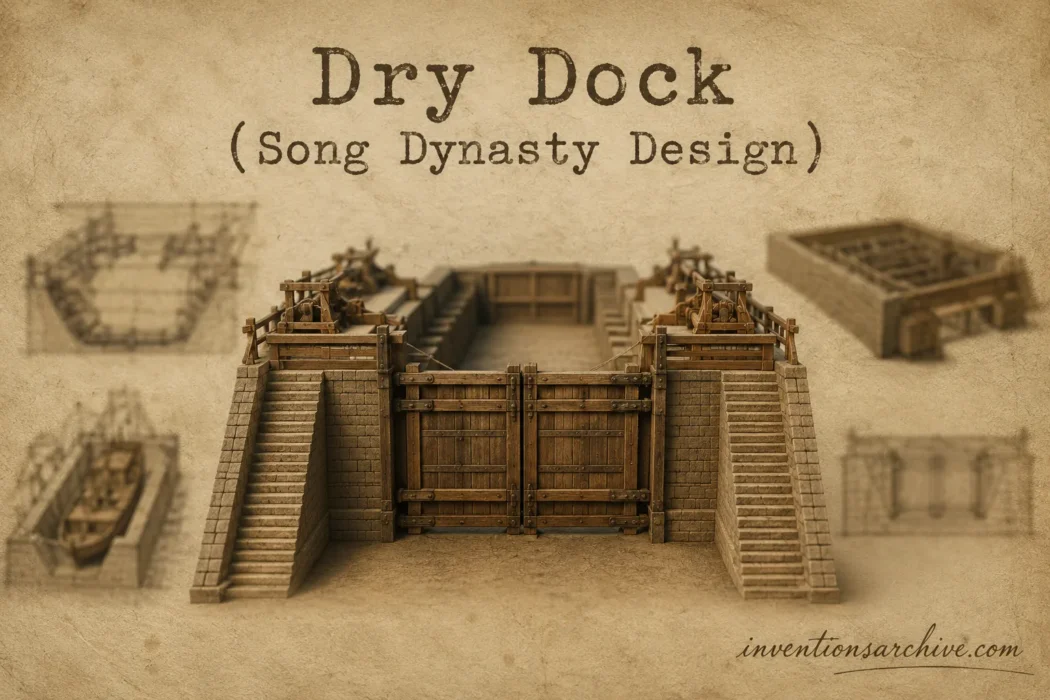
| Invention Name | Song Dynasty Dry Dock |
|---|---|
| Short Definition | A purpose-built basin that admitted floating ships, drained the water beneath them, and transferred their weight onto timber supports for hull repair. |
| Approximate Date or Period | Documented for the Xining reign, 1068–1077 |
| Geography | North end of Jinming Pond, Bianjing (modern Kaifeng), Northern Song China |
| Inventor or Source Culture | Plan associated with palace official Huang Huaixin; recorded by Shen Kuo |
| Category | Marine engineering, ship maintenance, hydraulic infrastructure |
| Importance | An early written description of a reversible float-in, drain, repair, and refloat system in China |
| Evidence Status | Based on a surviving written account No detailed engineering drawing survives in the cited material, and the Jinming Pond study does not identify this particular basin archaeologically. |
| Main Problem Solved | Access to the decayed underwater hulls of very large imperial vessels |
| How It Works | Fill the basin, position the ships above submerged beams, isolate and drain the basin, complete repairs, then admit water again. |
| Material or Technical Basis | Excavated earth basin, timber crossbeams, supporting pillars, controlled water entry, and wheel-driven drainage |
| Early Use Context | Repair and later sheltered storage of two large palatial dragon ships |
| Development Path | Earlier beaching and hauling methods → controlled basin support → later masonry graving docks and floating dry docks |
| Debates or Different Views | Global priority debated Earlier Mediterranean texts describe related dock-like works, while the Song account remains an early clearly described Chinese example. |
Why the Imperial Ships Could Not Be Repaired Afloat
Shen Kuo’s account begins with two dragon ships presented to the Song throne near the start of the dynasty. In Joseph Needham’s English rendering, each vessel measured more than 200 feet, roughly 61 metres. Their upper works included several decks and palatial rooms prepared for imperial use.
These were not the narrow racing craft now commonly called dragon boats. They were large court vessels. The surviving description presents them as ceremonial and palatial ships rather than ordinary cargo carriers, and it does not establish that they served as frontline warships.
Time created a maintenance problem below the waterline. Wooden planking, seams, fastenings, and structural joints could deteriorate while remaining difficult to inspect. Workers could reach the visible upper hull from platforms or small boats, but the submerged bottom stayed hidden. A vessel of this scale was also too large to treat like a small boat that could simply be dragged onto a bank.
The practical challenge was therefore precise: remove the supporting water without losing safe support for the ship. Huang Huaixin’s proposal treated the basin, its water, and its timber structure as one operating system.
Jinming Pond as an Engineering Setting
Jinming Pond lay outside the walls of Northern Song Bianjing, the city now known as Kaifeng. Research on the site describes it as a large imperial water landscape with an earlier connection to naval training. It later became known for court buildings, water displays, and dragon-boat events.
This setting matters because the dock did not appear beside an isolated workshop with no hydraulic resources. Jinming already offered a large managed body of water near the capital, experienced labor, and court interest in maintaining ceremonial vessels. Shen Kuo located the new basin at the north end of the pond, where it could be filled from the existing water body.
The evidence for Jinming Pond is broader than the evidence for the dry dock itself. Historical writing, a surviving Song-period visual tradition, and archaeological work help locate and reconstruct the garden. They do not, by themselves, identify the precise footprint of Huang Huaixin’s repair basin. The dock remains chiefly a textually documented installation within a better-attested imperial landscape.
The Dry Dock Operation, Stage by Stage
1. A Basin Large Enough for the Ships
Workers excavated a separate basin capable of receiving the dragon ships. The account gives no verified length, width, or depth. Its size had to allow a vessel to enter while floating and to leave working space around the exposed hull once the water was removed.
2. Crossbeams Raised on Pillars
Heavy beams were laid across the basin on supporting pillars. While the basin was full, these supports remained beneath the water and below the incoming ships. Once drainage began, they became the solid structure that replaced the support previously supplied by buoyancy.
The wording indicates transverse timber support rather than a single lifting point. That arrangement would spread weight across more of the hull. The record does not state how the beams aligned with the keel, whether shaped side supports were added, or how workers prevented local pressure from damaging the planking.
3. Water Admitted Through an Opening
A breach or opening allowed the basin to fill rapidly from Jinming Pond. The ships were then towed into position above the submerged beams. The text does not describe a modern hinged gate or a removable caisson, so illustrations that show either feature should be treated as reconstructions rather than preserved Song specifications.
4. The Basin Isolated and Drained
After the entrance was closed, water was removed “by wheels” in the familiar English translation. The phrase points to mechanically assisted drainage, probably using established Chinese water-lifting technology. It does not tell us the exact wheel form, the number of machines, their power source, or how long emptying took.
5. Weight Passed from Water to Timber
Drainage changed the ship’s support gradually. At first, displaced water carried most of the load. As the water level fell, buoyant force decreased and the hull settled onto the beams. Alignment had to be maintained during this transition. If the ship contacted one support too early or rested unevenly, its long wooden structure could twist or lean.
6. The Lower Hull Became Accessible
With the basin drained and the ships resting above the floor, workers could reach planking and joints that had remained underwater. The surviving passage says the ships stood clear for repair, but it does not list the specific carpentry performed. Replacement of decayed material is the reported purpose; detailed restoration methods are not preserved.
7. Refloating Reversed the Process
When repairs were complete, water entered the basin again. Rising buoyancy released the vessels from the timber support, allowing them to float out. This reversibility separated the design from a permanent cradle or a one-way launching trench.
8. The Basin Became Covered Storage
Shen Kuo’s account adds that the beams and pillars were later removed and the basin covered by a large roof, creating sheltered storage for the ships. The roof reduced exposure to weather while the vessels were laid up. It also shows that the project addressed two related needs: underwater-hull repair and protection between periods of court use.
Why the Design Was More Than an Excavated Pond
| Design Element | Function in the System |
|---|---|
| Excavated basin | Created a bounded space whose water level could be controlled independently of the main pond. |
| Water connection | Allowed the ships to enter and leave while floating. |
| Crosswise beams | Received the vessel’s weight after buoyant support declined. |
| Pillar foundations | Raised the beams and left working clearance beneath and around the hull. |
| Wheel-driven drainage | Removed water after the entrance had been closed. |
| Refilling | Restored buoyancy and released the repaired vessel from its supports. |
| Protective roof | Converted the area into sheltered storage after the repair operation. |
A simple wet basin keeps a ship afloat. A simple shed keeps a ship under cover. Huang Huaixin’s design combined water control, structural support, repair access, and later storage. Its identity as an invention rests in that coordinated cycle rather than in any single beam, wheel, or excavation.
What Changed Compared with Earlier Hull-Access Methods
Mariners had long exposed hulls by beaching vessels, hauling smaller craft ashore, or leaning a larger ship onto one side. The last method became known in later European practice as careening or heaving down. Ropes, tides, and shore equipment brought one side of the bottom within reach.
Careening demanded less permanent infrastructure, but it exposed only part of the hull at a time and placed an uneven load on the vessel. A basin dry dock required excavation, drainage, and prepared supports, yet it could hold a ship upright while making the lower hull accessible from both sides.
| Method | How the Hull Was Exposed | Main Limitation |
|---|---|---|
| Beaching | The vessel settled on a shore or firm tidal ground as water receded. | Depended on local terrain, water levels, and the hull’s ability to rest safely. |
| Hauling or slipway | The vessel was pulled up an inclined surface. | Large ships required heavy hauling power and a structure able to carry the moving load. |
| Careening | The vessel was deliberately leaned to expose one side. | Only part of the bottom was available at once, and the tilted hull carried unusual stresses. |
| Song basin dry dock | The ship floated in upright; the water was then removed beneath it. | Required accurate positioning, dependable closure, drainage machinery, and carefully placed supports. |
Huang Huaixin and Shen Kuo Had Different Roles
The invention is sometimes assigned directly to Shen Kuo because his book preserves the account. That merges documentation with design.
Huang Huaixin is the person associated with proposing the repair plan during the Xining reign. Shen Kuo was the scholar-official who recorded the episode in Mengxi Bitan, known in English by titles such as Dream Pool Essays and Brush Talks from Dream Brook. Shen’s text provides the technical sequence available to later historians.
The distinction also resolves a common date error. The years 1068–1077 identify the reign period in which the plan was reportedly put forward. The later date commonly attached to Shen Kuo’s book concerns the surviving written account, not the first day on which the dock operated.
English spellings vary because older studies used earlier romanization systems. Huang Huaixin may appear as Huang Huai-Hsin; Shen Kuo as Shen Kua or Shen Gua; Jinming as Chin-ming; and Xining as Hsi-Ning. These forms usually point to the same people, place, and reign period rather than to separate inventions.
What the Written Account Confirms and Leaves Open
| Supported by the Account | Not Preserved in the Account |
|---|---|
| Two unusually large imperial dragon ships required hull repair. | The vessels’ displacement, exact beam, draft, framing plan, and repair history. |
| Huang Huaixin proposed a basin at the north end of Jinming Pond during the Xining reign. | The name of the supervising engineer, workforce size, construction duration, and cost. |
| Heavy transverse beams stood on pillars within the basin. | The number, spacing, dimensions, wood species, joints, and protective packing of the supports. |
| The basin was flooded, the ships moved above the beams, and the water removed by wheels. | The closure design, drainage-wheel form, power source, pumping rate, and drainage time. |
| The ships were repaired, refloated, and later protected beneath a roofed structure. | How often the basin operated, whether other vessels used it, and how long the facility survived. |
No surviving engineering drawing is attached to the account. A modern reconstruction can show the logic of the operation, but details such as a gate, sluice, beam profile, or pump train must be labelled as inferred unless a separate source establishes them.
The absence of a known physical dock does not cancel the written testimony. It limits the questions that can be answered. The record is strong enough to describe the sequence and attribution; it is not strong enough to support a precise scale model presented as an exact replica.
Was the Song Basin the World’s First Dry Dock?
The safest description is that Huang Huaixin’s installation is one of the earliest clearly described dry-dock systems and an early documented Chinese example. Calling it the uncontested first dry dock in all history goes beyond the surviving evidence.
An older Mediterranean account, preserved by Athenaeus from material associated with Callixenus of Rhodes, describes a special trench or dock used with an enormous vessel in Ptolemaic Egypt. The installation reportedly involved supports, water admitted from the sea, a closed entrance, and mechanical drainage. Historians have differed over whether this was a true repair dock, a launching installation, or a literary description that cannot be matched confidently to archaeological remains.
The Song account has its own limits, yet its repair purpose is explicit. The dragon ships entered because their decayed hulls could not be repaired while afloat, and the sequence ended with the vessels refloated after the work. That makes it especially valuable for the history of ship maintenance.
From the Song Basin to Later Dock Forms
The basic operating logic of a modern graving dock remains recognizable: a ship floats into an enclosed basin, the entrance is sealed, water is removed, and the vessel rests on prepared blocks. Modern docks add masonry or reinforced concrete construction, engineered keel and bilge blocks, high-capacity pumps, drainage channels, inspection systems, and closures designed for repeated use.
A floating dry dock follows a different structural method. Instead of draining a basin excavated into the shore, the dock submerges by taking water into ballast tanks, receives the vessel, and rises when those tanks are pumped out. The Song installation was a fixed basin dry dock, not an early floating dock.
| Stage | Form | What Changed |
|---|---|---|
| Earlier Practice | Beaching, hauling, ship sheds, and later careening traditions | Used shore slope, low water, pulling force, or deliberate heeling to reach part of the hull. |
| Song Installation | Excavated basin with submerged timber supports and mechanical drainage | Allowed large ships to enter afloat, remain upright, and be refloated after repair. |
| Later Graving Docks | Permanent basins with masonry floors, shaped blocks, gates or caissons, and improved pumps | Made repeated docking more controlled and suited to naval and commercial yards. |
| Floating Dry Docks | Buoyant structures with ballast tanks and lifting decks | Moved the lifting facility into the water and reduced dependence on a suitable excavated shoreline. |
| Modern Alternatives | Marine railways, vertical ship lifts, syncrolifts, and heavy-lift platforms | Adapted hull access to different vessel sizes, harbor conditions, and maintenance workflows. |
This sequence shows functional continuity, not a proven chain of copying. The available evidence does not demonstrate that the builders of late-medieval European graving docks knew Huang Huaixin’s design. Similar problems can produce similar basin-and-pump solutions in different maritime cultures.
Why Song China Could Support a Project of This Scale
The dry dock belonged to a society with extensive water transport, managed canals, large cities, state workshops, and mature shipbuilding knowledge. Northern Song Bianjing depended heavily on waterways for supply and movement. Jinming Pond itself joined hydraulic management with court activity.
Across the Song period, government participation in maritime commerce and naval affairs grew, while shipbuilding and navigation received sustained technical attention. The dragon-ship dock was not a standard ocean-going shipyard described across the empire, but it drew on the same capacities: excavation, timber construction, water lifting, organized labor, and the ability to maintain large wooden vessels.
The project also reveals a form of invention often hidden by object-based histories. Huang Huaixin did not need to invent timber beams, basins, or water wheels separately. The new result came from arranging known resources so that a massive vessel could pass through a controlled sequence: afloat, supported, dry, repaired, and afloat again.
Technologies Connected to the Song Dry Dock
Sources and Verification
- The Evolutionary Development of Floating Dry Docks — Used for the translated Song dry-dock account, the reported dimensions and purpose of the dragon ships, early docking comparisons, and the limits of tracing direct technological transmission. This East Carolina University maritime-studies thesis documents its historical sources and reproduces the passage through Joseph Needham’s study.
- 夢溪筆談 Dream Pool Essays — Used to identify Shen Kuo’s surviving work as the primary textual setting for the episode. The Internet Archive record provides access to the public-domain Chinese text and its bibliographic metadata.
- Reconstruction of the Masterplan of Jinmingchi Garden in Northern-Song Bianjing (Modern Kaifeng) — Used for the location, earlier functions, court setting, written descriptions, visual evidence, and archaeological study of Jinming Pond. It is a scholarly architecture and urban-history article with a stated research basis.
- China’s Emergence as a Maritime Power — Used for the wider Song context of maritime commerce, state involvement, naval development, and shipbuilding technology. The chapter appears in The Cambridge History of China and is published by Cambridge University Press.
- Charlestown Navy Yard: Dry Dock 1 — Used to verify how careening exposed one side of a large wooden hull, why it stressed ships, and how basin dry docks changed hull access. The page is maintained by the U.S. National Park Service as part of a documented naval-yard history.
- U.S. Navy Salvage Manual, Volume 2 — Used for the modern technical definition of an enclosed dry-dock basin with a watertight entrance that can be pumped dry. It is an official Naval Sea Systems Command manual.
- Hellenistic Royal Barges — Used to verify that an older literary tradition describes a special dock made for a giant Ptolemaic vessel, which complicates unqualified global-first claims. The chapter is part of an academic study published by Cambridge University Press.