
| Invention Name | Cog ship |
|---|---|
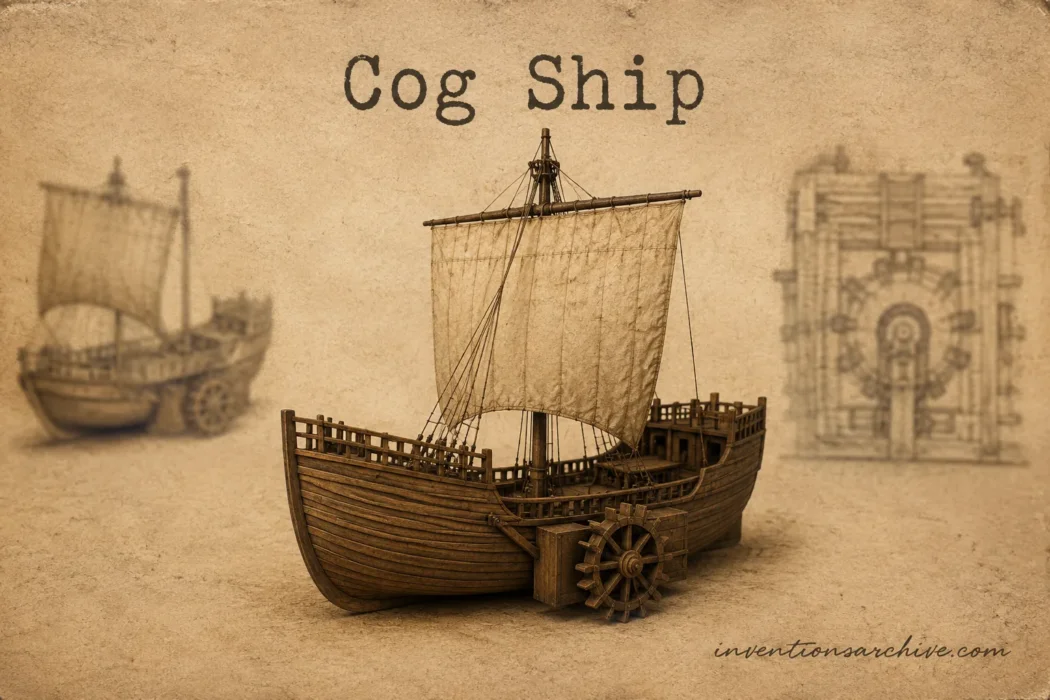
| Short Definition | A broad medieval sailing vessel built around cargo volume, usually with a flush-planked bottom, overlapping side planks, one square sail and a stern-mounted rudder. |
| Approximate Date or Period | Gradual development Seagoing forms are associated mainly with the High and Late Middle Ages; cogs remained prominent into the fifteenth century. |
| Geography | North Sea, Wadden Sea, Baltic Sea and connected northern European ports |
| Inventor or Source Culture | No single inventor Developed through northern European boatbuilding traditions, with the early geographic path still debated. |
| Category | Maritime transport, shipbuilding and cargo technology |
| Importance | Made high-volume movement of food, timber, salt, bricks and other bulky goods more practical across northern European sea routes. |
| Evidence Status | Based on surviving evidence Shipwrecks, timber dating, fastenings, rigging remains, cargo records, seals and written references |
| Main Problem Solved | Carrying large, heavy or low-value cargo with fewer voyages and a relatively small sailing crew |
| Material or Technical Basis | Oak hull, bottom-based construction, overlapping side planking, iron and wooden fastenings, moss caulking, square sail and centreline stern rudder |
| Early Use Context | Coastal and regional trade linking river ports, the North Sea, the Sound and Baltic market towns |
| Development Path | Regional flat-bottomed cargo traditions → seagoing cog forms → larger late medieval cogs → mixed and carvel-built multi-masted cargo ships |
| Surviving Evidence | Bremen Cog (about 1380) and Svælget 2 (about 1410), together with other cog and cog-like wrecks |
Why Northern European Trade Needed a Cargo-First Ship
Medieval ports around the North Sea and Baltic required more than small quantities of luxury goods. Towns needed grain, salt, timber, dried fish, stone, bricks, cloth, metal and provisions. Many of these products were heavy, bulky or modest in value. Their trade depended on reducing the transport cost of each barrel, beam or sack.
Earlier regional craft could carry cargo along rivers, estuaries and coasts, but growing trade rewarded a different balance of qualities. Speed mattered less than usable hold volume, manageable crewing and dependable movement between ports. A broad hull allowed merchants to combine cargo that would otherwise require several smaller voyages.
| Earlier Constraint | Change Offered by the Cog |
|---|---|
| Smaller holds divided cargo among more vessels and voyages. | A fuller hull concentrated a larger shipment in one vessel. |
| Heavy steering oars became harder to use as hull size and displacement grew. | A rudder mounted on the stern centreline gave a larger hull a more suitable steering arrangement. |
| Open working areas exposed crew and equipment during longer passages. | Deck structures on some later cogs provided sheltered working and living space. |
| Trade in bulky everyday goods was limited by transport cost. | Greater capacity lowered the number of voyages needed to move salt, timber, food and building materials. |
The change did not make every older boat obsolete. Small craft remained better suited to shallow creeks, local fishing, ferry work and feeder transport. Large cogs depended on cargo, finance, warehouses and ports able to handle their scale.
A Shipbuilding Tradition Rather Than a Fixed Model
Modern reconstructions often show a cog as a high-sided ship with straight stem and stern posts, one mast, a square sail, a centreline rudder and raised structures at the bow or stern. Surviving wrecks show that the underlying category is less tidy.
Archaeologists commonly examine a combination of features: flush-laid bottom planks, overlapping side planks, bottom-first or bottom-based assembly, straight posts, characteristic floor timbers and a stern-hung rudder. No isolated feature proves that a wreck is a cog. The pattern matters, as do date, region and construction sequence.
The question of geographic origin is also unsettled. Dendrochronology and wreck comparisons have shifted attention among the former Zuiderzee area, the Wadden Sea and the region near the base of the Jutland peninsula. Research on eighteen wrecks concluded that a gradual change from river and tidal-water cargo craft into a seagoing type is more plausible than a single act of invention.[a]
How Hull Construction Created Cargo Space
A Bottom Built Before the Full Frame System
The mature cog differed from a modern frame-first ship. Builders established much of the bottom and outer shell before the complete internal framing was fitted. The broad lower body produced a large carrying floor and useful internal volume without requiring a deep, narrow hull.
At midships, the bottom could use flush-laid planking, where adjacent boards met edge to edge. The sides rose in overlapping strakes. This mixed arrangement gave the vessel a wide cargo-bearing base while retaining the northern European lapstrake method along the sides.
Overlapping Sides, Fastenings and Sealed Seams
In clinker or lapstrake construction, each side plank overlaps the plank below it. Fastenings lock the overlap, while frames, beams and internal timbers support the shell. The method leaves the horizontal stepped lines visible in many ship reconstructions.
The Bremen Cog shows how labour-intensive this structure was. Oak formed the main hull. Thousands of wrought-iron nails, wooden fastenings and bolts held its parts together. Moss was driven into seams as caulking, and cracks were treated during construction. Shipwrights worked from learned proportions, full-scale judgement and inherited practice rather than a surviving set of drawn plans.[b]
One Mast, a Square Sail and Centreline Steering
A cog generally carried one large square sail on a single mast. This was an economical arrangement for routes where favourable winds could drive a loaded vessel across coastal and regional waters. The rig was simpler than a later multi-masted system, though the sail, yard, mast supports and running ropes still placed heavy loads on the hull.
The sternpost rudder moved steering onto the vessel’s centreline. A side steering oar could serve smaller craft well, but its size and working loads became troublesome as cargo hulls grew. The stern-hung rudder distributed steering through the after structure and suited a fuller, heavier vessel.
| Feature | Technical Function | Effect on Cargo Use |
|---|---|---|
| Broad, flatter bottom | Created a wide lower hull and cargo-bearing floor. | Increased usable hold volume and suited ports with limited depth. |
| Overlapping side planks | Formed a shell joined by iron fastenings and supported by internal timbers. | Allowed high sides around a capacious hold. |
| Moss caulking | Filled seams where water could enter between timbers. | Protected cargo and reduced leakage during a voyage. |
| Single square sail | Converted following and broad-reaching winds into propulsion. | Moved a large load without a large multi-sail crew. |
| Sternpost rudder | Applied steering on the centreline through the stern structure. | Made control of a heavy cargo hull more practical. |
| Raised stern structure | Added a protected deck area on some later vessels. | Separated part of the crew’s working and living space from the hold. |
Loading Capacity Did Not Remove Stability Limits
A large hold was useful only when cargo, ballast, sail force and freeboard remained in balance. Heavy goods altered how deeply the hull sat in the water. Poor weight distribution could increase heel, strain timbers or leave too little side height above the waterline.
Engineering work based on a reconstructed Bremen Cog model tested several loading conditions. The calculations explored ballast, cargo mass, sail force, heel and remaining freeboard. They support a practical reading of the ship as a vessel for sheltered northern waters, coastal routes and relatively short crossings. The same study cautions against assuming that a Bremen-type hull was the preferred ship for exposed North Atlantic passages: its broad, flatter bottom could strike heavily into large waves, and static models cannot reproduce every changing sea condition.[c]
This does not mean that every ship called a cog stayed near shore. Historical terminology covered vessels of different sizes, and larger examples may have behaved differently. It means that one preserved hull should not be treated as a performance model for every medieval ship bearing the name.
Cargo Capacity Changed What Could Be Traded
The economic value of the cog lay in ordinary cargo. Salt preserved food. Timber supplied buildings, barrels, ships and fuel. Grain fed towns. Bricks and stone supported construction. Dried fish connected northern fisheries with inland and overseas consumers.
These products did not always yield a high return per unit of weight. They became more viable over distance when one hull could carry a large shipment and when merchants could expect buyers, storage and onward transport at the destination.
Related articles: Dry Dock (Song Dynasty Design) [Medieval Inventions Series], Pound Lock [Medieval Inventions Series]
- Food and preservation: grain, salt, dried or salted fish, meat and barrelled provisions
- Construction and ship supply: timber, bricks, stone, pitch, tar and replacement materials
- Workshop and market cargo: wool, cloth, metals, tools, containers and household goods
The cog is closely linked with Hanseatic commerce, yet it was not the private technology of the Hanseatic League. Similar vessels operated beyond Hanseatic cities. The stronger claim is that broad cargo ships fitted the commercial system that connected North Sea and Baltic ports: merchants, credit, warehousing, convoy arrangements, tolls, river transport and urban demand.
The Bremen Cog Turned an Image Into an Excavated Ship
Before the Bremen find, much of the familiar cog image came from town seals, manuscript pictures, church paintings and later reconstructions. Medieval artists did not necessarily intend to provide measured ship plans, and the surviving pictures do not always display the same features.
Dredging work in the Weser near Bremen-Rablinghausen uncovered the wreck in 1962. It was recovered in parts during several salvage campaigns, reconstructed at the German Maritime Museum and subjected to a long conservation programme. The museum identifies it as a cargo ship from about 1380 and describes it as the best-preserved medieval merchant vessel of its kind. Nearly forty years passed between discovery and freestanding public display.[d]
The hull measured more than 20 metres long and almost 8 metres wide. Museum research estimates a carrying capacity of about 80 to 84 metric tons. Its full-bodied shape, fastenings, oak planks and sealed seams offered physical evidence where historians had previously relied heavily on pictures and texts.
Conservation Became Part of the Invention’s History
Waterlogged wood can shrink, warp and split when it dries. Conservators immersed the Bremen timbers in polyethylene glycol, a synthetic wax that gradually replaced water within the wood. Treatment ran from 1981 to 1999, and the ship was displayed without a supporting frame in 2000.
Later movement in the planks showed that conservation did not end when the hull entered the exhibition hall. Temperature, humidity, structural support and the slow behaviour of treated timber still require monitoring. Photogrammetry now helps the museum detect deformation without dismantling the wreck.
Svælget 2 Raised the Known Size of the Cog
Svælget 2 was found in the Sound near Copenhagen during archaeological work connected with the Lynetteholm project. Dendrochronology dates the ship to about 1410. The Viking Ship Museum reports dimensions of roughly 28 metres long, 9 metres wide and 6 metres high, with an estimated cargo capacity of about 300 tons. It is the largest cog yet identified archaeologically.
The timber tells its own trade story. The outer planks came from Pomeranian oak, while the frames came from the Netherlands. Researchers interpret this pattern as evidence that heavy planking timber was shipped west and the vessel was built in the Netherlands, where local timber supplied much of the framing.
Sand at a depth of about 13 metres protected the starboard side from keel to gunwale. This level of survival preserved rigging evidence that is normally lost. It also retained extensive remains of a timber stern castle, providing the first secure archaeological proof for a structure long known mainly through medieval pictures.
A brick-built galley contained about 200 bricks and 15 tiles. Nearby finds included bronze cooking pots, ceramic and painted wooden bowls, fish and meat remains, shoes, combs and rosary beads. No cargo has been identified. The objects recovered so far can be explained as ship equipment, provisions or crew possessions, and the wreck has produced no evidence of military use.[e]
The absence of cargo is itself informative but not conclusive. Barrels, cloth bundles and timber could float away as a ship sank, while soluble or perishable goods may leave little trace. An empty archaeological hold does not prove an empty medieval ship.
| Research Question | Bremen Cog | Svælget 2 |
|---|---|---|
| Date | About 1380 | About 1410 |
| Best-Preserved Evidence | Large reconstructed hull and construction details | Starboard side to gunwale, rigging, stern castle and galley remains |
| Estimated Capacity | About 80–84 metric tons | About 300 tons |
| Main Research Value | Established a physical reference for Bremen-type cog construction and long-term wet-wood conservation. | Demonstrated the upper scale reached by cogs and preserved rare evidence of rigging, shelter and life aboard. |
| Remaining Uncertainty | Its final construction state and exact sinking circumstances remain unsettled. | Its original cargo has not been identified, and conservation and study continue. |
Why the Cog Was Not Simply a Larger Viking Ship
Both belong to northern European wooden shipbuilding history, and both could use overlapping planking and square sails. That shared vocabulary can hide differences in purpose and structure.
Many Viking Age vessels were built with fine underwater lines and a keel-centred clinker shell. Their forms ranged from warships to cargo carriers, so there was never one universal “Viking ship.” The mature cog placed greater emphasis on a broad cargo bottom, high sides, a centreline stern rudder and a hold shaped for volume.
The comparison should therefore be made between construction traditions and operating roles, not between a supposedly primitive ship and a later superior one. Open-decked longships, Scandinavian cargo vessels, river craft and cogs solved different transport problems. Their periods of use also overlapped with local boat traditions that continued because they remained useful.
Castles, Defence and Life Aboard
Raised bow and stern structures appear often in medieval images, but pictures alone could not prove exactly how they were built. Svælget 2 has altered that position by preserving part of a timber stern castle.
Such a structure could shelter crew, provide a working platform and raise observers above the deck. On ships used during conflict, height could also aid defence. That does not make every cog a warship. Merchant vessels might be armed or adapted when risk demanded it, while the Svælget 2 excavation has produced no evidence of combat use.
The brick galley and personal belongings from Svælget 2 also show that life aboard was organised around more than the cargo hold. Crew members cooked, ate, maintained their appearance, practised religion and managed ropes, sail and repairs. The accommodation remained basic, but the ship carried parts of daily life into a working maritime space.
Where the Cog Design Reached Its Limits
The features that made the cog a useful bulk carrier also imposed constraints. A large square sail concentrated force in one rig. High sides and raised structures added windage. A broad, flatter bottom favoured cargo volume and some shallow-water access, yet it could respond harshly in steep seas.
Shipbuilders did not solve these issues by abandoning every cog feature at once. Late medieval and early modern cargo vessels drew from several traditions. Multi-masted rigs divided sail area, carvel planking created a smoother outer hull, and stronger internal framing supported larger ships. Hull types overlapped, terminology shifted and regional yards combined methods.
| Stage | Form | What Changed |
|---|---|---|
| Earlier Cargo Traditions | River, estuary and coastal vessels with local construction methods | Moved goods through shallow and sheltered routes but varied widely in capacity and steering arrangement. |
| Seagoing Cog | Broad bottom, overlapping sides, square sail and sternpost rudder | Combined large hold volume with a rig and steering system suited to regional sea trade. |
| Large Late Medieval Cog | Vessels on the scale represented by Svælget 2 | Extended cargo capacity, deck shelter and rigging demands within the cog tradition. |
| Later Merchant Ships | Mixed construction, stronger framing, carvel planking and multiple masts | Distributed sail forces and supported larger hulls for broader route conditions. |
What the Cog Added to Transport Technology
The cog’s inventive value came from the integration of several choices around one purpose: moving bulky cargo at workable cost. No individual plank, fastener, sail or rudder explains its effect alone.
- Hull form treated cargo volume as the main design requirement.
- Centreline steering supported the control of heavier vessels.
- A single large sail allowed a relatively small crew to manage a substantial load under suitable winds.
- Ship size became linked with organised finance, timber supply, ports, warehousing and predictable markets.
- Later vessels retained the cargo-centred approach while changing planking, framing and sail plans.
Sources and Verification
- [a] To be or not to be a cog: the Bremen Cog in perspective — Used to verify the archaeological debate over cog classification, early development and geographic origin. (Reliable because it is a peer-reviewed article in the International Journal of Nautical Archaeology.)
- [b] The Cog of Bremen 1962–2017 — Used to verify the Bremen hull’s cargo capacity, oak construction, fastenings, moss caulking and conservation history. (Reliable because it is a publication of the German Maritime Museum, Leibniz Institute for Maritime History.)
- [c] The Bremen-Cog: reconstructed one more time — Used to verify modelled loading conditions, stability research and cautions about exposed North Atlantic performance. (Reliable because it is a technical study published in the academic journal Archaeonautica.)
- [d] The Bremen Cog from the Hanseatic era – 600 years of history at which to marvel — Used to verify the 1962 discovery, salvage, reconstruction, exhibition date and current photogrammetric monitoring. (Reliable because it is the official object and exhibition page of the German Maritime Museum.)
- [e] World’s largest cog discovered in Danish waters: Archaeologists reveal a medieval super ship — Used to verify the date, dimensions, capacity, timber origins, preservation, rigging, stern castle, galley and personal finds from Svælget 2. (Reliable because it is the official archaeological release of the Viking Ship Museum in Roskilde.)