
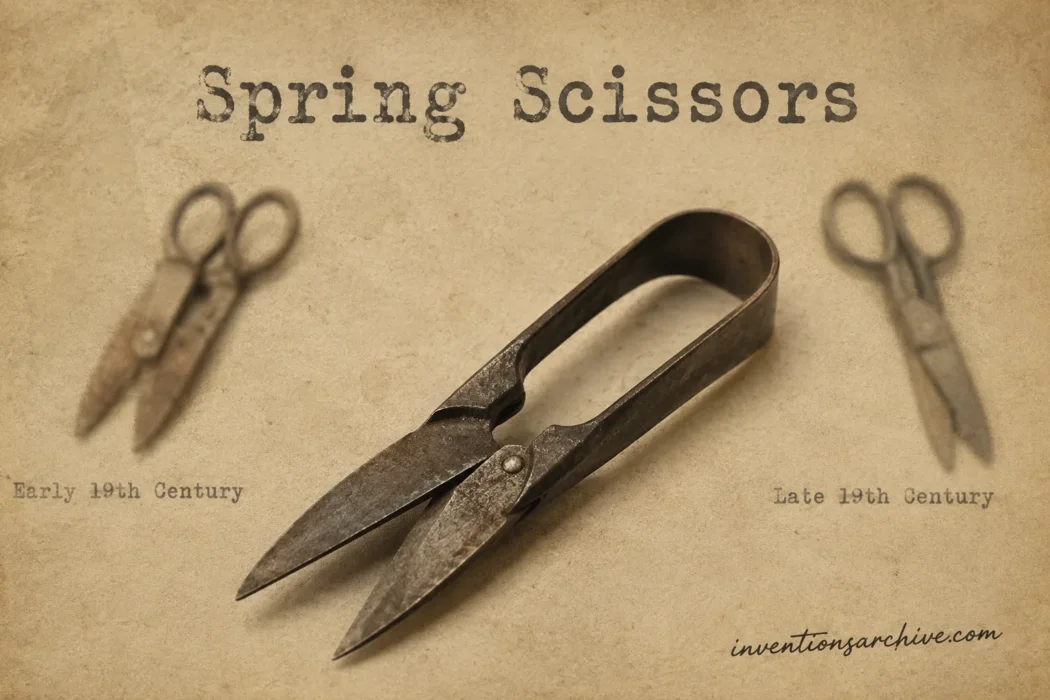
| Invention Name | Spring Scissors, also called Bow Shears or Spring Shears |
|---|---|
| Short Definition | A two-bladed cutting tool whose flexible bow stores elastic energy and returns the blades to the open position. |
| Approximate Date or Period | Approximate Surviving Middle Eastern evidence is about three millennia old; the exact first appearance remains uncertain. |
| Geography | Early evidence from the Middle East, followed by documented forms in the Mediterranean world, Europe and East Asia |
| Inventor or Source Culture | Attribution varies No individual inventor is known; related forms may have developed within several metalworking traditions. |
| Category | Hand tool, cutting technology and spring mechanism |
| Importance | It placed a connection, movement guide and return spring within one compact mechanical form. |
| Evidence Status | Based on surviving evidence Physical objects confirm long use, but they do not identify the first maker or first place of invention. |
| Main Problem Solved | Repeatable two-blade cutting without manually pulling the blades apart after every cut |
| How It Works | Hand pressure closes the blades and bends the bow; releasing that pressure allows the bow to recover and reopen them. |
| Material or Technical Basis | Elastic deformation in the bow combined with harder, edge-holding blade sections |
| Early Use Context | Textile work, wool shearing, hair cutting and other repeated cutting tasks; some surviving examples have medical or ritual associations. |
| Development Path | Non-linear Bronze spring shears → iron and steel bow shears → pivot scissors → modern pivoted tools with added return springs |
| Modern Descendants | Thread snips, traditional wool shears, spring-action craft scissors and adaptive self-opening scissors |
A Cutting Tool Built Around Elastic Return
A conventional pivot scissor places two crossed blades around a central fastener. Ancient spring scissors used another arrangement. Their blades extended into arms connected by a curved strip or loop of metal. This bow joined the two sides and supplied the force that opened them.
When the arms were squeezed, the opposed edges moved together and the bow changed shape. Once the grip relaxed, the metal attempted to recover its previous form. That recovery separated the blades and prepared the tool for another cut.
The Cut and the Return Stroke
The mechanism divides each cycle into two movements. The user supplies the closing force. The spring supplies the return movement.
Elastic materials can store energy while they are being deformed and exert a restoring force when the external load is removed. This general physical behaviour explains why the bow can function as a return spring, provided that its deformation remains within a range from which the metal can recover.[b]
The bow does not create the cutting force by itself. Its primary historical role is to reopen the blades. A stronger spring can produce a faster return, but it also resists the hand during closing. Tool makers therefore had to balance recovery, comfort, blade travel and resistance.
One Flexible Element Performed Several Jobs
The bow was mechanically economical. It reduced the need for separate hinges, springs and return levers, yet its apparent simplicity concealed several demands.
| Element | Mechanical Role | Design Demand |
|---|---|---|
| Opposed blades | Pass against one another and divide material by shearing. | Hard enough to retain usable edges without becoming too brittle |
| Arms | Carry hand pressure from the grip area toward the blades. | Resist unwanted bending that would disturb blade contact |
| Bow or loop | Connects the two sides, stores elastic energy and reopens the blades. | Flexible enough to bend repeatedly without taking a permanent set |
| Blade contact line | Keeps the cutting edges close enough to produce a shearing action. | Remain aligned as the bow flexes and the tool ages |
| Grip area | Receives the closing force from the hand. | Provide control without adding excessive closing travel |
In modern engineering language, the bow behaves as a compliant element. Its movement comes from controlled flexure within the material rather than rotation around a separate joint. The ancient maker would not have used that term, but it describes the mechanical distinction accurately.
What Changed When the Blades Reopened Themselves
Knives and razors were already effective cutting tools. They did not, however, perform the same action as a pair of opposed blades. A single edge usually moves across material supported by a surface, tensioned by the other hand or held against another object. Spring shears brought the cutting edges together within the tool itself.
| Single-Edge Cutting | Cutting with Spring Shears |
|---|---|
| A knife or razor presses or draws one edge through supported material. | Two opposed edges pass closely against one another. |
| The material often needs a backing surface, tension or careful hand positioning. | The material can be placed between the blades and divided within the tool. |
| The cutting tool does not contain a mechanism that resets a second edge. | The bow automatically returns both blades toward their open position. |
| Repeated short cuts may require repositioning the blade and material separately. | Repeated squeezing can produce a sequence of short, controlled cuts. |
| Well suited to slicing, shaving, scraping and cuts against a surface | Well suited to trimming fibres, hair, thread, cloth edges and fleece |
This difference mattered most in work made up of many short cutting cycles. The tool reopened itself while the other hand remained available to hold, tension or reposition the material.
The improvement was task-specific. Spring shears did not replace knives, and a knife could remain better for long slices, food preparation, scraping or work against a board. The inventions continued beside one another because they produced different kinds of cut.
The Metallurgy Hidden in the Bow
The blades and the bow required opposing material behaviour. A cutting edge benefited from hardness and resistance to wear. The spring section needed flexibility, resistance to repeated bending and enough strength to return the arms to their original separation.
A tool made uniformly soft could bend permanently or lose its edge. A tool made uniformly hard could hold a sharper edge yet become vulnerable to cracking at the bow. The maker had to control the properties of different zones or combine pieces with different characteristics.
Research discussed by the Institute of Evolutionary Biology describes this as a demanding problem in Roman ironworking. The bow needed relatively soft, flexible iron while the blades required harder material. Producing both was possible, but joining them within one dependable tool introduced another manufacturing difficulty.
Regional designs did not follow one straight sequence of improvement. Early Chinese spring shears could be formed from a single piece of iron, while some Roman forms brought separate parts together. Material quality, furnace practice, forging knowledge and local traditions affected what could be produced reliably.
What Surviving Objects Can and Cannot Prove
Archaeological scissors are often incomplete, corroded or removed from their original working environment. Even so, preserved examples reveal blade geometry, bow shape, material choice, decoration and the contexts in which the tools were deposited.
Late Iron Age Shears from Hertford Heath
A pair of iron shears in the British Museum came from a high-status cremation grave at Hertford Heath in England. The burial is dated to about 30–15 BCE. The object has two curved blades joined by a flattened iron bar formed into an omega-shaped handle. The catalogue also records wood traces and fabric impressions on the surviving surfaces.[c]
The object confirms that a developed spring-shear form existed in Late Iron Age Europe. Its burial context does not by itself identify the owner’s occupation or prove that the shears were used for one specific material. Fabric impressions may result from wrapping, contact inside the grave or an association with textile work; the object record does not settle that question.
A Decorated Roman Pair from Anatolia
The Metropolitan Museum of Art holds elaborately inlaid shears assigned, with caution, to the second century CE. They are reported as coming from the area of ancient Trebizond in Anatolia and were made from bronze or copper alloy with silver and a dark copper material. Figures decorate both sides of the blades, creating paired animal scenes when the shears close.[d]
Related articles: Lever [Ancient Inventions Series]
The museum describes the decoration as Egyptianizing rather than Egyptian and suggests that the object may have served a ritual purpose at a sanctuary of Isis. The wording remains deliberately cautious. The shears demonstrate that the form could carry decorative and possibly ceremonial meaning, but the proposed ritual setting is not a confirmed use history.
Small Roman Shears in a Medical Collection
The Science Museum Group catalogues two small bronze Roman pairs dated to 201–500 CE. One is described as a 68-millimetre surgical shear and is held within a collection devoted to classical and medieval medicine.[e]
That classification is evidence for a medical interpretation of these particular objects. It should not be extended to every small ancient shear. Similar dimensions could suit grooming, thread cutting or delicate craft work, and many archaeological tools survive without enough contextual information to distinguish among those uses.
Spring Shears and Pivot Scissors Used Different Architectures
Spring shears are sometimes presented as primitive versions of modern scissors. That description hides the main mechanical difference. A bow shear obtains movement by bending its connecting metal. Pivot scissors obtain movement by rotating two separate members around a central joint.
| Design Feature | Spring Shears | Pivot Scissors |
|---|---|---|
| Main movement | Controlled bending of a bow or loop | Rotation around a rivet, screw or similar joint |
| Opening stroke | Produced automatically by the recovering bow | Usually produced by finger movement unless an additional spring is fitted |
| Blade relationship | Blades remain on arms connected behind the grip area. | Blades cross at the pivot and continue into separate handles. |
| Alignment control | Depends heavily on bow shape, arm stiffness and even deformation. | Depends heavily on joint fit, pivot tension and blade geometry. |
| Common wear problem | Bow fatigue, permanent bending or fracture | Pivot loosening, joint wear or excessive blade clearance |
| Useful working pattern | Fast repeated squeezing with automatic reopening | Controlled opening and closing over a wider range of blade lengths and handle forms |
Why Pivoted Forms Expanded
A central joint made it easier to control where two long blades crossed. It also allowed makers to vary the relationship between handle length, blade length and pivot position. Finger bows could actively open and close the tool, reducing dependence on a large flexible section behind the blades.
Pivot scissors still created their own engineering problems. The joint had to remain tight enough to hold the edges together without producing excessive friction. Wear could create a gap between the blades, while corrosion or dirt around the fastener could restrict movement.
Why the Bow Form Did Not Disappear
The pivot design became common for sewing, household cutting and many precision tasks, but the integrated bow retained advantages where automatic reopening and a direct squeezing grip were useful. Traditional wool shears and compact thread snips preserve the basic arrangement with little need for a central joint.
A bow shear also contains very few independent moving components. There is no pivot screw to loosen. Its weakness appears elsewhere: the bow is repeatedly stressed and can become the first region to deform or break.
From an Integrated Bow to an Added Spring
Modern “spring scissors” can refer to tools that differ sharply from ancient bow shears. Many contemporary versions are ordinary pivot scissors fitted with a separate compression spring, leaf spring or torsion spring. The pivot controls the blade movement, while the added spring supplies the return stroke.
| Stage | Form | What Changed |
|---|---|---|
| Early Spring Form | Two blades connected by a bronze or iron bow | The connecting metal performed the return movement without a central pivot. |
| Regional Iron Forms | Single-piece or joined iron and steel bow shears | Different metalworking traditions altered bow shape, blade quality and assembly. |
| Pivot Form | Crossed blades rotating around a central fastener | Blade guidance shifted from controlled flexure to a rotary joint. |
| Spring-Assisted Pivot Form | Pivot scissors with a spring between the handles or around the joint | Automatic reopening returned as a separate function added to the pivot mechanism. |
| Adaptive Form | Self-opening scissors with enlarged or whole-hand grips | The return spring became part of an accessibility and strain-reduction strategy. |
A United States patent published in 1991 illustrates one modern branch of this development. The design placed a torsion spring inside recesses around the pivot of kitchen shears. Enclosing the spring was intended to protect it from exposure, reduce obstruction between the handles and limit direct contact with the user’s fingers.[f]
The patent did not introduce the general idea of self-opening shears. That mechanism was already ancient. Its subject was a narrower engineering change: placing a separate return spring within a pivoted tool and shielding it from conditions that could shorten its service life.
The Return Spring as an Accessibility Feature
Self-opening action later gained another purpose. It could reduce the amount of active finger movement required to reopen scissors after each cut.
Dorset County Hospital’s hand-therapy guidance describes adapted scissors with larger grips and a spring that makes opening easier for people affected by hand osteoarthritis.[g] Related occupational-therapy designs may use continuous loop handles or whole-hand squeezing rather than small finger rings.
The mechanical benefit is specific. The spring assists the return stroke. It does not guarantee a low closing force, and an unsuitable spring can still increase fatigue. Handle shape, blade condition, joint friction and the material being cut also affect how much effort the tool requires.
Modern adaptive scissors may include a guard or locking device because their natural resting state is open. The safety feature answers a problem created by the return mechanism itself: a tool designed to reopen automatically also needs a dependable way to remain closed during storage.
Failure Patterns Reveal the Limits of the Design
Elastic Fatigue
Repeated bending places alternating stress in the bow. Small defects, corrosion pits or unevenly worked areas can become starting points for cracks. The tool may continue working while damage develops, then fail at the curved section where movement is concentrated.
Permanent Set
If the bow is forced beyond the range from which it can recover, it may retain part of the bent shape. The blades then reopen less fully, sit at a different angle or lose the pressure needed to pass closely against one another.
Blade Misalignment
The spring and the blade guide are part of the same structure in a traditional bow shear. Uneven deformation can therefore disturb the cutting edges as well as the opening action. The blades may meet near one end while leaving too much space elsewhere.
Corrosion at the Most Stressed Area
Corrosion removes metal and creates irregular surfaces. Damage near the bow is especially serious because that section must flex repeatedly. Archaeological examples often preserve the thicker blades better than the thinner or more heavily stressed parts of the spring.
Spring Resistance
A return spring can make repeated work easier only when its force suits the task. Too little resistance produces an incomplete return. Too much resistance makes closing difficult and can transfer unnecessary load to the hand. The same balance shaped ancient bow shears and remains relevant in modern spring-assisted scissors.
Sources and Verification
- [a] Scissors Evolve Too: Cultural Evolution on Darwin Day — Used to verify the uncertain origin, approximate age of surviving Middle Eastern spring scissors, regional forms and the metallurgical contrast between flexible bows and harder blades. (Reliable because it is published by the Institute of Evolutionary Biology, a joint CSIC and Pompeu Fabra University research institute.)
- [b] 5.3 Elasticity: Stress and Strain — Used to verify the physical principle that elastic deformation produces a restoring force when the applied load is removed. (Reliable because OpenStax is an academic educational publisher based at Rice University.)
- [c] British Museum: Shears, Museum Number 1958,0704.667 — Used to verify the 30–15 BCE burial date, iron construction, omega-shaped handle and archaeological context of the Hertford Heath shears. (Reliable because it is the British Museum’s direct catalogue record for the object.)
- [d] The Metropolitan Museum of Art: Shears — Used to verify the probable second-century CE date, Anatolian provenance, materials, decoration and cautious ritual interpretation of the Roman-period object. (Reliable because it is the museum’s direct curatorial record.)
- [e] Science Museum Group Collection: Two Pairs of Ancient Roman Scissors — Used to verify the 201–500 CE date, bronze material, dimensions and medical collection classification of the small Roman shears. (Reliable because it is the Science Museum Group’s direct object catalogue.)
- [f] US5063671A – Kitchen Shears with Hiding Spring — Used to verify the 1991 pivoted kitchen-shear design with an enclosed torsion spring and storage lock. (Reliable because the page reproduces the published patent record and links to the United States patent system.)
- [g] Hand Osteoarthritis and Adaptive Devices — Used to verify the use of larger grips and self-opening springs in adapted scissors for people with hand osteoarthritis. (Reliable because it is patient guidance written by hand-therapy and occupational-therapy staff at an NHS hospital.)