
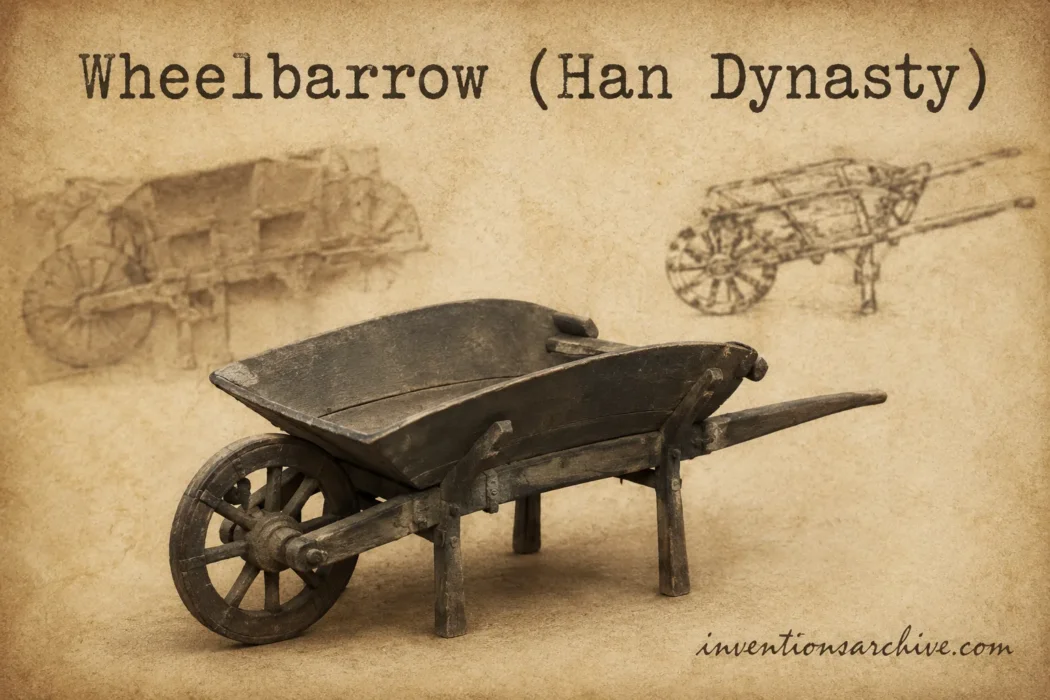
| Invention Name | Wheelbarrow |
|---|---|
| Short Definition | A hand-propelled carrier that places a load on a frame supported partly by a single wheel. |
| Approximate Date or Period | Possible textual references in the late Western Han; secure images from the Eastern Han, especially the 2nd century CE Based on surviving evidence |
| Geography | Han China; the clearest early pictorial evidence is associated with Sichuan and other Eastern Han tomb contexts. |
| Inventor or Source Culture | Anonymous or collective development within early imperial China; later tradition links some forms to Zhuge Liang. |
| Category | Transport, agriculture, construction, trade, and material handling |
| Evidence Status | Confirmed pictorial evidence Earlier date debated Attribution varies |
| Main Problem Solved | Moving compact loads with one operator where shoulder carrying, two-person barrows, or wider carts were less practical. |
| How It Works | The wheel supports part of the load while the handles let the operator lift, balance, steer, and push the frame. |
| Material and Technology Basis | Wooden frame, wooden wheel and axle, joined carrying platform or box, and two handles; later versions added metal fittings, improved tires, and new tray materials. |
| Early Use | Local transport of goods, household loads, farm produce, building material, and supplies; some later Chinese forms also carried passengers. |
| Surviving Evidence | Eastern Han tomb murals, carved stone reliefs, pictorial bricks, historical texts, and later illustrations. |
| Development Path | Shoulder poles and handbarrows → one-wheel carrier → central-wheel and front-wheel forms → metal, rubber-tired, two-wheel, and powered descendants |
| Main Variations | Central-wheel Chinese barrow; front-wheel barrow; open platform; box or tray form; passenger carrier; two-wheel barrow; powered barrow. |
| Impact Areas | Transport, agriculture, construction, mining, markets, gardens, workshops, and local distribution. |
| Predecessors | Carrying baskets, shoulder poles, sledges, two-person handbarrows, and two-wheeled carts. |
| Later Forms | European front-wheel barrows, steel-tray barrows, pneumatic-tire models, stable two-wheel models, and compact powered carriers. |
| Related Inventions | Wheel and axle, lever, handbarrow, cart, spoked wheel, tire, hand truck, and compact dumper. |
| Modern Descendants | Garden wheelbarrows, builders’ barrows, two-wheel utility carts, battery-powered barrows, and tracked mini transporters. |
| Main Attribution Question | Zhuge Liang is linked to later named transport devices, but Han images predate his best-known activity Attribution varies |
A wheelbarrow is a compact transport machine built around a simple idea: place a wheel beneath part of the load and let one person control the remaining weight through two handles. In Han China, that arrangement produced more than a garden tool. It became a narrow-track carrier suited to farms, streets, building sites, workshops, and local routes where a full cart could be awkward.
What the Han Wheelbarrow Was
The Han-period wheelbarrow was a human-powered load carrier with one wheel, a supporting frame, and handles. The operator pushed or guided it while the wheel carried part of the mass. This separated it from a two-person handbarrow, which suspended the full load between carriers, and from a two-wheeled cart, which usually required more width and often an animal or a second person.
Early Chinese forms were not all identical. Some reconstructions and later illustrations show a large wheel placed near the center of the load. That layout transferred a high share of the weight to the axle. The operator supplied forward force and balance rather than holding most of the cargo in the hands. Balance depended on where the load sat, not only on how heavy it was.
The one-wheel layout also reduced the width of the running path. A barrow could pass along narrow field edges, lanes, bridges, and work areas that were less comfortable for a broad cart. It still needed a passable surface, and it could become unstable if loaded unevenly, but its route needs were modest.
How the Origin Is Traced
Wheelbarrow history is reconstructed from several types of evidence, including references in early texts, dated tomb art, carved reliefs, pictorial bricks, later technical descriptions, and comparisons with surviving traditional forms. Each type of source helps clarify a different part of the wheelbarrow’s development and use.
Dated images are particularly useful because they can reveal the position of the wheel, the shape of the frame, the operator’s role, and how loads were carried. UNESCO’s historical account refers to a Han-period tomb frieze along with several other illustrations from the period, supporting the view that wheelbarrows were recognizable working devices rather than inventions known only from later written descriptions.
Han tomb reliefs must still be read with care. They were made for funerary settings, not as engineering drawings. Their purpose was to represent activities, status, stories, or an idealized continuation of life. Even so, the images preserve practical details that artists and viewers expected to recognize. Tokyo National Museum’s account of Eastern Han stone reliefs explains the wider tomb and shrine tradition in which scenes of buildings, vehicles, work, and ritual were carved during the 1st and 2nd centuries CE.[b]
What Counts as the First Wheelbarrow?
The phrase “first wheelbarrow” can mean several things:
- the first device ever made, which may leave no surviving trace;
- the earliest written phrase that might describe one;
- the earliest image clear enough to identify the mechanism;
- the first preserved physical example;
- or the first form that became widely used.
For Han China, the earliest secure surviving depictions are stronger evidence than the name of a supposed inventor. A dated picture proves that a recognizable form existed by that date. It does not prove that the pictured example was the very first one made.
The Greek Evidence Question
Historian M. J. T. Lewis compared the Chinese evidence with Greek building inventories from 408/407 and 407/406 BCE that mention a body for a “one-wheeler.” His study also discusses a Chengdu-area Han image commonly dated to 118 CE and another Sichuan relief placed around 150 CE. The Greek wording may indicate a construction wheelbarrow, but no matching image or surviving machine confirms its exact form, and no clear continuous European tradition follows from it.[c]
This evidence changes the wording of a careful claim. It is reasonable to describe Han tomb images as among the earliest secure pictorial records of a true wheelbarrow. It is harder to prove that no one in any other region had ever tried a one-wheel carrier earlier.
The Problem It Answered
People could move goods long before the wheelbarrow. They used baskets, shoulder poles, pack animals, sledges, handbarrows, and carts. The issue was not the absence of transport. It was the gap between what one person could carry and what a larger vehicle could conveniently reach.
A shoulder pole distributed weight across the body but still required the carrier to bear the full load. A handbarrow could move bulky material, yet it usually occupied two people. A cart carried more, though its two wheels needed a wider path, and its axle and draft arrangement made it less agile in confined spaces.
The wheelbarrow occupied the middle ground. It helped one worker move a compact load while using a single track. The practical gain came from weight transfer, balance, and access, not from the wheel alone.
| Before the Invention | What Changed After It |
|---|---|
| One carrier bore the full weight in baskets or on a shoulder pole. | The wheel supported part of the load while the operator lifted and balanced the remainder. |
| A handbarrow often required two people. | One person could move a load that still needed close steering. |
| Two-wheel carts needed a wider track and more turning space. | A single wheel could follow a narrow path and turn in a smaller work area. |
| Loose soil, bricks, harvested produce, and workshop goods were moved in repeated small carries. | A tray, platform, or box allowed more material to move in each trip. |
| Load carrying and steering were often separate tasks or shared between workers. | The handles combined lifting, balance, propulsion, and steering in one operator’s control. |
| Large carts were inefficient for short movements inside farms, yards, and building areas. | The wheelbarrow served short-distance transport between storage, work, and delivery points. |
How the Mechanism Worked
The wheelbarrow combines two old mechanical ideas: the wheel and axle and the lever. The wheel reduces sliding friction by rolling. The frame and handles act as a lever around the wheel or axle region. When the load is positioned close to that support point, the operator needs less upward force at the handles.
The University of Houston’s engineering history explanation describes this balance clearly: the wheel carries much of the load, while the handles give close directional control. It also notes that poor load placement can make the same barrow much harder to manage.[d]
Load Position
Position matters as much as total mass. Cargo placed nearer the wheel reduces the lifting force required at the handles. Cargo placed too far behind the wheel increases the operator’s burden. Cargo placed unevenly to one side makes the vehicle harder to balance.
Chinese central-wheel forms could place the wheel beneath or within the load area. This reduced the share held by the operator but required space around the wheel and careful side-to-side balance. Later European front-wheel forms left a more open tray behind the wheel, which made loading simple but placed more weight in the user’s hands.
Steering and Surface
A single wheel follows a narrow line, but the operator must prevent the frame from tipping. Firm paths make this easier. Deep mud, loose stone, steep slopes, and uneven loading increase the effort. The invention did not remove physical labor; it changed how the labor was distributed.
Materials and Construction
Han-period examples are known mainly through images rather than preserved complete machines. Their likely material was wood: a wooden wheel, axle, frame, handles, and load platform or box. Wooden transport equipment was practical to repair, but it rarely survives for two thousand years unless buried in unusual conditions.
Carpenters already knew how to build wheels, carts, joints, frames, and load beds. The wheelbarrow did not require a new material. It required a new arrangement of known parts. That is one reason a single named inventor is difficult to establish. Craftspeople could refine wheel placement, frame shape, axle support, and carrying surfaces through repeated use.
Later barrows added iron straps, nails, rim protection, metal wheels, sheet-metal trays, molded polymer tubs, rubber tires, and pneumatic tires. Each change addressed wear, corrosion, impact, traction, capacity, or comfort. The basic geometry remained recognizable.
Early Uses in Han China
The pictorial record places the wheelbarrow in a wider setting of work and movement. Han tomb scenes often show vehicles, workshops, food preparation, farming, servants, animals, buildings, and processions. Within that visual language, a one-wheeled carrier belonged to ordinary transport rather than ceremonial display alone.
Likely and later well-documented uses included:
- moving grain, vegetables, fuel, tools, and household goods;
- carrying soil, stone, brick, timber pieces, and other building material;
- taking produce between fields, storage areas, roads, and markets;
- moving loads through lanes too narrow for a conventional cart;
- supporting workshop, estate, and local distribution work;
- and, in some later Chinese forms, transporting a seated passenger or balanced side loads.
Not every listed use is visible in the earliest surviving Han image. The broader list reflects the functions documented across the later Chinese wheelbarrow tradition. The safest early statement is that the device was a practical carrier for people and goods.
Development from Earlier Carriers
The wheelbarrow belongs to a longer history of human-powered transport. Baskets and shoulder poles were simple and flexible. Sledges moved heavy material over prepared ground. Handbarrows spread a load between two carriers. Carts shifted weight onto wheels but needed more width and a larger frame.
The one-wheel carrier combined parts of these systems. It retained the close human control of a handbarrow, borrowed wheel and axle knowledge from carts, and reduced the path width to a single rolling line. The result was not a smaller cart in every respect. It was a separate solution with its own balance rules.
| Stage | Form | What Changed |
|---|---|---|
| Earlier Tools | Baskets, shoulder poles, sledges, and two-person handbarrows | Loads could be moved, but people carried most or all of the weight. |
| Existing Wheel Technology | Two-wheel carts and chariots | Wheel, axle, frame, joinery, and road-use knowledge were already available. |
| Han One-Wheel Carrier | Wooden frame with one wheel and two handles | One operator could move and steer a load on a narrow track. |
| Later Chinese Forms | Large central wheel with platforms, boxes, racks, or seats | More of the load could rest over the axle; layouts adapted to freight and passenger use. |
| European Medieval Forms | Front wheel with tray or platform behind it | Loading space became open and simple, while the operator carried a larger share at the handles. |
| Industrial Forms | Metal frames, steel trays, improved rims, and rubber tires | Durability, traction, and maintenance improved. |
| Modern Descendants | Two-wheel, powered, battery, and tracked carriers | Stability and carrying capacity rose while the human pushing effort fell. |
Could the Idea Be Older?
One scholarly study of Chinese wheeled vehicles discusses possible single-wheel traces and early written signs that might push the idea further back than the Han. The evidence is not firm enough to replace the Eastern Han depictions as the safest reference point. Wheel ruts can be incomplete, and an old written character may describe a handcart without revealing its exact wheel count.[e]
Possibility is not the same as identification. An earlier date may become more convincing if a clear object, dated image, or unambiguous text is found. Until then, the 2nd-century pictorial evidence remains the stronger foundation.
Main Forms and Variations
| Variation | Typical Layout | Practical Character |
|---|---|---|
| Han Pictorial Form | Single wheel, wooden frame, handles, compact load area | Early evidence confirms the recognizable one-wheel carrier, though artistic detail varies. |
| Central-Wheel Chinese Barrow | Large wheel under or within the load area | Places much of the cargo over the axle; suited to balanced side or platform loads. |
| Front-Wheel Barrow | Wheel at the front with a tray behind | Simple loading and dumping; more handle weight for the operator. |
| Open Platform Barrow | Flat or lightly framed carrying bed | Useful for sacks, bundles, tools, and irregular loads. |
| Box or Tray Barrow | Deep-sided container on the frame | Holds soil, grain, rubble, compost, and loose material. |
| Passenger Form | Seat or balanced carrying position near a central wheel | Documented in later Chinese practice; designed around balance rather than dumping. |
| Two-Wheel Barrow | Two parallel wheels under a tray | More stable when standing or moving slowly, but wider and less agile on narrow tracks. |
| Powered Barrow | Motor or battery drive with wheels or tracks | Moves heavier loads in restricted work areas while preserving compact dimensions. |
Sail-Assisted Forms
Later observers described large Chinese wheelbarrows fitted with sails. These were not the standard Han form, and their earliest date is uncertain. They show how far the one-wheel carrier could be adapted when roads, winds, cargo patterns, and local craft knowledge allowed it.
The sail did not remove the need for an operator. It supplied extra forward force under suitable conditions, while the person still balanced and guided the vehicle. This was a later branch of the tradition, not evidence that Han wheelbarrows carried sails.
What Changed Because of It
The wheelbarrow altered small-scale transport by making one worker more capable over short distances. Its value was strongest where loads were too bulky for comfortable carrying but too small, frequent, or confined for a large cart.
Several work patterns became easier:
- Farm work: produce, soil amendments, tools, seed, and harvested material could move between closely spaced points.
- Building work: earth, stone, brick, mortar ingredients, and debris could move through active work areas.
- Markets and local trade: one person could transport goods through lanes and crowded spaces.
- Workshops and estates: fuel, raw material, containers, and finished goods could move without assigning two carriers.
- Road and landscape work: loose material could be carried and tipped at precise locations.
The wheelbarrow did not replace carts, pack animals, or shoulder carrying. It added a useful scale of transport between them. This is why it remained alongside larger vehicles rather than making them obsolete.
Labor and Access
Its effect on labor was practical rather than absolute. One person could perform a task that might otherwise require two, or could move more material per trip than by hand. Yet the operator still supplied propulsion, steering, and balance. On poor ground, the work could remain demanding.
The narrow wheel track also mattered. Fields, terraces, paths, alleys, and partly built structures often limited vehicle width. A one-wheel carrier could enter spaces that a broad axle could not use comfortably.
Zhuge Liang and the Wooden Ox
Zhuge Liang, who lived from 181 to 234 CE, is often named as the inventor of the Chinese wheelbarrow or of devices called the “wooden ox” and “gliding horse.” The surviving record does not support a simple claim that he created the wheelbarrow from nothing.
UNESCO’s account of the “Wooden Ox” connects the tradition with Chinese one-wheel transport while also presenting Han engravings of rural life and labor. Since dated Han images precede Zhuge Liang’s mature career, his role is better treated as a later attribution, adaptation, or association with specialized transport, not secure authorship of the basic invention.[f]
The names themselves are another source of uncertainty. Historical texts do not provide a modern technical drawing that proves every “wooden ox” or “gliding horse” had the same construction. Some descriptions may refer to related carriers rather than one fixed model.
Common Misunderstandings
“Zhuge Liang Invented It in 231 CE”
This is too exact. Eastern Han images appear earlier. His name belongs to the later tradition around specialized carriers, not to a proven first construction date.
“The Earliest Picture Proves the First Use”
A surviving picture proves that the device existed by the date of the image. The actual working idea may have appeared earlier in forms that left no trace.
“All Wheelbarrows Put the Wheel at the Front”
Many modern garden models do. Traditional Chinese forms often placed a large wheel nearer the center, allowing the axle to support more of the load.
“It Was Only a Farm Tool”
Wheelbarrows served farming, building, workshops, markets, road work, household transport, and later passenger movement. Their value came from compact load handling, not from one trade alone.
“China’s Evidence Rules Out Every Earlier Experiment Elsewhere”
The Han record is unusually clear, but disputed Greek wording may point to an earlier one-wheel carrier. The evidence supports careful comparison rather than an absolute global claim.
Related Inventions
- Wheel and Axle: The rolling support that carries part of the load.
- Handbarrow: A two-person carrier that supplied the frame-and-handles concept without a wheel.
- Shoulder Pole: A flexible human-carrying system used for balanced loads.
- Two-Wheeled Cart: An older vehicle tradition that supplied wheel, axle, frame, and joinery knowledge.
- Spoked Wheel: A lighter wheel form used in many vehicles and adaptable to one-wheel carriers.
- Iron Tire and Rubber Tire: Later rim technologies that improved wear resistance and traction.
- Hand Truck: A different compact lever-and-wheel carrier for upright loads.
- Powered Mini Dumper: A motorized descendant for heavier short-distance material movement.
Frequently Asked Questions
Was the Wheelbarrow Invented During the Han Dynasty?
The clearest surviving Chinese evidence comes from the Han period, especially Eastern Han tomb images from the 2nd century CE. Earlier textual hints exist, but their exact meaning is debated.
Who Invented the Han Chinese Wheelbarrow?
No securely identified inventor is known. The device is better understood as a collective development among carpenters, carriers, farmers, builders, and transport users. Zhuge Liang was linked to later named forms, but Han depictions predate him.
What Is the Earliest Surviving Evidence?
The strongest early evidence consists of Eastern Han tomb murals and reliefs showing recognizable one-wheeled carriers from the 2nd century CE.
How Did a Chinese Wheelbarrow Differ from a Common Modern One?
Many traditional Chinese designs placed a large wheel near the center of the load, so the axle carried much of the weight. A common modern garden barrow places the wheel at the front and the tray behind it, leaving more weight on the handles.
Why Was One Wheel Useful?
One wheel gave the vehicle a narrow running line and tight steering. It could enter paths and work areas that were inconvenient for a wider cart, while still transferring part of the load from the operator to the ground.
Sources and Verification
- [a] The Wheelbarrow — Used to verify the Han tomb frieze evidence and the presence of several period illustrations. (Reliable because it is preserved in UNESCO’s institutional document archive.)
- [b] Stone Relief Carvings of China — Used to verify the dating and funerary setting of Eastern Han stone relief traditions. (Reliable because it is an official Tokyo National Museum exhibition record.)
- [c] The Origins of the Wheelbarrow — Used to verify the debated ancient Greek “one-wheeler” interpretation and the limits of absolute first-invention claims. (Reliable because it is a peer-reviewed history of technology article preserved by JSTOR.)
- [d] Wheelbarrow | The Engines of Our Ingenuity — Used to verify the wheel-and-lever explanation and the effect of load position on operator effort. (Reliable because it is an engineering history resource published by the University of Houston.)
- [e] Wheeled Vehicles in the Chinese Bronze Age (c. 2000–741 B.C.) — Used to verify the broader Chinese vehicle history and the uncertainty surrounding possible pre-Han one-wheel evidence. (Reliable because it is a detailed scholarly study with archaeological and inscriptional discussion.)
- [f] ‘The Wooden Ox’, the world’s first wheelbarrow — Used to verify the traditional “wooden ox” association and its relation to Han-period rural engravings. (Reliable because it is preserved in UNESCO’s institutional document archive.)