
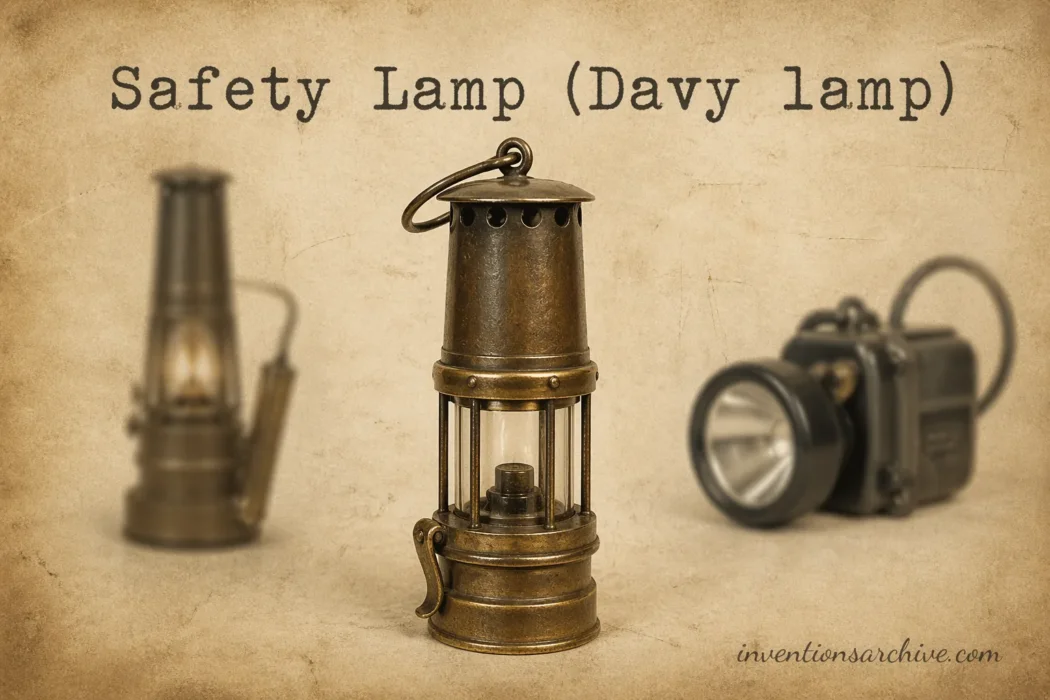
| Invention Name | Davy lamp (miners’ safety lamp) |
|---|---|
| Short Definition | An oil lamp whose flame is enclosed by fine metal gauze to reduce the chance of igniting a flammable mine atmosphere. |
| Approximate Date or Period | Confirmed Developed in 1815; mine trials followed in early 1816 |
| Geography | London and the coalfields of North East England |
| Inventor or Source Culture | Commonly attributed to Sir Humphry Davy; developed during parallel British work on mine safety lamps |
| Category | Mining safety, illumination, combustion science |
| Importance | Made enclosed-flame lighting practical in many gassy coal workings and became a major nineteenth-century mining safety technology. |
| Evidence Status | Confirmed Original prototypes, contemporary papers, drawings and early lamps survive |
| Main Problem Solved | Reducing ignition of firedamp by the naked flames used for underground lighting |
| Development Path | Experiments with flame transmission through restricted passages led to an oil flame surrounded by heat-absorbing wire gauze. |
| How It Works | The metal gauze conducts heat away from a flame attempting to pass through its small openings, helping prevent flame propagation beyond the enclosure. |
| Material or Technical Basis | Oil lamp, metal reservoir and protective fine wire-gauze enclosure |
| Early Use Context | Coal mines where methane-rich firedamp made candles and other exposed flames especially hazardous |
| Related Developers | William Reid Clanny and George Stephenson |
The Lighting Problem Beneath the Coalfields
Early nineteenth-century coal mining depended heavily on exposed flames. Candles and simple oil lamps were convenient sources of underground light, but some coal seams released flammable gas into the workings. Miners called this dangerous atmosphere firedamp, a term applied especially to mixtures containing methane. When enough methane mixed with air, an ordinary flame could ignite the mixture and produce a mine explosion.
The danger was already well known, but expanding and deepening coal workings increased pressure to find a practical light that could be carried into places where firedamp might occur. The 1812 explosion at Felling Colliery near Gateshead, in which 92 men and boys were killed, became one of the disasters that intensified organized efforts to improve mine safety. The Sunderland-based Society for Preventing Accidents in Coal-Mines subsequently sought technical solutions and approached leading investigators, including Humphry Davy.[a]
Davy was not entering an untouched field. Sunderland physician William Reid Clanny had already presented an early safety-lamp design in 1813. His approach isolated the flame and used a mechanically supplied airflow, but the resulting apparatus was cumbersome for routine mining. By 1815, engineer George Stephenson was also independently experimenting with safer lamps at Killingworth Colliery. The history of the safety lamp is therefore better understood as a concentrated period of parallel invention than as a problem suddenly solved by one person alone.[b]
Davy’s Experiments in the Autumn of 1815
Davy began focused work on the firedamp problem at the Royal Institution in London in the autumn of 1815. The institution’s surviving collection dates his sequence of prototype work to approximately October through December. Rather than beginning with the familiar finished lamp, he investigated a more basic question: under what conditions could a flame inside a lighting device be prevented from igniting an explosive mixture outside it?
Experiments showed that flame transmission could be interrupted when combustion had to pass through sufficiently restricted metallic passages. The metal removed heat from the hot gases associated with the flame. Davy explored several arrangements before applying this principle to lamps and lanterns. His research was presented to the Royal Society in a paper read on 9 November 1815, later published in the 1816 volume of Philosophical Transactions. The Royal Society still preserves the manuscript and drawings associated with this work.[c]
The speed of the development is notable. Several designs appeared during a short experimental period, and Davy continued refining the enclosure as his understanding of flame behavior improved. A further paper read to the Royal Society on 11 January 1816 described the use of wire gauze around the flame, the arrangement that became most closely associated with his name.
Why Wire Gauze Could Contain a Flame
The defining feature of the Davy lamp is not that it removes the flame. It places the flame inside a metal barrier that admits air and allows light to escape while restricting the transmission of combustion into the surrounding atmosphere.
Flame propagation requires sufficiently hot reacting gases to ignite the next portion of combustible mixture. In a Davy lamp, the numerous metal wires present a large heat-conducting surface around the small openings in the gauze. When a flame reaches this barrier, heat is transferred into the metal. The gases passing through the openings can consequently be cooled below the conditions needed for the flame front to continue outward.
This distinction is important. The gauze is not a solid wall sealing the lamp from the mine air. Air can move through it, and a flammable mixture can enter the enclosure. What the design seeks to interrupt is the passage of flame from the lamp to a surrounding explosive atmosphere. The Royal Institution’s surviving prototype illustrates the mature form clearly: a basic lamp with its flame surrounded by a cylindrical wire-gauze chimney.[d]
The principle linked practical mining technology with experimental research on combustion. Davy’s lamp became an especially visible example of a scientific observation being translated into equipment for industrial use, while subsequent work on flame continued to refine the understanding of why metallic screens and narrow passages could stop combustion from propagating.
From Laboratory Device to Working Mine Lamp
A safety concept had little value to mining communities unless it could survive actual underground conditions. Davy therefore worked with figures connected to the northern coal industry to have lamps tested in mines. The Royal Institution records a successful trial at Hebburn Colliery in January 1816, after which versions of the lamp quickly entered production and use.
Other contemporary tests took place in collieries associated with the prominent mining viewer John Buddle. Historical accounts preserved through the Royal Society describe lamps being tried in workings where firedamp occurred and then introduced more broadly in collieries under Buddle’s direction. The transition from laboratory experiment to repeated mine use took place within months rather than years.[e]
The earliest Davy lamps were mechanically simple. An oil reservoir and wick provided the flame, while the gauze formed the protective enclosure above it. Surviving lamps in the Science Museum Group collection, dated to 1815 and described as among the first used in a coal mine, retain this recognizable arrangement. The collection also preserves the material evidence needed to distinguish early working lamps from later reconstructions and modified safety-lamp designs.[f]
Davy, Stephenson and Clanny
The familiar name Davy lamp can obscure the fact that several inventors were tackling the same problem. Their devices did not simply duplicate one another, and their claims became the subject of an intense nineteenth-century priority dispute.
| Developer | Documented Work | Main Approach | Historical Position |
|---|---|---|---|
| William Reid Clanny | Safety-lamp work documented by 1813 | Separated the flame from the mine atmosphere using an enclosed system with mechanically supplied air | Earlier than Davy’s 1815 work, but the first design was too cumbersome for widespread routine use |
| Humphry Davy | Experimental work and Royal Society paper in 1815 | Used restricted metallic passages and ultimately fine wire gauze to prevent flame propagation | The wire-gauze form became one of the best-known and most influential early safety lamps |
| George Stephenson | Independent mine-based experiments in 1815 | Controlled the relationship between the enclosed flame, air intake and surrounding mine atmosphere; later forms incorporated gauze | Developed the competing Geordie lamp and disputed Davy’s priority |
Clanny’s earlier work means that describing Davy as the inventor of the first safety lamp without qualification is misleading. Stephenson’s simultaneous work creates a different problem of attribution: Davy and Stephenson developed successful approaches independently during 1815, and supporters of both men later argued over who deserved priority.
The Smithsonian’s National Museum of American History identifies Clanny, Davy and Stephenson as the three principal developers of the first generation of miners’ safety lamps. Science Museum records likewise describe Stephenson’s experiments as taking place simultaneously with Davy’s and document the later Geordie form. The strongest historical description is therefore that the Davy lamp was Davy’s experimentally developed wire-gauze safety lamp within a wider contemporary search for safe mine lighting, not the sole origin of the safety-lamp concept.
The Lamp Became a Gas Warning Device as Well as a Light
The interaction between the enclosed flame and mine atmosphere gave flame safety lamps another historical role. Changes in the flame could indicate that the surrounding atmosphere had changed. Miners and mine officials consequently came to use suitable safety lamps not merely as lighting devices but also as tools for recognizing potentially dangerous gaseous conditions.
This function became deeply associated with mining practice long after electric lamps provided better routine illumination. Historical flame safety lamps could reveal atmospheric changes through alterations in flame appearance or behavior, although interpreting such indications safely required trained mine practice. Modern electronic detectors eventually provided direct measurement without depending on an exposed combustion flame.
The dual function helps explain why the flame safety lamp survived far beyond the period in which it was the best available source of underground light. Its importance lay in the controlled relationship between flame and mine atmosphere, not simply in producing illumination.
A Safety Lamp Was Never an Absolute Guarantee
The word safety can give a misleading impression when applied without historical context. Early Davy lamps reduced a major ignition risk, but they did not make a methane-rich mine intrinsically safe. Their protection depended on the physical condition of the lamp and on conditions around it.
Later nineteenth-century investigations exposed weaknesses in older unshielded forms. Science Museum Group records from the Royal Commission on Accidents in Mines note concern that Davy- and Stephenson-type lamps could become insecure in faster ventilating air currents unless protected by suitable shields or cases. This encouraged later designs that combined gauze with glass, protective bonnets, stronger cages and locking systems.[g]
Mine safety was therefore never reducible to the lamp alone. Ventilation, inspection, lamp maintenance, control of ignition sources and rules governing work in gassy areas remained essential. British mining law increasingly formalized these practices during the nineteenth century, including requirements surrounding locked safety lamps in dangerous workings.
The limitations also complicate a simple heroic narrative in which one invention permanently ended firedamp explosions. Explosions continued to occur after the Davy lamp appeared. What changed was that mine operators had a practical means of carrying an enclosed flame into many environments where naked lights had presented a much greater ignition hazard.
How the Original Form Evolved
The early gauze lamp provided a starting point rather than the final design of the miners’ lamp. One weakness was illumination: surrounding a small oil flame with metal gauze reduced the useful light reaching the miner. The National Coal Mining Museum notes that an early Davy flame safety lamp could provide only a fraction of the light available from the naked flames it replaced.
Manufacturers and engineers subsequently altered the safety-lamp family in search of better light, stronger protection and more reliable behavior in moving air. Glass cylinders became common in later designs because they could expose more of the flame’s light while working with gauze and other protective components. Protective metal frameworks guarded fragile parts, while locking mechanisms were intended to prevent a lamp from being casually opened underground.
These later lamps were often hybrids of ideas associated with Davy, Clanny, Stephenson and subsequent designers rather than simple copies of the 1815 apparatus. By the second half of the nineteenth century, “miner’s safety lamp” described a mature technology with numerous patented and manufactured variations.
What Survives From the 1815 Development
The history of the Davy lamp is unusually well supported by surviving physical and documentary evidence. The Royal Institution preserves Davy’s prototype material from his 1815 experiments in its historic collection in London. These objects provide direct evidence of his rapid movement through different arrangements before arriving at the wire-gauze form.
The Royal Society holds the manuscript of Davy’s 1815 paper, together with associated drawings showing proposed safety-lamp forms. The manuscript record identifies the paper as having been read on 9 November 1815 and later published as On the fire-damp of coal mines, and on methods of lighting the mines so as to prevent its explosion.
The Science Museum Group preserves two early Davy safety lamps dated to 1815 and catalogued as the first examples used in a coal mine. Their survival makes it possible to compare the documented experimental principle with physical lamps produced for actual mining use.
Collections elsewhere preserve later Davy, Clanny, Stephenson and hybrid lamps, revealing how rapidly the original safety problem generated a distinct branch of mining technology. Together, these artifacts show that the Davy lamp was not merely a famous sketch or laboratory demonstration. It entered a working industrial environment, was modified repeatedly and became the ancestor of a broad family of flame safety lamps.
Its Place in Mining and Combustion History
The Davy lamp altered the relationship between coal mining and fire. Before its development, illumination itself could be an immediate ignition source wherever firedamp accumulated. The wire-gauze lamp demonstrated that a flame could remain present while its ability to transmit combustion into the surrounding atmosphere was restricted.
That principle mattered beyond the individual lamp. Davy’s experiments generated new observations about flame, heat transfer and the conditions under which combustion can or cannot propagate. His published investigations became part of the developing nineteenth-century science of combustion, while the device provided a clear industrial application of laboratory experimentation.
In mining culture, the flame safety lamp acquired an importance that outlasted its practical dominance. Battery-powered electric lighting eventually displaced flame lamps for ordinary illumination, and electronic instruments became better suited to quantitative gas detection. Yet the traditional miner’s lamp remained an enduring symbol of coalfield work because it represented one of the earliest sustained attempts to engineer around the invisible atmospheric hazards of underground mining.
Sources and Verification
- [a] The Miner’s Life in 7 Objects — National Coal Mining Museum for England account used to verify the 1812 Felling Colliery disaster, the organized search for safer lighting and the place of Davy’s work within early mining safety history.
- [b] Safety Lamps — Smithsonian Institution overview documenting William Reid Clanny, Humphry Davy and George Stephenson as major early safety-lamp developers and describing their distinct approaches.
- [c] Paper, ‘On the fire damp of coal mines and on a lantern for preventing its explosion’ by Sir H [Humphry] Davy — Royal Society archival record of Davy’s 1815 manuscript, its reading date and the surviving manuscript pages and illustrations.
- [d] Humphry Davy’s miners’ safety lamp — Royal Institution collection record documenting the 1815 prototype period, materials, wire-gauze principle and the January 1816 Hebburn Colliery trial.
- [e] Sir Humphry Davy and the coal miners of the world — Royal Society scholarly commentary reviewing Davy’s experimental papers, early colliery trials, work with Michael Faraday and the contemporary Stephenson dispute.
- [f] Davy Lamps — Science Museum Group collection record for two early Davy lamps dated to 1815, with information on their construction, use and historical context.
- [g] Safety lamp — Science Museum Group record from the Royal Commission collection documenting later concerns about older Davy- and Stephenson-type lamps in faster ventilation currents and the use of protective shields or cases.