
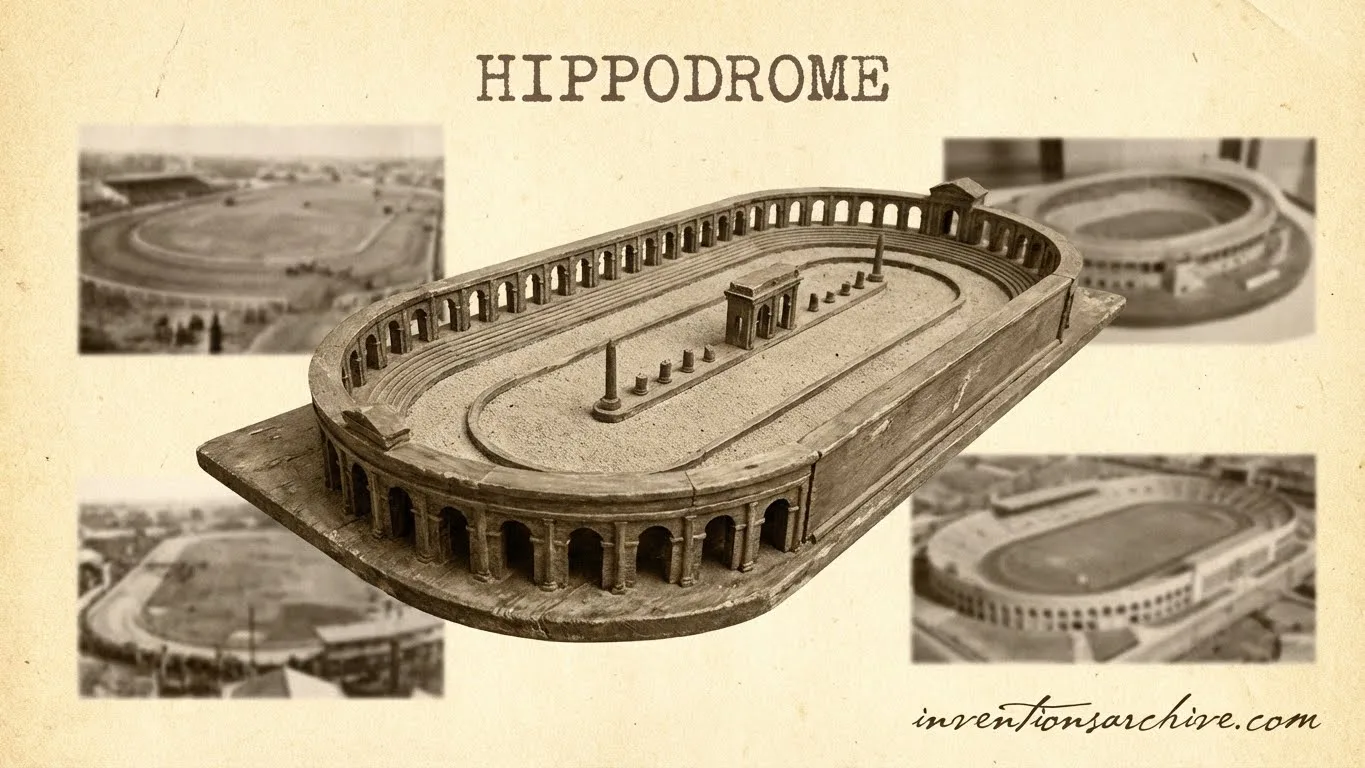
| Invention Name | Hippodrome |
|---|---|
| Short Definition | A long open racecourse designed for horse racing and chariot racing. |
| Approximate Date / Period | Greek racecourses developed before the best-known surviving references; Olympia’s hippodrome is described as a 5th century BC venue. Approximate |
| Geography | Ancient Greece; later adapted across the Roman and Byzantine world. |
| Inventor / Source Culture | Anonymous / collective Greek civic and festival culture. Attribution varies |
| Category | Architecture; transport infrastructure; sports and public-event design. |
| Main Problem Solved | Provided a defined, repeatable space for fast horse and chariot contests, spectators, judges, starting points, and turning points. |
| How It Worked | Racers moved along an elongated track, turned around marked posts or barriers, and completed set laps before spectators. |
| Material / Technical Base | Earthworks, flat racing ground, embankments, stone or timber structures, starting areas, and later monumental barriers. |
| Early Use | Equestrian contests at Greek festivals, including horse races and chariot races. |
| Evidence Status | Textual descriptions, archaeological traces at some sites, later monumental remains, and institutional site records. Based on surviving evidence |
| Surviving Evidence | Olympia’s location is not confirmed; Constantinople preserves visible remnants and monuments from its later hippodrome setting. |
| Development Path | Open racing ground → Greek hippodrome → Roman circus → Byzantine ceremonial hippodrome → modern racecourse and stadium planning. |
| Related Inventions | Chariot, stadium, starting gate, Roman circus, spectator seating, racetrack, lap marker. |
| Modern Descendants | Horse-racing tracks, large stadiums, parade grounds, ceremonial squares, and loop-based sports circuits. |
| Importance | It turned elite horse and chariot contests into organized public events and shaped later Roman and Byzantine public architecture. |
The hippodrome was an ancient racecourse built for horses and chariots, but its importance was not limited to sport. It was a public design invention: a planned space where speed, spectators, judging, ceremony, and civic identity could meet in one visible setting. In Greek cities and sanctuaries, the hippodrome gave equestrian contests a defined form. In Roman and Byzantine cities, the same idea grew into larger venues for mass entertainment and public ceremony.
What the Hippodrome Was
A hippodrome was usually a long, open track for horse racing and especially chariot racing. The word comes from Greek roots connected with horse and course, which fits the object closely: it was a place where horses ran a marked route before an audience.
Its shape varied by place and period. Many early Greek examples were less monumental than later Roman circuses. Some were simple open grounds with turning points. Others had embankments, viewing areas, start lines, and planned course divisions. Britannica describes the typical hippodrome as an oblong space, often with one semicircular end and one squared end, and notes that the Roman counterpart was the circus.[b]
The most important feature was not decoration. It was controlled movement. Horses and chariots could run fast, turn, repeat laps, and finish in a way that judges and spectators could follow.
The Problem It Answered
Before the hippodrome became a recognized venue type, horse and chariot contests could take place on open ground, roads, flat fields, or festival spaces. That worked for informal racing, but it created limits.
- Racers needed a clear path and turning points.
- Judges needed visible starts, finishes, and laps.
- Spectators needed a safe and organized place to watch.
- Large festivals needed a repeatable layout for recurring events.
- Elite owners and city authorities needed a public stage for display and reputation.
The hippodrome answered these needs by turning a racing path into a purpose-built civic space. It did not remove risk from chariot racing, but it made the event more structured.
| Before the Hippodrome | What Changed After It |
|---|---|
| Races could use open fields, roads, or temporary festival spaces. | Racing moved into a defined course with marked direction and repeated laps. |
| Starts, turns, and finishes were harder to standardize. | Starting areas, turning posts, and finish points made contests easier to judge. |
| Spectators gathered around a racing space with limited order. | Embankments, viewing areas, and later tiered seating shaped the crowd experience. |
| Equestrian contests were tied mainly to local custom or festival space. | The hippodrome became a repeatable architectural idea across Greek, Roman, and Byzantine settings. |
| Horse and chariot contests had less permanent civic visibility. | The venue made racing part of urban memory, ceremony, and public architecture. |
How a Hippodrome Worked in Simple Terms
A hippodrome worked by combining four basic elements: a long course, a starting area, a turning system, and a viewing arrangement. The course had to be long enough for speed. The turns had to be clear enough for repeated laps. The audience had to see the race without standing inside the racing path.
In simple terms, the race followed this pattern:
- Horses or chariots lined up at a starting area.
- They moved down the long stretch of the course.
- They turned around marked points or a central barrier.
- They repeated the course for a set distance or number of laps.
- Judges and spectators watched the finish from fixed positions.
Later Roman and Byzantine versions could include a central divider, lap markers, monuments, decorated barriers, and formal seating. The basic idea stayed the same: a race needed a readable path.
Earlier Ideas and Tools Behind It
The hippodrome did not appear from nowhere. It depended on several older practices and technologies.
Horse Domestication and Training
Long before hippodromes, people trained horses for riding, pulling, travel, display, and competition. Without trained horses, there was no need for a specialized equestrian venue.
The Chariot
The chariot gave ancient racing its most visible early form. A chariot race required more room than a footrace. It also needed turning space, because a chariot could not change direction like a runner.
The Stadium and Festival Ground
Greek athletic culture already had spaces for footraces, wrestling, and other contests. The hippodrome extended the same organizational logic to horses and chariots. It was not simply a bigger stadium; it had different geometry because animals, vehicles, turns, and longer racing distances changed the requirements.
Earthworks and Seating Banks
Early hippodromes often used the land itself. A slope or embankment could help spectators see. Excavated earth could shape viewing banks. This made the hippodrome a practical invention as much as an architectural one.
Origin and Early Evidence
The oldest hippodromes are difficult to reconstruct with certainty. Many were open-air spaces rather than stone buildings, so floods, cultivation, rebuilding, and later city growth could erase them more easily than temples or theaters.
Olympia gives a useful example. Its hippodrome was important enough to be remembered in ancient descriptions, yet its exact physical location has not been confirmed. That does not make the venue imaginary. It means the evidence is mixed: written testimony is stronger than surviving architecture.
The International Olympic Committee places chariot racing at the Ancient Olympic Games from 680 BC, beginning with the four-horse chariot race.[c] This early date helps explain why later Greek sanctuaries needed large equestrian venues, even when the surviving ground plan is uncertain.
Design Features That Made It Useful
The hippodrome’s value came from a small group of design decisions. Each one solved a practical problem.
Long Racing Ground
A horse or chariot needs distance to build speed. A short arena would not show endurance, pace, or control. The long course allowed a race to develop over time.
Turning Points
Turning was one of the defining parts of the race. A clear turning marker made the course repeatable. It also gave spectators a visible point of tension without requiring the article to dwell on danger or accidents.
Viewing Areas
Large crowds needed sightlines. Early earth banks and later tiered seating helped turn racing into a public event rather than a private contest.
Starting and Judging Areas
A race required a visible start and finish. In more developed venues, starting systems and officials helped make the contest more orderly.
Central Barriers and Monuments
In Roman and Byzantine forms, the central divider or decorated spine became more than a traffic feature. It could hold lap markers, statues, columns, or monuments. This helped convert the racecourse into a civic display space.
Development Path from Open Track to Urban Monument
The hippodrome changed as it moved through different cultures and building traditions. Greek examples were often tied to festivals and sanctuaries. Roman circuses enlarged and formalized the idea. Constantinople then made the hippodrome a central ceremonial space for an imperial capital.
| Stage | Form | What Changed |
|---|---|---|
| Earlier Tool | Open racing ground | Horse and chariot contests used suitable flat spaces without a fully formalized venue. |
| Greek Invention | Hippodrome | The racing path became a recognized space with turns, viewing areas, and festival use. |
| Roman Adaptation | Circus | The long racetrack became more monumental, urban, and tied to large public spectacle. |
| Byzantine Form | Imperial hippodrome | The venue combined racing, ceremony, public gathering, and visible political ritual. |
| Modern Descendant | Racecourse and stadium circuit | Looped tracks, stands, crowd control, and public-event planning continue the design logic. |
Greek Hippodromes and Festival Use
In Greece, hippodromes belonged to the wider world of games, sanctuaries, and civic competition. Horse and chariot racing required wealth, training, animals, teams, and space. This made the hippodrome a place where athletics, status, and public identity overlapped.
At Olympia, the hippodrome was connected to equestrian events rather than footraces. The nearby stadium served other competitions. This distinction matters because short summaries often treat ancient athletic venues as if one shape served every event. In reality, the event shaped the architecture.
Greek hippodromes were not always heavily built. Some relied on landscape and temporary arrangements. That is one reason their early history can be harder to prove archaeologically than stone theaters, temples, or city walls.
Related articles: Water Organ (Hydraulis) [Ancient Inventions Series], Chariot [Ancient Inventions Series]
Roman Circuses and the Larger Urban Form
The Roman circus was not simply a renamed hippodrome. It was an enlarged and more urbanized development of the same basic racing idea. Oxford Academic’s chapter on circuses and hippodromes states that the Roman circus drew from Greek hippodromes and Etruscan arenas for equestrian contests, then became a major Roman venue for public spectacle.[d]
Roman circuses expanded the racecourse into a more formal architectural type. The long track, central barrier, starting gates, and mass seating made the venue suitable for repeated public events at a scale that earlier Greek sites did not always reach.
This shift shows one of the hippodrome’s strongest effects: it gave later builders a working model for how to manage speed, crowd sightlines, and repeated laps in one planned space.
The Hippodrome of Constantinople
The most famous later hippodrome was in Constantinople. It was not the earliest hippodrome, but it became one of the most important examples because it stood near the imperial palace and helped define the public life of the city.
Cambridge University Press describes the Hippodrome of Constantinople as a fourth-century AD construction by Constantine I, serving Byzantine history as a ceremonial, sportive, and recreational center, with chariot races especially important in its early period.[e]
Other institutional history of Istanbul material records that Septimius Severus began building the Hippodrome at Byzantium and that Constantine completed and expanded it as part of the new imperial capital’s urban development.[f] This explains why attribution can vary depending on whether the focus is the first construction phase, the imperial rebuilding, or the fully developed monument.
Constantinople also changed what a hippodrome meant. It was still a racecourse, but it was also a ceremonial setting. Public space, imperial presence, monuments, and urban memory merged there.
Main Forms and Variations
The word “hippodrome” can hide several different forms. The main variations depended on period, location, building resources, and public purpose.
| Type or Variation | Typical Setting | Main Features |
|---|---|---|
| Open Greek Hippodrome | Festival ground or sanctuary landscape | Long flat course, marked turns, limited permanent architecture in many cases. |
| Sanctuary Hippodrome | Olympia and other religious-athletic centers | Used for equestrian contests connected with festival programs and civic honor. |
| Urban Greek Hippodrome | Greek cities and regional centers | More connected with civic identity, training, and local public events. |
| Roman Circus | Roman cities | Monumental seating, central barrier, formal starting gates, larger urban audience. |
| Byzantine Hippodrome | Constantinople and major eastern Roman cities | Racecourse plus ceremonial space, monuments, factions, and public imperial display. |
| Modern Racecourse Descendant | Sports and entertainment venues | Looped track, managed spectatorship, controlled start and finish, specialized rules. |
What Changed Because of the Hippodrome
The hippodrome helped turn equestrian competition into a structured public event. This mattered in several concrete ways.
Racing Became Easier to Organize
A defined course made it easier to repeat events across festivals and civic calendars. Starts, turns, laps, and finishes could be recognized by racers, judges, and spectators.
Spectatorship Became Part of the Design
The hippodrome was not just a track. It included the viewer. The layout made racing visible as a public event, which later influenced the design of circuses, stadiums, and racecourses.
Architecture Served Ceremony
In places such as Constantinople, the hippodrome became a formal setting for processions, display, and public ritual. Racing architecture became civic architecture.
Later Venues Borrowed the Logic
Modern racetracks, stadium circuits, and large public arenas still depend on a similar idea: define the action, separate participants from spectators, make the event visible, and repeat the course or program in an orderly way.
Common Misunderstandings
A Hippodrome Was Not Always a Massive Stone Stadium
Some early hippodromes were likely simple open spaces shaped by landscape and practical need. The more monumental image comes largely from later Roman and Byzantine forms.
The Earliest Evidence Is Not the Same as the First Use
When a site record or ancient author gives a date or description, it shows what can be traced. It does not prove that no earlier or simpler racecourse existed.
The Roman Circus Was Related, Not Identical
The Roman circus developed from similar equestrian-racing needs, but it became more monumental, more urban, and more tied to Roman public spectacle.
Constantinople’s Hippodrome Was Not the Original Hippodrome
It is the best-known later example, but the basic form came from earlier Greek racecourse traditions.
Related Inventions
The hippodrome sits inside a wider chain of transport, architecture, and public-event inventions:
- Chariot — the vehicle that made high-speed ancient racing a major spectacle.
- Stadium — a related athletic venue, usually better suited to footraces and field events.
- Roman Circus — the larger Roman descendant of the hippodrome idea.
- Starting Gate — a race-control device that helped make starts fairer and more visible.
- Spectator Seating — banks, tiers, and stands that turned contests into mass public events.
- Lap Marker — visual counting systems that helped audiences and officials follow repeated circuits.
- Racecourse — the modern sporting descendant of the ancient equestrian track.
Frequently Asked Questions
Who invented the hippodrome?
No single inventor is known. The hippodrome developed as a collective Greek architectural and festival solution for horse and chariot racing.
What was a hippodrome used for?
It was mainly used for horse racing and chariot racing. In later cities, especially Constantinople, it also served as a ceremonial and public gathering space.
Is a hippodrome the same as a Roman circus?
They are closely related but not identical. The Greek hippodrome was the earlier racecourse form, while the Roman circus became a larger and more monumental urban venue.
Why is the Hippodrome of Constantinople famous?
It is famous because it became one of the central public spaces of Constantinople, combining chariot racing, imperial ceremony, monuments, and civic life.
Does the Olympia hippodrome still survive?
Its exact location has not been confirmed. The site is known through ancient description and institutional reconstruction rather than a fully preserved visible track.
Sources and Verification
- [a] Tour of the sanctuary — Used to verify the Olympia hippodrome’s 5th century BC dating, uncertain location, and reliance on Pausanias for its form. (Reliable because it is an official Greek Ministry of Culture institutional resource.)
- [b] Hippodrome | Byzantine, Roman & Greek | Britannica — Used to verify the basic architectural definition, typical shape, and relationship between the Greek hippodrome and Roman circus. (Reliable because it is a long-standing edited reference source.)
- [c] Chariot racing – Ancient Olympic Games — Used to verify the presence of chariot racing in the Ancient Olympic Games from 680 BC. (Reliable because it is the official International Olympic Committee resource.)
- [d] 33 Circuses and Hippodromes — Used to verify the scholarly connection between Greek hippodromes, Etruscan equestrian arenas, and the Roman circus. (Reliable because it is an Oxford Academic chapter by a classical art and archaeology scholar.)
- [e] The Hippodrome of Constantinople — Used to verify the fourth-century construction, Byzantine use, and ceremonial role of Constantinople’s Hippodrome. (Reliable because it is a Cambridge University Press academic publication page.)
- [f] THE IMPERIAL TRANSFORMATIONS OF A GRAND CITY: ISTANBUL | History of Istanbul — Used to verify the account that Septimius Severus began the Hippodrome at Byzantium and Constantine later completed and expanded it. (Reliable because it is an institutional city-history publication.)