
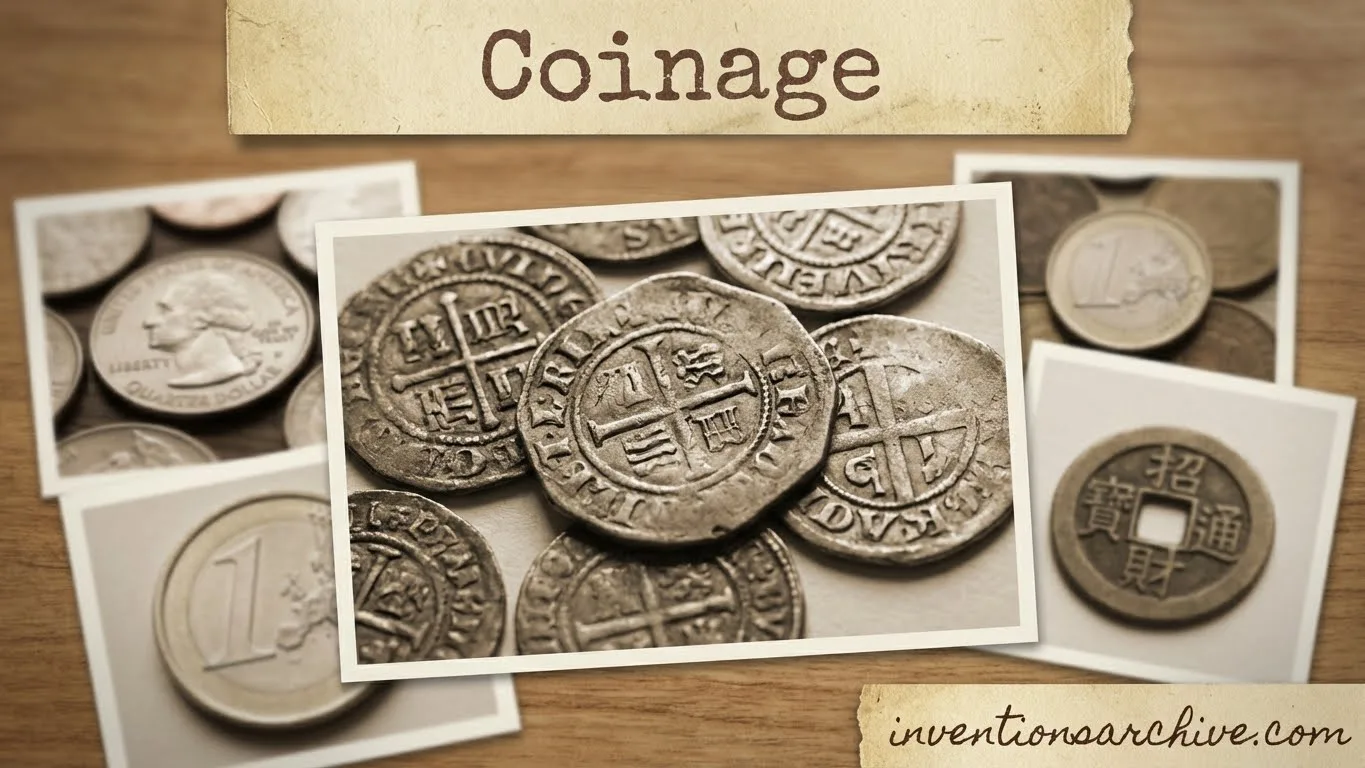
| Invention Name | Coinage |
|---|---|
| Short Definition | Standardized metal money issued with an authority mark, weight system, and recognized value. |
| Approximate Date / Period | Late 7th century BCE Approximate Debated [a] |
| Main Geography | Lydia and Ionian Greek cities of western Anatolia; related early traditions in China and India. |
| Inventor / Source Culture | Anonymous / collective; strongly linked with Lydian and western Anatolian issuing authorities. |
| Category | Measurement, trade, administration, communication, manufacturing. |
| Evidence Status | Based on surviving coins, archaeological finds, inscriptions, and later written testimony. |
| Main Problem Solved | Reduced the need to weigh and test metal for each payment. |
| How It Worked | Metal blanks were standardized, then marked by an issuing authority to signal weight, source, and accepted value. |
| Main Material Base | Electrum at first; later gold, silver, copper alloys, bronze, and base metals. |
| Early Use Areas | Payments, marketplaces, public accounts, treasuries, temple deposits, and long-distance trade. |
| Development Path | Weighed metal and ingots → stamped electrum pieces → gold and silver coinage → civic and imperial coin systems → modern minted currency. |
| Surviving Evidence | Electrum coin objects, incuse reverses, lion-head types, Lydian legends, excavated coin groups. Example: a British Museum electrum coin from Lydia, circa 575 BCE. [b] |
| Main Variations | Electrum coins, gold staters, silver civic coins, bronze small change, cast Chinese coins, Indian punch-marked coins, modern token coinage. |
| Related Inventions | Weighing scales, touchstones, seals, dies, metallurgy, accounting, banking, paper money. |
| Modern Descendants | National coinage, commemorative coins, machine-struck coins, cash systems, numismatic collections. |
| Why It Matters | It made value easier to recognize, count, store, move, and record across repeated transactions. |
What Coinage Is
Coinage is the invention of making money into recognized, repeatable metal units. A coin is not just a small piece of metal. It is a piece of metal shaped, weighed, and marked so that other people can accept it without testing the whole value from the beginning each time.
This makes coinage different from earlier forms of money. Before coins, people used many exchange tools: weighed silver, copper, gold, grain, livestock, shells, tools, ingots, and credit arrangements. Some of these worked well in local settings. Others became difficult when value had to move across merchants, cities, rulers, and language groups.
The coin solved one part of that problem. It joined three ideas into one object:
- Material value: early coins were usually made from precious or useful metals.
- Standard weight: the object followed a weight standard, such as a stater or a fraction of one.
- Public mark: an image, punch, inscription, or symbol connected the piece to an issuer.
The result was not modern money in the full sense. It was a portable promise of measured value, backed by custom, authority, and repeated use.
How Coinage Is Traced
The origin of coinage is usually linked with Lydia in western Anatolia and with neighboring Ionian Greek cities. Lydian royal issues are especially important because they show consistent style, recurring symbols, and in some cases Lydian inscriptions. Yet the early record is not tidy. Several early electrum series cannot be assigned to one mint, ruler, or issuing occasion with certainty. The Austrian Archaeological Institute notes that many early electrum coinages remain difficult to attribute, even though Lydian royal coinage stands out by its style and consistency. [e]
This is why the word invention needs care here. Coinage was not one sudden object made by one named person in a documented workshop. It was a set of practices that came together: weighing metal, marking objects, trusting seals, managing treasuries, and moving value through trade.
What Survives
The evidence includes small electrum coins, larger staters and fractions, punch marks, incuse reverses, animal symbols, and later gold and silver issues. Some coins survive as museum objects. Others come from excavated contexts such as temple deposits and city layers.
These remains show how the early coin was both practical and visual. A mark could identify an issuer. A weight standard could make counting easier. A repeated design could build trust without requiring every user to read an inscription.
What Is Still Uncertain
Three points remain open in careful histories of coinage:
- The exact first year is not known.
- The first issuing authority is not always certain.
- Some early coin types may have served more than one purpose: payment, prestige, public identity, or treasury management.
This uncertainty does not weaken the history. It makes the history more accurate.
Early Coin Weight and Origin Data
Early coinage can be compared more clearly when the measured object weight is kept separate from the denomination or weight standard assigned by a catalogue. The examples below use museum and numismatic collection records rather than replacing measured weights with nominal values. All weights are shown in grams.
| Example | Date | Metal | Weight | Standard / Denomination | Mint / Authority | Find Context / Provenance | Certainty |
|---|---|---|---|---|---|---|---|
| Miletus electrum stater | c. 650–600 BCE | Electrum | 10.813 g | Stater; the object record does not name a weight standard | Miletus, Ionia | British Museum RPK,p161A.1.Amy; no excavation findspot listed in the object record | High for catalogue mint and weight [h] |
| Lydian lion-head 1/3 stater | c. 575 BCE | Electrum | 4.670 g | 1/3 stater; Lydo-Milesian weight standard | Lydia; precise mint or issuing authority not named in the record | British Museum 1866,1201.3669; Woodhouse collection provenance, no findspot listed | Regional attribution Exact issuer remains unspecified [b] |
| Ionian horse type 1/3 stater | 6th century BCE | Electrum | 4.650 g | 1/3 stater; Lydo-Milesian weight standard | Ionia; precise mint not named in the record | British Museum 1926,0203.1; no excavation findspot listed | Regional attribution Weight and standard are explicit; mint is broad [i] |
| Colophon Hoard electrum fraction | 6th century BCE | Electrum | 0.300 g | 1/48 stater (?) | Ionia; precise mint not named in the record | Excavated/findspot: Colophon; recorded as part of the Colophon Hoard | Find context recorded Denomination is catalogued with a question mark [j] |
| Teos silver stater | c. 540–478 BCE | Silver | 11.301 g | Stater; Aeginetic weight standard | Teos, Ionia | British Museum 1876,0803.8; no excavation findspot listed | High catalogue specificity Mint, denomination, standard, and weight are stated [k] |
| Aegina turtle stater | c. 700–550 BCE | Silver | 12.120 g | Stater; weight standard not separately named in this object record | Aegina | British Museum EH,p423.5.Aeg; earlier collection provenance, no excavation findspot listed | High for mint and weight Catalogue date spans a broad range [l] |
| ANS Lydian 1/3 stater | 7th century BCE | Electrum | 4.680 g | 1/3 stater; cited ANS record does not state a named weight standard | Lydia; precise mint or authority not supplied in the cited entry | ANS 1975.218.49; gift of Burton Y. Berry | Regional attribution Object weight is explicit; exact mint is not [m] |
| Jin-state hollow-handle spade money | 5th century BCE | Bronze | 42.680 g | Cast spade money; no Mediterranean stater standard applies | Associated with the Jin state; British Museum record gives China as production place | British Museum 1996,0612.1; museum acquisition provenance, no excavation findspot listed | High for object data Production place is broad; state association is catalogued [n] |
The table shows why denomination labels should not be treated as measured weights. Two western Anatolian pieces catalogued as one-third staters weigh 4.650 g and 4.680 g, while the Miletus stater in this sample weighs 10.813 g. The 0.300 g Colophon Hoard fraction also shows how small some electrum denominations could be. The Chinese spade-money example belongs to a different cast tradition and weight system, so its 42.680 g measurement should not be read as a direct denomination equivalent to a Mediterranean stater.
Object-level data also exposes the limits of origin claims. A museum record may identify a precise mint such as Miletus or Teos, give only a broad region such as Lydia or Ionia, or preserve a find context without identifying a mint. Those distinctions are kept in the table instead of converting every regional attribution into a named issuing authority. For China, the Guanzhuang excavation independently documents organized production of standardized spade coins around 640–550 BCE, but that site-level dating should not be assigned to an unrelated museum specimen simply because both belong to early Chinese coinage. [f]
The Problem Coinage Answered
Coinage answered a practical problem: metal was valuable, but raw metal was not always easy to trust. A piece of electrum, silver, or gold could vary in weight. Its purity could vary too. A buyer or seller might need a scale, experience, and a way to judge metal quality.
Electrum created a special challenge. It is a natural alloy of gold and silver, and its proportions are not always the same. In Lydia, this metal was available in river and regional deposits. It could be used for payments, but users still had to ask: how much gold is in this piece, how much silver is in it, and how should it be valued?
The stamped coin changed the transaction. A marked unit could be counted rather than weighed each time. The Archaeological Exploration of Sardis explains that stamped, pre-weighed pieces transferred part of the trust from the metal itself to the issuing authority; this made exchange easier when electrum bullion was difficult to evaluate piece by piece. [d]
Earlier Money Forms Before Coinage
Coinage belongs to the history of money, but it is not the beginning of money. Human groups used many forms of value before stamped coins existed.
Metal by Weight
Silver, gold, copper, and bronze could be weighed for payments. This was flexible, but it slowed transactions. Each piece needed assessment. Small payments could be awkward. Different regions used different standards.
Ingots and Metal Pieces
Some communities used ingots, bars, rings, lumps, or other shaped metal pieces. These were closer to coinage because they had physical form and recognized material value. They still lacked the full combination of regular denomination, official image, and repeated issue.
Seals and Marks
Seals already carried authority in administration and trade. They could identify a person, office, workshop, or household. Coinage adapted that older habit of marking objects, but applied it to money itself.
Commodity Money and Credit
Grain, livestock, shells, textiles, and written obligations could function as value in specific settings. Coinage did not erase these systems. It added a new form: small, durable, countable money that could travel.
How Early Coins Worked
Early coinage worked through a simple principle: make a metal piece regular enough to be recognized, then mark it so people know who stands behind it. The American Numismatic Association describes early Lydian coins as electrum pieces with regular weights, impressed patterns, and incuse depressions formed during minting by hammering a punch that forced the blank into the die. [c]
This description should not be read as a modern minting manual. It is a historical explanation of the principle. The important parts were regularity, authority, and recognition.
The Main Parts of the System
- Blank or flan: the small metal piece before marking.
- Weight standard: the intended weight or fraction used by the issuing system.
- Die or punch: the tool that created the mark.
- Design: an image, animal, symbol, inscription, or pattern.
- Acceptance: the social and economic habit of treating the marked object as money.
A coin became useful only when people accepted it repeatedly. That acceptance could rest on metal content, local authority, civic identity, ruler reputation, or a combination of all four.
Main Materials and Technical Principle
Coinage began with precious metal, but its later history used many metals and alloys. The material mattered because early coins often carried value in two ways: as metal and as a marked unit.
| Material | Typical Role | What It Offered |
|---|---|---|
| Electrum | Early western Anatolian coinage | Precious, locally available in Lydia, but variable in composition. |
| Gold | High-value coinage | Dense value in a small object; useful for large payments and storage. |
| Silver | Common ancient civic coinage | Flexible for trade, wages, public accounts, and wider circulation. |
| Copper and Bronze | Lower-value daily coins | Better suited to small payments where precious metal was too valuable. |
| Base-Metal Alloys | Later token and subsidiary coins | Value came more from legal and social acceptance than from metal content. |
The technical principle stayed surprisingly stable: coinage turns value into a repeatable object. The metal may change. The issuing authority may change. The production tools may change. The central idea remains the same: people need a way to recognize, count, and pass value without restarting the whole valuation process each time.
Early Uses and Real Context
Early coins were not museum pieces in their own time. They moved through practical settings where people needed compact value.
Market Exchange
Coins helped repeated transactions. A seller did not need to weigh raw metal every time if the coin was recognized. Small denominations made smaller payments easier, although early electrum coins could still represent substantial value.
Public Payments and Treasuries
Issuing authorities could pay workers, manage stores of value, receive payments, and organize accounts more easily when value came in standardized units.
Temples and Deposits
Coins appear in religious and public contexts because temples and sanctuaries often held wealth, received offerings, and participated in economic life. Finds from such contexts can help archaeologists date and interpret early coinage.
Identity and Communication
A coin carried a message. Even when many users could not read, an image could say where the coin came from or whose authority stood behind it. Lions, seals, owls, turtles, bulls, and other symbols were not decoration only. They were identity marks.
How Coinage Spread and Changed
Coinage spread because it solved a shared problem, but it did not spread in one single line. It developed across regions with different materials, shapes, and issuing customs.
Related articles: Balance Scale [Ancient Inventions Series], Lighthouse [Ancient Inventions Series]
In the Aegean and western Anatolia, coinage moved from electrum issues to gold and silver series, then into wider Greek civic coinages. Cities used images that identified local gods, animals, produce, myths, or civic symbols. Coins became a way to organize value and show public identity at the same time.
China followed a different early path. Archaeological work at Guanzhuang in Henan Province found moulds for casting standardized spade coins, and systematic radiocarbon dating placed organized minting there around 640-550 BCE. This supports the idea that early coinage traditions were not simply one invention copied everywhere from a single source. [f]
India also had a distinct early coinage tradition with punch-marked silver pieces. These often used multiple symbols rather than ruler portraits. That difference matters. It shows that coinage is not one visual style; it is a broader technology of standardized value.
Development Path From Earlier Tools to Later Forms
| Stage | Form | What Changed |
|---|---|---|
| Earlier Tool | Weighed metal, ingots, commodity money, credit records | Value existed, but many payments needed weighing, testing, memory, or local trust. |
| Invention | Stamped electrum and other early coins | Metal pieces became more recognizable, countable, and tied to an issuing authority. |
| Improved Form | Gold and silver systems, civic silver coins, bronze small change | Denominations became clearer and better suited to different payment sizes. |
| Administrative Form | Royal, civic, imperial, and state coinage | Coins became tools for taxation, public accounts, trade, identity, and official payments. |
| Modern Descendant | Machine-struck national coins and token coinage | Metal content became less important than legal value, design control, and public trust. |
This path was not identical in every region. Some traditions used struck coins. Others cast coins in moulds. Some used precious metal. Others used bronze or copper alloys. The shared idea was not the shape. It was the use of standardized marked money.
Main Types and Variations
Coinage developed into many forms because different communities needed different values, materials, and symbols. The most useful way to understand the variations is to look at function rather than beauty.
| Type or Variation | Common Material | Historical Role |
|---|---|---|
| Electrum Coins | Natural gold-silver alloy | Early western Anatolian coinage; helped make variable precious metal more acceptable. |
| Gold Coins | Gold | High-value payments, reserves, prestige, and long-distance value storage. |
| Silver Civic Coins | Silver | Widespread ancient trade and public payments; often carried city symbols. |
| Bronze and Copper Coins | Bronze, copper, copper alloys | Useful for lower-value transactions and local circulation. |
| Cast Chinese Coins | Bronze and copper alloys | Often made by casting rather than striking; included spade, knife, and round forms. |
| Punch-Marked Coins | Silver | Early Indian tradition with symbols punched onto the surface, often without ruler portraits. |
| Token or Subsidiary Coins | Base-metal alloys | Modern and later systems where legal value exceeds metal value. |
| Commemorative Coins | Varied metals | Issued to mark events, institutions, rulers, anniversaries, or cultural memory. |
Before and After Coinage
The change brought by coinage was not instant, and it was not the end of all earlier exchange. Its real effect was more practical: it made certain payments faster to recognize, easier to count, and simpler to record.
| Before Coinage | What Changed After It |
|---|---|
| People often relied on weighed metal, ingots, commodities, or local credit. | Marked metal units could be counted and recognized more quickly. |
| Metal purity and weight might need checking in each transaction. | The issuer’s mark helped signal an expected standard. |
| Small pieces of valuable metal could be hard to evaluate together. | Fractions and denominations made sums easier to calculate. |
| Exchange depended heavily on local knowledge and direct trust. | Recognized symbols helped value travel across wider networks. |
| Administrative payments needed more weighing, recording, and checking. | Public accounts, wages, taxes, fees, and treasury movements became easier to organize. |
| Images were not usually part of money itself. | Coins became small carriers of place, authority, and public identity. |
What Changed Because of Coinage
Once coinage became familiar, it changed several areas of daily and institutional life.
Trade Became Easier To Repeat
Coins helped repeated transactions because users could work with known units. A merchant still had to think about trust, distance, and local acceptance, but the coin reduced the need to judge every piece of metal from scratch.
Accounting Became More Concrete
Coins made value easier to record in numbers. That helped public treasuries, private stores of wealth, market exchange, and wage payments. It also created clearer habits of pricing.
Authority Became Visible
A coin could carry an image that spoke for a city, ruler, league, temple, or issuing body. This made coinage a communication tool as well as a payment tool.
Economic Life Became More Countable
In the late archaic Greek economy, coins came to serve as a medium of exchange, measure of value, store of value, and medium of payment, with market trade, international commerce, and labor more often mediated through coined money. [g]
That shift did not happen evenly everywhere. Agriculture could remain less monetized than urban trade. Local exchange and credit continued. Coinage added a strong new tool, not a total replacement for every older practice.
Common Misunderstandings
Coinage Was Not the First Money
Money existed before coins. Coinage was a new way to make money portable, countable, and publicly marked. Earlier systems used weighed metal, commodities, credit, shells, tools, and other value forms.
There Is No Single Certain Inventor
Lydia is strongly linked with early coinage, but the invention was not recorded as the work of one named person. Rulers such as Alyattes and Croesus are connected with important issues and reforms, yet the wider invention was collective and gradual.
Croesus Did Not Simply Invent All Coinage
Croesus is linked with a major gold and silver reform. Earlier electrum coinage existed before that reform. The famous name is important, but it should not erase the earlier development.
The Earliest Surviving Coin Is Not Always the First Coin Ever Made
Archaeology works with what survives. A coin dated to a certain period proves that coinage existed by then. It does not prove that no earlier examples were made, lost, melted, or still undiscovered.
Early Coins Did Not All Show Rulers
Many early coins used animals, symbols, punches, or civic images. Portraits of rulers became more common in later traditions, but they were not required for coinage to work.
Related Inventions
Coinage sits between older measurement tools and later financial systems. These related inventions and technologies help place it in a wider history of value:
- Weighing Scale: allowed metal and goods to be measured before coinage made counting easier.
- Touchstone: helped test precious metal quality before and alongside coined money.
- Seal and Stamp: supplied the older idea of marking an object with authority or identity.
- Metallurgy and Refining: made metal extraction, alloy control, and later gold-silver separation more useful for currency.
- Writing and Inscriptions: allowed names, symbols, and issuing marks to carry identity across distance.
- Accounting Systems: turned counted coins into recorded payments, balances, wages, and public accounts.
- Banking: grew alongside coin storage, money-changing, credit, deposits, and transfers.
- Paper Money: later separated monetary value further from metal objects.
Frequently Asked Questions
Who invented coinage?
Coinage has no single certain inventor. The earliest well-known struck coinage is strongly linked with Lydia and nearby Ionian Greek communities in western Anatolia. The development appears to have been collective, involving rulers, mints, merchants, metalworkers, and local systems of trust.
When did coinage begin?
Coinage is usually placed in the late 7th century BCE, but the exact date is debated. Surviving evidence shows that coinage was established by the 6th century BCE in western Anatolia, while other early coinage traditions developed in regions such as China and India.
What were the earliest coins made of?
Many early western Anatolian coins were made of electrum, a natural alloy of gold and silver. Later coinage used gold, silver, bronze, copper alloys, and other metals depending on value, region, and purpose.
How is coinage different from money?
Money is the broader idea: anything accepted as value, payment, or account. Coinage is a specific form of money made from standardized marked pieces, usually metal, issued and accepted under a recognized system.
Did coinage immediately replace barter and weighed metal?
No. Coinage spread gradually and existed alongside older systems. Weighed metal, credit, local exchange, and commodity money continued in many places. Coins were useful because they made many payments easier, not because they replaced every older method at once.
Why did coinage become important?
Coinage became important because it made value easier to recognize, count, move, store, and record. It also gave issuing authorities a visible way to mark identity, quality, and accepted value on a durable object.
Sources and Verification
- [a] Sardis – The Metropolitan Museum of Art — Used to verify the Lydian attribution, the disputed exact date, electrum as the early material, and the connection with Croesus and gold/silver coinage. (Reliable because it is an official museum essay from The Metropolitan Museum of Art.)
- [b] British Museum — coin 1866,1201.3669 — Used to verify a surviving electrum coin object from Lydia, its circa 575 BCE date, 4.67 g measured weight, one-third stater denomination, Lydo-Milesian weight standard, material, and incuse-reverse description. (Reliable because it is an official British Museum collection record.)
- [c] Lydia & the First Coins – American Numismatic Association — Used to verify the historical explanation of early Lydian coin weights, impressed patterns, incuse depressions, and punch-and-die minting principle. (Reliable because it is an institutional numismatic museum resource.)
- [d] The Coins of Sardis — Used to verify why electrum bullion created trust and valuation problems and how stamped, pre-weighed coins simplified exchange. (Reliable because it is an archaeological project publication connected with the Archaeological Exploration of Sardis.)
- [e] Early Lydian Coinage and Chronology — Used to verify attribution uncertainty, the role of Lydian legends, the presence of many early electrum series, and the need for die study, metal analysis, written sources, and archaeological contexts. (Reliable because it is an Austrian Archaeological Institute research project page.)
- [f] Radiocarbon-dating an Early Minting Site: The Emergence of Standardised Coinage in China — Used to verify evidence for standardized spade-coin minting at Guanzhuang and its radiocarbon-dated period around 640-550 BCE. (Reliable because it is a peer-reviewed research article hosted by Cambridge Core for Antiquity.)
- [g] Money, Credit, and Banking – The Cambridge Companion to the Ancient Greek Economy — Used to verify the economic functions performed by coins in the late archaic period, including medium of exchange, measure of value, store of value, and medium of payment. (Reliable because it is a Cambridge University Press academic chapter.)
- [h] British Museum — Miletus electrum stater RPK,p161A.1.Amy — Used to verify the circa 650–600 BCE date, electrum material, 10.813 g measured weight, stater denomination, and Miletus mint attribution. (Reliable because it is an official British Museum collection record.)
- [i] British Museum — Ionian electrum coin 1926,0203.1 — Used to verify the 6th-century BCE date, 4.650 g weight, one-third stater denomination, Lydo-Milesian weight standard, and broad Ionian mint attribution. (Reliable because it is an official British Museum collection record.)
- [j] British Museum — Colophon Hoard electrum coin 1983,0710.6 — Used to verify the 0.300 g weight, Colophon Hoard findspot, Ionian attribution, and tentative one-forty-eighth stater catalogue designation. (Reliable because it is an official British Museum collection record.)
- [k] British Museum — Teos silver stater 1876,0803.8 — Used to verify the circa 540–478 BCE date, 11.301 g weight, silver material, Aeginetic weight standard, and Teos mint attribution. (Reliable because it is an official British Museum collection record.)
- [l] British Museum — Aegina silver stater EH,p423.5.Aeg — Used to verify the circa 700–550 BCE catalogue date, 12.120 g measured weight, silver material, stater denomination, and Aegina mint attribution. (Reliable because it is an official British Museum collection record.)
- [m] American Numismatic Society — 2012 Issue 2 — Used to verify ANS object 1975.218.49 as a Lydian electrum one-third stater dated to the 7th century BCE and weighing 4.68 g. (Reliable because it is an official American Numismatic Society publication identifying the collection object.)
- [n] British Museum — Jin-state spade-money 1996,0612.1 — Used to verify the 5th-century BCE date, bronze material, cast production, 42.68 g weight, Jin-state association, and broad China production place. (Reliable because it is an official British Museum collection record.)