
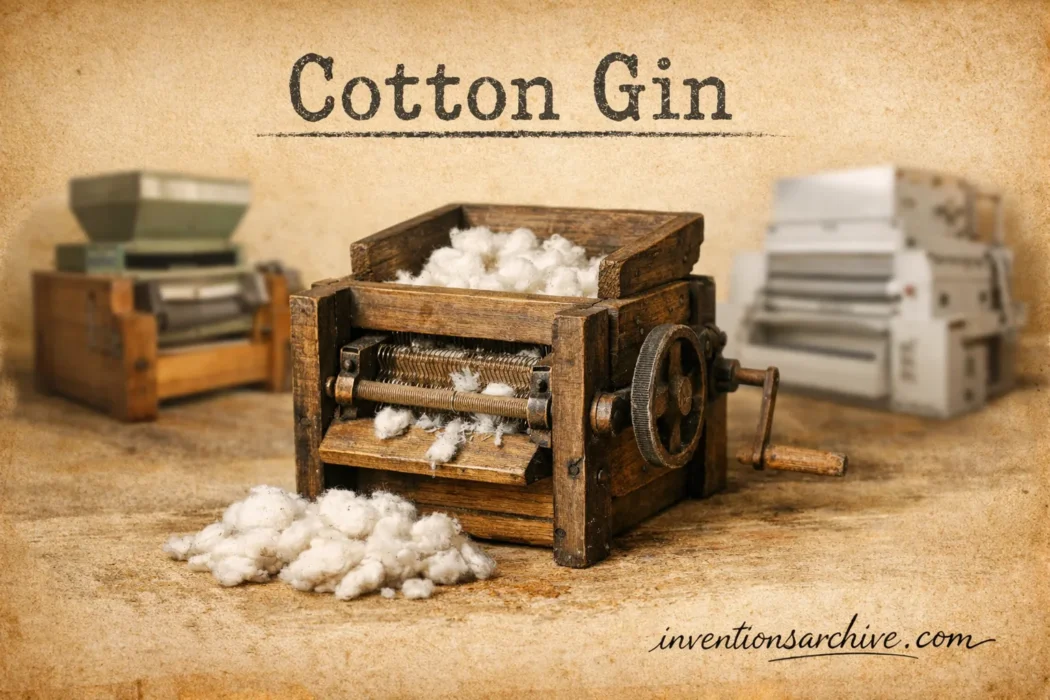
| Topic | Details |
|---|---|
| Invention Name | Cotton gin (“gin” from “engine”) |
| Short Definition | A machine that separates cotton fibers from seeds far faster than hand cleaning. |
| Approximate Date / Period | 1793 working machine; patent granted in 1794 Working model: approximate; patent date: exact |
| Geography | Georgia, United States; older seed-removal gins existed in other regions earlier |
| Inventor / Source Culture | Eli Whitney; development also linked in historical discussion to Catherine Greene, Phineas Miller, and earlier gin traditions |
| Category | Agricultural processing, textile preparation, mechanical technology |
| Why It Mattered |
|
| Need Behind It | Sticky seeds in inland short-staple cotton made manual cleaning too slow for scale. |
| How It Works | Teeth or hooks pull fiber through narrow slots; seeds stay behind; brushes clear the lint. |
| Material / Technology Base | Wooden frame, wire teeth or hooks, screen or ribs, brushes, later saws and powered drive systems |
| First Use Context | Cleaning upland cotton before spinning and weaving |
| Spread Route | Georgia to the wider U.S. cotton belt; later industrial gin systems spread across cotton-growing regions |
| Derived Developments | Saw gin refinements, roller gin specialization, lint cleaning lines, baling systems, cottonseed processing |
| Fields Affected | Agriculture, trade, textiles, transport, manufacturing, labor systems |
| Debates / Different Views | The “first” claim is disputed; older gins existed before Whitney, and the exact share of ideas among Whitney, Greene, and skilled workers remains debated |
| Precursors and Successors | Precursors: roller and hand gins; Successors: saw gins, steam-powered gins, integrated modern gin plants |
| Main People and Cultures | Eli Whitney, Catherine Greene, Phineas Miller, earlier cotton-working cultures outside the United States |
| Main Variations | Single-roller gin, double-roller gin, saw gin, horse-powered gin, steam-powered gin, modern gin stand |
Most inventions save time. The cotton gin changed time inside the cotton trade: a small hand-powered machine could clean up to fifty pounds of cotton in a day, while hand cleaning yielded only about a pound after long hours of work. That jump turned short-staple cotton from a stubborn crop into a profitable one, and the effects spread far beyond the field (Details-1).
Page Sections
What the Cotton Gin Is
The cotton gin is a seed-separating machine. Its task sounds simple—pull the usable fiber away from the seed—but that one step sat right in the middle of the cotton economy. Before ginning, harvested cotton was still a tangled mix of lint, seed, and plant debris. After ginning, the fiber could move toward spinning, weaving, and trade.
The word “gin” comes from “engine.” That old name fits. This was not a field tool and not a loom. It was a processing machine, placed between harvest and textile manufacture. That middle position gave it unusual force. A small change there altered everything upstream and downstream.
- Before ginning: cotton was bulky, seed-filled, and slow to prepare
- After ginning: fiber became market-ready far faster
- Main result: more cotton could move into mills, ports, and export channels
Where It Came From and Why It Appeared
The machine appeared because short-staple cotton posed a nasty practical problem. It could grow inland across large parts of the American South, yet its sticky green seeds clung to the fiber. Long-staple cotton, easier to clean, grew well only in limited coastal areas. So the real bottleneck was not growing cotton. It was cleaning inland cotton fast enough.
Older cotton gins already existed before Whitney. Seed-removal tools had been used for centuries in other places, mostly in roller forms. Whitney’s step was narrower and more practical: he built a machine suited to short-staple upland cotton in the United States. That is why the cotton gin’s story should not be flattened into a myth about a machine appearing out of nowhere. It didn’t. It solved a very local crop problem with unusual speed.
In Georgia, Eli Whitney worked on the design while connected to the circle around Catherine Greene and Phineas Miller. The working machine dates to 1793, and the patent followed in 1794. Almost at once, copies spread. That part, a bit rough and familiar in invention history, shaped Whitney’s career as much as the machine itself. He became famous, yes. Rich from the gin, no.
Why Short-Staple Cotton Mattered So Much
Short-staple cotton had two traits that mattered at once: it grew over a wide inland area, and it was painful to clean by hand. Once a machine handled the second problem, the first trait suddenly mattered far more. Acreage could expand. Supply could rise. Markets noticed.
How the Machine Works
The early cotton gin used a plain idea executed well. A rotating cylinder fitted with wire teeth or hooks caught the cotton fibers and pulled them through narrow openings. The openings were too tight for the seeds to pass. Seeds stayed behind; fiber moved through. Brushes then swept the lint away from the teeth so the machine would not choke on its own output. Simple, neat, and very effective (Details-2).
- Step 1: seed cotton enters the machine
- Step 2: rotating teeth catch the fiber
- Step 3: slots, ribs, or screens block the seeds
- Step 4: brushes strip the fiber from the moving teeth
- Step 5: clean lint and separated seed leave by different paths
What the machine did not do matters just as much. It did not pick cotton from the plant. Harvest still depended on hand labor for a long time. So the cotton gin cut one stage of labor, not the whole chain.
Main Parts of the Early Design
- Frame or box: held the working parts in line
- Rotating cylinder: drove the pulling action
- Wire teeth or hooks: grabbed lint from the seed mass
- Ribs or screen: kept seeds from following the fiber
- Brush cylinder: cleared lint from the teeth
- Crank or later power source: supplied motion
Main Types and Variations
People often speak of the cotton gin as if it were one fixed machine. It wasn’t. Over time, several forms appeared, each shaped by fiber length, desired speed, and later by factory-scale handling. That difference matters.
Roller Gin
The roller gin is the older family of designs. In broad terms, it uses rollers to draw fiber while leaving seed behind. Roller systems tend to be gentler on the fiber, though slower than the classic saw gin. For that reason, roller gins remained useful where longer and finer fibers needed more careful treatment.
Saw Gin
The saw gin became the dominant form for much of U.S. upland cotton. Instead of relying on rollers alone, it uses toothed circular elements to pull lint through the ginning ribs. This design is faster, better suited to large throughputs, and closely tied to the rise of inland short-staple cotton.
Whitney’s early machine and the later saw gin are related in purpose, though not every later gin copied his original form piece by piece. Like many inventions, the cotton gin quickly moved from one person’s machine to a family of machines.
Powered and Industrial Gins
Hand cranks gave way to animal power, then steam, then electric systems. With that shift, the gin stopped being just a compact machine and became a plant: unloading, drying, cleaning, separating, lint cleaning, and baling all linked in sequence. By then, the cotton gin was less a single device and more a processing line.
Related articles: Spinning jenny [Industrial Age Inventions Series], Textile Spinning Wheel [Medieval Inventions Series]
From Small Machine to Modern Gin Plant
Modern ginning starts before the gin stand itself. The plant must handle moisture, trash, green bolls, and flow control before the lint reaches the separating stage. USDA explains the main function plainly: a cotton gin separates lint from seed and also removes foreign matter, moisture, and other contaminants that reduce value (Details-3).
- Unloading: seed cotton enters the plant
- Drying and cleaning: excess moisture, leaves, sticks, and burs are reduced
- Ginning: lint and seed are separated
- Lint cleaning: remaining foreign matter is reduced
- Baling: clean lint is compressed for storage and transport
EPA’s technical description shows how large this process became. A typical modern facility is divided into five processing areas, and modern gins can remove nearly all seed and a very high share of trash from the lint. Depending on plant scale, output can reach many 480-pound bales per hour. That is a long way from a hand-cranked box with wire hooks (Details-4).
Timeline and Spread
- Before 1793: older cotton gins already existed outside Whitney’s setting, mostly in roller forms
- 1793: Whitney developed the working machine in Georgia
- 1794: patent granted in the United States
- Late 1790s: copied machines and legal disputes spread quickly
- 19th century: saw gins spread across the U.S. cotton belt
- Later 19th century and after: integrated ginning plants linked cleaning, drying, conveying, and baling
- Today: ginning is a coordinated industrial process rather than a stand-alone hand machine
Effects on Farming, Trade, and Industry
The cotton gin mattered because it changed cost, speed, and scale at the same time. A crop that had been too slow to prepare by hand could now move through the market in far larger quantities. Cotton acreage expanded. Exports climbed. Textile mills gained a steadier supply of raw fiber.
The machine also had a hard and lasting labor consequence. It reduced the labor of seed removal, yet it did not reduce the need to plant, tend, and pick more cotton. In the U.S. South, cotton production became so profitable that the forced labor system tied to cotton expanded with it. National Park Service records note that cotton came to represent more than half the value of U.S. exports between 1820 and 1860, while the slave-state count and the enslaved population also rose sharply in the same era (Details-5).
- Farm effect: upland cotton became worth large-scale planting
- Trade effect: more lint entered domestic and export channels
- Industrial effect: mills could draw on larger raw-cotton supplies
- Labor effect: field labor did not shrink; in the American South, it expanded with cotton acreage
- Machine effect: later ginning, cleaning, and baling systems grew around the same basic need
Limits and Common Myths
Myth one: Eli Whitney invented the first cotton gin of any kind. Not quite. Older seed-removal gins existed earlier. His machine is remembered because it solved the short-staple upland problem in a way that fit American production conditions.
Myth two: the cotton gin replaced cotton labor in full. It didn’t. It replaced one slow processing stage. Harvest still demanded a great deal of labor.
Myth three: Whitney made a fortune from the gin itself. He did not. Patent copying and long legal fights ate into the return. The cotton gin became famous faster than it became profitable for its inventor.
Myth four: the machine stayed basically the same forever. Not really. Later gins changed power source, tooth design, scale, cleaning stages, airflow, and baling systems. The early machine set the direction. Later engineering widened it.
FAQ
Did Eli Whitney invent the first cotton gin?
No. Older cotton gins existed before him, mostly in roller forms. Whitney’s place in history comes from making short-staple cotton much easier to clean in the United States.
Why was the cotton gin so useful for short-staple cotton?
Short-staple cotton could grow over a wide inland area, but its seeds clung tightly to the fiber. The cotton gin removed that bottleneck and made the crop far more marketable.
How did the early cotton gin work in simple terms?
Rotating teeth or hooks pulled the fiber through narrow gaps. The seeds were too large to pass through those gaps, so they stayed behind. Brushes then cleared the clean lint from the teeth.
What is the difference between a roller gin and a saw gin?
A roller gin uses rollers and is usually gentler on fiber. A saw gin uses toothed circular parts and is faster, which made it well suited to large-scale upland cotton processing.
Are modern cotton gins still just one machine?
No. Modern ginning is a linked plant process that includes unloading, drying, cleaning, separating, lint cleaning, and baling.