
| Invention Name | Nikola Tesla’s documented invention portfolio |
|---|---|
| Short Definition | Patented motors, polyphase power methods, high-frequency electrical apparatus, remote control, wireless-energy systems, and a bladeless turbine |
| Approximate Date or Period | Main period discussed: late 1880s to 1910s |
| Geography | Primarily the United States, especially New York; later experimental work also in Colorado Springs |
| Inventor or Source Culture | Nikola Tesla, working chiefly in the United States |
| Category | Electrical engineering, electric motors, high-frequency systems, wireless control, turbomachinery |
| Importance | Advanced practical polyphase AC motors and systems; developed high-frequency apparatus; patented remote control and other electrical systems |
| Evidence Status | Confirmed for specific patented devices Attribution varies for broad technologies |
| Main Problem Solved | Efficient electric-power conversion, motor operation, high-frequency experimentation, remote control, and specialized energy conversion |
| Development Path | Polyphase motor patents → Westinghouse commercialization → high-frequency research → remote control and wireless transmission → turbine work |
| Technical Basis | Rotating magnetic fields, phase-shifted AC, electromagnetic induction, resonance, tuned circuits, radio control, viscous fluid drag |
| Main Attribution Problem | Tesla is often credited with entire fields—AC, radio, X-rays, electricity—that predated him or involved several inventors |
Nikola Tesla did not invent electricity, alternating current, the electric motor as a whole, radio as a complete technology, or X-rays. His strongest invention claims are narrower and better documented: polyphase AC motors and related power-transmission methods, high-frequency electrical apparatus associated with the Tesla coil tradition, wireless remote control, several wireless-energy transmission systems, and the Tesla turbine.
The distinction matters because Tesla worked inside fields that were already moving quickly. Some of his achievements were new patented machines. Others were improvements to existing electrical practice. A few were experimental systems that never became commercial infrastructure. Later retellings often merge all three categories into a single list of “Tesla inventions.” Surviving patents, museum objects, court records, and engineering-history research allow a more exact account.
What Tesla Can Be Credited With Most Confidently
| Technology or Claim | Tesla’s Documented Role | Best Attribution |
|---|---|---|
| Polyphase AC motor and power system | Patented motors and transmission methods using phase-shifted currents to create a moving magnetic field; licensed to Westinghouse | Strong Tesla invention claim, with independent related work by Galileo Ferraris |
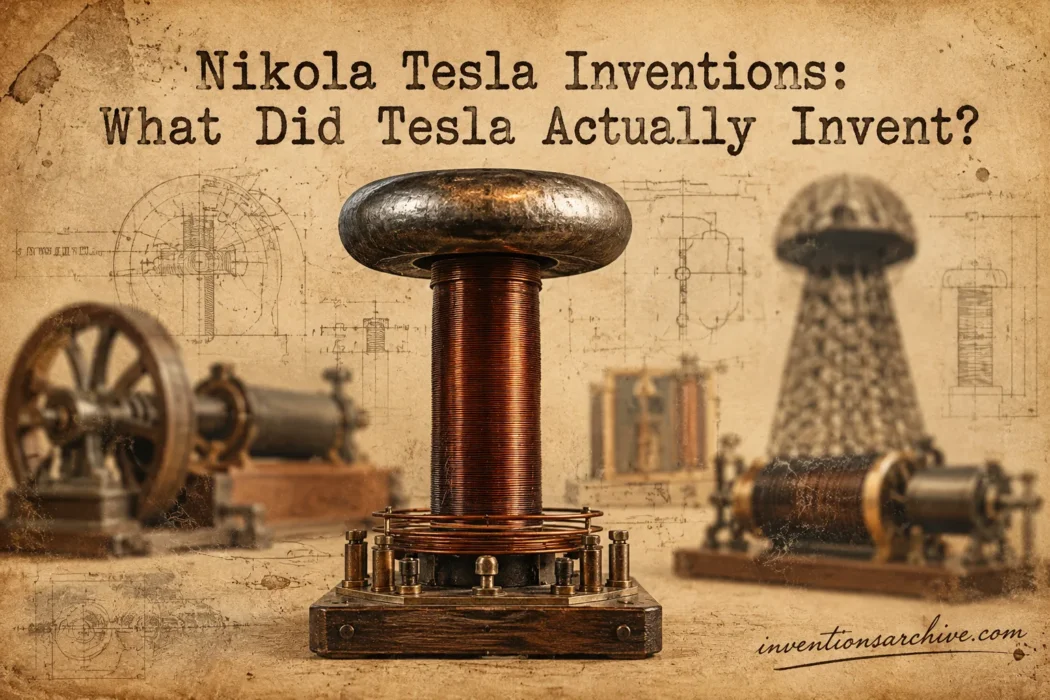
| Tesla coil and high-frequency apparatus | Developed and patented high-frequency, high-potential oscillatory circuits and transformer arrangements | Strong Tesla association; better treated as a family of related inventions than one isolated device |
| Wireless remote control | Patented a system for remotely controlling the propulsion, steering, and other mechanisms of moving vessels or vehicles | Strong Tesla invention claim |
| Tesla turbine | Patented a turbine using closely spaced smooth disks rather than conventional blading | Strong Tesla invention claim |
| Wireless transmission of electrical energy | Patented several transmitting and receiving arrangements and pursued large-scale experiments | Documented Tesla research and patents; not a completed worldwide utility system |
| Radio | Developed tuned high-frequency circuits and wireless signaling ideas that became prior art in later patent litigation | Major early contributor, not the sole inventor of radio |
| Alternating current | Built new motors and polyphase systems around AC | Did not invent AC itself |
The Polyphase AC System Is Tesla’s Strongest Electrical Claim
Alternating current already existed before Tesla’s motor work. A Smithsonian object record, for example, documents an Elihu Thomson machine built in 1878 or 1879 that could deliver either alternating or direct current. Tesla’s contribution was therefore not the creation of AC itself. [a]
What Tesla patented in the late 1880s was a way to use alternating currents with controlled phase relationships to create a magnetic field whose effective poles moved around the motor. That moving field could drive a rotor without the commutator arrangement used in many earlier motors. U.S. Patent 381,968, filed in 1887 and granted on May 1, 1888, describes an electro-magnetic motor built around this approach. Related patents issued the same day covered electrical transmission of power and further motor arrangements. [b]
The engineering advantage was not simply that the current alternated. The important step was the coordinated use of multiple AC phases. With windings placed so that their magnetic effects reached maximum strength at different moments, the combined field appeared to rotate. A rotor inside that field could then be set into motion through electromagnetic induction or related motor action. This made polyphase AC useful as a practical motor system rather than merely a way to transmit electrical energy.
Ferraris and Tesla Should Not Be Collapsed Into One Story
Galileo Ferraris independently demonstrated the rotating magnetic field principle in Italy in the 1880s. A 2025 study in IEEE Industry Applications Magazine, archived by Politecnico di Torino, separates the historical roles with unusual precision: it attributes the rotating magnetic field theory to Ferraris while crediting Tesla with development of the first industrial induction motor. The study treats the two men as independent, near-contemporary contributors rather than reducing the history to a single inventor. [c]
This distinction also explains why two seemingly contradictory claims can both contain part of the historical record. Ferraris had earlier experimental and theoretical work on the rotating field. Tesla produced a powerful set of motor and transmission patents and pursued an industrial electrical system around them. Calling Tesla the sole discoverer of the rotating magnetic field is too broad; saying that his motor work was merely a copy of Ferraris is also too broad.
Westinghouse Turned Tesla’s Motor Work Into Commercial Machinery
George Westinghouse acquired rights to Tesla’s AC patents and his company’s engineers refined the machines for manufacture. The National Museum of American History preserves a Westinghouse two-phase induction motor from 1888 identified as a Tesla-designed motor without commutator or contact brushes. A related museum record describes the Westinghouse Model A as the first commercial AC motor. [d]
That sequence is important for invention attribution. Tesla’s patents describe the electrical principles and machine arrangements. Westinghouse engineers then converted those ideas into commercial products and a broader industrial system. Patent, engineering refinement, and market adoption were connected stages, not the same event.
The Tesla Coil Grew Out of a Larger High-Frequency Research Program
The phrase “Tesla coil” can make Tesla’s high-frequency work look like a single gadget invented on one day. His surviving record is broader. During the 1890s he developed apparatus for producing very rapid electrical oscillations, raising voltage to very high potentials, coupling primary and secondary circuits, and studying resonance in electrical systems.
U.S. Patent 568,180, granted on September 22, 1896, covers apparatus for producing electrical currents of high frequency. The patent describes charging a circuit with electrical capacity and discharging it through a circuit with low self-induction to obtain rapid oscillations. The Smithsonian preserves this patent in its Tesla holdings. [e]
Tesla also patented electrical transformer arrangements and systems for high-frequency lighting and energy conversion. These inventions belong to the technical lineage now associated with Tesla coils: resonant or near-resonant high-voltage transformer systems that can produce high-frequency electrical effects. It is more accurate to treat the Tesla coil as the recognizable outcome of a series of Tesla experiments and patents than to force the entire subject into one patent number.
His lighting experiments belong in the same research family. Tesla demonstrated luminous effects in rarefied gases and explored ways of operating lamps with high-frequency currents. Those experiments were real and influential, but they do not make him the sole inventor of fluorescent lighting or neon lighting. Those technologies emerged through separate lines of discharge-tube, gas, phosphor, electrode, and commercial-development work.
Remote Control Is One of Tesla’s Clearest Inventions
Tesla’s 1898 remote-control patent is unusually direct evidence because both the purpose and the controlled functions are spelled out. U.S. Patent 613,809, granted November 8, 1898, describes a method and apparatus for controlling moving vessels or vehicles from a distance. The system could affect propulsion, steering, and other mechanisms carried by the moving object. The Smithsonian preserves the patent record in its Nikola Tesla patent collection. [f]
Tesla demonstrated a radio-controlled model boat in New York in 1898. The important invention was not the hull. It was the control system: transmitted signals were received on the moving craft and converted into mechanical actions. That placed wireless signaling, switching, and electromechanical control into one working system.
Modern drones, remotely operated vehicles, radio-controlled models, and robotic systems are far more advanced and use technologies developed much later. Describing Tesla as the inventor of the modern drone would therefore be anachronistic. His defensible claim is narrower: he patented and demonstrated an early practical wireless remote-control system.
The Tesla Turbine Was Real, Patented, and Commercially Limited
Tesla’s turbine is another invention with a clear patent record. U.S. Patent 1,061,206, granted May 6, 1913, describes a turbine in which fluid moves through spaces between a series of smooth disks mounted on a shaft. Energy is transferred through the interaction of the moving fluid with the disk surfaces rather than through conventional turbine blades. [g]
The design is often called a bladeless turbine, although the absence of conventional blades does not mean the machine had no internal rotating structure. Its runner consisted of closely spaced disks. Fluid entered near the outer region, moved through the disk spaces along a curved path, and transferred motion to the rotor through viscous and adhesive effects described in Tesla’s patent.
The turbine did not displace mainstream steam and gas turbine designs. A patent establishes that Tesla devised and claimed the machine; it does not establish that the design later became the dominant engineering solution. Real machines must also meet demands involving materials, rotor stress, sealing, flow behavior, manufacturing tolerances, operating range, and efficiency at useful scale.
Wireless Power Was a Patent Program and an Experiment, Not a Finished Global Grid
Tesla devoted years to transmitting electrical effects without ordinary connecting wires. His patents include grounded transmitting and receiving circuits, elevated terminals, tuned systems, and methods intended to transfer electrical energy through natural media. U.S. Patent 649,621, granted May 15, 1900, describes a transmitting apparatus with grounded and elevated terminals and a receiving arrangement tuned to the transmitted oscillations. [h]
These records show that “wireless power” was not merely a late legend attached to Tesla’s name. He patented apparatus, performed experiments, and tried to expand the idea into a large communications-and-energy project. The historical limit is equally important: his work did not result in a completed worldwide electrical distribution system.
Wardenclyffe Laboratory on Long Island became the best-known site of that ambition. The U.S. National Park Service identifies it as Tesla’s laboratory from 1902 to 1906 and the location of his most advanced wireless-power experiments. The intended “World Wireless System” was never perfected into the service Tesla envisioned, and financial backing disappeared before the project became an operating global network. [i]
This is a useful dividing line between patented invention and completed infrastructure. Tesla had real wireless-transmission patents. He also had an unfinished large-scale program. Claims that he had already solved unlimited worldwide wireless electricity go beyond the surviving engineering record.
The 1943 Radio Case Did Not Declare Tesla the Sole Inventor of Radio
Radio is the area where a real Tesla contribution is most often turned into an inaccurate one-sentence story. Tesla worked on high-frequency oscillations, tuned circuits, wireless signaling, and transmitting and receiving arrangements before radio became a mature communications industry. Those contributions later mattered in patent disputes.
The U.S. Supreme Court’s 1943 decision in Marconi Wireless Telegraph Co. of America v. United States examined claims in several wireless patents. The Court discussed Tesla’s earlier disclosure of a four-circuit arrangement and synchronization between transmitting and receiving circuits. It concluded that Tesla had anticipated some features later claimed by Marconi. Yet the decision did not simply rule that Tesla invented radio. [j]
The opinion explicitly distinguished Marconi’s earlier reputation for successful radio transmission from the later patent claims under dispute. It also treated Oliver Lodge, John Stone Stone, and Tesla as part of the prior technical record. For the broad claims examined in the case, Stone’s work was especially important to the Court’s reasoning. The familiar statement that “the Supreme Court gave radio to Tesla in 1943” removes those legal and technical distinctions.
The historically safer wording is that Tesla made early contributions to tuned wireless systems and some of his work became prior art against later Marconi claims. Radio itself emerged from work by several experimenters and inventors, including Hertz, Lodge, Tesla, Marconi, Stone, and others.
Claims That Need Narrower Wording
| Popular Claim | Historical Record | More Accurate Wording |
|---|---|---|
| Tesla invented electricity | Electrical science and electrical machines existed long before Tesla | Tesla invented and improved specific electrical machines and systems |
| Tesla invented alternating current | AC generators and AC experiments predated his late-1880s motor patents | Tesla developed polyphase AC motors and related transmission methods |
| Tesla invented the electric motor | Electric motors existed before Tesla; Ferraris independently worked on the rotating magnetic field | Tesla developed influential polyphase AC motor systems and industrial induction-motor designs |
| Tesla invented radio | His tuned wireless work was early prior art, but radio arose through several inventors and experiments | Tesla was an early contributor to wireless signaling and tuned radio-frequency systems |
| Tesla invented X-rays | Wilhelm Conrad Röntgen discovered X-rays in 1895; Tesla later conducted related high-voltage and imaging experiments | Tesla experimented with X-ray-related apparatus after Röntgen’s discovery |
| Tesla invented fluorescent and neon lighting | Tesla performed high-frequency gas-discharge lighting experiments, but the later lamp technologies had separate development histories | Tesla advanced high-frequency lighting experiments rather than single-handedly inventing the later commercial lamp types |
| Tesla completed worldwide wireless electricity | He patented wireless-energy apparatus and pursued Wardenclyffe, but the planned global system was not completed | Tesla developed and tested wireless-energy concepts and apparatus |
Röntgen’s priority is particularly clear. Nobel Prize records date his discovery of X-rays to November 1895 and describe the experiments that produced the new radiation. Tesla’s later work belongs to the early experimental history of X-ray apparatus, not to the discovery itself. [k]
Why Patent Counts Do Not Equal Invention Counts
Lists of Tesla’s achievements often try to settle his output with one total number of patents and then treat that number as the number of inventions. That method is unreliable. One technical idea can generate several patents covering a motor, a method of operating it, a distribution system, a controller, a transformer arrangement, or a later improvement. The same invention can also have related filings in several countries.
The Smithsonian’s Greenleaf Pickard Notebooks and Nikola Tesla Patents collection makes the problem visible. Its Tesla material includes separate records for electrical transformers, high-frequency-current apparatus, wireless transmission, signaling, motors, controllers, radiant-energy devices, fluid propulsion, and the turbine. Some are distinct inventions; others belong to related technical families. [l]
Patent dates also need care. A grant date is not automatically the date on which Tesla first conceived an idea, built a prototype, gave a lecture, or demonstrated a device. For example, the remote-control patent was filed in July 1898 and granted in November of that year. Other Tesla filings were divided, renewed, or granted well after the underlying experiments began. Counting inventions therefore requires technical grouping, not simple arithmetic.
Patent, Prototype, Demonstration, and Commercial Use Were Different Stages
| Tesla Project | Documented Stage | What the Evidence Supports |
|---|---|---|
| Polyphase AC motors | Patents, physical motors, commercial manufacture | A mature invention family that entered industrial use through Westinghouse |
| High-frequency apparatus | Patents, lectures, laboratory demonstrations | A sustained line of experimental and practical electrical apparatus |
| Remote-control boat | Patent and public demonstration | A working early wireless-control system |
| Tesla turbine | Patent and physical development | A genuine turbine design that did not become the standard industrial form |
| World Wireless System | Patents, experiments, purpose-built laboratory and tower project | An ambitious program that was not completed as an operating worldwide network |
This separation prevents two opposite errors. One is dismissing Tesla because some projects failed commercially. Commercial failure does not erase a documented invention. The other is treating every proposal, patent, or laboratory effect as if it had already become a reliable large-scale technology. Tesla’s record contains both mature inventions and unfinished engineering ambitions.
What Tesla Actually Invented
The strongest evidence supports Tesla as the inventor or principal developer of a cluster of polyphase AC motor and power-transmission inventions, several forms of high-frequency electrical apparatus, an early and practical wireless remote-control system, and the bladeless Tesla turbine. His wireless-energy patents were also real inventions, although the worldwide system he hoped to build was never completed.
His role becomes less exclusive when the claim expands from a specific machine to an entire field. Tesla did not create AC from nothing, did not invent every electric motor, did not discover X-rays, and cannot be described accurately as the sole inventor of radio. In those areas, the surviving record points to earlier work, independent discovery, parallel invention, and later engineering by many people.
That narrower account does not reduce Tesla’s place in engineering history. It makes the attribution stronger. The Tesla inventions that survive careful checking are important because they can be tied to dated patents, working machinery, contemporary demonstrations, museum objects, and later industrial use—not because every electrical technology of the period can be assigned to one name.
Sources and Verification
- [a] Reproduction Thomson alternating and direct current generator — National Museum of American History object record documenting an AC/DC generator design built in 1878 or 1879, before Tesla’s polyphase motor patents.
- [b] US381968A – Electro-magnetic motor – Google Patents — Digitized U.S. patent record for Tesla’s electro-magnetic motor, including the May 1, 1888 grant and the technical specification.
- [c] Galileo Ferraris Versus Nikola Tesla Discovering the Rotating Magnetic Field — Politecnico di Torino institutional research record for the 2025 IEEE history study comparing Ferraris and Tesla using documented chronology.
- [d] Westinghouse alternating current induction motor — Smithsonian museum record for an 1888 Tesla-designed Westinghouse motor and its commercial context.
- [e] US 568,180, Apparatus For Producing Electrical Currents Of High Frequency — Smithsonian archival patent record verifying Tesla’s 1896 high-frequency-current apparatus.
- [f] US 613,809, Method of and Apparatus For Controlling Mechanism Of Moving Vessels Or Vehicles — Smithsonian archival record verifying Tesla’s 1898 remote-control patent.
- [g] US 1,061,206, Turbine — Smithsonian archival record for Tesla’s turbine patent, granted May 6, 1913.
- [h] US 649,621, Apparatus For Transmission Of Electrical Energy — Smithsonian archival patent record for Tesla’s wireless-energy transmission apparatus, dated May 15, 1900.
- [i] Wardenclyffe Laboratory — U.S. National Park Service record documenting the surviving laboratory, Tesla’s work there from 1902 to 1906, and the unfinished World Wireless System project.
- [j] MARCONI WIRELESS TELEGRAPH CO. OF AMERICA v. UNITED STATES. UNITED STATES v. MARCONI WIRELESS TELEGRAPH CO. OF AMERICA. — Cornell Legal Information Institute text of the 1943 U.S. Supreme Court decision, including the Court’s discussion of Tesla, Lodge, Stone, and Marconi.
- [k] Wilhelm Conrad Röntgen – Biographical — Nobel Prize record describing Röntgen’s 1895 discovery of X-rays and the experiments behind it.
- [l] Greenleaf Pickard Notebooks and Nikola Tesla Patents — National Museum of American History collection containing numerous Tesla patent records across motors, high-frequency systems, wireless transmission, signaling, controllers, and fluid machines.