
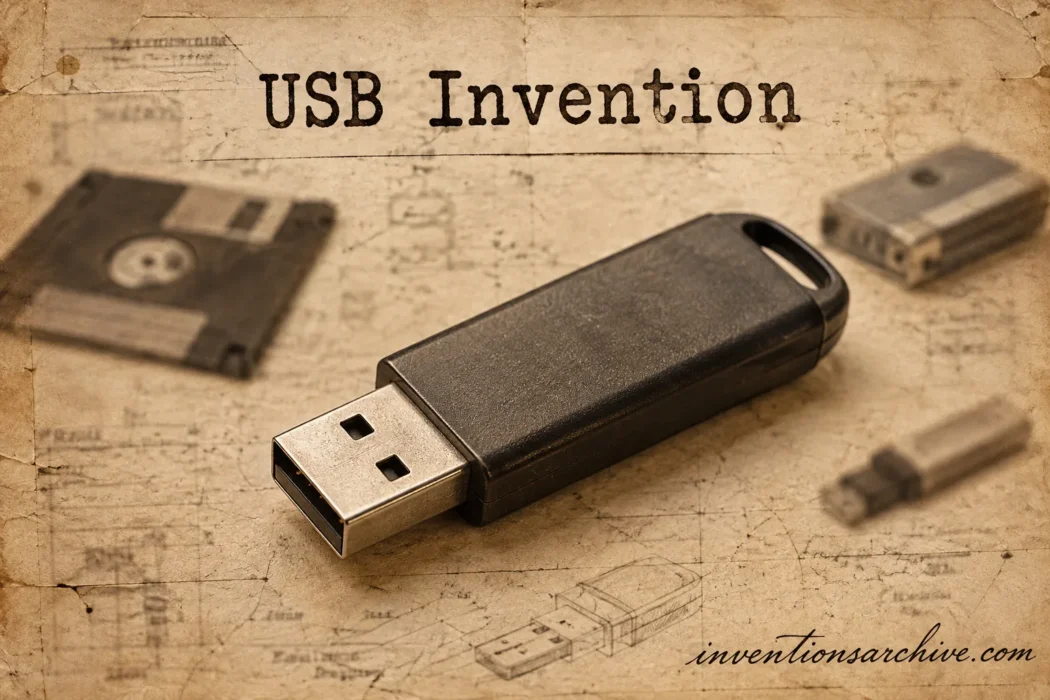
| Invention Name | Universal Serial Bus (USB) |
|---|---|
| Short Definition | A host-controlled serial interface standard for connecting, identifying, powering, and exchanging data with peripheral devices. |
| Approximate Date or Period | Confirmed development path Work at Intel dates to about 1992; USB 1.0 was released on January 15, 1996. |
| Geography | United States, with early Intel work in Oregon and development through a multi-company industry group. |
| Inventor or Source Culture | Commonly associated with Ajay V. Bhatt and Intel engineering teams; standardized through collaboration among seven companies. |
| Category | Computer interface, serial bus, and industry standard. |
| Importance | Replaced many peripheral-specific connection methods with a common interface designed for easy attachment, device discovery, data transfer, and power. |
| Evidence Status | Well documented The standard, revision dates, company participants, patents, and contributor records survive in institutional and technical archives. |
| Main Problem Solved | Too many incompatible PC ports, cables, configuration steps, and device-specific connection methods. |
| Development Path | Intel research around 1992 → internal specification work in 1994 → industry working group in 1994 → public introduction in 1995 → USB 1.0 in 1996. |
| Original Data Rates | 1.5 Mbit/s Low-Speed and 12 Mbit/s Full-Speed. |
| Original Standard Companies | Compaq, Digital Equipment Corporation, IBM PC Company, Intel, Microsoft, NEC, and Northern Telecom. |
USB is most closely associated with Intel engineer Ajay V. Bhatt, but it was not invented by one person on one date. Intel had been working on a simpler way to connect PC peripherals since about 1992. An internal specification took shape in 1994, engineers from several companies formed a working group that year, and the first final Universal Serial Bus specification was released on January 15, 1996.
That makes 1996 the clearest date for the birth of USB as a published industry standard. The invention process itself began earlier and involved engineering, corporate coordination, operating-system support, chip design, connector design, and agreement on how many different kinds of peripherals would share one external bus.
Who Invented USB?
Ajay Bhatt is the name most often attached to the invention of USB because he was an early advocate inside Intel for replacing the collection of serial, parallel, and peripheral-specific connections on PCs with a common interface. Intel’s history places work on the problem around 1992, while the European Patent Office describes Bhatt’s frustration with the reconfiguration, rebooting, and port confusion involved in attaching peripherals to personal computers.
Bhatt did not design the entire system alone. The European Patent Office groups Ajay V. Bhatt, Bala Sudarshan Cadambi, Jeff Morriss, Shaun Knoll, and Shelagh Callahan together in its account of the USB development team. Early USB-related patents also name other Intel engineers, including Puthiya Kottal Nizar, Richard M. Haslam, and Andrew M. Volk. The USB Implementers Forum’s own honor roll recognizes an even broader set of people who helped define, promote, test, and establish the early specification.
Jim Pappas also belongs in the story. After early specification work had begun, Pappas joined Intel from Digital Equipment Corporation and led the wider effort to turn the proposed serial bus into an industry project. That role mattered because a universal connector would fail if computer makers, operating-system vendors, chip suppliers, and peripheral manufacturers adopted incompatible versions.
From Intel’s 1992 Work to USB 1.0 in 1996
The different dates attached to USB are not necessarily contradictions. They mark different stages of the invention.
| Date | Stage | What Happened |
|---|---|---|
| About 1992 | Problem definition | Intel began working on a simpler answer to the growing difficulty of attaching peripherals to PCs. |
| Early 1994 | Internal specification | Early work on a proposed serial bus had reached specification form inside Intel. |
| May 1994 | Industry working group | Intel invited major industry participants to its Jones Farm campus in Hillsboro, Oregon, to develop the proposed bus further. |
| September 1995 | Public industry introduction | USB was presented to an industry gathering of about 700 people in San Jose; 160 companies had registered for USB Vendor IDs by then. |
| January 15, 1996 | USB 1.0 | The first final USB specification was released by the seven-company group, with 1.5 Mbit/s and 12 Mbit/s operating speeds. |
| August 27, 1997 | Windows support | Windows 95 OEM Service Release 2.1 added USB support, helping move the standard from specification to routine PC use. |
| 1998 | Broader adoption | Windows 98, the iMac, and USB 1.1 all arrived during a period when the peripheral ecosystem expanded rapidly. |
| April 27, 2000 | USB 2.0 | High-Speed mode raised the maximum signaling rate to 480 Mbit/s. |
If a single year is required for the question “When was USB invented?”, 1996 is the strongest answer because that is when USB 1.0 became a final published standard. For the start of development, however, the record points several years earlier.
The Seven Companies Behind the First USB Standard
USB 1.0 names Compaq, Digital Equipment Corporation, IBM PC Company, Intel, Microsoft, NEC, and Northern Telecom. Their involvement shows why USB is better understood as a collaborative industry standard than as a proprietary Intel port.
The companies brought different needs to the project. PC makers needed a connector that could become standard hardware. Microsoft needed operating-system behavior that supported device detection and configuration. Semiconductor and electronics companies had to make controllers, hubs, and peripheral hardware practical at low cost. Agreement across those parts of the PC industry was part of the invention itself.
The USB Implementers Forum, formed in 1995, became the organization responsible for promoting the technology, coordinating compliance, and supporting interoperability among products built to USB specifications. That institutional layer helped prevent “USB-compatible” devices from fragmenting into incompatible vendor versions.
What Problem USB Was Designed to Solve
A typical early-1990s PC could use different connectors for the keyboard, mouse, printer, modem, joystick, scanner, and other peripherals. Serial ports and parallel ports served different jobs. PS/2 connectors were common for keyboards and mice. SCSI could be used for devices such as scanners and storage. Some hardware required extra interface cards or its own connection method.
The difficulty was not limited to plug shapes. Adding hardware could involve driver installation, resource conflicts, port settings, and a reboot. The aim behind USB was to make peripheral attachment behave more like a normal consumer connection: plug in a supported device, let the host detect it, identify what it is, load the appropriate software support, and begin communicating without asking the user to understand the electrical details of the port.
USB therefore combined several ideas in one standard: a common external connector system, serial data transport, automatic device enumeration, defined device behavior, hot attachment, hubs, and power delivered through the cable. A USB flash drive, by contrast, is a later storage product that uses the USB interface; it is not the invention of USB itself.
How the Original USB System Worked
USB 1.0 used a host-centered architecture. The host computer controlled communication and scheduled transfers. Devices did not simply speak whenever they wanted; they communicated through transactions managed by the host. Hubs could extend the connection tree so that many devices shared the same host controller.
When a device was attached, the host could detect the connection and perform enumeration: it learned information about the device, assigned it an address, identified its capabilities, and selected an appropriate configuration. This behavior was central to the plug-and-play experience because the computer could discover what had been connected instead of relying on a user to set a port manually.
The first specification supported 1.5 Mbit/s Low-Speed operation for simple peripherals and 12 Mbit/s Full-Speed operation for devices needing more bandwidth. Those rates were modest by later standards, but they were suited to many of the keyboards, mice, telephony devices, printers, and other peripherals the designers wanted one bus to handle.
Power Was Part of the Connection
USB cables carried power as well as data. This allowed small peripherals such as keyboards and mice to operate without a separate power adapter. It also opened a path that later turned USB into a common charging and power-delivery connection, a use that grew far beyond the original PC-peripheral problem.
Low Cost Shaped the Architecture
Early USB development treated low implementation cost as a design requirement. IEEE’s historical record notes that the mouse was used as a demanding cost target because it was a very inexpensive peripheral. That pushed the designers toward a simpler device side and a more capable host side. The host-centered arrangement made it easier to build inexpensive USB devices while leaving more of the control work to the computer.
This choice also separated USB from peer-to-peer approaches that placed more intelligence in each connected device. The result was well suited to mass-market PC peripherals, where a few extra components in every low-cost mouse, keyboard, or accessory could have slowed adoption.
Why Early USB Used A and B Connectors
The original USB connector system reflected the host-device hierarchy. Standard-A connectors were associated with the host side, while Standard-B connectors were used on many peripheral devices. Their different physical forms helped enforce the direction of the connection and prevented users from building an invalid cable arrangement by simply joining equivalent device ends together.
These early connectors were not reversible. USB Type-C, introduced much later, changed the physical model: the plug can be inserted in either orientation, and connection roles can be identified electronically. That is why USB-C should not be treated as another name for USB itself. USB is the broader interface family; USB Type-C is a connector and cable system that can carry different USB capabilities.
Why USB Did Not Replace Older Ports Overnight
A standard can be published before a working ecosystem exists around it. USB 1.0 arrived in January 1996, but widespread use required controller chips in computers, operating-system support, compliant peripherals, device drivers, hubs, cables, and testing programs.
Microsoft support arrived in Windows 95 OEM Service Release 2.1 in August 1997. Windows 98 followed in June 1998 with broader USB support. Apple’s original iMac, released in August 1998, also gave USB a highly visible consumer role by using USB for devices including its keyboard and mouse instead of relying on Apple’s older desktop peripheral connector.
The iMac did not invent USB. Its importance in the USB story is adoption: a major consumer computer committed users and peripheral makers to the newer interface at a time when the market still contained many older ports.
USB 1.1 and USB 2.0 Turned the Interface Into a Mass-Market Standard
USB 1.1 was released on September 23, 1998. It clarified and corrected parts of the earlier specification while retaining the original 1.5 Mbit/s and 12 Mbit/s rates.
USB 2.0, released on April 27, 2000, added 480 Mbit/s High-Speed operation. The forty-fold increase over 12 Mbit/s expanded the kinds of products that could use USB effectively, including higher-performance storage, imaging, and communications hardware. USB was no longer limited by the expectations of low-speed PC accessories.
Later revisions continued raising data rates, but the naming became easier to misunderstand because USB version names and connector shapes describe different things. USB 2.0, USB 3.x, and USB4 describe generations of USB technology. USB-A, USB-B, Mini-USB, Micro-USB, and USB Type-C describe connector families or forms. A USB-C port therefore does not, by its shape alone, reveal the maximum data rate supported by the device.
From USB-A to USB-C and USB4
USB Type-C Revision 1.0 appeared in 2014 as a new connector ecosystem designed for thinner devices, reversible insertion, and newer power and data uses. It gradually replaced many earlier USB connector forms without erasing the distinction between the connector and the protocol running through it.
USB4, first released in 2019, changed the architecture for high-speed operation while retaining compatibility with earlier USB generations. Current USB4 documentation supports operation up to 80 Gbit/s with suitable USB Type-C cables and equipment. The USB Implementers Forum published a USB4 Version 2.0 specification package in April 2026 and USB Type-C Cable and Connector Specification Release 2.5 in the same month.
The scale has changed from the 12 Mbit/s ceiling of USB 1.0 to multi-gigabit links, but the original design goal remains recognizable: provide a shared external connection system so that a computer does not need a different interface for every category of peripheral.
USB Was Not Defined by One Patent
Another common simplification is to search for a single “USB patent” and treat its filing date as the invention date. The surviving patent record does not support that approach. Early USB development produced several patents covering parts of the bus architecture and communication methods, with overlapping groups of Intel engineers named as inventors.
For example, the European Patent Office associates Bhatt, Cadambi, Morriss, Knoll, and Callahan with USB and lists patent EP 0789867 B1 in its inventor profile. IEEE’s historical material identifies a group of early patents and additional named engineers. These patents document technical contributions, but the public USB standard was a larger specification created through company collaboration. Patent filing dates therefore should not replace January 15, 1996 when identifying the release of USB 1.0.
Why Ajay Bhatt’s Name Became the Short Answer
When a technology has many contributors, historical summaries often attach it to the person who first framed the problem clearly, championed the idea, or became its best-known representative. Bhatt fits that role for USB. He pushed for a common interface inside Intel before USB was an established industry project and is directly named in early patents and later institutional accounts.
The accurate short form is therefore: Ajay Bhatt is commonly credited as a leading inventor of USB, but USB was developed by a larger Intel team and standardized through a seven-company collaboration. Development began in the early 1990s, and USB 1.0 was released on January 15, 1996.
Sources and Verification
- Explore Intel’s history- Plug and Play — Intel’s corporate history places work on the peripheral-connection problem around 1992 and an internal USB specification draft in 1994.
- Milestones:Universal Serial Bus (USB), 1996 — IEEE’s Engineering and Technology History Wiki documents Bhatt’s early advocacy, Jim Pappas’s role, the May 1994 working-group meeting, and the January 1996 release.
- Milestone-Proposal:Universal Serial Bus (USB) — The IEEE Milestones record preserves detailed dates for USB’s public introduction, Windows support, iMac adoption, USB 1.1, USB 2.0, and early design constraints.
- File:USB 1.0 Specification.pdf — IEEE’s archive identifies the surviving USB Specification Revision 1.0 as the January 15, 1996 specification originally published by the seven-company group.
- Ajay V. Bhatt, Bala Sudarshan Cadambi, Jeff Morriss, Shaun Knoll, Shelagh Callahan — The European Patent Office documents the named Intel inventors, Bhatt’s motivation, the seven-company context, and associated patent information.
- USB-IF Honor Roll Awards — USB-IF’s own contributor record shows the broad group of engineers and advocates recognized for defining and establishing the early USB specification.
- USB Type-C® Cable and Connector Specification — USB-IF explains the purpose of the Type-C connector system and its relationship to newer device form factors and USB functionality.
- USB4® — USB-IF describes USB4 architecture, USB Type-C operation, compatibility with earlier USB generations, and support for up to 80 Gbit/s operation.
- USB4® Specification v2.0 — USB-IF’s specification record documents the April 2, 2026 publication of the current USB4 Version 2.0 package.
- USB Type-C® Cable and Connector Specification Release 2.5 — USB-IF records the April 8, 2026 Type-C Release 2.5 specification package.