
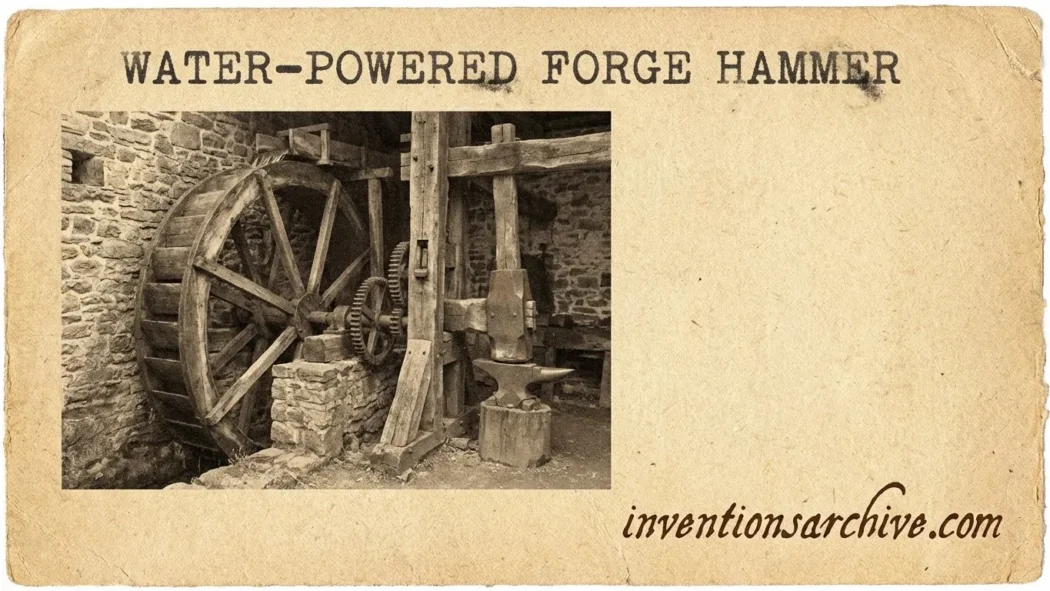
| Invention Name | Water-Powered Forge Hammer |
| Short Definition | Waterwheel-driven power hammer for metal forging |
| Approximate Date / Period | Medieval era; widespread later (Approx.) |
| Date Certainty | Approximate (varies by region) |
| Geography | Europe; later many industrial regions worldwide |
| Inventor / Source Culture | Anonymous / collective workshops |
| Category | Materials processing; metallurgy; mechanical power |
| Core Power Source | Flowing water (stream, leat, or mill race) |
| Key Mechanism | Waterwheel → shaft/cams → lifted helve → gravity blow |
| Primary Use | Shaping and consolidating hot iron and steel |
| Need / Reason | Higher force; steady rhythm; less manual hammering |
| Materials / Tech Basis | Timber frame; iron/steel head; stone/iron anvil block; wooden/metal cams |
| Typical Outputs | Bars; plates; hardware; agricultural edge tools |
| First Use Context | Forges near reliable water supply |
| Spread Route | Mill regions → craft centers → early factories |
| Derived Developments | Mechanized forging lines; later steam and electric hammers |
| Impact Areas | Craft production; infrastructure hardware; education; heritage industry |
| Debates / Different Views | “First” dates uneven; local evidence gaps (Varies) |
| Precursors + Successors | Hand sledge hammers → water-powered helve → steam hammer → electric power hammer |
| Influenced Variants | Tilt hammer; helve hammer; trip hammer; hammer forge layouts |
| Why It Matters |
|
A water-powered forge hammer is a power hammer driven by a waterwheel, built to deliver heavy, repeatable blows for forging iron and steel. It sits at a sweet spot in industrial history: simple enough to be built from wood, iron, and stone, yet strong enough to reshape how workshops produced bars, plates, and tools.
Names Used in Workshops
- Trip hammer (lift and drop)
- Tilt hammer (a common forge form)
- Helve hammer (lever/beam hammer)
Core Idea
Flowing water turns a wheel, the wheel turns a shaft, and cams lift a beam so the hammer head can fall with consistent timing. The result is rhythm plus force, day after day, without relying on a crew swinging sledges for every strike.
Contents
What It Is
In a forge, a water-powered hammer acts like a tireless striker: it repeatedly lifts and releases a heavy head so the blow lands in the same place with steady timing. The key is not mystery or complexity. It is controlled repetition powered by a stream.
The phrase forge hammer matters because trip hammers also existed for other jobs, such as crushing or pounding. A forge hammer is tuned for hot metal: the head shape, anvil mass, and frame stiffness aim for shaping and consolidation, not grinding.
Water power was widely adopted for industrial motion beyond grinding grain, including driving bellows for furnaces and forges and powering tilt or trip-hammers for forging ironDetails.
What “Tilt” Often Means
Many forge hammers use a helve, a long beam that pivots on a support. When the tail is lifted by a cam, the head end rises. When released, the beam tilts and the head drops onto the workpiece with gravity-driven impact.
Why Workshops Wanted It
- Higher force than routine hand striking
- Repeatable blows for drawing out bars and flattening plate
- More consistent output from a small team, without changing the craft’s judgment
Main Parts of the System
A water-powered forge hammer is a chain of sturdy parts that protect the rhythm. Each piece exists to move power forward while keeping the blow predictable and the frame stable.
- Water supply: stream, leat, sluice gate, and mill race
- Waterwheel: converts flow into rotating torque
- Main shaft: carries rotation to the hammer side
- Camshaft or cam ring: lifts the hammer beam in pulses
- Helve (beam): lever that amplifies lift into usable hammer travel
- Hammer head: mass that delivers the blow
- Anvil block: heavy base that reflects energy back into the work
- Frame and guides: keep motion aligned; limit side-to-side swing
| Part | Role | What It Protects |
|---|---|---|
| Waterwheel | Continuous rotation | Steady power |
| Cams | Lift then release | Rhythm |
| Helve | Levered motion | Controlled travel |
| Anvil block | Rigid support | Efficient impact |
| Frame | Alignment | Accuracy |
How It Works
The action is simple to picture: rotation becomes lift, lift becomes a drop, and the drop becomes a blow. What makes it impressive is that the cycle repeats with machine patience while the craft decisions stay with the human eye.
- Water turns the wheel, producing steady rotation.
- The wheel drives a shaft fitted with cams.
- Each cam lifts the tail of the helve (or a lifting arm).
- As the cam rolls away, the helve is released and the head drops under gravity.
- The head strikes above a fixed anvil with repeatable impact.
The Motion in One Line
Flowing Water → Waterwheel → Camshaft → Lift → Release → Gravity Blow
That line is the heart of the water-powered forge hammer: a clean conversion of nature’s motion into timed impact with very little waste.
Early Evidence and Timeline
These hammers did not appear in isolation. They grew out of a broader shift: using waterwheels not only for milling, but also for industrial motion inside furnaces and forges. Once a workshop could rely on water flow, the hammer’s rhythm became a new kind of infrastructure.
In the European ironmaking tradition, one clear marker is the rise of water-powered forging tools for turning bloomery iron into workable bar. A U.S. National Park Service overview notes that by the 1100s, water-powered hammers were replacing hand hammers for forging out bars of ironDetails.
| Period | What Changed | Why It Mattered |
|---|---|---|
| Medieval era | Water power enters forge work | More output with steady rhythm |
| Late medieval to early modern | Hammer forges spread in mill regions | Specialized workshops emerge |
| Industrial era | Steam and later electric power grow | Higher peak force and flexible siting |
| Heritage era | Preservation and demonstration | Living knowledge stays visible |
Forge Work and Products
A forge hammer’s strength shows up in the everyday things it helped make: bars for further shaping, flat stock for fittings, and robust pieces used in building and farming. The hammer is not the whole workshop; it is the heavy heartbeat that supports many other steps.
In water-powered industrial sites, the hammer often worked alongside other water-driven machines. Abbeydale Industrial Hamlet describes waterwheels feeding multiple systems, including tilt hammers, a blowing engine, grindstones, and boring machinery, all powered by water fed through the dam and channel systemDetails.
Where the Hammer Helps Most
- Drawing out hot bars (lengthening)
- Upsetting ends (thickening)
- Flattening plate and strap
- Consolidating welded stacks into solid stock
What It Does Not Replace
The hammer provides force, not judgment. Skilled hands still decide where the blow lands, when the work is ready, and which shape the piece should become.
Related articles: Ironworking [Ancient Inventions Series]
Types and Variations
“Water-powered forge hammer” is a family label. In practice, designs vary by how the helve pivots, how the cams lift, and what the workshop needs to shape. The names change from place to place, yet the shared idea remains cam-lift plus gravity fall.
By Hammer Geometry
- Tilt hammer: a helve pivots so the head “tilts” down onto the anvil
- Helve hammer: emphasizes the lever beam itself (often used as a broad term)
- Trip hammer: general term for lift-and-drop power hammer (forge or non-forge)
By Lifting System
- Camshaft with multiple cams: sets the striking rhythm
- Adjustable cams: allows changes in lift height and strike pattern (Workshop dependent)
- Single or paired hammers: one heavy head or two heads sharing the same drive
By Waterwheel Style
Workshops chose wheels that fit local water. An undershot wheel suits faster shallow flow; an overshot wheel fits a controlled drop; a breastshot sits between. The hammer does not demand one wheel type, it demands reliable rotation.
| Variant | Typical Lift Feel | Common Strength |
|---|---|---|
| Tilt / helve forge hammer | Levered arc | Controlled shaping |
| General trip hammer | Lift-and-drop cycle | Simple repetition |
| Hammer forge layout | Integrated line | Workshop efficiency |
Limits and Upgrades
The hammer’s performance depends on the water supply and the geometry of the lever. A stronger flow or higher head can raise a heavier helve more often. A tighter frame reduces energy loss. Over time, workshops refined the same basic pattern rather than replacing it.
A key step in this mechanization story is the pairing of water wheels with a camshaft, used to overcome the force and energy limits of hand-operated hammers. A Springer Nature chapter notes this as a Middle Ages shift, with lever-type hammers operated by a camshaft driven by a water wheelDetails.
A Quiet Design Strength
Even with upgrades, the design stays readable: rotate, lift, release. That clarity is why water-powered forge hammers kept working in many regions alongside newer power sources.
Legacy and Preservation
Today, the water-powered forge hammer is both a working concept and a heritage artifact. In some valleys and mill regions, water-driven forges stayed productive surprisingly late, because the system is robust, repairable, and suited to steady craft output.
A detailed case study of an Italian hammer forge, published in the journal Machines, describes an in-depth analysis “from the water wheel to the hammers” and notes that water-powered trip hammers and workshops remained productive in some areas until the middle of the 20th centuryDetails.
Why It Still Draws Attention
- Visible power: energy you can see moving through parts
- Repeatable motion: cams make rhythm tangible
- Material truth: wood, iron, and water doing real work
What Preservation Usually Focuses On
- Water path: channels, gates, wheel pit
- Transmission: shafts, cams, bearings
- Hammer line: helve, guides, anvil foundation
- Sound structure: frame stiffness and alignment
FAQ
Is a water-powered forge hammer the same as a trip hammer?
A trip hammer is a broad term for a lift-and-drop power hammer. A water-powered forge hammer is one important member of that family, tuned for forging rather than crushing or milling.
Why are many called “tilt hammers”?
The hammer head sits on a pivoting beam. When the tail lifts and releases, the beam tilts and the head falls. The term highlights the lever motion, not the power source.
Did water power also run forge bellows?
Yes, many historical forge sites used waterwheels for more than one job. A waterwheel can drive bellows motion and a hammer line in the same complex, depending on layout and available flow.
What makes the anvil foundation so important?
The anvil block and its footing absorb shock and return energy into the work. A heavy, well-set base keeps the blow efficient and the alignment stable, protecting both the hammer and the product.
How did workshops control the striking rhythm?
The rhythm comes from the cams. Their spacing sets how often the helve is lifted. Their shape and height influence how the lift feels, keeping the cycle consistent.
Are any water-powered forge hammers still operating?
Some survive in preserved industrial sites and craft heritage settings. When operated for demonstration, the focus is often on showing motion transmission and the timed impact that made these hammers so useful.