
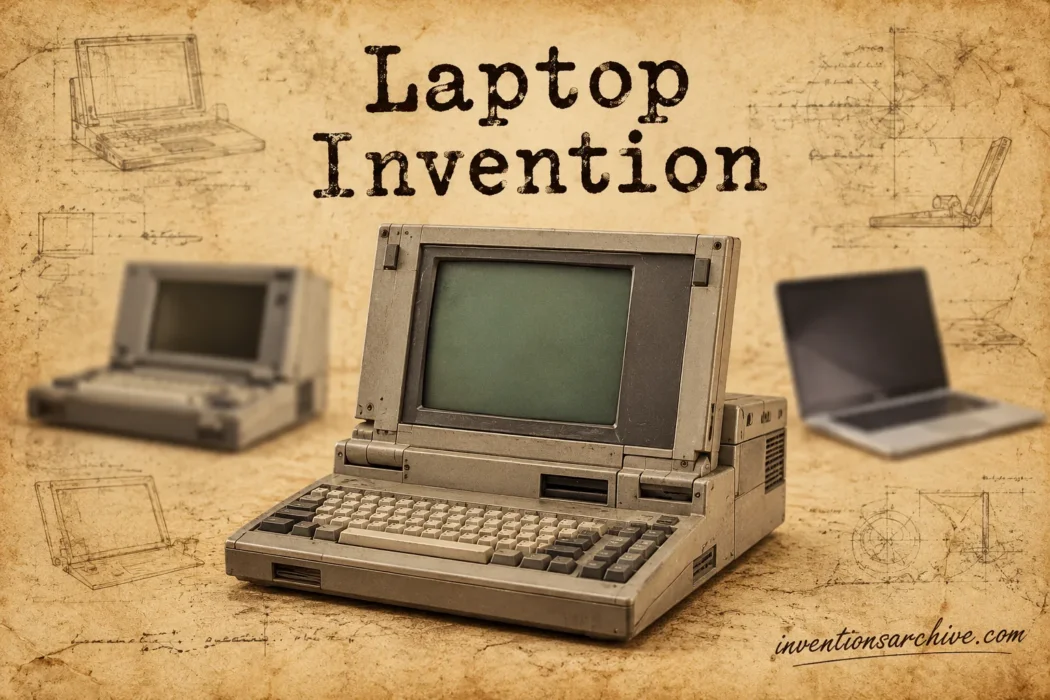
| Invention Name | Laptop / Portable Personal Computer |
|---|---|
| Short Definition | A self-contained computer designed to be moved and used away from a conventional fixed desktop installation; the modern laptop uses a hinged clamshell layout with the display above the keyboard. |
| Approximate Date or Period | Concepts from 1968; working portable systems from 1973; modern clamshell form commercially established in 1982 |
| Geography | United States and Canada, with later development across the international computer industry |
| Inventor or Source Culture | Attribution varies Alan Kay, Paul Friedl and IBM colleagues, Mers Kutt and the MCM team, Adam Osborne and Lee Felsenstein, Epson engineers, Bill Moggridge and GRiD Systems all represent different stages |
| Category | Computing, Personal Electronics, Mobile Computing |
| Importance | Moved general-purpose computing from fixed installations toward personally carried, self-contained machines |
| Evidence Status | Attribution varies by definition No single machine satisfies every historical meaning of “first portable computer” or “first laptop” |
| Main Problem Solved | Allowing users to move a complete computing environment rather than depend on a fixed terminal, desktop system, or computer room |
| Development Path | Dynabook concept → early portable prototypes → commercial portable computers → luggables → battery-powered mobile computers → clamshell laptops |
| Early Technical Basis | Microprocessors, compact displays, semiconductor memory, cassette or disk storage, integrated keyboards and later rechargeable batteries |
| Modern Descendants | Notebook PCs, ultrabooks, mobile workstations, convertible laptops and other portable personal computers |
The question “Who invented the first portable computer?” sounds as though it should lead to one inventor and one machine. The historical record is less tidy. A computer could be portable without being light enough for a lap, commercially sold without being a mass-market success, or shaped like a modern laptop while lacking its own internal battery.
That distinction explains why IBM SCAMP, the MCM/70, IBM 5100, Osborne 1, Epson HX-20 and GRiD Compass all appear in histories of portable computing. They did not accomplish the same thing. SCAMP was an early working prototype. The MCM/70 helped establish portable personal microcomputing. IBM sold the 5100 as a portable computer in 1975. The Osborne 1 made the transportable personal computer commercially visible. Epson brought battery-powered computing into a much lighter package. Bill Moggridge’s GRiD Compass supplied the clamshell form that most clearly resembles today’s laptop.
Why There Is No Single First Portable Computer
Several separate questions are often compressed into the phrase “first laptop.” Was the machine only proposed, or was it built? Did it operate as a complete computer? Could a person carry it? Did it run from batteries? Was it manufactured for customers? Did it sell in meaningful numbers? Did the screen fold over the keyboard?
Change any one of those requirements and the winner changes. A conceptual design can precede every physical machine without being a manufactured invention. A laboratory prototype can operate before the first product reaches customers. A 25-kilogram computer can be “portable” according to 1970s terminology while being far outside what anyone today would call a laptop.
The strongest history therefore follows the separate technical steps rather than forcing one machine to hold every title.
Alan Kay’s Dynabook Defined the Portable Personal-Computer Idea
One of the earliest clear visions of a notebook-sized personal computer came from computer scientist Alan Kay. In 1968, while working at the University of Utah, Kay began exploring the idea that computing could move away from large institutional machines toward a thin personal device. His later Dynabook concept developed this into a portable computer intended to function as a personal medium, particularly for learning and creative work. The Computer History Museum describes the 1968 Dynabook mockup as a design that was too advanced to build with the technology then available.[a]
The distinction matters. The Dynabook was not a commercially manufactured laptop sitting on a store shelf in 1968. It was a design vision that anticipated characteristics later associated with personal mobile computers: a thin body, individual ownership, an electronic display, interactive software and computing that could travel with its user.
Kay’s contribution is therefore strongest when described as an early conception of portable personal computing, rather than as the manufacture of the first working laptop.
1973 Produced Two Different Claims: IBM SCAMP and the MCM/70
The history becomes more concrete in 1973. By then, portable computing was no longer only a future concept. Two projects on opposite sides of the U.S.–Canada border were demonstrating that a complete computer could be packaged into a form intended to move.
IBM SCAMP Was a Working Suitcase-Style Prototype
In late 1972, IBM’s General Systems Division asked the company’s Scientific Center in Palo Alto to develop a computer that would promote the APL programming language. Paul Friedl and his colleagues spent about six months developing SCAMP, short for Special Computer, APL Machine Portable.[b]
SCAMP combined components that would normally have been associated with separate pieces of computer equipment. It incorporated a cathode-ray-tube display, keyboard, cassette recorder for secondary storage, memory cards and IBM’s PALM processor board. Its enclosure folded into a suitcase-like package, with the upper display section raised for operation.
This was a functioning computer, not a sketch. IBM used SCAMP in more than one hundred demonstrations for tasks including financial analysis, project planning, education, engineering and statistics. Surviving project workbooks held by the Smithsonian record a first SCAMP demonstration on September 11, 1973.[c]
SCAMP was nevertheless a prototype. It was not a normal production computer offered to customers. Its historical importance lies partly in what came next: IBM used it as the prototype foundation for the IBM 5100 portable computer.
The MCM/70 Brought Portability Into Personal Microcomputing
At almost the same time, Canadian company Micro Computer Machines was developing the MCM/70. The project grew from ideas developed by company co-founder Mers Kutt and used Intel’s 8008 microprocessor. An early demonstrator was ready for a public presentation at the Fifth International APL Users’ Conference in Toronto in May 1973. The MCM/70 was officially announced in Toronto on September 25 of that year.[d]
The MCM project deserves attention because it joined several ideas that later became routine in personal computers. It was designed around an individual user rather than as a terminal to a remote mainframe. The production model incorporated an APL keyboard, plasma display, cassette storage, operating software and an APL interpreter in ROM. Manufacturing began in mid-1974.
Its development also produced an unusually early experiment in genuinely untethered portable computing. In July 1973, MCM placed MCM/70 hardware, a keyboard, a one-line plasma display and a cassette drive into an attaché case and powered the system entirely from batteries. The machine, called the Executive, was demonstrated at the APL Congress at the Technical University of Denmark in August. York University’s Computer Museum describes it as what can now be considered the first portable and battery-operated PC.[d]
MCM did not turn the Executive into its main production design. The commercial MCM/70 that followed was a flat-top machine rather than a clamshell notebook. Even so, the 1973 demonstrations make it difficult to tell the history of portable personal computing by beginning with the Osborne 1 eight years later.
IBM 5100 Turned the SCAMP Line Into a Commercial Product
IBM announced the IBM 5100 in 1975. Unlike SCAMP, it was a commercial computer rather than an internal demonstration prototype. It packaged a display, keyboard, processor, memory and storage capability into one transportable unit and could run APL and BASIC, depending on configuration.
Its portability has to be understood in the language of its period. The machine weighed about 55 pounds, or roughly 25 kilograms. The Computer History Museum describes it as “marginally portable,” a useful reminder that portability originally meant that an entire computer could be moved as one piece, not that it could comfortably sit on someone’s knees.[f]
The 5100 therefore has a defensible claim as an early commercially available portable computer. It is a much weaker candidate for “first laptop” in the modern sense. Its physical design belonged to the transportable-computer era: a self-contained machine intended to be carried to a working location and then placed on a surface.
Xerox NoteTaker Connected the Dynabook Idea to the Luggable Generation
Xerox PARC developed another important experimental machine in 1976. Designed by Doug Fairbairn, the Xerox NoteTaker included a mouse and touch-sensitive screen and attempted to realize as much of Alan Kay’s Dynabook vision as contemporary technology allowed. It never became a commercial product.[g]
The NoteTaker matters because its influence did not end inside Xerox. Its suitcase-style arrangement helped shape the next commercially important stage of portable computing. Computer History Museum records connect the appearance of the later Osborne 1 with the NoteTaker design.
This creates a visible design sequence. Dynabook supplied an ambitious vision of personal mobile computing. NoteTaker translated part of that vision into a working experimental computer. The Osborne 1 then adapted the transportable all-in-one idea into a product that could be manufactured and sold on a much larger scale.
The Osborne 1 Made Portable Personal Computing a Commercial Category
Introduced in 1981, the Osborne 1 is one of the machines most often called the first portable computer. That description needs qualification, because SCAMP, the MCM/70 line and IBM 5100 all preceded it. What the Osborne 1 did particularly well was turn portability into a commercially visible personal-computer proposition.
The machine weighed roughly 24 pounds and sold for $1,795. It used a 5-inch display, had 64 KB of memory and two 5.25-inch floppy drives, and came with a valuable package of business software. The Computer History Museum identifies it as the first mass-produced portable computer and describes it elsewhere as the first commercially popular portable.[h]
Adam Osborne Was Not the Sole Designer
The Osborne 1 is closely associated with entrepreneur Adam Osborne, whose company, product strategy and software-bundling model helped define the machine’s market position. The hardware design, however, should not be attributed to Osborne alone.
Lee Felsenstein, already known for work in the early personal-computer community, designed Osborne Computer Corporation’s first product. Computer History Museum records identify him as the designer of the company’s portable computer and note that the design was inspired by the Xerox NoteTaker.[i]
Calling Adam Osborne “the inventor of the laptop” therefore compresses several different roles into one. Osborne was central to the product and company. Felsenstein was central to the engineering of the Osborne 1. Earlier portable computers already existed, and the Osborne itself did not yet have the physical arrangement that came to define the modern laptop.
Why the Osborne 1 Is Better Described as a Luggable
The machine was self-contained and could be carried by its handle, but it was closer to a compact suitcase computer than to a current notebook. Its display was fixed into the main body rather than hinged above the keyboard. It was heavy enough that “luggable” became a useful description for this generation of machines.
That distinction is not merely about comfort. A luggable computer solved the problem of transporting a complete desktop-style computing environment. A laptop had to solve additional problems: reducing weight, protecting the screen during transport, arranging the display for normal seated use, fitting the electronics into a flatter enclosure and eventually supplying enough battery power for practical work away from an electrical outlet.
Epson HX-20 Showed What Battery-Powered Mobility Could Look Like
The Epson HX-20, introduced in 1982, attacked portability from another direction. Epson describes it as the world’s first hand-held computer. Its A4-sized body weighed approximately 1.6 kilograms, a fraction of the weight of the IBM 5100 or Osborne 1.[j]
The HX-20 contained a full-stroke keyboard, small liquid-crystal display, microprinter and built-in nickel-cadmium battery. Epson states that the battery could support up to about 50 hours of off-grid use. Interfaces allowed connection to external devices, while optional cassette storage extended its capabilities.
The HX-20 did not establish the modern hinged-laptop shape; its display remained within a flat keyboard-centered body. What changed was the meaning of mobility. A portable computer no longer had to mean a heavy computer that could theoretically be carried between desks. It could be light enough to travel routinely and operate from its own power supply.
Bill Moggridge’s GRiD Compass Established the Clamshell Laptop Form
If “laptop” means a computer whose physical design clearly anticipates the notebook computers used today, the GRiD Compass provides one of the strongest answers.
British industrial designer Bill Moggridge designed the Compass for GRiD Systems. The Computer History Museum credits Moggridge with designing the first laptop computer, while its account of the GRiD engineering project describes the GRiD Compass 1100, introduced in 1982, as likely the first commercial computer created in a laptop format.[k]
The decisive feature was its clamshell architecture. The screen was hinged to the main body and folded flat over the keyboard when the computer was closed. This arrangement accomplished several tasks at once: it protected the display, reduced the transport footprint, placed the screen in a useful viewing position when opened and created a compact rectangular object that could be carried without dismantling anything.
The Compass also incorporated a magnesium case, electroluminescent display, bubble memory and built-in modem. It was expensive and aimed at specialized professional, government and institutional users rather than the broad consumer market. GRiD machines later became strongly associated with mobile professional computing, including use connected with NASA’s Space Shuttle program.
The First Compass Models Expose an Important Historical Paradox
The GRiD Compass looked far more like a current laptop than the Osborne 1, yet the earliest Compass versions did not contain internal batteries.[l]
This is one reason a simple checklist cannot determine the first laptop. The MCM Executive demonstrated battery-operated portability years earlier, while the Epson HX-20 delivered excellent battery mobility in a flat form. The Compass supplied the clamshell architecture that became dominant, but its early versions did not yet combine that architecture with every feature expected from a modern notebook.
Laptop history is therefore a convergence story. The familiar machine emerged when several previously separate advances—compact processing, flat displays, portable storage, rechargeable power and clamshell industrial design—eventually met in the same product category.
| Machine | Date | Strongest Historical Claim | Why It Is Not the Entire Answer |
|---|---|---|---|
| Dynabook | 1968 concept | Early influential vision of notebook-sized personal computing | Conceptual rather than a commercial production computer |
| IBM SCAMP | 1973 | Early working suitcase-style portable computer prototype | Prototype rather than a normal commercial product |
| MCM/70 and Executive | 1973–1974 | Early portable personal microcomputer; 1973 Executive demonstrated battery operation | Production MCM/70 did not use the later clamshell laptop form |
| IBM 5100 | 1975 | Early commercially sold self-contained portable computer | Approximately 55 lb and unlike a modern laptop in form |
| Osborne 1 | 1981 | First mass-produced and commercially popular portable personal computer | Luggable suitcase form with fixed display rather than a clamshell |
| Epson HX-20 | 1982 | Very light, self-powered hand-held computer with built-in rechargeable battery | Flat-top layout rather than the modern hinged notebook configuration |
| GRiD Compass | 1982 | Leading candidate for the first commercial computer in the modern clamshell laptop format | Early versions lacked an internal battery and targeted a specialized high-cost market |
How a 55-Pound Portable Became a Laptop
The transition from IBM 5100 to modern notebook was not simply a matter of making the same computer smaller. Several engineering constraints had to change together.
Displays Had to Stop Being Bulky
Early portable designs such as SCAMP and the Osborne 1 relied on cathode-ray-tube displays. CRTs could provide a useful computer screen, but the tube required depth, added weight and consumed substantial power. That geometry naturally encouraged suitcase-style cases with the display buried in the body.
Flat-panel technologies changed the industrial design possibilities. The MCM experiments used a plasma display, the Epson HX-20 used an LCD and the GRiD Compass used a thin electroluminescent panel. Once a screen no longer required the depth of a CRT, designers could place it in a hinged lid rather than in a heavy box.
Storage Had to Travel With the Computer
Portable computers also needed a practical way to carry programs and data. SCAMP and the MCM line used cassette-based storage. The Osborne 1 integrated floppy disk drives into its case. GRiD pursued bubble memory, a non-volatile solid-state storage technology that avoided a conventional spinning disk inside the mobile machine.
Later hard drives, flash storage and solid-state drives would make storage faster and denser, but the earlier machines had already established the design requirement: a portable computer needed its useful software and user data to travel with it.
Power Became Part of the Computer’s Design
A machine can be transportable without being electrically independent. That difference separates many early portables from later mobile computers.
The 1973 MCM Executive demonstrated that a general-purpose personal computer could operate entirely from batteries, but it remained an experimental branch of the MCM project. Epson’s HX-20 made rechargeable battery operation a central feature of a manufactured lightweight computer. The earliest GRiD Compass models show that the clamshell form and battery mobility did not arrive in a perfectly synchronized sequence.
As processors, semiconductor memory and displays became more power-efficient, battery operation could move from an unusual feature toward an expected property of a laptop.
The Case Became a Working Mechanism
The enclosure of an early portable computer mainly held components together for transportation. The clamshell transformed the case into part of the machine’s everyday operation.
Closing the lid protected the display and keyboard. Opening it positioned the screen. The hinge allowed the machine to shift between a compact transport state and a larger working state without detachable parts. This is why the GRiD Compass occupies such a different place in laptop history from a luggable even though both could be carried.
The basic arrangement proved unusually durable. Processors, storage media, batteries, displays and ports have changed repeatedly, but the screen-hinge-keyboard relationship introduced by early clamshell machines remains recognizable in current laptops.
When “Laptop Computer” Became a Product Description
The terminology also changed as the hardware changed. During the 1970s, “portable computer” was broad enough to include machines that required considerable effort to move. By the early 1980s, manufacturers had products compact enough for a more specific category.
The Gavilan SC provides useful evidence for this transition. A Smithsonian National Museum of American History collection record describes the Gavilan as a portable computer marketed as a “laptop computer” when the phrase was new.[m] The machine came from Gavilan Computer Corporation, founded by Manuel “Manny” Fernandez, and belongs to the early-1980s period when the laptop was becoming a recognizable commercial class rather than only an engineering description.
This does not make the Gavilan the origin of every technology inside a laptop. The clamshell form had already appeared in GRiD’s machines, while portable and battery-powered computing had earlier precedents. Its value to the history is linguistic and commercial: by this point, “laptop” was becoming a name that could be used to sell a distinct kind of computer.
Who Invented the Laptop?
For the broad question “Who invented the first portable computer?”, no single name covers the complete development.
If the requirement is an early working portable computer prototype, IBM’s 1973 SCAMP and the team led by Paul Friedl belong near the beginning of the documented story. If the focus is portable personal microcomputing, Mers Kutt and the MCM/70 project are difficult to omit, especially because MCM demonstrated a battery-powered attaché-case version in 1973.
If “first” means an early commercial portable computer, IBM 5100 belongs in the discussion from 1975. If the claim is narrowed to the first mass-produced, commercially popular portable personal computer, the Osborne 1 of 1981 is the stronger answer, with Adam Osborne representing the product and business concept and Lee Felsenstein responsible for its hardware design.
If the question is specifically about the machine that most clearly established the modern clamshell laptop form, Bill Moggridge’s GRiD Compass is the strongest candidate. Its folding screen and keyboard arrangement became the physical template followed by generations of notebook computers.
That is why “Who invented the laptop?” and “Who invented the first portable computer?” should not be treated as identical questions. Portable computing existed before the laptop form, and battery-powered mobility existed separately from it. The modern laptop appeared when those different lines of invention finally converged.
Sources and Verification
- [a] Portable Computers — Computer History Museum — Documents Alan Kay’s 1968 Dynabook concept and its place in the development of mobile personal computing. The Computer History Museum maintains major collections and archival records on computing history.
- [b] IBM SCAMP Microcomputer — National Museum of American History — Verifies the late-1972 project request, Paul Friedl’s development team, SCAMP’s components, portable suitcase structure, demonstrations and its role as the prototype for the IBM 5100. This is the Smithsonian’s direct collection record for the surviving SCAMP.
- [c] Workbook, SCAMP — National Museum of American History — Catalogs surviving engineering workbooks from the SCAMP project and records the September 11, 1973 first demonstration date. The documents form part of the Smithsonian’s IBM-related computing collection.
- [d] The MCM/70 Personal Computer — York University Computer Museum — Documents the MCM/70’s design, May 1973 demonstration, September 1973 announcement, mid-1974 production and Mers Kutt’s role. York University’s museum preserves and researches the Canadian MCM computer history.
- [f] IBM 5100 Portable Computer — Computer History Museum — Verifies the 1975 date, IBM 5100’s use of APL and its approximately 55-pound weight.
- [g] Xerox Notetaker — Computer History Museum — Verifies Doug Fairbairn’s design, the 1976 date, mouse and touch-sensitive screen, its relationship to the Dynabook vision and its non-commercial status.
- [h] 1981 Timeline of Computer History — Computer History Museum — Records the Osborne 1 as the first mass-produced portable computer and provides its introductory price, weight, display, memory and disk-drive specifications.
- [i] Lee Felsenstein — Computer History Museum — Verifies Felsenstein’s role designing Osborne Computer Corporation’s first product and the influence of the Xerox NoteTaker on the Osborne 1.
- [j] HX-20 — Epson — Provides Epson’s direct product history for the July 1982 HX-20, including its 1.6-kilogram weight, A4 footprint, nickel-cadmium battery and stated operating time.
- [k] Bill Moggridge — Computer History Museum — Identifies Moggridge as the designer of the GRiD Compass and credits him with the first laptop computer design.
- [l] GRiD Compass Laptop — Computer History Museum — Records the 1982 introduction, early clamshell design and the absence of batteries in the first Compass versions.
- [m] Galivan SC Portable Computer — National Museum of American History — Smithsonian collection record documenting the Gavilan portable computer and noting that it was marketed as a “laptop computer” when the phrase was new.