
| Invention Name | Electricity and Electrical Power Technology |
|---|---|
| Short Definition | A natural phenomenon involving electric charge, together with the human-made technologies used to produce and control electrical current. |
| Approximate Date or Period | Electrical effects were known long before modern science; controllable electrical technologies developed mainly from the 1600s through the late 1800s. |
| Geography | Early observations in the Mediterranean world; later experimental and industrial development across Europe and North America. |
| Inventor or Source Culture | No single inventor. Major contributors include William Gilbert, Benjamin Franklin, Alessandro Volta, Hans Christian Ørsted, Michael Faraday, James Clerk Maxwell, Thomas Edison, Nikola Tesla, George Westinghouse, and many others. |
| Category | Physics, electrical engineering, energy technology |
| Importance | Enabled batteries, generators, motors, electric lighting, telecommunications, electronics, industrial power, and electrical grids. |
| Evidence Status | Confirmed: no single inventor |
| Main Problem Solved | Electrical technologies made naturally occurring electrical effects measurable, storable, continuously available, mechanically generatable, and distributable. |
| Development Path | Static charge → charge storage → continuous current → electromagnetism → electromagnetic generation → motors and lighting → utility networks |
| Technical Basis | Electric charge, electric fields, current, voltage, resistance, magnetism, electromagnetic induction, and electrochemical reactions. |
Electricity was not invented by Benjamin Franklin, Nikola Tesla, Thomas Edison, or any other single person. Electricity is a natural physical phenomenon. Lightning, static charge, and electrical activity in living organisms existed long before humans began studying them.
What people invented were ways to produce, store, measure, control, convert, and distribute electrical energy. That distinction explains why so many different names appear in accounts of who “invented electricity.” Franklin studied electrical charge and lightning. Alessandro Volta produced a sustained current with an early battery. Michael Faraday established the principle behind electromagnetic generators. Edison developed an integrated electric-light and direct-current utility system. Tesla and Westinghouse helped make polyphase alternating-current systems practical on a large scale.
The history therefore has no single invention date. It is a sequence of discoveries and devices that gradually changed electricity from an observed natural effect into a controllable source of energy.
Electricity Existed Before Anyone Could Generate It
One of the oldest electrical effects known to humans is static attraction. The English word electricity ultimately derives from the Greek word elektron, meaning amber. When amber is rubbed with certain materials, it can acquire an electric charge and attract lightweight objects.
Ancient observations of such effects were real, but they did not amount to a theory of electricity. People could see that rubbing materials sometimes produced attraction or sparks without knowing about electric charge, electrons, fields, or current. Calling any ancient observer the “inventor of electricity” would therefore confuse observation of a natural phenomenon with invention of a technology.
A more recognizable experimental science of electricity emerged much later. In 1600, English physician and natural philosopher William Gilbert published De Magnete. His investigations compared magnetic effects with the attraction produced by rubbed materials. Gilbert used the Latin term electricus for objects that behaved like amber after rubbing, helping establish the vocabulary from which later electrical terminology developed.
The change was methodological as much as linguistic: electrical attraction could now be reproduced and compared through controlled experiments rather than treated simply as an unusual property of amber.
Static Machines Made Electrical Effects Repeatable
Early researchers still lacked anything resembling a modern electrical supply. Their electricity was usually static charge created by friction. During the seventeenth century, experimenters began developing machines that made this charge easier to produce repeatedly.
In 1663, Otto von Guericke described an apparatus using a rotating sulfur globe. Other researchers later developed improved glass-cylinder and glass-globe machines. Friction against the rotating surface accumulated static charge, allowing sparks and attraction effects to be demonstrated more reliably than by rubbing a small piece of amber by hand.
This was electrical generation in one limited sense: mechanical work was being used to separate charge. Yet the result was very different from the continuous current supplied by a battery or modern generator. Charge accumulated and then discharged, often as a brief spark.
Experiments during the early eighteenth century also revealed that electricity could move through some materials more readily than others. This helped researchers distinguish what would later be understood as conductors and insulators. Electrical research was becoming a study of how charge behaved, not merely how to produce spectacular sparks.
The Leyden Jar Made Electricity Storable
A major limitation of friction machines was that their charge was difficult to retain. The development of the Leyden jar in the 1740s changed that.
The device emerged from experiments associated independently with researchers in Germany and the Netherlands, particularly Ewald Georg von Kleist and Pieter van Musschenbroek. A typical Leyden jar used a glass dielectric between conducting surfaces. Charge could accumulate on opposite sides of the glass and later be released through a conducting connection.
This meant experimenters could separate two operations that had previously occurred almost together: generating charge and discharging it. Electricity could be collected, retained, transported in an experimental device, and released when desired.
The Leyden jar also gave researchers stronger and more repeatable effects to investigate. Benjamin Franklin became deeply interested in the device and used it in experiments that helped clarify how charge was distributed across its conducting surfaces.
| Stage | Representative Technology | What Changed |
|---|---|---|
| Produce static charge | Friction machine | Electrical charge could be created repeatedly for experiments. |
| Store charge | Leyden jar | Separated charge could be accumulated and discharged later. |
| Supply continuous current | Voltaic pile | An electrochemical source produced sustained current instead of a brief static discharge. |
| Generate current mechanically | Faraday’s induction experiments and early generators | Motion and magnetism could produce electrical current without relying on a chemical cell. |
Benjamin Franklin Did Not Invent Electricity
Benjamin Franklin is probably the person most often incorrectly described as the inventor or discoverer of electricity. Electrical experiments had already been conducted for generations before Franklin began his own work in the 1740s.
Franklin’s contribution was different. He developed influential explanations of electrical charge, used the terms positive and negative in his electrical theory, investigated Leyden jars, and argued that lightning and laboratory electricity were manifestations of the same natural phenomenon.
His famous storm experiments need to be separated from the simplified story in which lightning supposedly struck a kite and “discovered electricity.” Franklin had already proposed an experiment using a pointed iron rod to draw electrical effects from a storm cloud.
Before Franklin reported performing his kite experiment, French experimenter Thomas-François Dalibard tested Franklin’s proposal at Marly-la-Ville near Paris. On May 10, 1752, electrical sparks were drawn from an insulated iron rod during stormy weather. The result supported Franklin’s prediction that clouds could produce the same kinds of electrical effects seen in laboratory experiments.
Later in 1752, Franklin reported obtaining comparable results with a kite arrangement. His letter to Peter Collinson concerning the electrical kite is dated October 3, 1752 in the Royal Society’s surviving archive.
Franklin’s research also led directly to the lightning rod. In that case, the invention claim is much clearer: he applied his understanding of atmospheric electricity to a practical protective system. His work mattered because it connected electrical theory with a useful technology, not because electricity began with him.
Volta Replaced the Momentary Spark with Continuous Current
Late eighteenth-century experiments created another problem. Researchers could generate and store static charge, but many future electrical technologies required a source capable of sustaining current.
Experiments by Italian physician Luigi Galvani on animal tissue helped trigger a debate over the nature of electricity. Galvani interpreted muscular contractions in terms of what became known as animal electricity. Physicist Alessandro Volta disagreed with parts of Galvani’s explanation and investigated the electrical effects produced by different conducting materials.
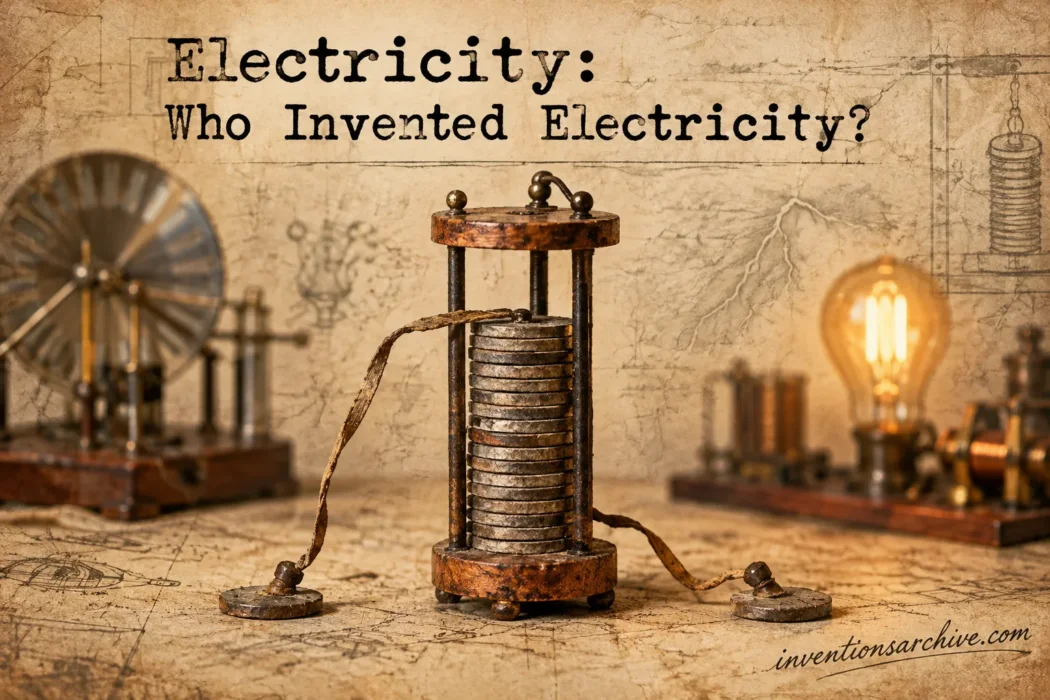
In 1800, Volta reported his new device to Royal Society president Joseph Banks. The voltaic pile used alternating metallic elements separated by electrolyte-containing material. Unlike a charged Leyden jar, which could release stored static charge in a short discharge, Volta’s arrangement supplied a sustained electrical current through an external circuit.
That difference reshaped electrical experimentation. Researchers could now maintain current long enough to study chemical decomposition, heating, conduction, and magnetic effects. Later batteries improved the materials and chemistry, but the voltaic pile established the basic idea of obtaining continuous current electrochemically.
Volta therefore did not invent electricity. He created the first widely recognized battery capable of supplying a continuous current. The unit volt later took his name.
Ørsted Showed That Electric Current Creates a Magnetic Effect
The availability of continuous current made discoveries possible that static-electricity experiments had not easily revealed.
In 1820, Danish physicist Hans Christian Ørsted observed that a current-carrying wire affected a nearby magnetic compass needle. Electricity and magnetism, long studied as largely separate phenomena, were physically connected.
André-Marie Ampère rapidly developed the study of interactions involving electric currents and magnetism. The unit ampere later commemorated his work. Georg Ohm then established a quantitative relationship among electrical current, resistance, and electrical potential difference, providing engineers and physicists with a way to analyze circuits mathematically rather than merely describe their effects.
The discoveries of the 1820s changed the central electrical question. Researchers were no longer dealing only with charge, sparks, and batteries. Current could produce magnetism, which raised another possibility: could magnetism be made to produce electricity?
Faraday Found the Principle Behind Electrical Generators
Michael Faraday supplied the experimental breakthrough that connects early electrical science directly with modern electrical generation.
Faraday first demonstrated electromagnetic rotation in 1821, an early step toward the electric motor. A decade later he returned to the relationship between electricity and magnetism from the opposite direction.
On August 29, 1831, experiments at the Royal Institution demonstrated electromagnetic induction. Faraday found that a changing magnetic condition could induce an electrical current in another circuit. His surviving ring-coil apparatus from that work remains in the Royal Institution’s collection.
A few months later, Faraday constructed generator apparatus that demonstrated how relative motion between a magnet and a conductor could produce current. His experiments established the principle from which electromagnetic generators developed.
The difference between Volta and Faraday is especially useful when asking who “invented electricity.” Volta obtained current from electrochemical reactions; Faraday showed how mechanical motion and magnetism could be used to generate it. These were different solutions to different problems.
Later engineers turned electromagnetic induction into practical magneto machines and dynamos. Faraday did not personally design every generator architecture that followed, but the induction principle he demonstrated in 1831 remains fundamental to electromagnetic generation.
The U.S. Energy Information Administration notes that most electricity generation still uses generators based on Faraday’s discovery. In a modern generating plant, a turbine may be driven by steam, falling water, wind, or another energy source, while the generator converts mechanical energy into electrical energy through electromagnetic effects.
Not every modern source works this way. Photovoltaic solar cells, for example, convert energy from sunlight directly into electrical current through semiconductor materials rather than using a rotating electromagnetic generator.
Maxwell Connected Electricity, Magnetism, and Light
Faraday was an exceptional experimentalist, but nineteenth-century electricity also needed a mathematical description capable of connecting the many observed effects.
James Clerk Maxwell brought electricity, magnetism, and light into a unified mathematical theory during the 1860s. While working at King’s College London, he developed equations describing the behavior of electric and magnetic fields and showed that electromagnetic disturbances could propagate as waves.
The predicted propagation speed corresponded with the measured speed of light, supporting the conclusion that light itself is electromagnetic radiation. The mature theory transformed separate experimental laws into a connected description of electromagnetism.
This did not make Maxwell an inventor of electricity either. His role was theoretical: the phenomena and many of their experimental relationships were already known. His work explained how those relationships belonged to the same physical system.
Electricity Became an Engineering System
By the second half of the nineteenth century, electrical science had moved far beyond static demonstrations. Generators could supply current, motors could turn electrical energy into motion, telegraph systems had created long electrical networks, and inventors were pursuing practical electric lighting.
The challenge had changed. It was no longer simply whether electrical current could be produced. Engineers had to determine how to generate large quantities of electrical energy, distribute it reliably, meter consumption, operate motors, illuminate buildings, and connect many customers to a common supply.
This is where Thomas Edison, Nikola Tesla, George Westinghouse, and the engineers working around them belong in the story.
Thomas Edison Built an Integrated Electric-Light System
Thomas Edison did not invent electricity. Nor did his work begin with the first electric lamp. Electric lighting existed before his best-known incandescent lamp research.
Edison’s achievement was to treat electric lighting as a complete commercial system. His laboratories and companies worked on practical incandescent lamps along with generators, distribution conductors, switches, sockets, protective devices, meters, and central generating stations.
On September 4, 1882, Edison’s Pearl Street station began operating in lower Manhattan. It supplied direct-current electricity to customers in the surrounding district. The station represented an early model of the electric utility: centralized generation connected to many users through a distribution network.
Direct current worked, but distributing power over longer distances created engineering and economic difficulties, especially when compared with systems that could conveniently change voltage for transmission.
Nikola Tesla Did Not Invent Electricity or Alternating Current
Nikola Tesla is another figure routinely described too broadly. Alternating current existed before Tesla, and AC electrical machines had already been developed. His contribution centered on making polyphase alternating-current systems and induction motors practical.
Tesla developed a motor based on a rotating magnetic field. Westinghouse engineers refined his concept, and a Westinghouse two-phase induction motor based on Tesla’s design appeared in 1888. Unlike many earlier motor arrangements, the induction motor could operate efficiently from a polyphase AC supply without the commutator system used in many DC machines.
Tesla’s work therefore belongs to the development of an effective AC power system, especially the combination of polyphase generation and motors. Saying that he “invented AC” erases earlier alternating-current machines, transformer work, and contributions by other engineers.
Westinghouse Made AC a Commercial Competitor
George Westinghouse developed a commercial alternating-current system using technologies and patents from several inventors. His companies adopted transformers, generators, distribution equipment, and later Tesla’s polyphase patents.
The major advantage of AC distribution was its compatibility with transformers. Voltage could be raised for transmission and reduced closer to the point of use. This made longer-distance power distribution more practical than the low-voltage DC networks then associated with Edison.
The often dramatized “War of the Currents” was therefore not a contest to determine who had invented electricity. It concerned competing ways to generate, transmit, distribute, and use electrical energy.
Niagara Falls Demonstrated Large-Scale AC Power
The development of the Niagara Falls hydroelectric system in the 1890s showed how far electrical technology had moved since the era of friction machines and Leyden jars.
A surviving Westinghouse generator from Adams Station, now held by the Smithsonian’s National Museum of American History, began operation on August 26, 1895. Its original specification was two-phase alternating current at 25 cycles, with a rated output of 5,000 horsepower.
The Niagara project used polyphase AC methods associated with Tesla’s patents and equipment developed by Westinghouse. Electricity produced at Niagara was used locally and later transmitted toward Buffalo, demonstrating the value of large central generating stations serving users beyond the immediate generating site.
Niagara did not mark the invention of electricity. It marked the maturation of a chain of earlier developments: electromagnetic induction, practical generators, transformers, polyphase systems, motors, transmission equipment, and electrical distribution.
Who Should Receive Credit for the Development of Electricity?
| Person or Development | Period | Actual Contribution | What the Evidence Does Not Support |
|---|---|---|---|
| William Gilbert | 1600 | Systematic experiments with electrical attraction and use of electricus. | That he created electricity itself. |
| Early electrostatic-machine makers | 17th–18th centuries | Made static electrical charge easier to generate repeatedly. | That continuous electric power had already been achieved. |
| Kleist and Musschenbroek | 1740s | Associated with the independent development of the Leyden jar for storing electric charge. | That the jar generated continuous current. |
| Benjamin Franklin | 1740s–1750s | Advanced charge theory, electrical terminology, Leyden-jar research, atmospheric-electricity experiments, and lightning protection. | That he invented or first discovered electricity. |
| Alessandro Volta | 1800 | Developed the voltaic pile, an early source of sustained electrical current. | That electricity began with the battery. |
| Hans Christian Ørsted | 1820 | Demonstrated that electric current produces a magnetic effect. | That he alone developed the later science of electromagnetism. |
| André-Marie Ampère | 1820s | Developed the study of forces and interactions associated with electric currents. | That his work constituted the invention of electrical current. |
| Georg Ohm | 1820s | Quantified the relationship among current, resistance, and electrical potential difference. | That he invented the phenomena his law described. |
| Michael Faraday | 1821–1831 | Demonstrated electromagnetic rotation and electromagnetic induction, leading toward motors and generators. | That all later generator and motor designs were his inventions. |
| James Clerk Maxwell | 1860s | Unified electricity, magnetism, and light mathematically through electromagnetic theory. | That theoretical unification created electricity. |
| Thomas Edison | 1870s–1880s | Developed an integrated incandescent-lighting and DC utility system with central generation and distribution. | That he invented electricity. |
| Nikola Tesla | 1880s | Developed polyphase AC concepts and induction-motor technology based on rotating magnetic fields. | That he invented electricity or alternating current itself. |
| George Westinghouse and his engineering organizations | 1880s–1890s | Commercialized AC generation and distribution using transformers, acquired patents, and polyphase technology. | That one company or individual originated the entire AC system. |
Why No Single Date Can Be Called the Invention of Electricity
The difficulty with assigning electricity an inventor becomes clear when its development is separated into technical stages.
A friction machine could produce static charge, but it could not provide the steady current needed for later devices. A Leyden jar could store separated charge, but it was not a continuous source. Volta’s pile could supply sustained current, but chemical cells were not the same as large mechanical generators. Faraday’s induction experiments established how mechanical energy could become electrical energy. Later engineers then had to devise machines and networks capable of producing and distributing that energy economically.
The same distinction applies to famous individuals. Franklin explained and applied electrical phenomena. Volta supplied continuous current. Ørsted connected current with magnetism. Faraday established electromagnetic induction. Maxwell explained electromagnetism mathematically. Edison developed a working utility and lighting system. Tesla developed polyphase AC and induction-motor technology. Westinghouse helped turn AC into commercial infrastructure.
None of those accomplishments created the natural phenomenon called electricity. Together, however, they explain how electrical effects that once appeared as brief static sparks became batteries, motors, generators, lighting systems, industrial machinery, transmission networks, and electrical grids.
For that reason, the historically accurate response to “Who invented electricity?” is that no one did. Electricity was discovered, investigated, and gradually understood. What humans invented were the technologies that made it possible to store electrical charge, maintain current, generate electricity mechanically, convert it into motion and light, and deliver electrical energy wherever it was needed.
Sources and Verification
- Smithsonian National Museum of American History — Electrical Years: Part 1 — Documents early electrostatic research, the development of friction machines, the origin of electrical terminology, and the Leyden jar in the scientific setting preceding Franklin.
- Smithsonian National Museum of American History — Electrical Years: Part 2 — Provides museum-based documentation of Franklin’s Leyden-jar research, positive and negative charge terminology, Dalibard’s May 1752 experiment, Franklin’s later kite work, and lightning-rod research.
- The Royal Society — Letter, ‘Of an electrical kite’ from Benjamin Franklin to Peter Collinson — Archive record for Franklin’s October 3, 1752 letter concerning the electrical kite and its subsequent presentation to the Royal Society.
- The Royal Society — Volta’s 1800 Letter to Joseph Banks — Archival record of Alessandro Volta’s March 20, 1800 communication describing electricity produced by contact between different conducting substances.
- Smithsonian National Museum of American History — Replica of Oersted’s Experimental Apparatus — Documents Ørsted’s 1820 observation that electric current in a conductor deflects a magnetic needle.
- Royal Institution — Michael Faraday’s Generator — Describes Faraday’s 1831 induction work, surviving generator apparatus, and the relationship among magnetism, motion, and generated current.
- King’s College London — James Clerk Maxwell — Documents Maxwell’s work at King’s during the 1860s and his mathematical unification of electricity, magnetism, and light.
- Thomas A. Edison Papers at Rutgers University — Electric Light and Power System — Describes Edison’s development of an integrated lighting system, including generators, wiring, meters, fixtures, and the Pearl Street central station.
- Smithsonian National Museum of American History — Electric Motor for Alternating Current — Documents Tesla’s induction-motor concept, the rotating magnetic field, and Westinghouse’s 1888 two-phase motor.
- Smithsonian National Museum of American History — Westinghouse Niagara Falls Generator, 1895 — Museum record for the Adams Station generator that began operation at Niagara Falls on August 26, 1895.
- U.S. Energy Information Administration — How Electricity Is Generated — Explains how electromagnetic generators descend from Faraday’s 1831 discovery and how mechanical energy is converted into electricity.
- U.S. Department of Energy — Solar Photovoltaic Cell Basics — Verifies that photovoltaic cells convert sunlight into electrical current through semiconductor materials without a rotating electromagnetic generator.