
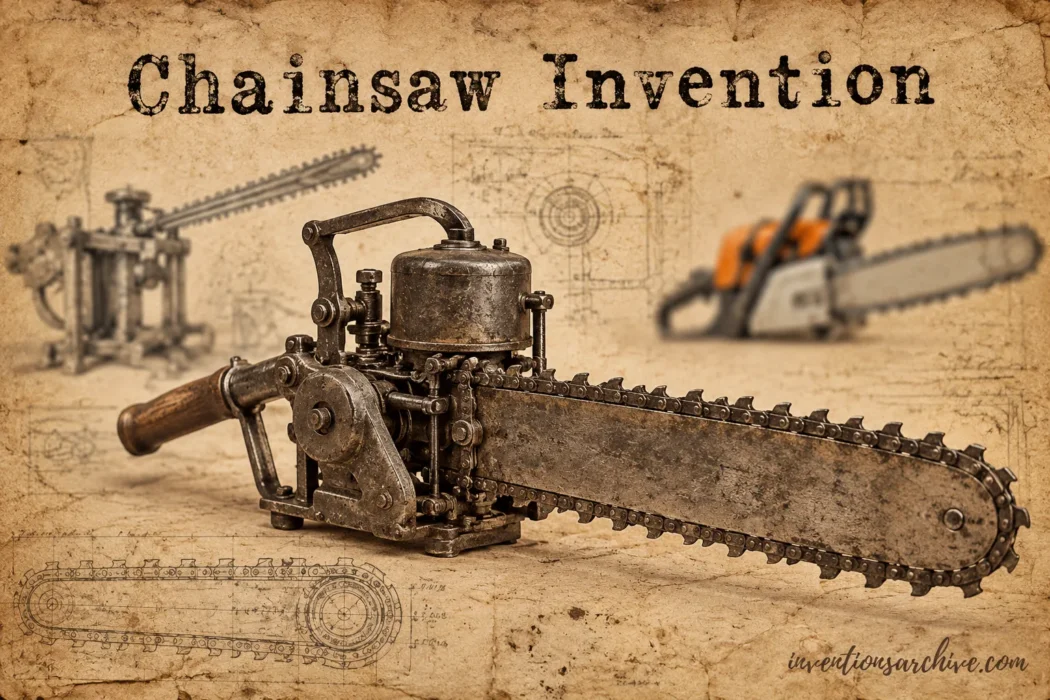
| Invention Name | Chainsaw |
|---|---|
| Short Definition | A cutting machine that moves a toothed chain continuously around a guided path, usually a guide bar. |
| Approximate Date or Period | 1780s for documented surgical chain saws; late nineteenth to early twentieth century for wood-cutting forms; 1920s for practical powered forestry machines |
| Geography | Scotland, Germany, the United States, Canada and other industrial forestry regions |
| Inventor or Source Culture | Attribution varies John Aitken, James Jeffray, Bernhard Heine, Frederick L. Magaw, Samuel J. Bens, James Shand, Emil Lerp, Andreas Stihl and later chain designers all contributed different stages. |
| Category | Surgical instrument history; sawing technology; forestry machinery; portable power tools |
| Importance | Replaced slow reciprocating hand cutting in many heavy timber tasks and became a standard portable cutting machine in forestry and wood processing. |
| Evidence Status | Based on surviving evidence Early surgical evidence is documented in eighteenth-century medical writing; later stages are supported by patents, museum collections and manufacturer archives. |
| Main Problem Solved | Continuous cutting through resistant material, first in confined surgical work and later in timber, without relying solely on a back-and-forth hand saw stroke. |
| Development Path | Flexible surgical saw → guided chain osteotome → chain-sawing machines for wood → portable powered saw → gasoline forestry saw → lighter one-person machines |
| Technical Principle | A toothed chain circulates around a controlled path so successive cutters pass through the material in one continuous direction. |
| Early Use Context | Obstetric and orthopedic surgery, followed much later by industrial timber cutting and logging. |
The question “Who invented the chainsaw?” has no accurate one-name answer because the object now called a chainsaw combines inventions that appeared in different settings. The earliest documented chain saws were small hand-powered surgical instruments. Wood-cutting chain machines came later, and portable engine-powered forestry saws arrived later still.
If the term means the earliest documented toothed chain used as a saw, the history begins in late eighteenth-century Scottish surgery. If it means a portable powered machine for cutting trees, the relevant names shift to inventors and manufacturers working in the late nineteenth and early twentieth centuries. The modern chainsaw is therefore better understood as a sequence of mechanical solutions rather than a single invention event.
Why the Earliest Chain Saws Appeared in Surgery
The first well-documented chain-saw designs were created to solve a medical cutting problem, not a forestry problem. Eighteenth-century surgeons sometimes needed to divide bone or cartilage through a small opening where a rigid hand saw was awkward to use. In obstetrics, one procedure associated with this history was symphysiotomy, in which the pubic symphysis was divided to enlarge the pelvis during obstructed childbirth.
Jean-René Sigault is recorded as performing a symphysiotomy in Paris in 1777.[k] Within the following decade, Scottish surgeon John Aitken described a flexible saw in his 1785 Principles of Midwifery, or Puerperal Medicine. The device was entirely unlike a modern gasoline saw in scale and power: it was a small flexible cutting chain intended for surgical work and operated by hand. A surviving 1785 edition provides direct documentary evidence that the idea was in circulation at that time.[a]
John Aitken and James Jeffray: Two Early Scottish Claims
Aitken is important because his 1785 medical text gives the early chain saw a firm documentary date. James Jeffray, a Scottish anatomist and surgeon, is associated with a second early line of development. Historical research on the instrument reports that Jeffray said he conceived a chain saw independently around the same period but was not able to have it made until about 1790.[b]
Jeffray’s interest was broader than childbirth. He argued that a flexible chain saw could remove diseased bone through a smaller opening and could help a surgeon avoid nearby soft tissues, blood vessels and nerves. By the early nineteenth century, chain saws had a place in surgery for bone cutting and joint operations. They remained medical instruments for decades before later saw technologies displaced them.
This is why statements such as “Aitken invented the chainsaw” need a qualifier. Aitken belongs near the beginning of the documented chain-saw principle, but he did not invent a portable gasoline forestry machine. Jeffray likewise belongs to the surgical history rather than to the direct invention of the twentieth-century logging saw.
Bernhard Heine Made the Chain Mechanism More Machine-Like
By about 1830, German instrument maker Bernhard Heine had developed an osteotome that moved a cutting chain around a guided mechanical path. The University of Würzburg’s medical-history collection preserves and documents Heine osteotomes from 1830, along with related experimental instruments from 1829 and the period immediately before 1830.[c]
Heine’s design is especially relevant because it looks mechanically closer to the later chainsaw concept than Aitken’s flexible hand-pulled saw. A hand crank drove the cutting mechanism, and the chain was controlled by the instrument rather than simply pulled from its ends. The device was still made for surgery and bone work, but it demonstrated an idea central to later chain machines: the cutting teeth could travel continuously along a guided route.
The similarity should not be turned into an unsupported claim that forestry manufacturers copied Heine directly. The medical and timber histories share a mechanical principle, but surviving evidence does not establish one simple, uninterrupted line from Heine’s operating instruments to every later logging saw.
The Chain Saw Moves From Bone to Wood
Moving a toothed chain around a guide was useful outside medicine because it offered a different way to mechanize sawing. During the nineteenth century, inventors tried endless saws and chain-like cutting systems for timber. These machines were usually too large, too dependent on stationary power or too cumbersome to serve as the portable tool later associated with logging.
Frederick L. Magaw’s 1883 U.S. patent for a Chain Sawing Machine shows an industrial wood-cutting stage of this development. His patent described a saw made from linked toothed sections and connecting links. It was a chain-sawing machine, but not the compact engine-and-guide-bar tool carried by a logger.[d]
Samuel J. Bens brought the concept closer to forestry use. His U.S. patent, filed in 1903 and issued in 1905, described an endless chain fitted with teeth, mounted and guided so that it could be driven continuously. The patent explicitly contemplated cutting through a tree, log, slab or other structure and was aimed particularly at crosscut sawing, then still dominated by hand-operated saws.[e]
| Stage | Form | What Changed |
|---|---|---|
| 1780s | Flexible surgical chain saw | Small toothed chain used by hand for bone and cartilage cutting. |
| c. 1830 | Heine osteotome | Cutting chain became part of a guided, hand-driven mechanism. |
| 1883 | Magaw chain-sawing machine | Linked toothed cutting elements were applied to industrial sawing. |
| 1905 | Bens endless-chain saw | The patent directly targeted crosscutting trees and logs with a guided moving chain. |
| 1918 | James Shand portable saw | A lightweight gasoline power source was combined with a portable chain-saw concept. |
| 1920s | Commercial powered forestry saws | Electric and gasoline machines moved from prototypes and patents toward regular forestry use. |
| 1940s–1950s | Improved cutting chains and one-person saws | Lower weight and better cutter geometry made the machine more practical for a single operator. |
James Shand Tackled the Portability Problem
By the early twentieth century, the basic idea of a moving cutting chain was no longer the main obstacle. The harder problem was carrying enough power into the forest without turning the saw into a stationary machine.
Canadian millwright and farmer James Shand addressed that problem in 1918. Canadian patent CA186260A records Shand as the inventor of a saw filed on March 19, 1918 and published on August 27 of that year.[f] A museum-history study based on Shand’s patent papers and surviving photographs describes two working models and reports that he used a small gasoline engine, with power transmitted to the cutting chain through a flexible cable.[g]
Shand’s machine did not create an immediate commercial industry. The same museum study notes that manufacturers showed little interest, and Shand eventually allowed the patent rights to lapse. His importance lies elsewhere: he was working directly on the problem that separated earlier chain machines from a practical logging tool—a comparatively light source of portable power.
Gasoline and Electric Power Reshaped the Forestry Saw in the 1920s
The late 1920s produced several machines that moved the chainsaw into a recognizable forestry form. This period is also where simplified invention stories often become inaccurate, because company histories and later retellings sometimes attach “first” to different machines.
Emil Lerp and the Dolmar Type A
Emil Lerp is closely associated with the early commercial gasoline chainsaw and the Dolmar Type A. The surviving German patent record confirms that Lerp filed for a portable tree-saw arrangement on June 15, 1928. The patent depicts a heavy machine carried by two operators and supported by an adjustable frame, showing how far early powered saws still were from the light one-person tool familiar today.[h]
Lerp’s place in the story matters because gasoline removed the electrical cable and stationary-power restrictions that limited many earlier powered saws. It did not solve every problem. Early gasoline machines were still heavy, often required two people and demanded substantial mechanical support in the field.
Andreas Stihl and the Commercial Engineering of Powered Chainsaws
Andreas Stihl’s contribution belongs to the engineering and commercialization of powered chainsaws rather than to the first appearance of the chain-saw principle. STIHL’s company archive records a two-man electric chainsaw from 1927 that weighed 48 kilograms and was designed for cutting felled trunks to length in log yards. Because it depended on electricity and could cut only in a restricted orientation, it was not yet a fully practical forest-felling machine.
STIHL records its 1929 gasoline-powered Type A at 6 hp and 46 kilograms. That model was still a two-person machine, but it could work away from an electrical supply and became part of the spread of powered sawing in forestry.[i]
Calling Stihl “the inventor of the chainsaw” erases more than a century of earlier surgical and mechanical work. A more accurate description is that Stihl was one of the engineers and manufacturers who helped turn the powered chain saw into a durable commercial forestry machine.
The Cutting Chain Was as Important as the Engine
Early powered saws could have a motor and a guide bar yet still cut inefficiently because chain-tooth geometry remained a limiting factor. Older “scratcher” chains resembled the tooth action of conventional saws and required heavy maintenance. Better chain design changed how effectively engine power became wood removal.
Joseph Buford Cox developed the Cox Chipper Chain in the 1940s after observing the way timber-beetle larvae cut through wood fibers. Oregon Tool’s company history places this work in 1946 and the founding of the Oregon Saw Chain Corporation in 1947. The chipper design used cutters that worked to the left and right and removed wood in a more effective shaving action than earlier scratcher patterns.[j]
This stage is easy to miss in inventor lists because it did not create a new engine or a new overall machine. It changed the part that actually cuts. A chainsaw is a system: motor, drive, chain, guide bar, controls and structural weight all affect whether the machine is useful in real work.
Why Forestry Needed a Portable Chainsaw
Axes and large crosscut saws could fell and section timber, but the work depended heavily on human effort and crew skill. Mechanized chain cutting promised continuous motion and a much higher cutting rate, provided the machine could be carried to the tree and survive demanding forest conditions.
The adoption record from British Columbia shows why portability and output mattered. Logging companies began experimenting with powered saws in the 1930s while dealing with difficult terrain, changing timber stands and shortages of workers willing to use traditional hand-falling methods. One company’s recorded power-saw production rose from about 6 million board feet in 1937 to 100 million in 1939.[g]
Those early machines were still heavy and troublesome. Museum records describe two-man saws around 120 pounds in some British Columbia operations. The next useful step was therefore not simply “more power.” Manufacturers needed lower weight, better power-to-weight ratios, reliable fuel delivery, improved chains and designs that a single person could control.
When the Chainsaw Became a One-Person Machine
After the Second World War, lighter engines and improved chains accelerated the shift from two-man saws toward one-person machines. The exact title of “first one-man chainsaw” varies among histories because manufacturers introduced different portable models in a short period and because prototypes, regional machines and commercial launches are not always dated in the same way.
What is clear is that the design target changed. A forestry saw no longer had to be a heavy machine carried and positioned by two workers. By the 1950s, the modern pattern—an engine, handles, a guide bar and a circulating cutting chain in one portable unit—was established. STIHL’s 1959 Contra, for example, weighed about 12 kilograms and produced 6 hp according to the company’s archive, a sharp contrast with the 46- to 48-kilogram two-man STIHL machines of the late 1920s.[i]
Later developments added anti-vibration systems, chain-braking systems, lighter alloys, refined carburetion, electric motors and eventually battery power. Those changes altered weight, comfort, emissions and control, but they retained the defining idea: a toothed chain moving continuously around a guided bar.
Which Inventor Counts Depends on Which “First” Is Meant
| Person | Date or Period | Contribution | Most Accurate Credit |
|---|---|---|---|
| John Aitken | 1785 | Documented a flexible toothed chain saw in an obstetric text. | Earliest firmly documented surgical chain-saw evidence in this development line. |
| James Jeffray | Late 1780s–c. 1790 | Independently conceived a chain saw for bone and joint surgery. | Independent early surgical chain-saw pioneer. |
| Bernhard Heine | c. 1830 | Built a hand-driven osteotome with a guided cutting chain. | Major mechanical precursor to the guided-chain concept. |
| Frederick L. Magaw | 1883 | Patented a chain-sawing machine using linked cutting elements. | Early industrial wood-chain-saw patent holder. |
| Samuel J. Bens | 1905 patent issue | Patented a guided endless-chain saw specifically suited to crosscutting trees and logs. | Major direct precursor to forestry chain sawing. |
| James Shand | 1918 | Patented a portable saw and worked with a small gasoline power source. | Early portable powered-chain-saw pioneer. |
| Emil Lerp | 1920s | Associated with the Dolmar Type A and early commercial gasoline forestry saws. | Early gasoline chainsaw pioneer. |
| Andreas Stihl | 1927–1929 onward | Developed and commercialized electric and gasoline-powered forestry chainsaws. | Major powered-chainsaw engineering and manufacturing pioneer. |
| Joseph Buford Cox | 1940s | Developed the chipper cutting chain. | Major contributor to modern chainsaw cutting performance. |
Surgical Chain Saw and Forestry Chainsaw Were Different Machines
| Feature | Late Eighteenth-Century Surgical Chain Saw | Heine Osteotome | Modern Forestry Chainsaw |
|---|---|---|---|
| Power | Human pulling force | Hand-driven mechanical action | Gasoline, corded electric or battery-electric motor |
| Material Cut | Bone and cartilage | Bone | Wood and related materials |
| Scale | Small surgical instrument | Compact surgical mechanism | Portable power tool |
| Guidance | Flexible chain controlled by the surgeon | Chain guided by a mechanical instrument | Chain circulates around a rigid guide bar |
| Purpose | Controlled surgical cutting through a confined opening | Bone resection and surgical cutting | Felling, bucking, limbing and other wood-cutting work |
So Who Invented the Chainsaw, and Why?
The earliest well-documented chain saw in this history is associated with John Aitken in 1785, with James Jeffray independently developing a surgical chain-saw idea around the same period. These instruments were created for medical cutting, including procedures involving the pubic region and diseased bone. Bernhard Heine’s osteotome around 1830 turned the moving chain into a more mechanically guided surgical machine.
The forestry chainsaw had a different development path. Nineteenth-century wood-sawing patents applied linked or endless cutting systems to timber; Samuel J. Bens patented an endless-chain saw specifically for crosscutting trees and logs in 1905; James Shand worked on portability and gasoline power in 1918; and the 1920s saw the emergence of commercial electric and gasoline forestry machines associated with Emil Lerp and Andreas Stihl. Joseph Buford Cox later improved the cutting chain itself.
For that reason, the most accurate answer is not that one person invented “the chainsaw” for one purpose. The surgical chain saw was created to make controlled bone cutting possible in confined operations, while the powered forestry chainsaw was developed later to mechanize tree and log cutting with a portable source of continuous power. The machines share a cutting principle, but their purposes, scale and engineering history are not the same.
Sources and Verification
- [a] John Aitken, Principles of Midwifery; or, Puerperal Medicine (1785) — A digitized copy from the British Library collection that verifies the publication date and medical context of Aitken’s work.
- [b] The chain saw–a Scottish invention. — PubMed record for a historical medical study discussing Aitken, Jeffray and early surgical chain-saw use.
- [c] University of Würzburg Institute for the History of Medicine: Surgical Collection, Osteotomes — University collection record documenting Bernhard Heine’s osteotome and related instruments in Würzburg around 1829–1830.
- [d] U.S. Patent 279,780, Frederick L. Magaw, Chain Sawing Machine — Patent record issued June 19, 1883 describing linked toothed elements in a chain-sawing machine.
- [e] U.S. Patent 780,476, Samuel J. Bens, Endless-Chain Saw — Patent issued January 17, 1905 that expressly describes a guided endless chain for crosscutting trees, logs and similar material.
- [f] Canadian Patent CA186260A, James Shand, Saw — Patent record verifying Shand’s 1918 Canadian filing and publication.
- [g] British Columbia’s Experience with Early Chain Saws — Museum-history study by a British Columbia Provincial Museum curator using patent papers, photographs, interviews and forestry records to document Shand and early powered-saw adoption.
- [h] German Patent DE508286C, Emil Friedrich Lerp — Patent record filed June 15, 1928 for a portable tree-saw arrangement carried by two operators.
- [i] STIHL Product Innovation Milestones — Manufacturer archive documenting the company’s late-1920s electric and gasoline chainsaws and later one-person developments.
- [j] Oregon Tool: 1940s Company History — Company archive describing Joseph Buford Cox’s chipper-chain development in 1946–1947 and its design basis.
- [k] The long and difficult birth of symphysiotomy or from Severin Pineau to Jean-Rene Sigault — PubMed record for a historical study documenting Sigault’s first recorded symphysiotomy in Paris on October 1, 1777.