
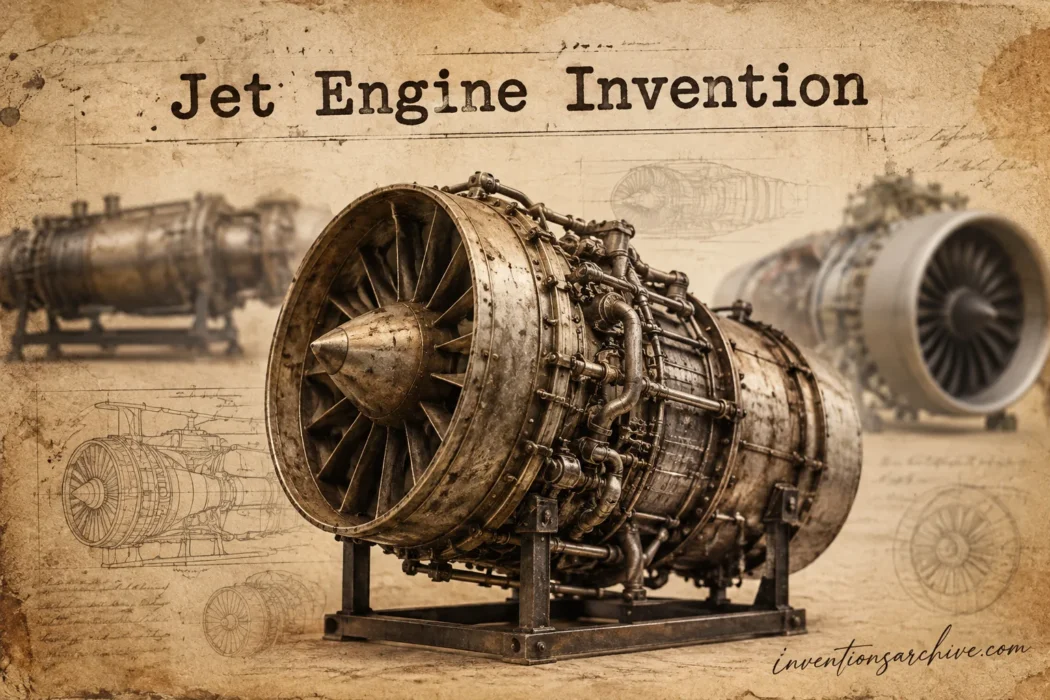
| Invention Name | Practical turbojet engine |
|---|---|
| Short Definition | An air-breathing gas-turbine engine that produces thrust from a high-velocity exhaust stream. |
| Approximate Date or Period | Late 1920s to early 1940s; first turbojet-powered aircraft flight in 1939 |
| Geography | Britain and Germany |
| Inventor or Source Culture | Frank Whittle and Hans von Ohain, working independently |
| Category | Aircraft propulsion; gas-turbine engineering |
| Importance | Enabled practical aircraft propulsion without a propeller and opened the route to high-speed gas-turbine aviation. |
| Evidence Status | Confirmed independent development Shared attribution |
| Main Problem Solved | Producing useful aircraft thrust at speeds and altitudes where piston-engine and propeller combinations faced growing limits. |
| Development Path | Whittle: 1929 concept → 1930 patent filing → 1937 W.U. test engine → 1941 flight. Von Ohain: 1933 studies → 1937 HeS 1 → 1939 HeS 3B flight. |
| How It Works | Intake → compressor → continuous combustion → turbine → exhaust nozzle |
| Technical Basis | A compressor and turbine linked by a shaft, with continuous combustion between them. |
| Modern Descendants | Turbofans and other gas-turbine aircraft engines |
| Attribution Issue | Attribution varies Patent priority, first running engine and first powered flight are different milestones. |
The phrase jet engine can describe several forms of reaction propulsion, but the invention question in aviation history usually concerns the practical turbojet: an air-breathing gas turbine that compresses incoming air, adds heat through continuous combustion, uses a turbine to drive the compressor and sends the remaining gas energy through a nozzle to create thrust.
On that definition, the invention is generally credited to Frank Whittle in Britain and Hans von Ohain in Germany, who developed turbojet systems independently. The Smithsonian’s National Air and Space Museum describes von Ohain as sharing credit with Whittle for independently inventing the jet engine.[a] The two men did not reach every milestone in the same order, which is why a one-name answer can be misleading.
Why Whittle and von Ohain Share the Credit
Whittle has the stronger claim to the earlier documented practical turbojet patent route. Von Ohain has the milestone that is easiest to see in flight history: his HeS 3B powered the first aircraft flight using a turbojet. Both programs also reached running experimental engines during 1937.
| Milestone | Frank Whittle | Hans von Ohain | What It Establishes |
|---|---|---|---|
| Early documented work | Gas-turbine aircraft ideas in 1928; direct jet concept developed by 1929 | Jet-propulsion studies begun in 1933 | Both lines arose before either produced a flight engine. |
| Patent / formal design milestone | British application filed 16 January 1930; accepted in 1931 as No. 347,206 | Independent German development followed in the 1930s | Whittle’s practical patent record came earlier. |
| Running experimental turbojet | Whittle Unit first ran on 12 April 1937 | HeS 1 ran successfully in early 1937 | Both programs had working hardware in 1937. |
| Aircraft flight | Power Jets W.1 flew officially in the Gloster E.28/39 on 15 May 1941 | HeS 3B powered the Heinkel He 178 on 27 August 1939 | Von Ohain’s engine reached turbojet-powered flight first. |
The dating of the 1937 engine runs is a good example of why invention histories need careful wording. The surviving Smithsonian record gives the HeS 1 date only as early 1937, while the Whittle Unit has a specific first-run date of 12 April 1937.[d][e] It is therefore safer to say that both programs reached running turbojets in 1937 than to force an exact day-by-day priority that the cited records do not establish.
Whittle: Earlier Patent, Longer Route to Flight
1928 Was a Starting Point, Not the Finished Turbojet
Whittle’s 1928 Cranwell thesis is often folded into a simple story in which the turbojet appeared fully formed at that moment. The surviving Science Museum Group record shows a more precise sequence. His thesis discussed jet propulsion by rocket and the gas turbine as an aircraft power plant, but the direct gas-turbine jet arrangement came later. By October 1929, Whittle was considering a fan enclosed in the fuselage to produce a fast airflow and had moved toward using a gas turbine rather than a piston engine to drive the system.[b]
That distinction matters because a surviving notebook, a patent application, a working test engine and an aircraft flight are not interchangeable evidence. Whittle’s early thinking shows the path of development; the 1930 filing marks a much clearer claim to the practical turbojet architecture.
The 1930 Patent Defined a Practical Gas-Turbine Jet
Whittle filed British patent application 1521/30 on 16 January 1930. It was accepted on 16 April 1931 as British Patent No. 347,206. A British Ministry of Defence propulsion text describes the filing as the first practical turbojet patent and shows the defining relationship between compressor, combustion system, turbine and connecting shaft.[c]
The patent did not mean a flight-ready engine existed in 1930. Whittle still faced the engineering and financial problem of turning a thermodynamic arrangement into machinery that could compress enough air, burn fuel continuously, survive high temperatures and keep the compressor and turbine operating together.
Power Jets and the Whittle Unit
Power Jets Ltd. was formed in 1936, and the experimental Whittle Unit became the hardware proof of the British program. The W.U. first ran on 12 April 1937.[d] Whittle’s early practical engines used a centrifugal compressor, an arrangement that could deliver useful compression in a compact experimental engine even though its wider diameter later made axial-flow layouts attractive for many high-output aircraft engines.
The Air Ministry later contracted for the W.1 to be tested in the Gloster E.28/39. Its first official flight took place on 15 May 1941. The Science Museum Group identifies the E.28/39 as the first Allied jet aircraft and describes the flight as proof that turbojet propulsion had become a viable alternative to the propeller for high-performance aircraft.[f]
Von Ohain, Heinkel and the First Turbojet-Powered Aircraft
An Independent German Development Line
Hans von Ohain began studies in 1933 on a propulsion process that separated compression and expansion through a compressor and turbine. His early model work led to industrial support from Ernst Heinkel’s aircraft company, where an experimental engine program could be developed with engineering staff, manufacturing capacity and an airframe project.
The hydrogen-fueled HeS 1 ran successfully in early 1937. Von Ohain’s later HeS 3B was a single-shaft turbojet with a centrifugal-flow compressor section and a radial turbine. It was not a copy of Whittle’s engine; the two programs shared the gas-turbine jet principle while taking different mechanical routes.[e]
27 August 1939: The Heinkel He 178 Flies
On 27 August 1939, the HeS 3B powered the Heinkel He 178 on what the National Air and Space Museum records as the world’s first flight of a turbojet-powered aircraft.[e] This is the milestone behind von Ohain’s claim to priority in flight.
The distinction between Whittle and von Ohain can therefore be stated without choosing an artificial winner: Whittle documented and patented a practical turbojet approach earlier; von Ohain’s engine powered a turbojet aircraft in flight earlier. The history of the invention includes both achievements.
What Whittle and von Ohain Actually Invented
A turbojet is not simply an engine that throws gas backward. Its defining feature is a self-sustaining gas-turbine cycle in which the turbine extracts enough energy from the hot gas stream to keep the compressor turning. NASA describes the basic flow through a turbojet as inlet, compressor, burner, turbine and nozzle.[g]
- Air enters through the inlet. The engine continuously draws in surrounding atmospheric air.
- The compressor raises the air pressure. Early practical designs could use centrifugal compression; later engines often used multiple axial stages.
- Fuel burns in a continuous airflow. The combustor adds energy without the separate power strokes of a piston engine.
- The turbine extracts part of that energy. A shaft connects the turbine to the compressor, allowing the gas turbine to keep its own compression process running.
- The remaining gas energy produces thrust. The exhaust is accelerated through the nozzle, creating the rearward momentum flow associated with forward thrust.
This architecture is what separates the practical turbojet from several earlier or contemporary machines that were described broadly as “jet” aircraft. A rocket carries its own oxidizer rather than relying on atmospheric air. A ramjet has no compressor driven by a turbine. A motorjet can create a jet-like exhaust while using a separate piston engine to drive its compressor. Those systems belong to reaction-propulsion history, but they do not establish the same invention milestone as the self-sustaining turbojet.
Earlier Claims That Need Different Labels
Maxime Guillaume’s 1921 Patent Was an Earlier Gas-Turbine Aircraft Concept
Whittle was not the first person to put a gas-turbine aircraft propulsion arrangement on paper. French engineer Maxime Guillaume filed French Patent FR534801 on 3 May 1921 for a “propulseur par réaction sur l’air.” The patent record predates Whittle’s filing by nearly nine years.[h]
That earlier document is important when discussing the ancestry of the turbojet, but a patent concept and a practical engine development program are different kinds of evidence. Guillaume’s record does not displace the 1930s Whittle and von Ohain programs as the routes that produced running turbojets and aircraft flight.
Henri Coandă’s 1910 Claim Remains Disputed
Henri Coandă’s 1910 aircraft is also frequently brought into “first jet” discussions. The National Air and Space Museum archive preserves the claim that Coandă’s aircraft left the ground in December 1910, while also noting that scholars have disputed the event because the claim was not documented at the time in the same way as later flights and because the propulsion system differed from later turbojets.[i]
Coandă therefore belongs in the history of early reaction-propulsion experimentation, but his claim should not be presented as a settled first practical turbojet flight.
The Caproni Campini N.1 Was a Motorjet, Not a Self-Sustaining Turbojet
The Italian Caproni Campini N.1 first flew on 28 August 1940. Its propulsion system used a piston engine to drive the compressor rather than a turbine extracting power from the hot gas stream. The RAF Museum describes it as an experimental aircraft powered by a turbine driven by a piston engine.[j]
That mechanical difference explains why the N.1 can appear in lists of early jet aircraft without taking the He 178’s place as the first aircraft powered by a true turbojet.
From Experimental Turbojets to Production Engines
The engines that brought jet aircraft into service were not simply copies of the first Whittle and von Ohain demonstrators. Engineers rapidly changed compressor layouts, combustion systems, turbine cooling, materials and manufacturing methods as the technology moved from experimental runs to production.
Germany’s Junkers Jumo 004 illustrates that transition. Development began under Anselm Franz, and the production 004B used an eight-stage axial-flow compressor. It powered the Messerschmitt Me 262, which the National Air and Space Museum identifies as the first operational jet fighter. Volume production of the 004B began in 1944, and nearly 6,000 Jumo 004 engines were built by the end of the war.[k]
This also corrects a common oversimplification: the Me 262 did not fly in service with von Ohain’s HeS 3B. Von Ohain’s engine established the 1939 flight milestone, while the Jumo 004 became a separate production engine family.
In Britain, Whittle’s development line continued through the W.2B. Further work by Rolls-Royce led to the Welland, which powered early Gloster Meteor aircraft.[c] The change from prototype turbojets to service engines therefore depended on industrial development well beyond the original invention claim.
Why Axial-Flow Compressors Became So Important
Whittle’s early engines and von Ohain’s HeS 3B used centrifugal compression in their practical layouts. A centrifugal compressor can achieve a useful pressure rise with relatively few stages, which made it well suited to early experimental engines. Its airflow turns outward from the shaft, however, which tends to increase engine diameter.
Axial-flow compressors keep the main airflow moving roughly along the engine axis through successive rotating and stationary blade rows. That arrangement supports many compression stages in a comparatively narrow engine. The Jumo 004B’s eight-stage axial compressor shows how quickly this architecture moved into production jet propulsion.[k]
The historical point is not that one compressor type “won” immediately. Centrifugal compressors remained useful in many gas-turbine applications. The axial layout became especially attractive where designers wanted high mass flow and a smaller frontal area for powerful aircraft engines.
From the Turbojet to the Engines Used on Modern Aircraft
The invention associated with Whittle and von Ohain is the early practical turbojet, not every later engine that falls under the broad label “jet engine.” Modern gas-turbine propulsion developed into several related forms. NASA describes the turbofan as a later variation of the gas-turbine engine, retaining a core engine while adding a front fan and an additional turbine to drive it.[l]
A turbofan adds a large fan and directs part of the airflow around the hot core rather than sending all of it through the combustor. NASA notes that most modern airliners use turbofan engines because they combine high thrust with good fuel efficiency.[l] Turboprops use turbine power to drive a propeller. The machinery has changed greatly since the 1930s, but the compressor–combustor–turbine relationship demonstrated by the early turbojets remains part of the gas-turbine core.
So Who Invented the Jet Engine?
If “invented” means the earlier documented practical turbojet patent route, Frank Whittle has the stronger claim: his British application was filed in 1930. If the milestone is the engine that powered the first turbojet aircraft flight, Hans von Ohain has that distinction through the HeS 3B and Heinkel He 178 in 1939.
For the invention of the practical modern turbojet as a technology, the most accurate attribution is therefore Frank Whittle and Hans von Ohain as independent co-pioneers.[a] Their work converged on the same gas-turbine propulsion principle through separate development programs, while earlier concepts by Guillaume and disputed jet-like aircraft claims belong to the longer prehistory of the idea.
Sources and Verification
- [a] Engine, Heinkel He S 011 Turbojet — National Air and Space Museum collection record stating that Hans von Ohain generally shares credit with Frank Whittle for independently inventing the jet engine.
- [b] Frank Whittle — Science Museum Group biographical record documenting Whittle’s 1928 thesis, the later 1929 direct-jet concept and the formation of Power Jets.
- [c] AP3456 – 3-1 – Basic Theory and Principles of Propulsion — UK government propulsion text documenting Whittle’s 16 January 1930 patent filing, Patent No. 347,206, the He 178 milestone and the W.2B-to-Welland development line.
- [d] Whittle W.1X Engine — National Air and Space Museum collection record giving the Whittle Unit’s 12 April 1937 first run and the W.1’s 1941 flight history.
- [e] Heinkel (von Ohain) HeS 3B Turbojet Engine, Reproduction — National Air and Space Museum record documenting the HeS 1 run in early 1937 and the HeS 3B-powered He 178 flight on 27 August 1939.
- [f] Gloster-Whittle E28/39 jet aeroplane, built 1941. — Science Museum Group collection record verifying the aircraft’s first official flight on 15 May 1941 and its place as the first Allied jet aircraft.
- [g] Turbojet Engine — NASA Glenn Research Center explanation of the inlet, compressor, burner, turbine, shaft and nozzle relationship in a turbojet.
- [h] FR534801A – Thruster by reaction on air — Patent record for Maxime Guillaume’s filing of 3 May 1921, useful for distinguishing an earlier documented concept from later practical engine programs.
- [i] Henri Coanda Papers [Stine] — National Air and Space Museum archive description recording Coandă’s claimed 1910 flight and the scholarly dispute surrounding that claim.
- [j] 1940 – RAF Museum — RAF Museum timeline verifying the Caproni-Campini N.1’s 28 August 1940 flight and its piston-engine-driven compressor arrangement.
- [k] Jumo 004B Engine — National Air and Space Museum collection record documenting the eight-stage axial compressor, production history and use in the Me 262.
- [l] Turbofan Engine — NASA Glenn Research Center explanation of turbofan architecture and its widespread use in modern airliners.