
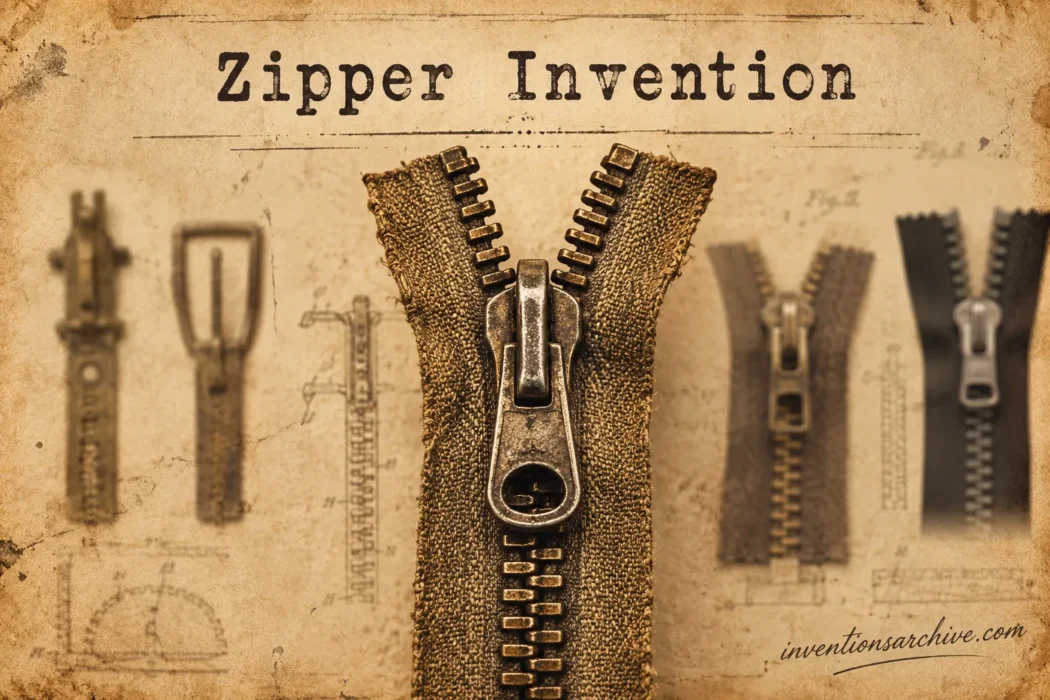
| Invention Name | Zipper / Slide Fastener |
|---|---|
| Short Definition | A reusable fastener in which a slider joins or separates two rows of interlocking elements attached to flexible tapes. |
| Approximate Date or Period | 1851 precursor; 1893 sliding clasp system; modern interlocking form developed in the 1910s and patented in 1917 |
| Geography | United States, with major development in Chicago, New Jersey and Pennsylvania |
| Inventor or Source Culture | Attribution varies Elias Howe, Whitcomb L. Judson and Gideon Sundback represent different stages; Sundback is most closely associated with the modern zipper. |
| Category | Mechanical fastener / clothing and textile hardware |
| Importance | Allows two flexible edges to be repeatedly joined or separated with one continuous slider movement. |
| Evidence Status | Confirmed Surviving patents, museum objects and institutional records document the main development stages. |
| Main Problem Solved | Fast, repeatable closure without fastening a long series of individual laces, buttons, hooks or clasps. |
| Development Path | 1851 clasp-and-rib closure → 1893 clasp locker → improved hook-and-eye fastener → interlocking elements and slider → commercial zipper |
| Modern-Zipper Patent | U.S. Patent 1,219,881, granted to Gideon Sundback on March 20, 1917 |
| Early Use Context | Shoes, boots, pouches, belts and military equipment before broad adoption in everyday clothing |
The zipper developed through several distinct inventions rather than appearing in one finished form. Elias Howe patented an early continuous garment-fastening system in 1851. Whitcomb L. Judson introduced a slider-operated clasp mechanism in the 1890s. Gideon Sundback later replaced the troublesome clasp arrangement with closely spaced interlocking elements that could be joined and separated reliably by a slider.
If one person must be named as the inventor of the modern zipper, Gideon Sundback is the strongest attribution. His U.S. Patent 1,219,881, granted in 1917, describes two flexible stringers carrying repeated interlocking members and a sliding device that locks or unlocks them according to its direction of travel. That arrangement is mechanically much closer to today’s zipper than the earlier systems of Howe or Judson.[a]
Who Invented the Zipper?
The answer depends on what is meant by “invented.” Three different achievements are often compressed into a single story.
Elias Howe produced an early patented attempt to close the edges of garments continuously. Whitcomb L. Judson developed a system in which a moving guide could engage or disengage a series of clasps. Gideon Sundback developed the compact interlocking-element system that established the mechanical pattern of the modern slide fastener.
These are not equivalent claims. Howe belongs to the zipper’s ancestry. Judson brought the sliding fastener much closer to practical use. Sundback changed the geometry and construction enough to produce the form that became commercially workable.
This distinction also explains why different histories give 1851, 1893, 1913, 1914 or 1917 as the date of the zipper’s invention. They are usually referring to different stages: an early patent, Judson’s clasp locker, Sundback’s design work, Sundback’s patent application, or the final U.S. patent grant.
Elias Howe’s 1851 Fastener Was an Early Precursor
Elias Howe Jr., best known for his work on the sewing machine, received U.S. Patent 8,540 on November 25, 1851. The actual patent title was Improvement in Fastenings for Garments, although later histories frequently describe the concept with phrases such as “automatic continuous clothing closure.”[b]
Howe’s patent covered a method for bringing together the two sides of a garment or similar article through combinations of clasps, ribs, links, cord and sliding components. The patent specifically referred to garments and ladies’ boots and described flexible ribs that could be made from materials such as rubber cloth, wire or strips of metal.
That makes Howe’s design relevant to zipper history, but calling it a modern zipper creates the wrong mechanical picture. His device did not use the dense alternating teeth and compact Y-channel slider familiar from later slide fasteners. Nor did Howe’s closure establish a widely adopted commercial system from which today’s zipper directly descended.
His 1851 patent is therefore best treated as an early patented precursor: evidence that inventors were already trying to replace individual fastening operations with a continuous mechanical closure decades before Judson and Sundback.
Whitcomb Judson Turned a Series of Clasps Into a Sliding Fastener
Whitcomb L. Judson moved the concept much closer to what a zipper does. Two patents granted on August 29, 1893—U.S. Patent 504,037 for a shoe fastening and U.S. Patent 504,038 for a clasp locker or unlocker—document related parts of his approach.[c][d]
The second patent states the idea particularly clearly. Judson wanted to engage or disengage an entire series of clasps through one continuous movement. His device was designed especially for shoes, but the patent also identified broader uses including mail bags, belts and seams joining flexible bodies.
This was an important step toward the operating logic of the zipper. A moving guide or block traveled along two rows of fastening parts and caused them to engage or separate. The user no longer needed to manipulate every clasp individually.
Judson’s mechanism, however, was still based on relatively elaborate clasping parts rather than the regular interlocking teeth of a modern zipper. Contemporary institutional histories describe it as difficult to use and prone to jamming.
The 1893 Chicago World’s Fair Did Not Turn It Into an Instant Success
Judson’s clasp locker was displayed at the World’s Columbian Exposition in Chicago in 1893. The Bureau International des Expositions describes the device as a predecessor of the zipper, built around hooks, eyelets and a sliding clasp. It also notes that the mechanism was regarded as complex and could jam.[e]
The exhibition is sometimes treated as if it marked the arrival of the familiar zipper. It did not. Judson had demonstrated a useful direction—many fasteners controlled by one moving component—but reliability still limited the design.
A surviving Judson fastener held by the National Museum of American History and dated to 1896 provides physical evidence of this intermediate stage. It belongs to the zipper’s development history without being mechanically identical to Sundback’s later interlocking system.
Sundback First Improved the Hook-and-Eye System
Gideon Sundback did not begin with a clean sheet. His early work continued the line of separable fasteners already being developed by Judson and the companies associated with those designs.
U.S. Patent 1,060,378, filed on April 2, 1908 and granted on April 29, 1913, shows Sundback still working with hook-and-eye members mounted on flexible stringers. The patent specifically sought greater flexibility and a lower chance of accidental disengagement after the two sides had been coupled.[f]
This 1913 patent matters because it shows that Sundback’s path to the modern zipper was itself gradual. He did not simply add a better slider to Judson’s product. His work moved through an improved hook-and-eye stage before arriving at a different interlocking geometry.
The 1917 Patent Established the Modern Mechanical Pattern
Sundback’s later separable fastener changed the structure of the closure. U.S. Patent 1,219,881 describes two flexible stringers carrying rows of like locking members. The elements on one side alternate with those on the other, and each has a projection and a corresponding recess. As the slider travels, those elements are guided into engagement or pulled apart.
The patent states that the design was intended to reduce weight and bulk, improve flexibility and locking security, and simplify the sliding device. It also made the components on the two sides alike instead of requiring separate forms of hook and eye.
One mechanical detail is especially recognizable today: the slider contains diverging channels forming a Y-shaped path. The textile tapes pass along either side while the interlocking members are directed together or apart. Sundback’s patent also describes the members as thin enough to be used in relatively large numbers, allowing the closed fastener to flex without the elements disengaging.
The National Inventors Hall of Fame credits Sundback with raising the density of fastening elements from roughly four per inch in earlier systems to about ten per inch, creating two facing rows of small elements and using a slider to bring them together. It identifies his invention as the modern zipper.[g]
What Changed From Howe to Sundback?
| Stage | Fastening Principle | What Changed | What Was Still Missing |
|---|---|---|---|
| Elias Howe, 1851 | Clasps, ribs and linked parts used to close garment edges | Early attempt at a continuous mechanical garment closure | No modern interlocking tooth chain |
| Whitcomb Judson, 1893 | Series of clasps operated by a moving guide | A single sliding movement could engage or disengage multiple fasteners | Complex clasp system with reliability and jamming problems |
| Gideon Sundback, 1913 | Improved hook-and-eye members on flexible stringers | Better flexibility and resistance to accidental disengagement | Still a transitional hook-and-eye arrangement |
| Gideon Sundback, 1917 patent | Repeated interlocking elements on two tapes controlled by a slider | Like-shaped elements, denser spacing, secure engagement and a compact sliding mechanism | The word “zipper” had not yet become the standard public name |
How Sundback’s Zipper Locks and Unlocks
A modern slide fastener works because the slider controls the path of two rows of mating elements. The textile sides are usually called tapes or stringers. Fastening elements are fixed along their inner edges.
When the slider moves in the closing direction, its internal channels guide the two rows toward each other. Alternating elements enter the space between their neighbors, and complementary projections and recesses keep the joined chain from simply pulling apart sideways. When the slider travels in the opposite direction, its central divider separates the rows and directs them into the two branches of the Y-shaped channel.
The slider does not permanently lock the whole fastener in one action. It progressively controls a short region immediately inside the slider. As the user moves it, successive elements enter or leave engagement.
This explains why Sundback’s smaller, regularly spaced elements worked better than a sparse row of larger clasps. More connection points allowed the fastener to bend with fabric while distributing the closure along a continuous edge.
Making the Fastener Reliably Was Part of the Invention’s Success
A practical zipper required more than a geometry that worked in a patent drawing. Large numbers of nearly identical fastening elements had to be produced, fixed to flexible tapes at regular intervals and assembled into long chains that could pass smoothly through a slider.
Sundback also worked on machinery for manufacturing the fastener. The National Inventors Hall of Fame describes a production process in which shaped wire could be cut into individual scoops, formed and attached to cloth tape. The manufacturing system allowed long lengths of fastener to be produced consistently instead of treating each closure as a largely hand-assembled mechanism.
This production work helps explain why the 1910s zipper line succeeded where earlier mechanisms struggled. Reliability depended on the dimensions and spacing of many repeated parts. A fastener containing dozens of elements could become difficult to operate if even a few were poorly aligned.
Early Zippers Were Used on Boots and Equipment Before Everyday Clothing
Sundback’s interlocking fastener did not immediately replace buttons across the clothing industry. The National Museum of American History records that the interlocking metal-tooth design was first used in boots. It also credits B.F. Goodrich with giving the fastener the name that eventually became familiar worldwide.
Other early applications included pouches and equipment where rapid opening and closing offered a practical advantage. Wartime use also exposed the fastener to situations in which compact, repeatable closure mattered more than fashion.
The gap between invention and widespread clothing adoption is useful when dating the zipper. A working modern mechanism existed before the object became a standard part of trousers, jackets and dresses. The Smithsonian notes that zippers were not widely used on clothing until the 1930s, when they began replacing buttons in applications such as men’s fly closures.
Why It Is Called a Zipper
The word zipper arrived after the mechanism itself. The National Inventors Hall of Fame credits the B.F. Goodrich company with introducing the term in 1923 in connection with rubber boots using the fastener. The name imitated the short “zip” sound associated with rapidly operating the closure.
Before that, patents and manufacturers used terms such as shoe fastening, clasp locker, separable fastener and hookless fastener. Sundback’s own 1917 patent does not call the device a zipper.
This produces another date distinction. 1917 is the patent date most closely associated with the mature Sundback mechanism; 1923 is associated with the name “zipper.” Treating 1923 as the date the device itself was invented confuses naming with mechanical development.
Why Gideon Sundback Receives the Main Credit
Elias Howe, Whitcomb Judson and Gideon Sundback all belong in an accurate history, but their contributions were different.
- Elias Howe: patented an early continuous garment-fastening concept in 1851.
- Whitcomb L. Judson: developed a clasp system in which a moving guide could lock or unlock a series of fastening elements and presented the idea commercially in the 1890s.
- Gideon Sundback: redesigned the fastening elements, increased their density, improved flexibility and security, developed the interlocking system documented in U.S. Patent 1,219,881 and worked on manufacturing methods that made long zipper chains practical.
- B.F. Goodrich: did not invent the mechanism but helped establish the word zipper through commercial use in the 1920s.
For a question phrased simply as “Who invented the zipper?”, naming Sundback alone loses part of the development history, while naming Howe or Judson alone makes an earlier mechanism sound more modern than it was. The most precise short answer is that Gideon Sundback developed the modern zipper during the 1910s, with his best-known U.S. patent granted in 1917, building on earlier closure work by Elias Howe and Whitcomb Judson.
Sources and Verification
- [a] U.S. Patent 1,219,881 — Separable Fastener — The 1917 Sundback patent documents the interlocking members, flexible stringers, slider construction, filing date and patent date of the mature design.
- [b] U.S. Patent 8,540 — Improvement in Fastenings for Garments — Howe’s original 1851 patent provides direct documentation of his garment-fastening mechanism and its actual patent title.
- [c] U.S. Patent 504,037 — Shoe-Fastening — One of Judson’s August 29, 1893 patents documenting his shoe-fastening system.
- [d] U.S. Patent 504,038 — Clasp Locker or Unlocker for Shoes — Judson’s patent directly describes the continuous movement used to engage or disengage a series of clasps and identifies possible uses beyond shoes.
- [e] Bureau International des Expositions — A to Z of Innovations at Expos: Zipper — The intergovernmental organization responsible for World Expos documents Judson’s 1893 Chicago exhibition context and the operating problems of the clasp locker.
- [f] U.S. Patent 1,060,378 — Separable Fastener — Sundback’s 1913 patent records the transitional hook-and-eye design and its goals of greater flexibility and resistance to accidental disengagement.
- [g] National Inventors Hall of Fame — Gideon Sundback — The Hall credits Sundback with the modern zipper and documents his increase in fastening-element density, interlocking arrangement, manufacturing work and the 1923 naming associated with B.F. Goodrich.
- [h] National Museum of American History — Sundback’s Modern Slide Zipper Patent Model — The Smithsonian collection preserves a Sundback patent model and documents the Hookless Number 2, early boot use, B.F. Goodrich naming tradition and later adoption of zippers in clothing.