
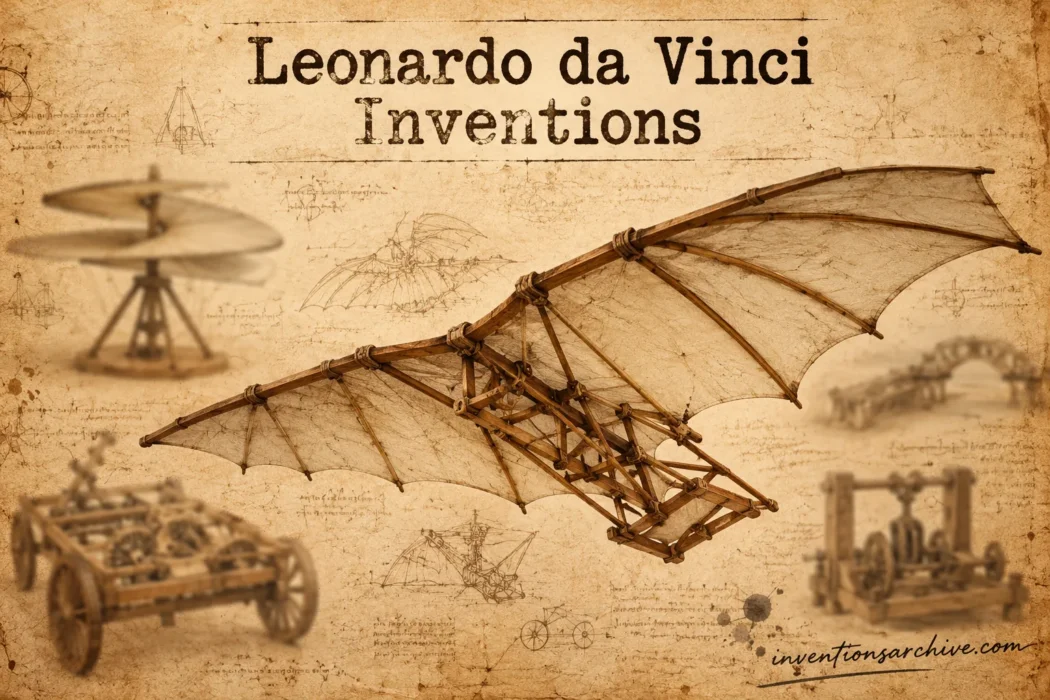
| Invention Name | Leonardo da Vinci’s machine designs and engineering studies |
|---|---|
| Short Definition | Renaissance designs for flight, automation, transport, hydraulics, measurement, production machinery, and military engineering |
| Approximate Date or Period | Primarily the late 1470s to the 1510s |
| Geography | Renaissance Italy, especially Milan and Florence; surviving sheets are now dispersed among major European collections |
| Inventor or Source Culture | Leonardo da Vinci within Italian Renaissance engineering and workshop traditions |
| Category | Mechanical engineering, flight, automation, hydraulics, instruments, production machinery, and military design |
| Importance | Shows an unusually systematic study of motion, force transmission, control, friction, automation, and the mechanical imitation of natural movement |
| Evidence Status | Mixed surviving evidence Original drawings and notes survive for many designs; documented construction is much rarer |
| Main Problem Solved | How to transmit, transform, regulate, measure, or automate motion for specific practical tasks |
| Development Path | Existing craft and engineering traditions → Leonardo’s studies and redesigns → manuscript preservation and dispersal → later scholarly and museum reconstructions |
| Surviving Evidence | Codex Atlanticus, Paris manuscripts, Madrid Codices, Codex on the Flight of Birds, Windsor sheets, British Museum drawings, and related records |
| Main Evidence Problem | A surviving sketch can document a concept without proving that a full-size machine was built or worked as later models do |
Leonardo da Vinci is often credited with inventing the helicopter, tank, automobile, robot, parachute, machine gun, diving suit, and dozens of other devices. The surviving record is more complicated. Leonardo left thousands of pages of notes and drawings, but those pages include finished-looking designs, rapid experiments, copied or reworked ideas, studies of existing machinery, speculative concepts, and mechanical fragments whose intended use is still debated.
The safest way to describe his inventions is therefore to separate what Leonardo actually drew or wrote from what later historians, engineers, and model makers reconstructed. The 2026 Leonardo//thek@ 2.0 project makes that distinction easier to study by integrating the nearly 1,200 folios of the Codex Atlanticus with about 600 Leonardo sheets in the Royal Collection at Windsor. Museo Galileo states that these two groups together represent roughly one-third of Leonardo’s surviving corpus of notes and drawings.[a]
Leonardo’s Machines Begin With Motion, Not With Modern Product Names
The most revealing way to understand Leonardo as an engineer is to look below labels such as “car,” “helicopter,” or “robot.” His notebooks repeatedly return to smaller mechanical problems: how to transfer rotation between shafts, turn back-and-forth movement into continuous rotation, store energy, reduce friction, lift loads, regulate speed, or make one motion trigger another.
Gears, pinions, worm screws, racks, pulleys, springs, ratchets, cams, cranks, escapements, and rolling contacts appear across many unrelated projects. Museo Leonardiano groups these studies as mechanisms and instruments because Leonardo often treated a mechanical element as a reusable solution rather than as a part belonging to only one machine.[b]
This mechanical vocabulary explains why his drawings range so widely. The same concern with controlled motion can appear in a clock, a textile machine, a theatrical automaton, a flying device, or a water-powered saw. Leonardo’s engineering value is often clearer in these repeated motion problems than in claims that he “invented” a modern object centuries early.
| Design | Surviving Source | Engineering Problem | Evidence Status |
|---|---|---|---|
| Aerial screw | Manuscript B, f. 83v | Vertical lift through a rotating spiral surface | Surviving design No documented full-scale flight |
| Beating-wing flying machine | Manuscript B, f. 74v | Human-powered wing movement | Surviving design Modern model interprets the mechanism |
| Delta-wing apparatus | Madrid Codex I, f. 64r | Gliding, balance, and directional control | Surviving design Later reconstruction |
| Self-moving carriage | Codex Atlanticus, f. 812r | Stored energy and autonomous movement | Strong design evidence Reconstruction details vary |
| Armored vehicle | British Museum, inv. 1860-6-16-99 | Protected mobile firepower | Surviving design Reworks older covered-war-wagon ideas |
| Three-row organ gun | Codex Atlanticus, f. 157r | Faster succession of volleys | Detailed design Not a modern automatic machine gun |
| Giant crossbow | Codex Atlanticus, f. 149r | Scaling a bow weapon to extreme size | Surviving design No established full-size build |
| Underwater equipment | Codex Atlanticus, f. 909v | Movement and breathing concepts for underwater operations | Surviving studies Not modern self-contained scuba |
| Hydraulic saw | Codex Atlanticus, f. 1078r | Automatic cutting and workpiece feed | Surviving design Reconstructed as an integrated machine |
| Hygrometer | Codex Atlanticus, f. 30v | Detecting changes in atmospheric humidity | Surviving design Clear measuring principle |
| Mechanical knight | Several Codex Atlanticus studies, including material associated with f. 579r | Programmed or cable-driven movement of an armored figure | Reconstructed interpretation No single complete blueprint survives |
| Mechanical lion | Historical accounts rather than a surviving complete drawing | Court automaton and ceremonial spectacle | Documented by later records Original mechanism is lost |
Flight Studies Changed as Leonardo Confronted the Limits of Human Power
Leonardo’s flying machines are often compressed into one story about a Renaissance helicopter. His notebooks instead show different approaches to flight. Early designs tried to imitate birds mechanically, using articulated wings and human muscle. Later studies paid more attention to gliding, balance, air currents, control surfaces, and instruments for understanding the air itself.
Beating Wings and the Attempt to Copy Birds
A late-1480s flying-machine design in Manuscript B, f. 74v places the operator on a platform and uses the pilot’s legs to act through cords and pulleys on articulated wings. Springs help sections of the wings return to position. The design reflects Leonardo’s attempt to translate bird anatomy into a mechanical linkage rather than simply attaching rigid wings to a person.[c]
The difficulty is power. Human muscles can produce useful mechanical work, but a large flapping machine must also lift its own structure and the operator while repeatedly accelerating broad wings. Leonardo’s later flight studies show growing attention to air currents and gliding, suggesting that he recognized the limits of relying on muscle power alone. A model based on his bird-flight studies uses fixed inner wing sections for support and flexible outer sections for control, a change in emphasis from pure flapping toward managed gliding.[d]
The Aerial Screw Was a Vertical-Lift Experiment, Not a Working Helicopter
The famous aerial screw appears in Manuscript B, f. 83v. Leonardo imagined a spiral linen surface around a vertical mast, driven by people pushing bars around a circular platform. His reasoning treated air as a material medium that could offer resistance to a rapidly rotating screw-shaped surface. Museo Leonardiano describes the design as an early anticipation of the helicopter, which is a useful historical comparison as long as it is not turned into a claim that Leonardo possessed a working rotorcraft.[e]
The differences from a modern helicopter are fundamental. There is no powered rotor system, aerodynamic rotor blade set, cyclic or collective pitch control, or lightweight engine. The aerial screw records an idea about vertical lift through rotation. It does not document successful vertical flight.
Gliding Brought Control and Air Currents Into the Design
Madrid Codex I, f. 64r contains a triangular-wing apparatus reconstructed by Museo Leonardiano as a gliding design. The museum’s interpretation includes a sail-like wing, a pilot position, cords, a rudder, and a pedal intended to alter the wing’s orientation. The design matters because the source problem has changed: instead of forcing wings to beat continuously, the machine is conceived around rising air and controlled gliding.[f]
Leonardo’s parachute belongs to the same wider attempt to reason about bodies moving through air, but it should not be used as proof that all his flight designs were buildable. A geometrically plausible canopy, a human-powered ornithopter, a glider study, and the aerial screw solve different problems and have different evidence behind them.
The Self-Moving Carriage Is Better Understood as an Automaton Than as a Car
Codex Atlanticus f. 812r is one of Leonardo’s most discussed machine sheets. It shows a wheeled device able to move without an animal pulling it. Modern reconstructions interpret its internal system as storing energy in springs, releasing that energy through gears, and controlling the vehicle’s motion mechanically. Museo Leonardiano’s 2010 model presents a newer reading of the mechanism, and the museum considers stage machinery for court performances a likely context.[g]
Calling the device “Leonardo’s car” is convenient but misleading. It was not designed around road travel, passenger transport, an internal-combustion engine, or the operating requirements that define the later automobile. Its stronger historical connection is to self-moving machinery and programmable spectacle.
The history of its reconstruction also shows why museum models must not be treated as untouched Renaissance blueprints. A 1952 Museo Leonardiano model used large leaf springs as its power source and added connecting elements needed to transmit the stored energy to the wheels. The museum explicitly notes that those connecting lines do not appear in Leonardo’s drawing. Later interpretations changed the internal arrangement.[h]
This does not make the drawing unimportant. It makes it more interesting as evidence. The sheet contains enough mechanical information to support serious reconstruction, yet not enough to remove every interpretive choice.
War Machines Mixed Redesign, Scale, and Mechanical Experiment
Leonardo worked for patrons who valued military engineering, and several of his best-known drawings concern weapons or protected vehicles. These designs should be discussed in the engineering culture of the fifteenth century rather than as isolated predictions of twentieth-century warfare.
The Armored Vehicle Reworked an Older Fighting-Wagon Idea
Leonardo’s covered fighting vehicle, now commonly called his tank, survives in a drawing held by the British Museum. The machine has a low protective body, weapons around its perimeter, a viewing position above, and a human-powered gear system for movement. Museo Leonardiano states directly that Leonardo took up and reworked the older idea of a covered armored carriage rather than creating the entire concept from nothing.[i]
That distinction matters. The design shows inventive integration of protection, mobility, observation, and distributed firepower, but “Leonardo invented the tank” erases the older lineage of covered war wagons and turns resemblance to a later vehicle into a false claim of direct technological descent.
The 33-Barrel Organ Gun Addressed the Delay Between Volleys
On Codex Atlanticus f. 157r, Leonardo explored several multi-barrel weapons. One design places thirty-three small barrels in three groups of eleven on a rotating structure. The arrangement allows one group to be used while the other groups pass through the slower parts of the firing cycle. The design is therefore about maintaining a faster sequence of volleys, not about automatic fire in the modern machine-gun sense.[j]
The difference is technological, not semantic. A modern automatic firearm uses the energy of firing or an external power system to cycle repeated shots from a continuing ammunition feed. Leonardo’s organ gun belongs to the much older family of volley weapons, though its rotating arrangement addresses the practical problem of downtime between discharges.
The Giant Crossbow Tested What Happens When a Familiar Device Is Enlarged
Codex Atlanticus f. 149r contains weapon studies including the famous giant crossbow. The surviving sheet is valuable because it records a design at extreme scale, where familiar principles encounter new structural and handling problems. The Veneranda Biblioteca Ambrosiana identifies the folio specifically with “various weapons and giant crossbow.”[k]
A large drawing does not establish that a corresponding full-size weapon was built. Enlarging a bow-like mechanism changes the stresses in its structure, the practicality of moving it, and the difficulty of controlling the stored energy. The sheet is strongest as evidence of Leonardo thinking through scale and mechanical force.
The Architronito Was Presented as a Development of an Older Idea
Leonardo also drew the architronito, a steam-pressure weapon in Manuscript B, f. 33r. Museo Leonardiano describes it as Leonardo’s development of an idea attributed to Archimedes. That source lineage makes the design a poor candidate for a simple “Leonardo invented the steam cannon” claim. It is better treated as an example of how he revisited older technical traditions and translated them into his own mechanical studies.[l]
Underwater Designs Combined Breathing, Movement, and Naval Strategy
Codex Atlanticus f. 909v is cataloged by the Veneranda Biblioteca Ambrosiana as containing instruments for naval battle and an underwater diving suit. The studies include concepts for enabling a person to remain below the surface and move in water, but they should not be described as modern scuba equipment. Modern scuba is self-contained; Leonardo’s underwater ideas belong to a much earlier family of surface-connected breathing and diving concepts.[m]
The sheet is also a reminder that several Leonardo designs were conceived for a specific tactical setting. Underwater movement was not simply a curiosity about human physiology. It was linked to naval operations. For a history of invention, the useful point is the combination of human movement, breathing, equipment, and an intended task—not a claim that fifteenth-century Italy already possessed twentieth-century diving technology.
Production Machinery Shows Leonardo Working on Automation Rather Than Spectacle
The famous flying and military drawings can obscure another part of Leonardo’s engineering work: machines intended to reduce repetitive labor and coordinate several operations automatically. These designs often reveal his mechanics more clearly because the problem is concrete and the required motion can be followed from one component to the next.
The Hydraulic Saw Synchronized Cutting With Material Feed
A hydraulic saw on Codex Atlanticus f. 1078r uses water power to drive a saw while a linked mechanism advances the timber gradually. In the Museo Leonardiano reconstruction, rotary movement from the water wheel is converted into the reciprocating movement of the blade, while a synchronized feed system keeps the workpiece moving toward the cutting action.[n]
The important idea is coordination. A machine that merely moves a blade still requires constant human handling. A machine that couples the blade cycle to controlled feed begins to automate a sequence of work.
Textile Designs Targeted Continuous Work
Leonardo’s textile studies include machines for spinning, twisting, doubling, weaving, and handling thread. One four-spindle continuous spinning design in Codex Atlanticus f. 1050r combines rotary and back-and-forth motion so thread can be twisted and distributed on a bobbin with less manual interruption.[o]
Rolling mills, presses, lifting devices, clocks, and workshop machinery carry the same theme. Leonardo repeatedly decomposed a task into motion sequences and then looked for ways to transmit, time, reverse, interrupt, or repeat those movements.[b]
Measurement Instruments Connected Observation to Mechanical Design
Leonardo’s interest in machines was tied to attempts to measure the conditions in which machines operated. This is especially clear in his flight research, where questions about air movement, orientation, and humidity led to instrument designs rather than another large vehicle.
A Hygrometer Turned Moisture Into a Change in Balance
Codex Atlanticus f. 30v contains a balance-form hygrometer. In the reconstructed principle, equal starting weights of a hygroscopic material and a material that does not absorb water respond differently as atmospheric moisture changes. The balance therefore turns humidity change into visible mechanical displacement.[p]
The instrument is a useful example of Leonardo’s method because it connects a natural phenomenon to a readable mechanical effect. The same broad impulse appears in devices for wind measurement and in an inclinometer intended to show a flying machine’s orientation relative to the ground.
These instruments also weaken the popular picture of Leonardo as someone who mainly drew futuristic vehicles. Much of his engineering effort concerned measurement, regulation, and the behavior of ordinary mechanical elements.
Automata Link Leonardo’s Engineering to Court Entertainment
Self-moving machines had a long history before Leonardo, including ancient and medieval automata. What makes his surviving material valuable is the way clockwork, pulleys, cams, cables, springs, and theatrical design converge in the culture of Renaissance courts.
The Mechanical Knight Is an Evidence-Based Reconstruction, Not a Single Blueprint
The object often called “Leonardo’s robot knight” does not survive as one finished master drawing labeled as a robot. Leonardo//thek@ records Codex Atlanticus studies around 1497 that include pulley arrangements, armor details, and mechanisms interpreted by scholars such as Carlo Pedretti and later researchers as parts of an automated knight. The same critical record also notes debate over how the fragments should be reconstructed and understood.[q]
It is therefore reasonable to discuss a Leonardo mechanical knight, but the evidence should be phrased precisely. Surviving sheets support the interpretation of an armored automaton assembled from several studies. They do not provide a single complete manufacturing drawing, and modern reconstructions necessarily join fragments and supply missing relationships.
The Mechanical Lion Has Historical Testimony but No Surviving Complete Mechanism
The mechanical lion belongs to a different evidence category. Later historical accounts describe Leonardo producing a clockwork lion connected with French royal ceremonial occasions. The Metropolitan Museum of Art notes a reported lion associated with Louis XII’s entry into Milan in 1509 and another commission connected with Francis I’s visit to Lyon in 1515. The lion was said to move and reveal lilies, a dynastic and Florentine symbol.[r]
Here the problem is almost the reverse of the knight. For the lion, documentary tradition supports the existence of an automaton, but no complete original engineering drawing of its internal mechanism survives. For the knight, mechanical fragments survive, while the precise form and construction history require more reconstruction.
Some Famous “Leonardo Inventions” Need Narrower Claims
Modern names make Leonardo’s drawings easy to recognize, but they can also smuggle later technologies backward into the fifteenth century. The following descriptions preserve the real achievement without claiming more than the evidence supports.
“Leonardo Invented the Helicopter”
More accurate: Leonardo drew an aerial screw that explored vertical lift through rapid rotation in air. It is historically comparable to a helicopter because of the vertical-lift idea, but it lacked the propulsion, rotor aerodynamics, and control system of a working helicopter.
“Leonardo Invented the Tank”
More accurate: Leonardo designed a human-powered armored fighting vehicle that reworked older covered-war-wagon ideas. The surviving drawing combines protection, movement, observation, and distributed weapons in one vehicle.
“Leonardo Invented the Car”
More accurate: Leonardo designed a self-moving spring-powered carriage, probably associated with staged entertainment. It is important in the history of automata and self-propelled mechanisms, but it was not an automobile in the later transport sense.
“Leonardo Invented the Machine Gun”
More accurate: Leonardo designed multi-barrel volley systems intended to reduce the delay between successive discharges. They were not automatic firearms.
“Leonardo Built the First Robot”
More accurate: Leonardo produced mechanical studies that scholars have reconstructed as an automated knight, and historical sources describe mechanical lions associated with court spectacle. Neither case supports a simple claim that he created the first robot in the modern meaning of the word.
The Bicycle Drawing Should Not Be Credited to Leonardo
The bicycle is different because the attribution itself fails. A bicycle-like sketch became visible during restoration of the Codex Atlanticus and was once used to argue that Leonardo had anticipated the bicycle. Museo Leonardiano now states that the line and technique are not Leonardo’s, that the design appears nowhere else in his work, and that it is a much later addition without a connection to Leonardo’s workshop.[s]
This case is useful because it shows why resemblance alone is weak evidence. A drawing inside a manuscript associated with Leonardo is not automatically a Leonardo design; handwriting, drawing technique, physical history of the sheet, and later additions all matter.
Why Working Reconstructions Do Not Prove Leonardo Built the Same Machine
Museum models and digital reconstructions can test whether an interpretation is mechanically coherent. They can reveal hidden relationships between gears, springs, pulleys, and linkages that are difficult to understand on a flat sheet. They can also expose missing information.
The self-moving carriage provides a clear example. Its 1952 reconstruction inserted transmission connections absent from the drawing, while the 2010 reconstruction proposed a different internal interpretation. Both models are useful. Neither turns every added component into a documented Leonardo part.
A 2025 engineering study of Leonardo’s pendulum-driven mill makes this issue explicit. Researchers traced the idea across several sheets, including an early Codex Forster I study and the more developed Codex Atlanticus f. 170r, then created a CAD reconstruction using historical evidence and engineering reasoning. The authors describe the resulting model as a preliminary interpretation, suitable for further refinement rather than as a recovered exact machine.[t]
This distinction is central to studying historical machinery. A reconstruction can show that one arrangement is plausible. It cannot by itself prove that Leonardo selected that arrangement, built it, or saw it operate.
Digital Reassembly Is Changing How the Machine Drawings Can Be Studied
Leonardo’s surviving papers are not preserved in the order in which he originally produced them. In the late sixteenth century, the sculptor Pompeo Leoni reorganized and remounted large numbers of sheets, contributing to the separation of material now found in the Codex Atlanticus and the Royal Collection at Windsor. That history makes it possible for related mechanical studies to appear far apart in modern collections.
Leonardo//thek@ 2.0, released in spring 2026, is important for engineering history because it allows the Codex Atlanticus and roughly 600 Windsor sheets to be examined in an integrated digital environment. That does not automatically settle disputed reconstructions, but it improves the ability to compare paper evidence, drawings, transcriptions, related studies, and earlier scholarship across collections.[a]
For machines assembled from scattered studies, this matters. A mechanism that looks isolated on one folio may make more sense when compared with a gear train, anatomical movement study, clock component, or automaton sketch preserved elsewhere.
What Leonardo Contributed to Engineering
Leonardo’s place in the history of invention does not depend on assigning him a list of modern products before their time. His surviving work shows a different achievement: he treated machines as combinations of controllable motions. He examined how force entered a system, how it passed through mechanical elements, how speed and direction changed, how friction interfered, how stored energy could be released, and how a sequence could be repeated or regulated.
That approach is visible in the transition from bird-inspired flapping wings toward gliding studies, in the spring-driven carriage, in textile mechanisms that coordinate several actions, in the hydraulic saw that links cutting with feed motion, and in instruments that convert humidity or orientation into visible mechanical readings.
It also explains why attribution must remain selective. Some Leonardo designs are clearly preserved on identifiable folios. Some rework older engineering traditions. Some survive as fragments that become meaningful only when compared with other sheets. Some machines are known through later written testimony. At least one famous supposed invention—the bicycle drawing—does not belong to Leonardo at all.
The strongest historical picture is therefore not a catalog of predictions. It is a record of sustained investigation into transmission, transformation, regulation, measurement, and automation of motion, preserved across manuscripts whose technical relationships are still being reconstructed and tested.
Sources and Verification
- [a] Leonardo//thek@ 2.0 — Museo Galileo’s research project page verifies the 2026 integrated digital corpus, its institutional partners, and the scale of the Codex Atlanticus and Windsor material.
- [b] Mechanisms and instruments — Museo Leonardiano documents Leonardo’s recurring study of screws, gears, pulleys, springs, motion transmission, lifting, and friction.
- [c] Flying machine — Museo Leonardiano identifies the Manuscript B, f. 74v design and explains the human-powered wing mechanism represented by its museum model.
- [d] Detail of a mechanical wing — Museo Leonardiano connects Leonardo’s articulated-wing studies with bird anatomy and his later doubts about human muscle power for sustained flapping flight.
- [e] Aerial screw — Museo Leonardiano verifies Manuscript B, f. 83v and the physical idea behind the spiral vertical-lift design.
- [f] Delta-wing apparatus — Museo Leonardiano identifies Madrid Codex I, f. 64r and explains the modern reconstruction of Leonardo’s gliding and control concept.
- [g] The self-moving carriage (2010) — Museo Leonardiano documents the later interpretation of Codex Atlanticus f. 812r and its probable use as court stage machinery.
- [h] The self-moving carriage (1952) — Museo Leonardiano explains that the early reconstruction added transmission connections absent from Leonardo’s surviving drawing.
- [i] Tank — Museo Leonardiano identifies the British Museum drawing and states that Leonardo reworked the earlier concept of a covered armored carriage.
- [j] Mitragliera a tre file di canne — Museo Leonardiano documents the three rotating groups of eleven barrels on Codex Atlanticus f. 157r and their volley-fire purpose.
- [k] Codex Atlanticus, folio 149 r (a+b) — The Veneranda Biblioteca Ambrosiana object record identifies the folio as containing various weapons and the giant crossbow.
- [l] Architronito, or steam cannon — Museo Leonardiano identifies Manuscript B, f. 33r and presents the design as Leonardo’s development of an idea attributed to Archimedes.
- [m] Codex Atlanticus, folio 909 v — The Veneranda Biblioteca Ambrosiana record identifies the sheet with instruments for naval battle and underwater diving equipment.
- [n] Hydraulic saw — Museo Leonardiano documents the Codex Atlanticus f. 1078r design and its coupling of water-powered cutting with automatic feed.
- [o] Four-spindle continuous spinning machine — Museo Leonardiano verifies the Codex Atlanticus f. 1050r spinning design and its combination of rotary and reciprocating motion.
- [p] Hygrometer — Museo Leonardiano identifies Codex Atlanticus f. 30v and explains the balance-based humidity principle.
- [q] leonardo//thek@ – Folio — Museo Galileo’s critical folio record preserves scholarly interpretations linking pulley, armor, and automaton studies to the mechanical knight.
- [r] Automaton clock in the form of an eagle — The Metropolitan Museum of Art’s object history summarizes documentary accounts of Leonardo’s clockwork lions for French royal occasions.
- [s] Bicicletta — Museo Leonardiano explains why the bicycle-like drawing on Codex Atlanticus f. 133v is no longer attributed to Leonardo or his workshop.
- [t] Pendulum Mill: The Lifelong Project of Leonardo da Vinci — A 2025 engineering study from University of Florence researchers and Museo Leonardiano traces the design across manuscripts and presents its CAD model as a preliminary interpretation.