
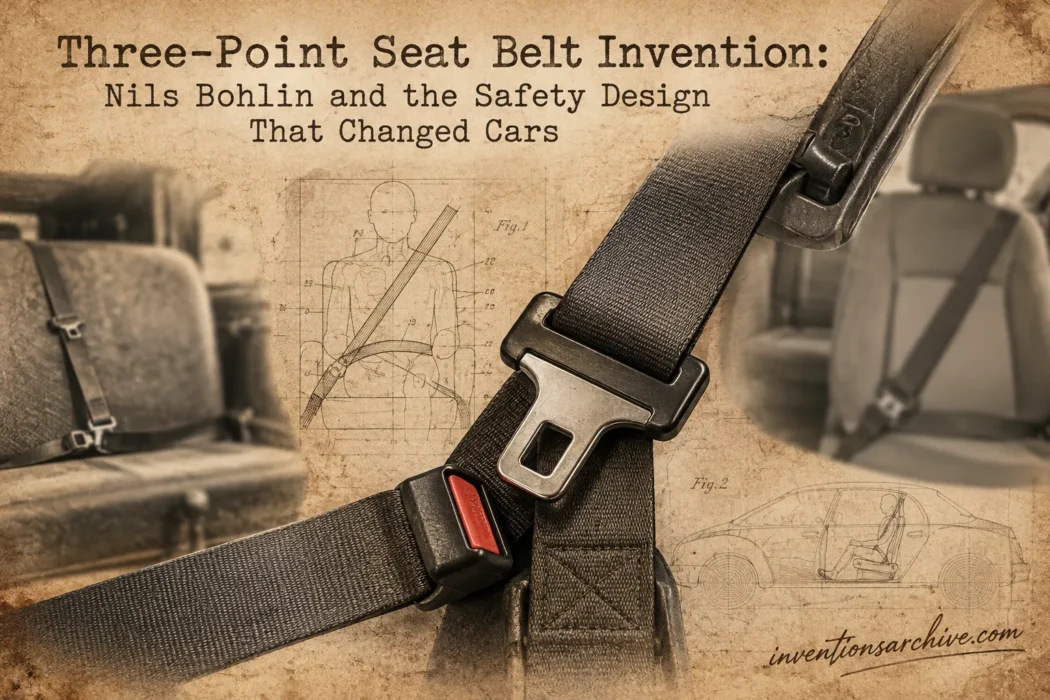
| Invention Name | V-Type Three-Point Safety Belt |
|---|---|
| Short Definition | A combined lap-and-shoulder restraint using three vehicle anchorage points to secure the pelvis and upper torso. |
| Approximate Date or Period | 1958–1959: Swedish patent application in 1958; production introduction in 1959. |
| Geography | Sweden |
| Inventor or Source Culture | Nils Ivar Bohlin, Volvo, Sweden |
| Category | Automotive Safety / Occupant Restraint |
| Importance | Established the lap-and-shoulder three-point geometry that became the dominant passenger-car seat-belt arrangement. |
| Evidence Status | Confirmed Patent records, manufacturer archives, accident research and surviving museum evidence document the design. |
| Main Problem Solved | Restraining both the upper and lower body while directing crash loads across the pelvis and rib cage in a system simple enough for everyday use. |
| How It Works | A lap section restrains the pelvis while a diagonal section controls forward motion of the torso; both operate as one connected restraint. |
| Patent Record | Swedish priority: August 29, 1958. U.S. Patent No. 3,043,625, filed August 17, 1959 and granted July 10, 1962. |
| Early Production Use | Volvo Amazon (120) and PV544, Nordic markets, 1959. |
| Development Path | Lap and diagonal restraints → earlier multi-point arrangements → Bohlin’s V-type three-point belt → retractors, pretensioners, load limiters and electronically coordinated restraint systems. |
Bohlin Did Not Invent the First Seat Belt
Nils Bohlin is accurately associated with the invention of the modern V-type three-point automobile safety belt, not with the first safety belt of any kind. Safety restraints existed decades before his work at Volvo. Patented belt systems, lap belts, diagonal restraints and more elaborate harnesses had already been proposed or used in automobiles, aircraft and racing vehicles.
The distinction matters because Bohlin’s achievement was unusually specific. He reorganized how an everyday passenger-car restraint crossed the human body, where it was anchored and how easily an occupant could fasten it. The result combined upper-torso and pelvic restraint without requiring the driver or passenger to put on a complicated harness.
The German Patent and Trade Mark Office traces vehicle safety-belt development to well before Bohlin and notes a 1903 French four-point-belt patent issued to Gustave-Désiré Leveau. By the 1950s, simple two-point lap belts and other restraint configurations were already known. Bohlin entered a field with many earlier ideas but no passenger-car arrangement that had achieved the combination of protection, positioning and everyday usability that Volvo wanted.
The Safety Problem Was Restraint Geometry
A collision can stop a vehicle much faster than an unrestrained occupant. The occupant continues moving relative to the passenger compartment until a restraint or part of the vehicle applies the forces needed to slow the body. Where those forces are applied is therefore central to occupant protection.
A lap belt controls the pelvis but provides little direct restraint to the chest and shoulders. A diagonal belt can restrain the upper torso but does not by itself provide the same control of the lower body. Earlier combinations of chest and hip restraints could also create unfavorable belt paths or force directions.
Bohlin’s patent discussed weaknesses in existing arrangements that combined chest and hip straps. One concern was that some configurations could transmit loads in ways that produced an undesirable downward force on the body and spine. His solution concentrated on a belt path that would hold the upper and lower body together while using the stronger structures of the pelvis and rib cage.
| Restraint Approach | Main Limitation or Design Characteristic | Bohlin’s Response |
|---|---|---|
| Two-Point Lap Belt | Primarily restrains the pelvis; upper torso can continue moving forward. | Added diagonal torso restraint as part of the same system. |
| Diagonal-Only Belt | Controls the upper body without equivalent pelvic restraint. | Combined the diagonal section with a lap section. |
| Earlier Y-Type Three-Point Arrangements | Used a different belt geometry and meeting-point arrangement. | Placed the connected lap-and-shoulder sections in a low-anchored V configuration. |
| Multi-Point Harness | Can provide extensive restraint but is less convenient for ordinary car occupants. | Created a restraint that could be fastened quickly with one hand. |
From Aircraft Ejection Seats to Volvo Safety Engineering
Bohlin’s route to automotive restraint design began in aviation. Before joining Volvo, he worked at Saab on aircraft-related safety engineering, including ejection-seat systems and restraints. That work dealt with a fundamental problem also present in automobile crashes: the human body must endure rapid changes in velocity while the restraint system controls its movement.
Volvo recruited Bohlin in 1958 to work on automotive safety. His aviation background did not mean that an aircraft harness could simply be transferred into a family car. An automobile restraint faced a different usability requirement. It needed to protect occupants while remaining comfortable and simple enough to be used on ordinary journeys.
This constraint shaped the design. A restraint that performs well when correctly worn has limited value if drivers routinely avoid it because fastening it takes too long or feels cumbersome. Bohlin therefore treated ease of use as part of the safety problem, rather than as a separate convenience feature.
The V-Shaped Belt That Defined Bohlin’s Design
The familiar three-point belt looks simple because its geometry has become ordinary. Its arrangement, however, addresses several problems at once.
One System Restrains the Pelvis and Upper Torso
The lower portion crosses the hips and pelvis. The diagonal portion travels from the shoulder region across the chest toward the opposite hip. Together they control forward movement of two major parts of the body that a lap-only restraint does not control equally.
The belt is intended to pass across the pelvis and rib cage, structures better suited to carrying restraint loads than softer areas of the abdomen.
The Low Anchorage Beside the Hip Matters
Bohlin placed the lower connection beside the occupant’s hip. This helped keep the lap section low and contributed to the V-shaped belt path described in Volvo’s historical record.
The resulting geometry has its point directed downward toward the floor rather than creating a meeting point high on the torso. When the restraint is loaded, the lap and diagonal portions work together to control the occupant rather than behaving as unrelated straps.
Three-Point Does Not Mean Three Separate Belts
The name refers to three anchorage locations, not three independent straps. In the classic arrangement, there is an upper anchorage near the shoulder and two lower anchorage locations on opposite sides of the seat or occupant.
The connected webbing produces the familiar path from shoulder to hip and across the pelvis. This is one reason the basic design can provide both torso and pelvic restraint without surrounding the wearer with a racing-style harness.
It Had to Be Fastened With One Hand
Bohlin described simplicity of operation as an important design requirement. The occupant needed to pull the belt across the body and connect it without working through a complicated sequence of straps and buckles.
That usability requirement helped distinguish the passenger-car solution from restraints designed for specialist environments such as aviation or motor racing. The geometry and the fastening method were developed as parts of the same system.
1958, 1959 and 1962 Refer to Different Stages of the Invention
Several dates are associated with the three-point belt because invention, patent filing, production introduction and patent grant did not occur on the same day.
| Date | Stage | What Happened |
|---|---|---|
| 1958 | Development at Volvo | Bohlin worked on the V-type lap-and-shoulder restraint after joining Volvo. |
| August 29, 1958 | Swedish Patent Priority | The patent family records a Swedish priority date for the safety-belt invention. |
| 1959 | Production Introduction | Volvo introduced the three-point belt as standard equipment in the Amazon (120) and PV544 on Nordic markets. |
| August 17, 1959 | U.S. Patent Filing | Bohlin’s U.S. application for the safety belt was filed and assigned to Aktiebolaget Volvo. |
| July 10, 1962 | U.S. Patent Grant | U.S. Patent No. 3,043,625 was granted to Nils Ivar Bohlin. |
| 1967 | Large Accident Analysis | Bohlin published an SAE analysis of more than 28,000 accident cases involving Volvo’s three-point restraint. |
This sequence explains why descriptions of the invention sometimes use 1958 and sometimes 1959. 1958 belongs to the development and patent-application history; 1959 marks the production introduction. The later 1962 date is the grant date of the corresponding U.S. patent, not the date on which the belt first entered cars.
The First Production Volvos With Bohlin’s Belt
Volvo’s historical record identifies the Amazon, also known as the 120 series, and the PV544 as the first models to receive the new three-point belt as standard equipment on Nordic markets in 1959. This was more consequential than simply offering a safety accessory. Standard installation put the restraint in the car without requiring each buyer to make a separate purchase decision.
The surviving patent drawing already shows the recognizable logic of the system. One part of the belt runs from a high mounting near the shoulder diagonally across the chest. The belt continues through the lower region to form the pelvic restraint, with mountings attached to the vehicle structure around the seat.
The transition was not immediately accepted by every customer. Earlier belts had acquired a reputation for inconvenience and limited protection, and some motorists remained skeptical of restraints. Making a better belt did not instantly create a culture of wearing it.
Volvo Patented the Design but Did Not Keep It Exclusive
A frequently repeated version of the story says that Volvo simply “gave away the patent.” That wording hides an important distinction.
The design was patented. Bohlin is named as the inventor in the U.S. record, and Aktiebolaget Volvo is identified as the assignee. Volvo nevertheless chose to make the three-point design available to other vehicle manufacturers rather than using the patent to keep the arrangement exclusive to Volvo automobiles.
Volvo’s own historical accounts describe the technology as being made available without payment so that other manufacturers could adopt it. The practical result was broader access to the design while the patent record itself continued to document Bohlin’s invention and Volvo’s ownership.
That distinction is more accurate than saying either that the belt was never patented or that ownership of the patent somehow ceased to exist immediately. Patent protection and restrictive enforcement are not the same thing.
Real-World Crash Data Put the Belt Beyond a Prototype
The three-point belt was not evaluated only with design reasoning and controlled tests. Bohlin later examined its performance across a large body of actual collisions.
His 1967 SAE technical paper analyzed more than 28,000 accident cases involving 37,511 belted and unbelted front-seat occupants. The vehicles were mainly two Volvo models equipped with the company’s combined lap-and-upper-torso restraint.
The study reported that the injury-reducing effect varied with accident speed and injury type. It also found strong protection against occupant ejection. Only about 26 percent of available belts were being used on average in the cases studied, illustrating how far adoption still lagged behind installation.
One of the paper’s most striking historical observations was that no belted occupant in its dataset suffered a fatal injury at reported accident speeds below 60 mph, while fatalities occurred among unbelted occupants across the speed range. That finding belongs specifically to the accidents and measurement methods in Bohlin’s dataset. It should not be interpreted as a universal survival threshold or as evidence that crashes below that speed are safe.
The value of the study lies in its scale and context. Less than a decade after the production introduction, engineers had real-world evidence showing how the three-point arrangement behaved across thousands of actual crashes rather than relying only on theoretical advantages.
What Happens When the Belt Is Loaded in a Crash
When a vehicle decelerates rapidly, an occupant tends to continue moving at the pre-impact velocity. A correctly positioned three-point restraint begins slowing the body through the belt system instead of allowing the occupant to travel freely into the steering wheel, dashboard, windshield or other parts of the passenger compartment.
The lap section controls the pelvis while the diagonal section restrains rotation and forward movement of the torso. Spreading restraint across the pelvis and rib cage also avoids concentrating the entire job on one narrow region of the body.
The belt does not eliminate crash forces. It changes how, where and over what interval those forces act on the occupant. Keeping the occupant within the intended seating position also allows other parts of the vehicle’s restraint system to work as designed.
Why the Airbag Did Not Replace the Belt
Modern airbags and three-point belts perform different jobs. The belt starts controlling occupant movement and helps maintain useful body position. An airbag provides an additional energy-absorbing surface during parts of the crash sequence.
The U.S. National Highway Traffic Safety Administration explicitly treats airbags as supplements to seat belts rather than replacements. An unbelted occupant may reach an inflating frontal airbag with much greater relative motion and from a poor position.
The Geometry Stayed Familiar While the Mechanism Evolved
A modern seat-belt system contains features that were not part of Bohlin’s original 1959 production arrangement. The recognizable lap-and-shoulder geometry survived while the surrounding mechanism became more responsive to normal driving and crashes.
Retractors allow the webbing to extend and retract during normal movement while locking when specified motion conditions occur. This removed much of the manual adjustment associated with early fixed belts.
Pretensioners can remove belt slack during a crash sequence, helping the restraint engage the occupant earlier. Load limiters can permit controlled belt payout under high loads to manage forces on the chest. Adjustable upper anchors improve belt positioning for occupants of different sizes, while buckle switches and reminder systems detect whether a belt is fastened.
These additions did not replace Bohlin’s central idea. They changed how the belt responds while preserving the relationship between a pelvic restraint, a diagonal torso restraint and three main anchorage locations.
Modern Crash Data Still Show the Value of Lap-and-Shoulder Belts
Current U.S. safety data continue to show large differences in injury risk associated with belt use. NHTSA reports that, for a front-seat occupant of a passenger car, using a seat belt reduces the risk of fatal injury by about 45 percent and the risk of moderate-to-critical injury by about 50 percent.
The continuing exposure of unbelted occupants is also visible in recent fatal-crash data. Among passenger-vehicle occupants killed in the United States in 2024 whose restraint use was known, 48 percent were unrestrained.
Those modern statistics should not be treated as a measurement of Bohlin’s original 1959 belt in isolation. Present-day vehicles combine belts with airbags, stronger occupant compartments, crash sensors, pretensioners, load limiters and other systems. They do show that the lap-and-shoulder restraint concept remains an active part of occupant protection rather than a historical feature superseded by later technology.
How to Interpret the “One Million Lives” Claim
Volvo credits the three-point belt with saving more than one million lives worldwide. The figure is widely associated with Bohlin’s invention, but its meaning should be kept precise.
It is an estimate of cumulative life-saving impact, not a registry containing more than one million individually documented cases in which investigators proved that a specific person would otherwise have died. Estimating prevented deaths requires comparing observed outcomes with expected outcomes without the restraint, something that cannot be directly observed for every crash.
The broader claim that seat belts prevent large numbers of deaths is supported by decades of crash research. The exact worldwide cumulative total attributed specifically to Bohlin’s design is necessarily an estimate.
A Surviving Early Belt Shows the Design in Physical Form
An early production example is preserved by the Smithsonian’s National Museum of American History. Its collection includes a seat with a three-point belt from a 1961 Volvo PV544 sedan, donated by Volvo Cars of North America.
The museum record identifies vinyl and nylon among the object’s materials. More importantly for the history of the invention, the seat preserves the restraint in the environment for which it was designed. It shows the technology as an integrated part of an automobile seat and body structure rather than as an isolated buckle or length of webbing.
That surviving object comes from only a few years after the 1959 production introduction and provides material evidence of the early passenger-car form of Bohlin’s restraint.
Why the Basic V-Type Layout Endured
Bohlin’s design addressed several requirements that had previously competed with one another. It restrained the pelvis and upper torso, directed the belt across stronger parts of the body, used a low anchorage arrangement and remained simple enough to fasten during ordinary driving.
Later restraint technology could therefore evolve around the layout instead of replacing it. Retractors changed how the belt adjusts. Pretensioners changed how quickly slack can be removed. Load limiters changed how webbing can respond under high force. Airbags added another layer of occupant protection. Electronic controls allowed these components to respond as a coordinated system.
Yet the visible belt path in a modern passenger car remains recognizably related to Bohlin’s 1958 design: across the pelvis, diagonally across the torso and secured through three anchorage locations. That persistence is the clearest measure of what he actually invented.
Sources and Verification
- Three-point safety belt — The German Patent and Trade Mark Office documents Bohlin’s 1958 Swedish patent application, his Saab background, earlier belt systems and the historical development of the three-point restraint.
- A MILLION LIVES SAVED SINCE VOLVO INVENTED THE THREE-POINT SAFETY BELT — Volvo Cars’ historical record describes Bohlin’s V-shaped geometry, low anchorage, one-hand usability, the Amazon and PV544 introduction, and Volvo’s decision to make the design available to other manufacturers.
- US3043625A – Safety belt – Google Patents — The digitized patent record identifies Nils Ivar Bohlin as inventor, Aktiebolaget Volvo as assignee, the Swedish priority date, U.S. filing date, grant date and technical description of the restraint.
- A Statistical Analysis of 28,000 Accident Cases with Emphasis on Occupant Restraint Value — Bohlin’s 1967 SAE technical paper provides the 28,000-plus accident-case analysis, the 37,511-occupant sample and the reported belt-use and injury findings.
- Seat Belt Safety: Buckle Up America — The U.S. National Highway Traffic Safety Administration provides current effectiveness estimates, 2024 restraint-status data and guidance on the complementary roles of seat belts and airbags.
- Seat with three-point seat belt from a 1961 Volvo PV 544 sedan — The Smithsonian National Museum of American History collection record documents a preserved early Volvo three-point-belt installation and its physical materials and provenance.