
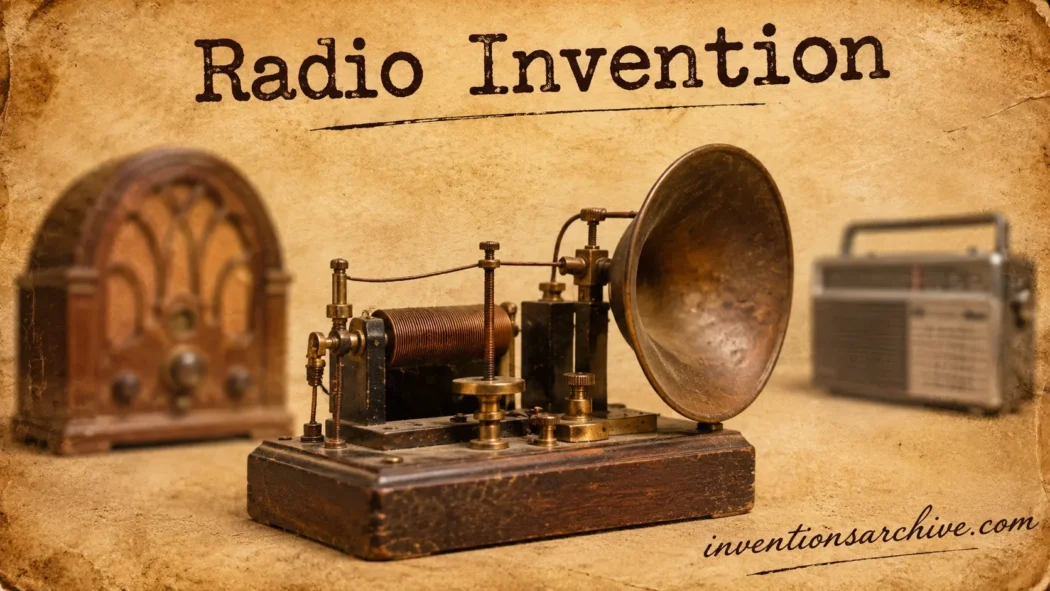
| Invention Name | Radio / Wireless Telegraphy |
|---|---|
| Short Definition | Transmission of information through electromagnetic waves without a continuous physical wire between transmitter and receiver. |
| Approximate Date or Period | Documented development 1880s–1890s; practical wireless telegraphy demonstrated by 1895. |
| Geography | Italy and the United Kingdom for Marconi’s early system; related developments in Germany, France, Russia, India, and the United States. |
| Inventor or Principal Contributors | Guglielmo Marconi is commonly credited with practical radio communication. James Clerk Maxwell, Heinrich Hertz, Édouard Branly, Oliver Lodge, Alexander Popov, Jagadish Chandra Bose, Nikola Tesla, Reginald Fessenden, and others made distinct contributions. |
| Category | Electrical engineering; wireless communication; telecommunications. |
| Importance | Enabled communication between ships, shore stations, and distant locations without connecting cables; later supported voice transmission and public broadcasting. |
| Evidence Status | Well documented Early experiments, patents, and commercial systems are recorded. Attribution varies Different technical achievements have different inventors. |
| Main Problem Solved | Sending information across distances where conventional telegraph wires were unavailable, impractical, or vulnerable. |
| Development Path | Electromagnetic theory → radio-wave experiments → wireless signaling → long-distance telegraphy → wireless speech → broadcasting → electronic AM and FM receivers. |
| Early Technical Basis | Spark-gap transmitters, antennas, earth connections, coherer detectors, relays, and Morse-code signaling. |
| Marconi’s First British Patent | No. 12,039; filed June 2, 1896; granted July 2, 1897. |
| Early Applications | Ship-to-shore communication, maritime distress signaling, naval communication, and commercial wireless telegrams. |
| Modern Descendants | AM and FM broadcasting, two-way radio, wireless data networks, satellite communication, and cellular radio systems. |
Guglielmo Marconi is most commonly credited with inventing practical radio communication in 1895. The Italian inventor developed a wireless telegraph system capable of sending coded messages through electromagnetic waves. He filed his first British radio patent in 1896, demonstrated communication over progressively greater distances, and established a commercial wireless business in 1897.
Marconi did not discover radio waves, and his early apparatus did not transmit speech or music. Physicists had already demonstrated electromagnetic radiation, while several inventors were investigating wireless signaling independently. The first widely recognized intelligible radio voice transmission came from Reginald Fessenden in 1900, and regular broadcasting developed later.
The date attached to the invention of radio therefore depends on the achievement being identified: the discovery of radio waves, the construction of a usable wireless telegraph, the transmission of human speech, or the establishment of broadcasting.
Who Invented Radio, and Why Is Marconi Credited?
Guglielmo Marconi (1874–1937) earned his place in radio history by developing and commercializing a practical system for transmitting telegraphic signals without wires. Beginning with experiments at his family’s Villa Griffone near Bologna, Italy, he developed equipment that could send recognizable messages over distances much greater than those demonstrated by many earlier laboratory arrangements.
His achievement centered on a working communication system. An operator could produce a sequence of electrical signals, transmit them through an antenna, and have corresponding signals detected at another location. The receiving apparatus could activate a recording instrument or another signaling device. This allowed established telegraph communication methods, including Morse code, to operate without a connecting cable.
In 1895, Marconi improved his experimental arrangement by using elevated conductors and earth connections. These changes extended the range of communication and helped him demonstrate signaling across intervening terrain. Subsequent tests in Britain established longer distances and attracted commercial and government interest.
Marconi shared the 1909 Nobel Prize in Physics with Karl Ferdinand Braun for their contributions to wireless telegraphy. Braun’s work on tuned circuits and transmitting equipment was part of the broader development that made more effective wireless systems possible.[a]
Marconi’s recognition does not establish that he invented every component in his apparatus. The technology drew on earlier scientific discoveries, existing detectors, electrical oscillators, and the work of competing researchers. His strongest historical claim concerns the creation of a practical wireless telegraph system and its development into a communication service.
How Radio Became Possible Before 1895
The conventional electrical telegraph could transmit information over long distances by the middle of the nineteenth century, but it depended on conductors connecting the sending and receiving stations. Submarine cables extended telegraphy across oceans, while ships at sea generally remained outside direct contact with land networks.
Removing the connecting wire required a way to produce a detectable electrical disturbance that could travel through space. Three developments brought that possibility within reach: electromagnetic theory, experimental radio-wave generation, and sensitive electrical detectors.
James Clerk Maxwell Predicted Electromagnetic Waves
During the 1860s, Scottish physicist James Clerk Maxwell formulated the relationship between electric and magnetic fields. His mathematical theory indicated that changing electric and magnetic fields could propagate together as electromagnetic waves.
Maxwell also identified light as an electromagnetic phenomenon. This provided a theoretical basis for other electromagnetic waves with wavelengths different from visible light.
His work did not produce a radio transmitter or receiver. It established the physical principles that later experiments could investigate.
Heinrich Hertz Demonstrated Radio Waves Experimentally
German physicist Heinrich Hertz experimentally produced and detected electromagnetic waves in the late 1880s. His apparatus used rapidly changing electrical currents and spark discharges to generate radiation that could be detected at a separate device.
Hertz demonstrated wave properties including reflection, interference, and polarization, confirming central predictions of Maxwell’s theory.
The experiments showed that electromagnetic waves existed and could travel through space. They were primarily investigations of physics, rather than a functioning system for exchanging coded messages between operators.
Branly, Lodge, and the Development of Radio-Wave Detection
Producing electromagnetic radiation was only one part of wireless communication. The receiving station also needed equipment sensitive enough to recognize a transmitted signal.
French physicist Édouard Branly investigated detectors containing metallic particles around 1890. Their electrical resistance changed when exposed to electromagnetic disturbances, making them useful for detecting radio-frequency signals.
British physicist Oliver Lodge continued investigating electromagnetic waves and demonstrated their transmission and detection in 1894. Lodge also advanced work on electrical resonance and tuning.
A detector based on metallic particles became known as a coherer. It was an important component in several early wireless systems, including Marconi’s apparatus.
The Science Museum’s historical collection documents this progression through surviving coherers, experimental equipment, and instruments associated with Hertz, Lodge, Popov, and Marconi.[b]
Marconi’s Experiments at Villa Griffone in 1895
Marconi began experimenting with electromagnetic waves at his family home near Bologna during 1894–1895. His early arrangements drew on Hertz’s oscillators and coherer-type detectors, which he adapted for communication rather than laboratory observation.
At first, the distances were limited. The equipment needed to detect weak signals consistently, and the relationship between antenna design and transmission range was not yet fully understood.
The Change That Increased Transmission Distance
Marconi found that placing a conductor above the ground and incorporating an earth connection into the electrical system greatly improved transmission range.
The elevated conductor served as an antenna. By refining both transmitting and receiving arrangements, he moved beyond short laboratory demonstrations toward communication over outdoor distances.
In his 1909 Nobel lecture, Marconi described using a coherer containing nickel and silver filings between metallic contacts. He also explained how a telegraph relay, recording mechanism, and automatic tapping arrangement helped the receiver distinguish successive Morse signals.
He identified August 1895 as the period when his elevated-conductor and earth-connection arrangement extended the range and allowed experiments involving obstacles between stations.[c]
Why Signaling Beyond a Hill Mattered
One of the frequently described Villa Griffone experiments involved transmitting a signal beyond an intervening hill, at a distance of approximately two kilometers.
This demonstration had practical implications. A wireless system restricted to a short, unobstructed laboratory path would have limited use for ships, coastal stations, or communication across irregular terrain.
The hill experiment demonstrated that usable signals could be received under conditions more demanding than those of a controlled room. It did not mean that every obstacle could be overcome or that radio waves would travel unlimited distances.
The successful combination of a signaling mechanism, effective antennas, sensitive detection, and increasing operational range distinguished Marconi’s work from earlier demonstrations of electromagnetic radiation.
The 1896 Patent and the First Commercial Radio Company
Marconi moved to Britain in 1896, where he pursued patent protection and demonstrated his apparatus to officials and technical observers.
His British patent, No. 12,039, “Improvements in Transmitting Electrical Impulses and Signals, and in Apparatus Therefor,” was filed on June 2, 1896. The complete specification was submitted in March 1897, and the patent was granted on July 2, 1897.
The patent described apparatus for transmitting signals using high-frequency electrical oscillations. Its disclosed arrangements included oscillators, receiving detectors, signal-operated relays, and methods for transmitting recognizable electrical impulses.
The patent record is evidence of a specific technical disclosure and the date on which protection was sought. It does not establish that Marconi first discovered electromagnetic waves or invented all the electrical components used in wireless communication.[d]
Marconi formed the Wireless Telegraph and Signal Company in July 1897 to develop commercial applications. The company was later renamed Marconi’s Wireless Telegraph Company.
Maritime communication offered an immediate market. Ships could not remain connected to telegraph cables while traveling, and coastal installations needed a means of exchanging information with vessels beyond visual signaling range.
In 1899, Marconi’s equipment supported wireless communication across the English Channel. That year, his company also provided wireless reports from the America’s Cup yacht races near New York, demonstrating how information could be collected from ships and delivered rapidly to observers on land.
How Marconi’s Original Radio System Worked
Marconi’s early radio apparatus operated as a wireless telegraph. Its purpose was to transmit controlled electrical impulses representing coded information.
The process required a transmitter, an antenna, electromagnetic waves, a receiving antenna, and equipment that converted the received signal into a recognizable indication.
The Spark-Gap Transmitter
An early transmitter generated brief bursts of high-frequency electrical oscillations associated with a spark discharge. These changing electrical currents produced electromagnetic radiation that could propagate away from the transmitting antenna.
The operator controlled the timing of the transmitted bursts with a telegraph key. Short and long signal intervals could represent the dots and dashes of Morse code.
Unlike later continuous-wave transmitters, spark equipment generated damped oscillations: the electrical activity in each burst decreased rapidly after it began. Such signals occupied a relatively broad range of frequencies and could interfere with other wireless stations.
The Coherer Receiver
The coherer was an early radio detector. In a typical metallic-filings design, the resistance between its contacts changed when the detector responded to an incoming electromagnetic signal.
That change allowed a separate electrical circuit to operate a relay, sounder, or recording instrument.
Many coherers required a tapping or shaking mechanism to restore their previous electrical condition before detecting another signal. This made receiver reliability an important engineering problem.
Marconi refined the detector and incorporated automatic restoring mechanisms into his apparatus. The details varied among his experimental designs and later commercial equipment.
How Morse Code Traveled Without Wires
The receiving station did not initially hear spoken words. It detected the timing of transmitted impulses.
- Signal encoding: The sending operator represented letters and numbers through the established patterns of Morse code.
- Transmission: The radio transmitter produced controlled bursts of electromagnetic radiation.
- Propagation: The waves traveled through space and could induce electrical responses in a receiving antenna.
- Detection: The receiving apparatus converted the incoming disturbances into recognizable electrical indications.
- Message interpretation: An operator read the sequence as Morse-code characters and reconstructed the message.
The information was carried by the presence and timing of radio-frequency signals. Voice radio later required a different method of encoding sound onto electromagnetic waves.
Why Tuning Became Necessary
Early wireless equipment had limited frequency selectivity. A receiver could respond to unwanted transmissions, while spark-generated signals could occupy overlapping portions of the radio spectrum.
Resonant circuits helped transmitters and receivers operate around selected frequencies. By adjusting circuit properties, engineers improved the ability of a receiving station to distinguish one transmission from another.
Tuning was a major area of research involving several inventors. It also became central to later patent disputes over radio apparatus.
Other Inventors Who Developed Radio Before and Alongside Marconi
Radio-related experiments were conducted independently in several countries during the 1890s. These researchers worked with electromagnetic waves, detectors, resonance, signaling, and wireless energy transmission, sometimes pursuing different technical objectives.
Alexander Popov and His 1895 Wireless Receiver
Russian physicist Alexander Stepanovich Popov developed a receiver using a coherer, antenna, relay, and signaling mechanism.
On May 7, 1895, Popov demonstrated electromagnetic signal reception before the Russian Physical and Chemical Society in St. Petersburg. His apparatus was associated with the detection of atmospheric electrical disturbances and the study of wireless signaling.
IEEE’s historical recognition of Popov’s work records a demonstration involving short electromagnetic signals over a distance of up to 64 meters.
Popov subsequently continued his investigations of wireless communication, including applications connected with naval requirements. Russia recognizes his May 7 demonstration through the tradition of Radio Day.[e]
Popov’s work establishes that useful radio detection and signaling experiments were taking place independently of Marconi. The historical distinction concerns the type of apparatus demonstrated, the communication it supported, and the later development of a sustained operational system.
Jagadish Chandra Bose and Millimeter-Wave Experiments
Indian physicist Jagadish Chandra Bose conducted pioneering experiments with short-wavelength electromagnetic radiation in Calcutta during the 1890s.
His research included electromagnetic-wave generation, detection, and the study of wave behavior through components resembling optical instruments.
In 1895, Bose demonstrated transmission and reception of approximately 60 GHz electromagnetic waves over a distance of about 23 meters. His experimental system involved specialized components including a horn antenna, dielectric lens, polarizer, and detector.
IEEE recognizes these 1894–1896 investigations as early millimeter-wave communication experiments.[f]
Bose’s research was technically distinct from Marconi’s long-distance wireless telegraphy. Its importance lies particularly in high-frequency electromagnetic experimentation and the development of components associated with microwave engineering.
Nikola Tesla’s Wireless Transmission Research
Nikola Tesla investigated high-frequency alternating currents, resonant electrical circuits, and methods of transmitting energy without conventional connecting wires.
His lectures during the early 1890s explored high-frequency electrical phenomena and possible applications of wireless transmission.
On September 2, 1897, Tesla filed a United States patent application covering a system for transmitting electrical energy. The resulting Patent No. 645,576 was granted on March 20, 1900.
A related patent, No. 649,621, also issued in 1900, described apparatus for electrical energy transmission.
These patents addressed resonant circuit arrangements and energy transfer. Tesla also recognized possible communication applications. His patented systems, however, were developed principally around wireless electrical transmission concepts and should not be treated as direct equivalents of Marconi’s commercial telegraph network.[g]
Tesla’s 1898 Radio-Controlled Boat
Tesla demonstrated a remotely controlled model boat at Madison Square Garden in New York in 1898.
The demonstration showed that electrical signals transmitted without a connecting control cable could operate mechanisms in a moving vessel. Commands could influence its steering and other functions.
His United States Patent No. 613,809, granted November 8, 1898, described methods and apparatus for controlling moving vessels or vehicles at a distance.[h]
This was an early application of wireless control rather than a public radio broadcasting system. It demonstrated that electromagnetic signaling could be used for purposes beyond communicating written messages.
Marconi’s 1901 Transatlantic Radio Experiment
By 1901, Marconi was attempting to extend wireless communication across the Atlantic Ocean.
The proposed distance was far greater than those achieved in his early experiments. Engineers and physicists questioned whether the available radio equipment could produce detectable signals over such distances, particularly because the curvature of Earth created difficulties for simple line-of-sight explanations.
From Poldhu to Newfoundland
Marconi established a high-power transmitting station at Poldhu in Cornwall, England. His receiving operation was set up at St. John’s, Newfoundland, approximately 3,500 kilometers across the Atlantic.
Storm damage complicated construction of the original transmitting antenna at Poldhu, requiring a replacement arrangement. In Newfoundland, Marconi and his assistants also encountered difficulties raising a receiving antenna and used a kite-supported wire.
On December 12, 1901, Marconi reported hearing the prearranged signal from Poldhu: three short Morse-code impulses representing the letter S.
He and assistant George Kemp reported recognizing the signal through a sensitive receiving arrangement. The event became the most famous of Marconi’s early long-distance experiments.
How Certain Was the 1901 Reception?
The reception was reported by the experimenters, but the very weak signal was not preserved as a conventional telegraphic tape record.
This creates an important difference between the historical report and a permanently recorded, independently repeatable measurement. The identity and strength of the received signal, atmospheric interference, and the available records have all been examined in later historical discussions.
The University of Oxford’s Museum of the History of Science documents the original receiving equipment and the difficulties involved in obtaining a clear record of the signal.[i]
Related articles: Internet Invention: Who Invented the Internet and When?, USB Invention: Who Invented USB and When?
The unresolved details of that particular reception do not invalidate the subsequent development of long-distance wireless communication.
The Better-Documented Experiments of 1902
Marconi continued testing transmission from Poldhu during a voyage aboard the steamship Philadelphia in February 1902.
The experiments produced received messages at increasing distances, with reported reception of ordinary messages at more than 1,500 miles and recognition of the three-dot signal at approximately 2,100 miles under favorable conditions.
A contemporary report published in Nature on March 6, 1902, described the results, including the distances associated with the shipboard tests.[j]
The additional experiments strengthened the evidence that radio communication could reach well beyond the visual horizon. They also demonstrated that reception conditions differed substantially between day and night.
The ionosphere, a region of Earth’s upper atmosphere containing electrically charged particles, later became central to the scientific explanation of long-distance radio propagation. Radio waves can be refracted through ionized atmospheric regions, allowing suitable frequencies to return toward Earth’s surface over great distances.
The effectiveness of this process depends on frequency, atmospheric conditions, time of day, and other factors. It was not sufficiently understood when Marconi attempted his first Atlantic transmission.
Long-distance wireless service continued to develop after the experiments. Regular commercial transatlantic radiotelegraph communication required further improvements in transmitting power, antenna systems, receiving equipment, and operating reliability.
When Was the Human Voice First Transmitted by Radio?
The earliest radio systems transmitted coded impulses. They could communicate information efficiently, but their basic signaling method could not reproduce the continuously changing sounds of speech.
Canadian-born inventor Reginald Aubrey Fessenden developed techniques that allowed electrical variations representing sound to influence a radio signal.
Fessenden’s December 23, 1900 Transmission
On December 23, 1900, Fessenden transmitted intelligible human speech using radio equipment at Cobb Island, Maryland.
The experiment took place during his work for the United States Weather Bureau, which was investigating wireless communication for meteorological operations.
Accounts of the experiment describe a transmission between stations approximately one mile apart. The sound was imperfect, but intelligible speech could be conveyed through electromagnetic waves.
The National Park Service identifies this event as an early successful transmission of the human voice by radio.[k]
Fessenden continued working on radiotelephony during the following years, including further speech-transmission experiments in North Carolina and Massachusetts.
Why Voice Radio Required a Different Signal
Human speech consists of continuously changing acoustic vibrations. A microphone converts those changes into corresponding electrical variations.
Transmitting recognizable speech requires a radio signal that can carry these variations and a receiver capable of recovering them.
In amplitude modulation (AM), the amplitude of a radio-frequency carrier changes in accordance with the information being transmitted. A suitable receiver detects these changes and reconstructs the audio signal.
Continuous-wave generation was better suited to this task than the intermittent, heavily damped oscillations produced by early spark-gap transmitters.
Fessenden’s research contributed to the development of radio telephony, the transmission of speech through radio waves. His achievement belongs to a different stage of radio history from Marconi’s initial Morse-code communication system.
Did Fessenden Make the First Radio Broadcast in 1906?
One of the most familiar accounts of early broadcasting describes Fessenden transmitting music and speech from Brant Rock, Massachusetts, on Christmas Eve, December 24, 1906.
According to the traditional account, the program included recorded music, a violin performance, spoken passages, and holiday greetings. Radio operators aboard ships were among the intended listeners.
The event is frequently identified as the first entertainment-oriented radio broadcast, but the surviving evidence for that particular Christmas Eve transmission is disputed.
The Documented December 21 Demonstration
Fessenden had developed equipment capable of transmitting speech and music by 1906. On December 21 of that year, his system was used in a documented demonstration of radiotelephony involving officials and observers.
That demonstration provides stronger contemporary evidence of his technical capabilities than the later accounts of the Christmas Eve program.
Why the Christmas Eve Account Is Debated
Historian James E. O’Neal investigated the Christmas Eve story using period publications, correspondence, and surviving radio logs.
In an article published by the IEEE Broadcast Technology Society in 2006, he reported finding no contemporary newspaper confirmation of the supposed Christmas Eve program and questioned why the account appeared prominently in much later descriptions.
An important retrospective account came from Fessenden himself in 1932, decades after the alleged broadcast. His widow Helen Fessenden also described the event in a biography published in 1940.
The absence of contemporary confirmation does not prove that the broadcast never occurred. It does mean that the traditional story cannot be presented with the same degree of documentary certainty as Fessenden’s established radio experiments and the December 21 demonstration.[l]
Fessenden’s place in the history of wireless speech is supported independently of this dispute. His experiments helped establish the technical possibility of transmitting voice and music through radio waves.
How Radio Became a Public Broadcasting Medium
Radio communication developed as a specialized service for telegraph operators, ships, governments, and commercial organizations before it became a household medium.
The transition required more reliable audio transmitters, improved receivers, practical electronic amplification, and stations capable of serving many listeners.
Experimental Broadcasting Before 1920
Researchers and experimental stations transmitted voice, music, and other audio material before regular commercial radio programming became established.
Lee de Forest was among the early experimenters who explored the use of radio for entertainment and public communication.
Some of these transmissions were individual demonstrations, while others involved repeated experimental programs. They did not yet constitute a widely adopted system of scheduled broadcasting for home audiences.
KDKA and the 1920 Presidential Election
On November 2, 1920, station KDKA in Pittsburgh broadcast results from the United States presidential election between Warren G. Harding and James M. Cox.
The station was operated through the Westinghouse broadcasting effort and became associated with the establishment of commercial radio programming.
Westinghouse engineer Frank Conrad had already been transmitting music and other material experimentally before KDKA’s election-night broadcast.
The Library of Congress documents the connection between Conrad’s earlier experimental operations, Westinghouse’s broadcasting activities, and KDKA’s November 1920 election coverage.[m]
KDKA’s 1920 broadcast is an important commercial broadcasting milestone. It should not be confused with the invention of radio waves, the first wireless telegraph message, or the first experimental transmission of human speech.
The Electronic Improvements That Made Home Radio Practical
Early receivers depended on mechanical indicators, magnetic detectors, coherers, or crystal detectors. Receiving weak audio signals with reasonable clarity required more capable electronic circuits.
Fleming’s Valve and de Forest’s Audion
British engineer John Ambrose Fleming developed a two-electrode thermionic valve in 1904. The device could act as a detector or rectifier, allowing changing electrical signals to be converted into a form suitable for further processing.
Lee de Forest developed the three-electrode Audion during 1906–1907. The addition of a control grid enabled electronic signal control and, through subsequent improvements and applications, amplification.
Vacuum-tube circuits made it possible to detect and strengthen weak radio signals electronically. They also supported more capable transmitters and receivers.
Edwin Armstrong’s Regenerative and Superheterodyne Circuits
American engineer Edwin Howard Armstrong developed important improvements in radio reception.
His regenerative receiver, developed around 1912–1913, used feedback to increase receiver sensitivity. This helped amplify signals that would otherwise have been difficult to detect.
During the First World War, Armstrong developed a superheterodyne receiver arrangement. The principle involves converting an incoming radio signal to another frequency where amplification and filtering can be performed more effectively.
Superheterodyne techniques became widely used in radio reception. The history of their invention also includes the independent work and earlier patent claims of French engineer Lucien Lévy.
Armstrong and the Development of FM Radio
By the 1930s, amplitude-modulated radio was established, but unwanted electrical interference remained a persistent problem.
Armstrong developed wideband frequency modulation in 1933. In an FM system, information changes the frequency of the carrier rather than its amplitude.
Because many kinds of electrical noise appear as unwanted amplitude variations, appropriately designed FM receivers can reduce their effects and improve audio reproduction.
The National Inventors Hall of Fame identifies Armstrong’s regenerative receiver, superheterodyne development, and wideband FM work as separate contributions to radio engineering.[n]
FM broadcasting was therefore a later development of radio communication, rather than the form of radio originally demonstrated by Marconi in 1895.
Why Radio Became Essential for Ships and Maritime Safety
Radio’s first widespread practical applications included communication between ships and coastal stations.
Before wireless telegraphy, ships traveling beyond the reach of visual signaling or coastal communication systems could remain isolated until they approached another vessel or returned to port.
Radio allowed operators to exchange navigational information, commercial messages, and requests for assistance without a continuous physical connection.
Marconi’s company installed equipment aboard passenger liners and other vessels, frequently supplying trained operators as part of the service.
The Titanic Disaster and Wireless Distress Calls
When RMS Titanic struck an iceberg in the North Atlantic on April 14, 1912, its wireless operators used radio equipment to transmit distress messages.
Operators Jack Phillips and Harold Bride worked the ship’s wireless installation as the emergency developed. Their transmissions helped alert other ships, including RMS Carpathia, which rescued more than 700 survivors.
The disaster exposed weaknesses in maritime radio operations. Wireless traffic was not always organized around emergency priorities, and communication practices differed among vessels and operators.
The need for more reliable distress communication contributed to changes in maritime radio requirements, including more systematic operating arrangements and international agreements.
The 1912 International Radiotelegraph Convention addressed radio communication rules and distress procedures, while subsequent maritime safety agreements strengthened requirements for shipboard communications.
Titanic did not introduce radio at sea, but the disaster demonstrated its value in emergencies and revealed shortcomings in the way the existing technology was being operated.
Did the Supreme Court Decide That Tesla Invented Radio in 1943?
A frequently repeated account of radio history states that the United States Supreme Court ruled in 1943 that Nikola Tesla, rather than Marconi, had invented radio.
The actual decision was narrower. It concerned specific patent claims and earlier technical disclosures, particularly arrangements for tuning circuits in wireless telegraph apparatus.
The Patent at the Center of the Case
The case, Marconi Wireless Telegraph Company of America v. United States, was decided on June 21, 1943.
One of the central patents was Marconi’s United States Patent No. 763,772, issued in 1904. It covered improvements involving four high-frequency circuits arranged so that the transmitting and receiving systems could be tuned into resonance.
The dispute required the Court to determine whether particular patent claims represented a patentable invention when compared with technical information already disclosed by other researchers.
The Roles of Tesla, Lodge, and John Stone Stone
The Court examined earlier work by Tesla, Oliver Lodge, and John Stone Stone.
Tesla’s patents described resonant electrical arrangements. Lodge had disclosed important principles of tuning and adjustable inductance. Stone’s earlier patent application presented a four-circuit wireless telegraph arrangement addressing selective reception.
The Court concluded that important claims of Marconi’s later patent were anticipated by earlier disclosures, relying especially on Stone’s work.
The decision did not establish that Tesla alone invented practical radio communication. Nor did it award Tesla ownership of all radio technology.
What the Court Actually Ruled
The Supreme Court held that broad claims of Marconi’s 1904 patent did not satisfy the requirements for patentable invention over the prior technical work examined in the case.
The Court distinguished those claims from Marconi’s original reputation as a pioneer of successful wireless transmission. It did not conduct a general historical proceeding to determine which single person invented radio.
The decision’s discussion of earlier inventors is valuable evidence of the overlapping development of tuned radio circuits. Its legal outcome concerned the validity of specified patent claims, rather than an exclusive historical title of “inventor of radio.”[o]
Which Date Marks the Invention of Radio?
Different historical dates describe different technical achievements. Treating them as interchangeable produces contradictory claims about the first radio, the first voice transmission, and the beginning of broadcasting.
| Date | Contributor or Event | Documented Development |
|---|---|---|
| 1860s | James Clerk Maxwell | Mathematical theory of electromagnetic waves. |
| 1880s | Heinrich Hertz | Experimental generation and detection of electromagnetic waves. |
| 1894 | Oliver Lodge | Public demonstrations of electromagnetic wave transmission and detection. |
| 1895 | Guglielmo Marconi | Development of a practical wireless telegraph arrangement in Italy. |
| 1895 | Alexander Popov and Jagadish Chandra Bose | Independent radio-wave detection and experimental transmission work. |
| 1896–1897 | Marconi | British wireless signaling patent filed and granted; commercial company established. |
| 1898 | Nikola Tesla | Demonstration of a remotely controlled boat using wireless signals. |
| 1900 | Reginald Fessenden | Early successful transmission of intelligible human speech by radio. |
| 1901 | Marconi | Reported reception of a transatlantic wireless signal. |
| 1906 | Fessenden | Documented radiotelephony demonstrations; disputed Christmas Eve broadcast account. |
| 1920 | KDKA / Westinghouse | Commercial broadcasting milestone associated with presidential election returns. |
| 1933 | Edwin Armstrong | Development of wideband frequency modulation. |
| 1943 | United States Supreme Court | Decision invalidating specified claims in Marconi’s later radio tuning patent. |
1895 remains the most widely used date for the invention of practical radio communication because of Marconi’s wireless telegraph experiments. The underlying electromagnetic science was established earlier, while radio speech, long-distance services, and broadcasting developed through additional inventions.
Marconi’s work joined existing scientific principles and electrical components into a usable communication system. Popov, Bose, Tesla, Fessenden, Braun, Armstrong, and other researchers contributed different discoveries and methods that extended what radio could accomplish.
The historical record supports Marconi’s central role in practical wireless telegraphy while showing that modern radio emerged through several distinct technical developments rather than one invention completed by a single person.
Sources and Verification
- [a] Guglielmo Marconi – Facts — NobelPrize.org. Confirms Marconi’s recognized work on wireless signaling in 1895 and his share of the 1909 Nobel Prize in Physics.
- [b] Titanic, Marconi and the Wireless Telegraph — Science Museum, London. Museum-based account of Maxwell, Hertz, Lodge, Marconi’s equipment, maritime wireless systems, and radio communication during the Titanic disaster.
- [c] Wireless Telegraphic Communication: Guglielmo Marconi’s Nobel Lecture — NobelPrize.org. Marconi’s December 11, 1909 account of his 1895 experiments, coherer improvements, antennas, and early communication-distance measurements.
- [d] British Patent GB189612039A — Google Patents historical patent record. Provides the original patent specification, filing date of June 2, 1896, and grant date of July 2, 1897.
- [e] Popov’s Contribution to the Development of Wireless Communication, 1895 — Engineering and Technology History Wiki, IEEE Milestone. Documents Popov’s May 7, 1895 demonstration and receiving apparatus.
- [f] First Millimeter-Wave Communication Experiments by J. C. Bose, 1894–1896 — Engineering and Technology History Wiki, IEEE Milestone. Records Bose’s experimental millimeter-wave system and its technical characteristics.
- [g] Tesla Patent US 645,576: System of Transmission of Electrical Energy — Historical United States patent specification. Verifies Tesla’s 1897 filing and the wireless energy transmission arrangements granted patent protection in 1900.
- [h] Tesla Patent US 613,809: Remote Control of Moving Vessels or Vehicles — Historical United States patent record. Documents the 1898 wireless-control invention and its proposed application to moving machinery.
- [i] Wireless World: Marconi and the Making of Radio — Atlantic Crossing — Museum of the History of Science, University of Oxford. Documents the 1901 transatlantic experiment, surviving receiving equipment, and limitations of the original reception evidence.
- [j] Further Developments in Wireless Telegraphy — Nature, March 6, 1902. A contemporary scientific publication reporting the distances and results of Marconi’s subsequent shipboard wireless tests.
- [k] Reginald Fessenden — United States National Park Service. Institutional history confirming the December 23, 1900 speech-transmission experiment at Cobb Island, Maryland.
- [l] A Fresh Look at Fessenden’s 1906 Broadcast — James E. O’Neal, IEEE Broadcast Technology Society Newsletter, Winter 2006, pages 12–14. Historical investigation of the Christmas Eve broadcast claim, contemporary records, and the documented December 21 demonstration.
- [m] Adventures in Research: A Radio Drama of Discovery — Library of Congress. Documents Frank Conrad’s experimental broadcasting and Westinghouse station KDKA’s November 2, 1920 election broadcast.
- [n] Edwin Howard Armstrong — National Inventors Hall of Fame. Institutional account of Armstrong’s regenerative circuit, superheterodyne work, and 1933 wideband FM development.
- [o] Marconi Wireless Telegraph Company of America v. United States, 320 U.S. 1 (1943) — United States Supreme Court opinion reproduced by Cornell Law School’s Legal Information Institute. Primary legal text establishing the patent claims considered and the Court’s actual ruling.