
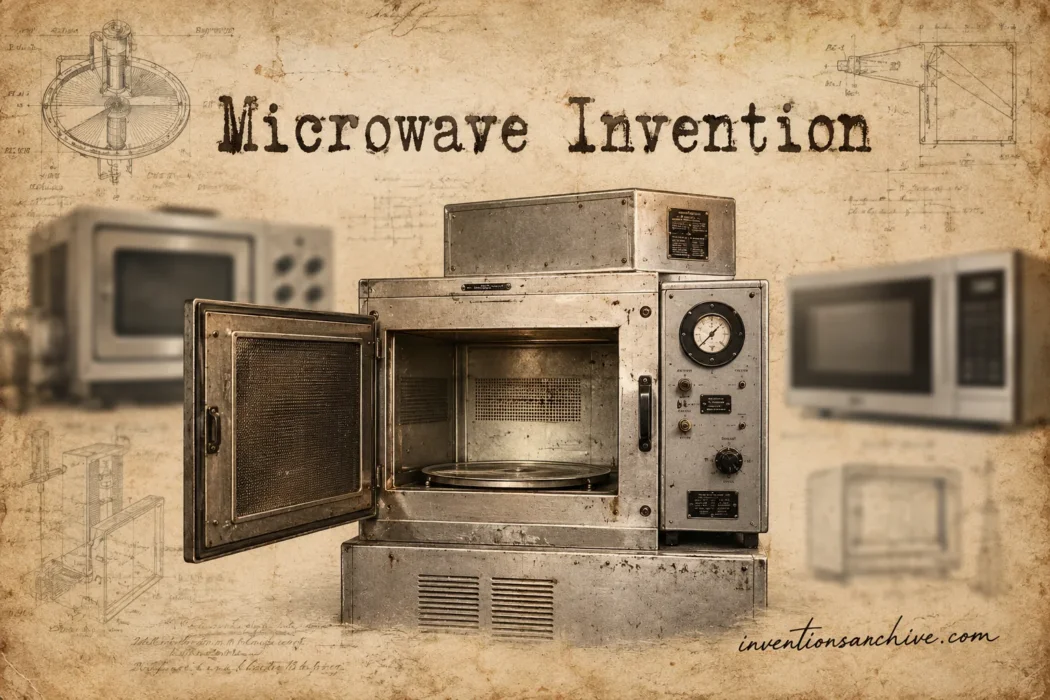
| Invention Name | Microwave oven / microwave cooking |
|---|---|
| Short Definition | An oven that uses microwave electromagnetic energy to deposit heat within food inside a metal cooking cavity. |
| Approximate Date or Period | 1945 for Spencer’s cooking experiments and patent filing; commercial microwave ovens followed in 1947. |
| Geography | United States, especially Raytheon’s Massachusetts operations; the cavity-magnetron precursor was developed in Birmingham, England. |
| Inventor or Source | Percy L. Spencer at Raytheon is commonly credited with microwave cooking; later Raytheon, Tappan and Amana engineering shaped the appliance. |
| Category | Electrical appliance, food technology and microwave engineering |
| Importance | Made rapid food heating practical by transferring electromagnetic energy directly into food rather than first heating an oven chamber in the conventional way. |
| Evidence Status | Confirmed Patent filings and museum records document the technical development. The famous melted-candy episode survives through later institutional accounts rather than the patent record itself. |
| Main Problem Solved | Using microwave-frequency energy as a controlled, practical method for rapidly heating and cooking food. |
| Development Path | Cavity magnetron for radar → unexpected food heating → deliberate experiments → 1945 cooking patent → 1947 Radarange → 1955 Tappan RL-1 → compact 1967 Amana Radarange |
| How It Works | A magnetron generates microwaves that enter a metal cavity, reflect within it and transfer energy to suitable components of the food. |
| Technical Basis | Cavity magnetron, microwave transmission, reflective metal enclosure and controlled field distribution |
| Early Use Context | Large commercial and institutional cooking equipment before compact domestic models became practical. |
Percy Spencer is usually named as the inventor of the microwave oven, but the familiar story about a candy bar melting in his pocket describes only the beginning of the invention. Microwave-frequency equipment already existed, and the high-powered cavity magnetron that made microwave cooking practical had been developed for radar before Spencer began experimenting with food.
Spencer’s contribution was to recognize an unexpected heating effect, test it deliberately, and turn it into a usable method for cooking food. A patent application filed on October 8, 1945, provides firmer evidence for that work than the later anecdotes surrounding the discovery. The appliance that eventually reached domestic kitchens required another two decades of work on microwave distribution, size, price, controls and consumer use.
The Discovery Began With Radar Work, Not Kitchen Research
Percy LeBaron Spencer was already an experienced radio and vacuum-tube engineer when the microwave-cooking idea emerged. He had joined the company that became Raytheon in 1925 and spent much of his career working with radio-frequency equipment. During World War II, Raytheon became a major producer of magnetrons used in radar systems.
Spencer’s connection with the magnetron was therefore far deeper than a chance encounter with an unfamiliar machine. He worked on ways to simplify magnetron manufacture at a time when demand for radar equipment was extremely high. The National Inventors Hall of Fame records that Raytheon’s magnetron production was about 17 units per day in 1941 before manufacturing changes associated with Spencer’s work helped raise output to roughly 2,600 per day.
This background helps explain why the later food-heating observation mattered. Many people might have noticed that something had become warm. Spencer was working in a field where he could connect the heating effect to the electromagnetic energy being generated by the equipment and then test whether the effect could be controlled.
The Cavity Magnetron Came Before Spencer’s Cooking Patent
The microwave oven should not be confused with the invention of the cavity magnetron itself. Magnetron technology had a longer history, and an important advance occurred at the University of Birmingham in 1940. John Randall and Harry Boot developed and operated a resonant cavity magnetron capable of producing powerful centimetre-wavelength radiation suitable for radar.
The Birmingham device was first operated on February 21, 1940. Its ability to generate high microwave power in equipment compact enough for airborne radar made it valuable during the war. The same general type of microwave source later became central to microwave ovens.
Spencer therefore did not discover microwaves and did not originate the Birmingham cavity magnetron. His place in microwave-oven history comes from another step: applying high-frequency microwave energy to food in a way that could become a controlled cooking process.
What Happened in the Raytheon Laboratory in 1945?
The best-known version of the story places Spencer near operating microwave equipment in a Raytheon laboratory in 1945. Later accounts from institutions including the National Inventors Hall of Fame describe him noticing that a candy bar in his pocket had begun to melt. Other retellings call it a chocolate bar. That variation is a reason to treat the exact food detail as an anecdote rather than as precise experimental documentation.
The important part of the story is what Spencer reportedly did next. Instead of dismissing the event, he tested the heating effect with food deliberately. Institutional histories describe him placing unpopped corn near a magnetron and seeing the kernels pop. Later versions of the story also describe an experiment involving an egg.
The popcorn experiment marks a more useful dividing line than the melted candy. A melted item could have been an unexplained accident. Repeating the effect with food chosen for an experiment showed that microwave energy could produce heating intentionally.
The invention still did not exist as a finished countertop oven. Spencer and other Raytheon engineers had to work out how microwave energy could be directed toward food, contained within an enclosure and distributed well enough to make cooking useful.
When the Heating Effect Became a Patentable Cooking Method
The documentary center of the microwave invention story is Spencer’s U.S. patent application titled Method of Treating Foodstuffs. It was filed on October 8, 1945, assigned to Raytheon Manufacturing Company and later issued as U.S. Patent 2,495,429 on January 24, 1950.
The two dates should not be merged. The 1950 date is when the patent was granted, not when Spencer first proposed the method. Descriptions that date the invention to 1950 solely because that year appears on the issued patent miss the 1945 application and the experimental work that preceded it.
The Patent Was About Microwave Cooking, Not the Modern Countertop Form
Spencer’s patent described cooking food through electromagnetic energy in the microwave region. It explained that earlier radio-frequency heating at much lower frequencies could require too much energy for practical cooking and proposed using wavelengths on the order of 10 centimeters or less.
A wavelength of about 10 centimeters corresponds to a frequency of roughly 3 GHz, placing the patent clearly in the microwave region. That example should not be mistaken for the exact operating specification of every later microwave oven. Modern domestic ovens commonly operate around 2.45 GHz.
The patent covered the principle of exposing food to microwave energy in a controlled manner. It did not describe every feature now associated with a domestic oven. Door interlocks, compact control panels, rotating trays, refined field-distribution systems and decades of appliance engineering belong to the later development path.
This distinction explains why both 1945 and later dates appear in histories of the microwave. Spencer’s work established the cooking method. Turning that method into a convenient household appliance was a separate engineering problem.
The Hard Part After the Discovery Was Controlling the Microwave Field
Microwave energy inside a metal enclosure does not automatically produce perfectly even heating. Waves reflect from the cavity walls and interact with one another, producing regions where electric-field intensity can differ. The amount and position of food inside the oven can also affect the field.
Raytheon engineers were working on this problem almost immediately after Spencer’s initial patent. William M. Hall filed a patent application for Heating Apparatus on January 11, 1947. The patent explicitly addressed the efficiency and uniformity of microwave-energy distribution in a cooking device.
Hall’s design described a metal enclosure containing food and a system that changed the electromagnetic field pattern within the cavity. Rather than allowing a fixed standing-wave pattern to create persistent areas of stronger and weaker heating, the apparatus sought to vary the field so the integrated heating effect became more uniform over time.
This work reveals an often-missed part of the invention. Discovering that microwaves could heat food solved only one problem. A usable oven also needed a reflective enclosure, a way to introduce microwave energy into that enclosure and techniques for reducing uneven heating.
How a Microwave Oven Heats Food
A modern microwave oven begins with a magnetron, an electron tube that converts electrical energy into microwave-frequency electromagnetic energy. The microwaves are coupled into a metal cooking cavity, where the walls reflect them rather than simply allowing the energy to pass through the enclosure.
Food absorbs part of this electromagnetic energy. An alternating microwave electric field interacts with polar molecules, especially water, and with dissolved ions. Their response to the rapidly changing field dissipates electromagnetic energy as heat. Water is therefore important to microwave heating, but the process should not be reduced to the claim that a microwave oven heats only water.
Why Metal Walls Matter
The oven cavity acts as an electromagnetic enclosure. Microwaves reflect from its conductive interior surfaces and remain available to interact with the food. Materials such as glass, paper and many ceramics allow much of the microwave energy to pass through them, which is one reason suitable containers can hold food without functioning as the primary energy absorber.
This basic arrangement reverses an important part of conventional oven heating. A conventional oven usually heats air, walls, racks and cookware before much of that energy reaches the food through conduction, convection and infrared radiation. Microwave energy can instead be absorbed within portions of the food itself.
Microwaves Do Not Cook Food From the Inside Out
The common claim that microwaves cook food from its center outward is inaccurate. Microwave energy penetrates into food only to a limited depth, and absorption reduces the energy as it travels through the material. In a thick item, the outer and near-surface regions may receive much of the direct microwave heating while heat reaches deeper regions partly by ordinary thermal conduction.
Uneven heating is therefore not an accidental flaw unrelated to the technology. It follows from the way electromagnetic fields interact with the cavity, the food’s shape, composition and position, and the limited penetration of the energy. Later oven designs used several approaches to average these differences, including mode-stirring systems and rotating food platforms.
The 1947 Radarange Was a Commercial Machine, Not a Countertop Oven
Raytheon began marketing commercial microwave ovens under the Radarange name in 1947. Smithsonian records state that a Cleveland restaurant bought Raytheon’s first commercial Radarange that year for about $3,000.
These early machines bore little resemblance to the small appliances later placed above kitchen counters. Early Radaranges stood roughly six feet tall and weighed more than 750 pounds. Their size, price and technical requirements made them suitable for institutional or commercial settings rather than ordinary homes.
The 1947 date is therefore correct when the question is the first commercial microwave oven. It is misleading when used to suggest that consumers could already buy something comparable to a modern domestic microwave.
The name itself reflected the technology’s origin. Radarange connected the new cooking equipment with radar, the field in which Raytheon had developed its magnetron manufacturing expertise.
Tappan’s 1955 RL-1 Brought Microwave Cooking Into the Home
A separate milestone arrived in 1955 with the Tappan Model RL-1, developed by Tappan in conjunction with Raytheon. The Smithsonian identifies the RL-1 as the first microwave oven designed for home use.
The word designed matters. The RL-1 represented a real attempt to move microwave cooking from restaurants and other professional settings into domestic kitchens, but it was still expensive and unfamiliar. Its retail price was $1,295. Only 34 units were manufactured during the first production year, according to Smithsonian collection records.
The appliance could be installed in a wall, and surviving examples show how manufacturers tried to make the new cooking method understandable to consumers. A Smithsonian RL-1 made in 1956 includes a drawer containing roughly 400 recipes arranged in 18 food categories. The recipe system was not a decorative extra. Microwave cooking behaved differently enough from familiar ovens that purchasers had to learn new timings, containers and preparation habits.
The RL-1 remained too costly and bulky for broad adoption. Production continued in later years, but domestic microwave cooking would need another reduction in size and price before becoming a mass-market appliance.
Why the 1967 Amana Radarange Matters
Raytheon acquired Amana Refrigeration in 1965, giving it a consumer-appliance brand through which microwave technology could reach a larger domestic market. In 1967, Amana introduced a far more compact Radarange priced at about $495.
Smithsonian research links this change partly to the availability of smaller and less expensive magnetrons developed in Japan. The resulting oven was much closer to the form consumers would recognize as a practical kitchen appliance.
A Smithsonian Amana Radarange example from around 1967 measures approximately 38 × 48 × 58 centimeters. The difference from the six-foot commercial machines of two decades earlier shows why 1967 is sometimes described as the beginning of the practical home microwave even though domestic microwave ovens had already been attempted in the 1950s.
Prices continued to fall. Smithsonian records note that by 1976 a new microwave oven could cost less than $300. By 2000, microwave ovens were present in about 90 percent of U.S. households. Adoption therefore followed a long curve: the cooking principle appeared in the 1940s, the first home-oriented model arrived in the 1950s, and broad household familiarity developed later.
Why Several Dates Are Called the “First Microwave”
Different dates can be correct because they describe different stages of the invention. Treating all of them as competing answers hides how the technology actually developed.
| Date | Milestone | What the Date Actually Represents |
|---|---|---|
| 1940 | Randall and Boot cavity magnetron | A high-power microwave source developed for radar at the University of Birmingham, before microwave cooking. |
| 1945 | Percy Spencer’s food-heating work | The accidental observation, deliberate experiments and October 8 patent filing for microwave cooking. |
| 1947 | Raytheon Radarange | The first commercial microwave-oven generation, built for professional rather than ordinary domestic use. |
| 1955 | Tappan RL-1 | The first microwave oven specifically designed for home use, though expensive and produced in very small numbers. |
| 1967 | Amana Radarange | A much more compact and practical consumer microwave that helped move the technology toward wider household adoption. |
This chronology also explains why statements such as “the microwave was invented in 1947” or “the first home microwave appeared in 1967” need qualification. The former refers to commercial equipment rather than the original cooking method. The latter overlooks the Tappan RL-1 of 1955.
Microwave Cooking Began Changing Food Packaging Almost Immediately
The invention quickly created problems beyond the oven itself. Food packaging had been designed around storage, conventional heating and ordinary handling. Microwave cooking introduced a need for materials that could hold food while allowing microwave energy to reach it.
Spencer himself filed a patent application on March 8, 1947, for a Receptacle intended for food heated or cooked in microwave equipment. The patent discussed a protective food wrapper made from material that allowed electromagnetic energy to pass through to the contents.
The existence of this patent only two years after the original food-heating application shows how quickly microwave development expanded beyond the energy source. Engineers were already considering the container, handling of hot food, steam and the interaction between packaging materials and microwave energy.
The recipe-card drawer supplied with the later Tappan RL-1 illustrates another part of the same transition. The appliance required an accompanying cooking culture: recipes had to be reformulated, packaging changed, cooking times reconsidered and consumers taught that microwave heating behaved differently from conventional ovens.
What the Candy-Bar Story Leaves Out
The melted-candy story survives because it gives the microwave oven a memorable origin. Taken literally as the whole invention story, however, it compresses several separate technologies and many years of development into one moment.
Microwave radiation was already known. Radar engineers were already using microwave-frequency systems. Randall and Boot had operated their cavity magnetron years earlier. Spencer had spent years working with magnetrons and manufacturing methods before the food-heating observation occurred.
Nor did the accidental event produce a finished oven. Spencer had to test the effect intentionally and describe a workable cooking method. Raytheon engineers then had to deal with microwave confinement and uneven field distribution. Commercial ovens had to be designed and manufactured. Later companies had to make the system smaller, cheaper and understandable to domestic users.
The accident was therefore an observation. The invention emerged when that observation was turned into repeatable experiments, a documented cooking method and eventually engineered equipment.
Why Percy Spencer Still Receives the Inventor Credit
Recognizing the earlier cavity magnetron and the later work of other engineers does not remove Spencer from the microwave oven’s history. His inventor credit rests on a narrower and better-supported claim.
Spencer recognized that microwave energy from magnetron equipment could heat food, pursued the observation through deliberate experiments, and filed a patent describing the use of microwave-region electromagnetic energy for cooking. Those steps established the technical path from radar hardware to microwave food preparation.
His 1945 patent also makes it possible to separate the documented invention from later storytelling. The patent does not depend on whether the object in Spencer’s pocket was described as candy or chocolate, nor on every detail of the laboratory anecdotes. It records a specific proposed method for treating food with microwave energy.
The most accurate attribution is therefore that Percy Spencer is commonly credited with the invention of microwave cooking and the foundational microwave-oven concept. He should not be credited with discovering microwaves themselves or with inventing the 1940 Birmingham cavity magnetron. Likewise, the compact domestic appliance was the product of further work by Raytheon engineers and later manufacturers.
The microwave oven developed through a sequence that is unusually well documented: radar research supplied the microwave source, Spencer identified and patented a new use for that energy, commercial Radaranges proved the process could work outside the laboratory, and later appliance engineering turned a machine weighing hundreds of pounds into equipment suitable for an ordinary kitchen.
Sources and Verification
- US2495429A – Method of Treating Foodstuffs — Percy L. Spencer’s patent record verifies the October 8, 1945 filing, January 24, 1950 grant, Raytheon assignment and the description of microwave-region electromagnetic energy for cooking food.
- Milestone plaque commemorates success of microwave pioneers — The University of Birmingham documents the work of John Randall, Harry Boot and their colleagues on the cavity magnetron and its original radar purpose.
- Who Invented the Microwave? — The National Inventors Hall of Fame records Spencer’s Raytheon career, magnetron-production work, the candy-bar and popcorn accounts, and the development of microwave cooking.
- US2618735A – Heating Apparatus — William M. Hall’s Raytheon patent documents early work on changing microwave field distribution to improve heating uniformity within a cooking enclosure.
- Tappan Model RL-1 Microwave Oven — The National Museum of American History identifies the RL-1 as the first microwave oven designed for home use and documents its price, early production and surviving recipe-card system.
- The Devil Is in the Details: Researching an Inventor’s Biography — Smithsonian invention-history research verifies the scale and price of early Radaranges and describes the 1955 Tappan and 1967 Amana stages of domestic microwave development.
- US2528251A – Receptacle — Spencer’s 1947 filing documents early efforts to design food packaging specifically for use with microwave heating equipment.
- Microwave Ovens — The U.S. Food and Drug Administration explains the magnetron, metal cooking cavity, microwave absorption by food and why microwave ovens do not cook thick foods from the inside out.