
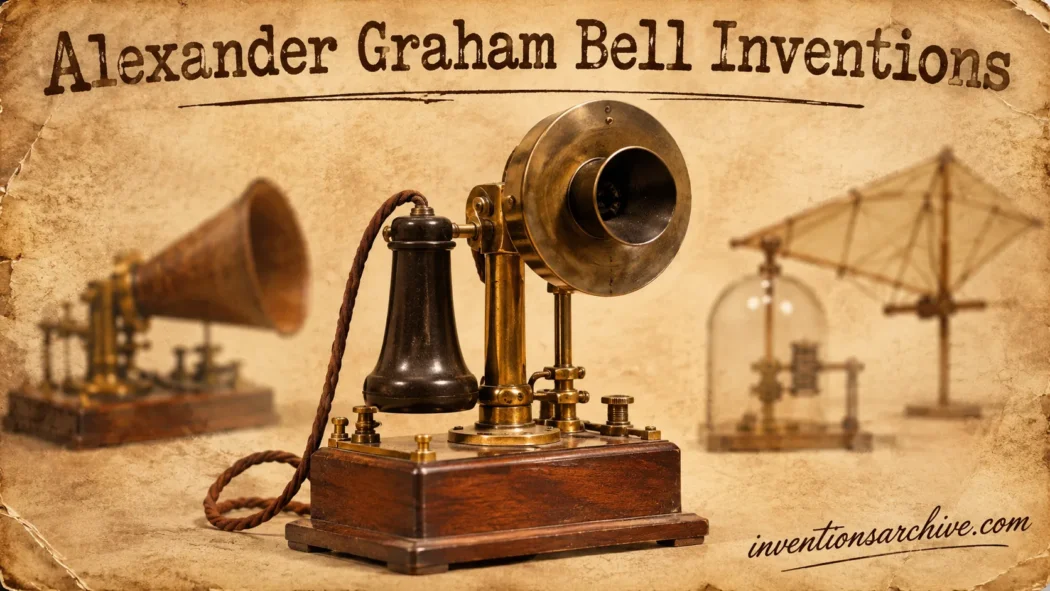
| Invention or Project | Date or Period | Bell’s Contribution and Historical Result |
|---|---|---|
| Telephone | 1876 | Principal patented inventor. Demonstrated intelligible electrical speech transmission with Thomas A. Watson. U.S. Patent 174,465. |
| Photophone | 1880 | Co-inventor with Charles Sumner Tainter. Transmitted speech wirelessly using a modulated beam of light. |
| Graphophone and Wax Recording | 1881–1887 | Volta Laboratory co-developer. Improved mechanical sound recording with Chichester Bell and Charles Sumner Tainter. |
| Induction Balance and Telephone Probe | 1881 | Experimental developer. Adapted electromagnetic detection to locating metal, including an unsuccessful attempt to find President Garfield’s bullet. |
| Audiometer | By 1884 | Early instrument developer. Applied electrical and acoustic techniques to measuring hearing ability. |
| Vacuum Jacket | 1881–1882 | Experimental designer. Investigated artificial respiration using changes in external air pressure. |
| Tetrahedral Kites | 1900s | Designer and experimenter. Developed modular flying structures, including the human-carrying Cygnet kite. |
| Aerial Experiment Association Aircraft | 1907–1909 | Research organizer and collaborator. Participated in the program that developed the Silver Dart, flown by J. A. D. McCurdy in 1909. |
| HD-Series Hydrofoils | 1911–1919 | Collaborator with Casey Baldwin. Developed experimental high-speed boats; the HD-4 reached approximately 114 km/h in 1919. |
Alexander Graham Bell (1847–1922) is credited with inventing the telephone, but his experimental work extended far beyond electrical communication. He developed a system for transmitting speech through sunlight, helped improve sound recording, investigated electromagnetic metal detection, designed instruments related to hearing and respiration, and participated in early aviation and hydrofoil engineering.
Bell’s work crossed several scientific fields because many of his experiments began with the same underlying questions: how vibrations could be measured, converted, transmitted, recorded, or used to control mechanical systems. His later research moved toward the problems of lift, structural strength, and resistance in air and water.
Not every device associated with Bell was invented by him alone. Thomas Watson helped develop the telephone, Charles Sumner Tainter contributed to the photophone and graphophone, and Casey Baldwin carried out much of the engineering behind the later hydrofoils. Bell’s contributions ranged from original patent claims to laboratory improvements, experimental prototypes, and the direction of collaborative research programs.
Bell’s Early Experiments with Sound and Electricity
Bell’s scientific interests developed from his family’s work in speech and communication. Born in Edinburgh, Scotland, he studied the mechanics of speech and the relationship between sound, hearing, and physical vibration. His father, Alexander Melville Bell, developed Visible Speech, a system of symbols representing the positions and movements used to produce speech sounds.
Alexander Graham Bell later taught speech and worked with deaf students in Canada and the United States. His mother and his wife, Mabel Hubbard Bell, were deaf. These personal and professional connections influenced his sustained interest in acoustic research, although his educational methods and views on deaf education were separate from his electrical inventions.
In 1874, Bell worked with physician Clarence Blake on experiments involving the human ear and a phonautograph. A phonautograph converted sound vibrations into visible tracings on a recording surface. Earlier versions had been developed by Édouard-Léon Scott de Martinville; Bell’s work investigated related acoustic mechanisms rather than originating the device.
The experiments helped connect two ideas that became central to Bell’s inventions: sound consists of physical vibrations, and those vibrations can be represented by another changing physical quantity.
How the Harmonic Telegraph Led to the Telephone
During the early 1870s, Bell investigated the possibility of transmitting multiple telegraph messages along a single electrical wire. Conventional telegraph systems represented messages through coded electrical signals, typically Morse code.
Bell’s proposed harmonic telegraph would distinguish simultaneous signals using different frequencies. He experimented with vibrating reeds and electrical circuits that responded to particular pitches.
By 1874, he was considering a further application: transmitting the vibrations of human speech rather than merely coded signals or musical tones.
Thomas A. Watson, a young electrical instrument maker in Boston, helped Bell construct and modify his experimental equipment. Their work established that mechanical vibrations could produce corresponding variations in an electrical circuit.
The challenge was to preserve enough detail in those variations for a listener to distinguish spoken words after transmission.[a]
The Telephone: Bell’s Best-Known Invention
Bell applied for his telephone patent on February 14, 1876. On the same day, inventor Elisha Gray’s attorney submitted a patent caveat describing a related method of electrical speech transmission.
Bell received U.S. Patent 174,465, titled Improvement in Telegraphy, on March 7, 1876. The patent described transmitting sounds through electrical variations corresponding to the vibrations of the original sound.
On March 10, 1876, Bell successfully transmitted intelligible speech to Watson using an experimental telephone. Bell’s laboratory notebook documents the event, including his request for Watson to come to him.
The first successful intelligible speech demonstration used a liquid-transmitter arrangement. Subsequent work with electromagnetic transmitters and receivers helped move the technology toward more practical instruments.
What Made Bell’s Telephone Work?
A telephone requires two fundamental processes: converting sound into an electrical signal and converting the received signal back into sound.
In Bell’s electromagnetic designs, sound waves caused a flexible diaphragm to vibrate. Movement associated with a magnetic system produced corresponding changes in an electrical current. At the receiving end, electrical variations acted on a diaphragm, making it vibrate and reproduce sound.
The changing electrical signal was intended to follow the variations of speech. This allowed the system to carry far more acoustic information than a telegraph circuit that merely opened and closed to represent coded symbols.
Bell demonstrated his telephone at the Philadelphia Centennial Exhibition in June 1876. The Bell Telephone Company was established in 1877, beginning the commercial expansion of the invention.
Early telephones still had limitations in volume, clarity, and transmission distance. Improvements by other inventors, including Thomas Edison’s work on carbon transmitters, helped produce more reliable commercial telephone systems.
Was Bell the First Person to Develop a Telephone?
Bell’s historical position is supported by his foundational patent, successful demonstration of intelligible speech, and continued work on practical telephone communication.
However, several inventors had investigated related technologies before or during his experiments.
Johann Philipp Reis demonstrated an electrical sound-transmission device in the 1860s. Antonio Meucci developed earlier experiments involving electrical voice communication and filed a patent caveat in 1871. Elisha Gray investigated electrical speech transmission and submitted his caveat on the same day as Bell’s patent application.
These contributions have led to continuing discussions about the telephone’s origins. Different experimental devices did not necessarily achieve the same degree of intelligibility, reliability, or technical development.
Bell’s 1876 patent and successful experimental work remain the principal basis for the conventional attribution of the telephone to him. The invention also depended on earlier research and later improvements by other engineers.[b]
The Photophone: Bell’s Wireless Telephone Using Sunlight
In 1880, Bell and Charles Sumner Tainter developed the photophone, an apparatus capable of transmitting speech through light rather than along an electrical wire.
It was one of Bell’s most distinctive inventions because it demonstrated that a beam of light could carry information about the human voice.
How Speech Was Transmitted on a Beam of Light
The photophone transmitter used a thin mirror that vibrated in response to speech. Sunlight directed toward the mirror was reflected toward a distant receiving instrument.
As the speaker’s voice moved the mirror, the reflected light changed in a corresponding pattern. This process allowed the light beam to carry variations representing the original sound.
One receiving arrangement used selenium, a material whose electrical resistance varies with illumination. Changes in received light caused changes in electrical current, which could be converted into audible sound through a telephone receiver.
The transmission process involved five connected effects:
- Speech caused a diaphragm or mirror to vibrate.
- The vibrating surface modulated reflected sunlight.
- The changing light traveled through open air.
- A light-sensitive receiver converted illumination changes into electrical variations.
- The receiving system reproduced the transmitted speech.
Bell and Tainter also investigated photoacoustic effects, including the production of sound when certain materials absorbed interrupted light. These experiments were related to the photophone but involved different receiving mechanisms.
The June 3, 1880 Demonstration
On June 3, 1880, Bell and Tainter demonstrated wireless speech transmission from the roof of the Franklin School in Washington, D.C., to a receiving location approximately 700 feet (213 meters) away.
The experiment showed that speech could travel between separated instruments without an electrical conductor connecting the transmitter and receiver.
Bell considered the photophone especially promising. Its practical use, however, was restricted by the need for adequate light, accurate alignment, and an unobstructed path between instruments.
Cloud cover and other atmospheric conditions could interrupt or weaken the signal. Electrical telephones connected by wires were more dependable for everyday communication in the nineteenth century.[c]
Its Relationship to Fiber-Optic Communication
The photophone and modern optical communication systems share the principle of using modulated light to transmit information.
Modern fiber-optic networks usually guide light through transparent optical fibers, using specialized transmitters, detectors, and signal-processing equipment. Bell’s photophone transmitted light through open air and relied on nineteenth-century optical and electrical components.
Bell did not invent lasers or optical fibers. His photophone established an early method of optical speech communication that anticipated an important principle used in later telecommunications.
The Graphophone and Bell’s Work on Recorded Sound
Bell’s success with the telephone provided resources for further experimentation. After receiving the French Volta Prize in 1880, he directed the prize money toward establishing the Volta Laboratory in Washington, D.C.
There, Bell worked with his cousin Chichester Alexander Bell and instrument maker Charles Sumner Tainter. Their principal objective was to improve the recording and reproduction of sound.
Improving Edison’s Phonograph
Thomas Edison had introduced the phonograph in 1877. Its early form used a stylus to record sound vibrations as impressions in a sheet of tinfoil wrapped around a rotating cylinder.
The method proved that sound could be recorded and reproduced, but the recording surface was fragile and difficult to use repeatedly.
The Volta Laboratory researchers experimented with wax-coated surfaces and improved recording mechanisms. Their work led to the graphophone, a machine designed to record and reproduce sound using improved cylinder records.
Wax provided a surface that could retain a groove engraved by a recording stylus. As the cylinder rotated, the stylus followed the changing vibrations of speech, leaving a corresponding pattern in the recording material.
During playback, the recorded groove guided the reproducing mechanism and caused it to generate vibrations corresponding to the original sound.
The laboratory also tested disc recordings, different recording materials, and methods of copying sound. Not all these experimental approaches became commercial products.[d]
The Graphophone as a Business Dictation Machine
One intended application was office dictation. A person could speak into a recording machine, and another worker could later reproduce the recorded speech for transcription.
Tainter continued refining the graphophone and supervised the manufacture of early experimental machines in 1885. Commercial production began in Bridgeport, Connecticut, in 1887.
Some early commercial graphophones were operated by a foot treadle and mounted on tables similar to those used for sewing machines. The mechanism turned the recording cylinder while a stylus recorded or reproduced speech.
Controlling the cylinder’s rotational speed was important because irregular movement changed the timing and pitch of recorded sound.
A surviving Type C graphophone made around 1888 is preserved in the Smithsonian’s National Museum of American History. Its components and markings document the early commercial development of the technology.[e]
The 1885 Recording That Preserved Bell’s Voice
One of the most informative artifacts from the Volta Laboratory is a wax-coated disc recorded on April 15, 1885.
The recording contains Bell’s voice testing the reproduction of numbers and monetary amounts. It also includes an identification of Bell and the Volta Laboratory.
The disc was accompanied by written documentation that helped researchers establish the speaker’s identity. Because the original material was fragile, conventional mechanical playback risked damaging the recording.
In 2012, researchers recovered its sound using a noncontact optical method that measured the recorded groove structure. The Smithsonian announced the identification of Bell’s voice in 2013.
The original disc, cataloged as ME.287881.01, survives in the Smithsonian collection. It provides physical evidence of Bell’s sound-recording experiments and preserves an audible record of the inventor himself.[f]
The Induction Balance: Bell’s Attempt to Locate Garfield’s Bullet
In July 1881, U.S. President James A. Garfield was shot in Washington, D.C. Physicians were unable to determine the precise location of a bullet lodged inside his body.
Bell attempted to solve the problem using an electromagnetic instrument known as an induction balance.
During earlier electrical experiments, Bell had observed that nearby metal could disturb an electromagnetic balance and produce an audible effect in a telephone receiver.
He adapted this principle into a detecting apparatus intended to reveal the presence of metal beneath the surface of the body.
The Electromagnetic Detection Principle
An induction balance uses interacting electromagnetic fields. When its electrical effects are arranged in a balanced condition, the receiving circuit produces little or no response.
A nearby conductive object can disturb the balance. That disturbance changes the electrical behavior of the receiving system and may produce an audible signal.
Bell’s apparatus was an early medical application of electromagnetic metal detection. It was not the first use of electromagnetic induction, but it demonstrated an attempt to apply the principle to locating an object inside the human body.
Why the Garfield Examination Was Unsuccessful
Bell’s first examination of Garfield on July 26, 1881, was hindered by electrical interference. A component added to the instrument produced noise that prevented reliable detection.
After further modifications, Bell returned on August 1.
Garfield’s physician, Dr. Willard Bliss, believed the bullet was on the right side of the president’s body. This assumption restricted the area Bell was permitted to examine.
Bell also suspected that metal springs in Garfield’s mattress might have interfered with his instrument. The precise contribution of this possible interference remains uncertain.
The examination did not locate the bullet. After Garfield’s death, the autopsy established that it had lodged on the left side of his body, outside the region emphasized during Bell’s examination.
Bell subsequently developed a related telephone probe intended to produce an audible response when its detecting element contacted metal.
The Garfield investigation did not achieve its intended medical result, but Bell’s experiments contributed to the early development of electromagnetic detection instruments.[g]
Bell’s Instruments for Hearing Measurement and Artificial Respiration
Bell’s continuing interest in hearing and physiology led to experiments with medical instruments. The audiometer addressed the measurement of hearing, while the vacuum jacket investigated the physical assistance of respiration.
The Audiometer
Bell developed an early audiometer that used electrical and acoustic techniques to test hearing ability.
Related articles: Thomas Edison Inventions: What Did Edison Invent and Improve?, Lewis Latimer Inventions: Electric Lighting and Engineering Contributions
A contemporary account published on October 9, 1884, described the instrument as a combination of a telephone and a galvanic battery. Its purpose was to test and register the hearing capacity of individuals with partial or apparently complete hearing loss.
The instrument generated test sounds whose strength could be varied, allowing hearing responses to be compared under different conditions.
Its function was different from that of a hearing aid. The audiometer assessed hearing sensitivity, while a hearing aid was intended to make sounds more audible to its user.
Bell’s work belongs to the early development of electrical hearing measurement. Modern audiometers use standardized testing frequencies, calibrated sound levels, and more precise electronic systems.[h]
The Vacuum Jacket
Bell also investigated artificial respiration, particularly after the death of his infant son Edward from respiratory problems in 1881.
He developed the concept of a vacuum jacket, an apparatus that used changes in external air pressure to assist the movement of the chest and the expansion of the lungs.
The principle involved lowering pressure around part of the body so that the resulting pressure difference could encourage inhalation. Restoring the pressure toward its original level could assist the return toward exhalation.
Bell described this experimental approach in early-1880s correspondence and in a presentation associated with the American Association for the Advancement of Science.
The concept resembles the physical principle later employed in negative-pressure ventilators, including iron-lung machines. Bell’s apparatus was experimental and should not be identified as the fully developed clinical iron lung used during the twentieth century.
Surviving correspondence, drawings, and descriptions document his interest in the technique, but do not establish widespread medical adoption of the original vacuum jacket.[i]
Tetrahedral Kites: Bell’s Experiments with Flight
Bell became increasingly interested in flight during the 1890s. His aviation experiments examined the relationship between structural weight, lifting surface, and stability.
Instead of beginning with a conventional airplane, Bell investigated large kites assembled from small geometric units.
Why Bell Used Tetrahedral Structures
A tetrahedron is a three-dimensional shape with four triangular faces. Bell experimented with kite cells based on this geometry, joining numerous units into larger structures.
Triangular arrangements can provide structural rigidity and distribute loads through connected members. Bell hoped that a modular structure could increase lifting area without an excessive increase in weight or a loss of strength.
His tetrahedral designs used repeated cells that could be combined into progressively larger flying structures.
The approach introduced several engineering problems. As the size of the kite increased, its total weight, aerodynamic resistance, structural connections, and control characteristics also changed. A rigid structure did not automatically produce an efficient or controllable flying machine.
The Cygnet Kite and the 1907 Human-Carrying Test
Bell’s best-known tetrahedral kite was the Cygnet, tested in December 1907 at Beinn Bhreagh, his estate near Baddeck, Nova Scotia.
The kite used thousands of tetrahedral cells and was towed over Bras d’Or Lake. Lieutenant Thomas E. Selfridge participated in the experimental flight as its passenger.
The Cygnet rose into the air carrying Selfridge, demonstrating that the structure could generate enough lift to support a person.
It remained a towed kite rather than an independently powered aircraft. During the test, the kite descended onto the water and was damaged when towing continued before the line could be released.
Bell’s notebooks document the flight and the circumstances of the damage. The experiment showed the lifting potential of the tetrahedral design while revealing the practical difficulties of using a very large kite for human flight.[j]
Bell’s Role in the Aerial Experiment Association
In 1907, Alexander Graham Bell and his wife, Mabel Hubbard Bell, helped establish the Aerial Experiment Association (AEA).
The group brought together Bell, Casey Baldwin, J. A. D. McCurdy, Glenn Curtiss, and Thomas Selfridge to investigate powered aircraft.
Mabel Bell supplied essential financial backing. The association operated through a collaborative arrangement in which members shared observations while taking responsibility for different experimental designs.
From the Red Wing to the Silver Dart
The AEA produced four principal powered aircraft:
- Red Wing: Flown by Casey Baldwin in March 1908, providing early experience with powered aircraft construction and control.
- White Wing: Introduced additional work on landing arrangements and flight-control systems.
- June Bug: Associated with Glenn Curtiss and used in successful powered-flight demonstrations during 1908.
- Silver Dart: The final AEA aircraft, developed with J. A. D. McCurdy as a principal designer and pilot.
The association’s progress reflected experimentation with motors, propellers, lifting surfaces, landing gear, and aircraft controls. Each design contributed experience to the next.
Bell’s role centered on organizing the research and participating in the exchange of engineering ideas. He was not the sole inventor of these aircraft.
The Silver Dart’s First Flight in Canada
On February 23, 1909, J. A. D. McCurdy piloted the Silver Dart from the frozen surface of Baddeck Bay in Nova Scotia.
The aircraft flew approximately 800 meters, reaching a speed of about 65 km/h (40 mph) and an altitude of roughly 9 meters (30 feet).
The flight is recognized as the first successful powered airplane flight in Canada. More than 100 spectators witnessed the event.
The Silver Dart was designed and constructed through the Aerial Experiment Association, founded with the support of Alexander and Mabel Bell. McCurdy’s contribution as a designer and pilot remains central to the aircraft’s history.
The Wright brothers had already achieved controlled, sustained powered flight in 1903. Bell’s aviation program therefore belongs to the further development of powered aircraft rather than the original invention of the airplane.[k]
The HD-4 Hydrofoil: Bell’s High-Speed Boat Experiments
Bell’s later research concentrated on hydrofoil boats, developed in close partnership with engineer Casey Baldwin.
The purpose was to reduce the resistance encountered by a vessel moving through water. Unlike a conventional displacement boat, a hydrofoil can raise much of its hull above the water as speed increases.
The Principle Behind Hydrofoil Lift
A hydrofoil uses underwater lifting surfaces resembling aircraft wings. When a vessel moves forward, water flows around these surfaces and produces hydrodynamic lift.
At sufficient speed, the lift supports much of the vessel’s weight, allowing the main hull to rise above the surface.
With less of the hull in contact with water, resistance can decrease substantially. This can allow a properly designed hydrofoil to achieve high speeds with less hull drag than a conventional vessel operating under comparable conditions.
The engineering difficulties include maintaining stability, controlling lift, resisting structural loads, and operating in changing water conditions.
Bell and Baldwin’s HD-Series Development
Bell and Baldwin tested an early hydrofoil craft known as Drome No. 6 in August 1908. After the Aerial Experiment Association ended, Baldwin remained at Beinn Bhreagh and continued the hydrofoil research.
The HD designation referred to hydrodrome. Baldwin developed the HD-1 in 1911, followed by the HD-2 in 1912 and HD-3 in 1913.
The experimental series gradually addressed problems of lift, hull resistance, propulsion, and stability. Bell collaborated closely with Baldwin, who carried out most of the detailed design, construction, and testing.
Hydrofoils had been investigated by other inventors before Bell’s experiments. The originality of the Bell-Baldwin program lay in its particular designs and the performance achieved through repeated testing.
The HD-4’s 1919 World Speed Record
The best-known result came with the HD-4, a hydrofoil craft approximately 18.3 meters (60 feet) long.
In 1919, the United States Navy supplied two Liberty engines for the project. Baldwin installed the engines in the HD-4, allowing the team to conduct higher-speed trials.
On September 9, 1919, the HD-4 reached approximately 114 km/h (70.8 mph) during a measured run on Bras d’Or Lake, Nova Scotia.
The speed established a world marine record that remained unbeaten for approximately ten years.
The craft demonstrated the potential of lifting a boat’s main hull clear of the water to reduce resistance. Despite the record, the U.S. Navy did not pursue the vessel into production.
Bell-Baldwin Hydrodromes Ltd. was incorporated in 1920 but sold no vessels and closed in 1923. Baldwin continued hydrofoil research beyond Bell’s death in 1922.
The HD-4 is appropriately described as a collaborative Bell-Baldwin achievement, with Baldwin responsible for much of the hands-on engineering that made the record possible.[l]
How Bell’s Inventions Differ in Authorship and Technical Contribution
Bell’s name appears in the history of several technologies, but the meaning of his contribution varies from project to project.
For the telephone, Bell held the foundational patent and participated directly in the successful experimental demonstration. Watson’s practical work on the apparatus was an essential part of that achievement.
For the photophone, Bell and Tainter jointly developed an original optical speech-transmission system. The work drew on known physical properties of light, sound, and selenium but combined them into a functional communication apparatus.
The graphophone followed a different path. Edison’s phonograph already existed, and the Volta Laboratory developed improvements that made sound recording more useful. Chichester Bell and Tainter were contributors to those inventions, and Tainter played a leading role in later graphophone development.
The induction balance applied electromagnetic knowledge to detecting metal. Bell’s adaptation was an experimental instrument built for a specific problem, rather than the invention of electromagnetic induction itself.
Bell’s audiometer and vacuum jacket were early experimental medical instruments. Their historical importance rests on documented investigations and technical concepts, not on claims that they represented the complete modern forms of those devices.
The tetrahedral kites were Bell’s structural experiments in flight. The Silver Dart, in contrast, emerged from a research association that included several engineers and was flown by McCurdy.
The HD-4 was a collaborative engineering achievement in which Baldwin’s design and testing work was especially extensive.
These distinctions also clarify several common historical attributions:
- Bell did not invent Edison’s original phonograph.
- He did not invent Emile Berliner’s disc-based gramophone.
- The photophone did not contain modern fiber-optic cables or lasers.
- Bell did not invent the first powered airplane.
- He and Baldwin improved hydrofoil technology that had earlier experimental predecessors.
- The Visible Speech system associated with the Bell family was developed by Alexander Melville Bell, his father.
Bell’s documented achievements include original inventions, improvements to earlier devices, experimental applications of known principles, and organized research carried out with other specialists.
The Original Evidence for Bell’s Inventions
Bell’s experimental work survives in patents, drawings, technical notebooks, correspondence, photographs, physical instruments, and sound recordings.
The Library of Congress preserves the Alexander Graham Bell Family Papers, including scientific notebooks and correspondence relating to the telephone, photophone, aviation, and other research activities.
Bell’s telephone patent provides a dated legal record of his electrical speech-transmission claims. His laboratory notebooks record the experimental work behind those claims and help distinguish a proposed mechanism from a demonstrated device.
The Sealed Volta Laboratory Deposits
The Volta Laboratory Associates deposited sealed containers with the Smithsonian Institution on February 28, 1880; April 6, 1880; and October 30, 1881.
The first two deposits preserved photophone materials. The third contained experimental sound-recording objects, including a modified phonograph fitted with a wax-coated recording cylinder.
These deposits were intended partly to preserve evidence relevant to invention-priority disputes.
The boxes remained sealed until 1937, when Smithsonian officials opened them in the presence of Bell family representatives.
The surviving objects are valuable because they preserve actual experimental arrangements rather than descriptions written many years after the events.
Other instruments and recordings from the Volta Laboratory entered the Smithsonian collections through later donations. These include original recording discs, experimental machinery, and commercial graphophones.
Some of the early records contain sounds that remained inaccessible for more than a century. Modern noncontact recovery methods have allowed researchers to reconstruct audio from fragile recording surfaces while reducing the risk of damage.[m]
Patents, Prototypes, and Working Machines
Different surviving records establish different aspects of Bell’s work.
A patent documents an invention claim at a particular date. A laboratory drawing can establish that a mechanism was proposed or investigated. A surviving prototype offers evidence about the materials and mechanical arrangement actually used. A recorded demonstration or contemporary test report can establish what the apparatus achieved under particular conditions.
The distinction is clear across Bell’s inventions. The 1876 telephone patent establishes the claimed electrical speech-transmission method. The 1880 photophone demonstration records successful optical communication. The Volta Laboratory’s wax recordings establish practical sound-recording experiments. The 1909 Silver Dart flight and the 1919 HD-4 speed trial document measured achievements from collaborative engineering programs.
Bell’s surviving records also preserve the contributions of Watson, Tainter, Chichester Bell, McCurdy, Baldwin, and other participants. The technical history of these inventions is therefore supported by evidence of both individual invention and shared experimental work.
Sources and Verification
- [a] Library of Congress — Telephone and Multiple Telegraph — Documents Bell’s acoustic research, harmonic telegraph experiments, collaboration with Watson, and transition toward electrical speech transmission. Based on the Alexander Graham Bell Family Papers.
- [b] Library of Congress — Who Is Credited with Inventing the Telephone? — Verifies Patent 174,465, Bell’s March 1876 demonstration, and competing historical claims concerning the telephone. Published by the United States national library.
- [c] Library of Congress — Today in History: June 3 — Confirms the 1880 photophone demonstration, light-based speech transmission, and the invention’s historical operating limitations. Supported by Library of Congress collections.
- [d] Smithsonian National Museum of American History — Sound Experiments at the Volta Laboratory — Documents Bell, Tainter, and Chichester Bell’s experimental recording methods, materials, and the development of wax-cylinder recording. Based on preserved laboratory artifacts.
- [e] Smithsonian National Museum of American History — Graphophone, Type C — Original museum object record detailing a commercial graphophone, Tainter’s engineering work, and the transition to production in 1887.
- [f] Smithsonian National Museum of American History — Experimental Sound Recording, Wax Disc on Binder’s Board — Catalog record for Bell’s April 15, 1885 recording, documenting the original disc, inscription, recovered sound, and identification of the speaker.
- [g] U.S. National Park Service — Famous Inventor Tried to Help Save President’s Life — Government historical account of Bell’s induction-balance experiments, the 1881 Garfield examinations, electrical interference, and the incorrect assumptions concerning the bullet’s location.
- [h] Library of Congress — Article, October 9, 1884 — Contemporary evidence describing Bell’s audiometer and its application to testing hearing ability. Preserved in the Alexander Graham Bell Family Papers.
- [i] Library of Congress — Letter from Alexander Graham Bell to Thomas Gleason, August 1882 — Original correspondence documenting Bell’s research into artificial respiration and his vacuum-jacket concept.
- [j] Library of Congress — Inventor and Scientist — Institutional history based on Bell’s surviving papers, documenting his tetrahedral kite research, the Cygnet experiments, and later work in aviation and hydrofoils.
- [k] Parks Canada — First Aeroplane Flying in Canada National Historic Event — Official historic designation confirming the Silver Dart’s February 23, 1909 flight, McCurdy’s role, and its documented distance, speed, and altitude.
- [l] Parks Canada — The HD-4 Hydrofoil — Official historical research account documenting the Bell-Baldwin hydrofoil program, Baldwin’s engineering responsibilities, and the September 9, 1919 speed record.
- [m] Smithsonian National Museum of American History — The Volta Laboratory and the Smithsonian — Documents the sealed laboratory deposits of 1880 and 1881, their preserved experimental contents, and their opening in 1937. Based on original institutional collections.