
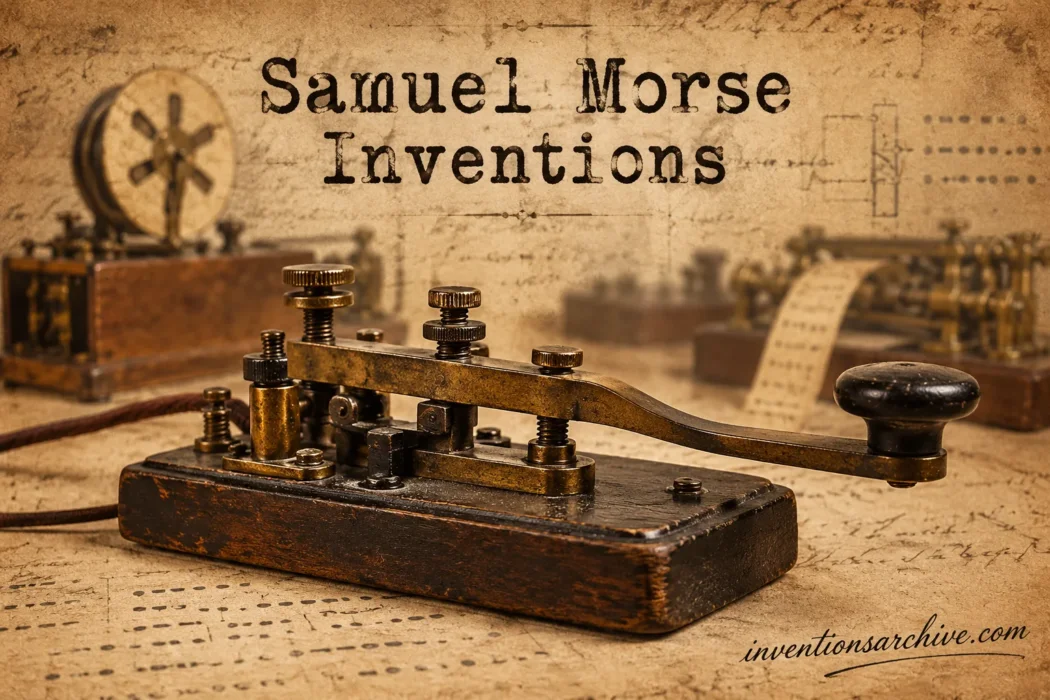
| Invention Name | American electromagnetic telegraph and the signaling system associated with Morse |
|---|---|
| Short Definition | A wired communication system that used controlled electrical pulses to operate a distant receiver and represent intelligible information. |
| Approximate Date or Period | Concept formed in 1832; experimental development in the 1830s; U.S. patent issued in 1840; Washington–Baltimore line demonstrated in 1844 |
| Geography | United States, especially New York, Washington, D.C., and Baltimore |
| Inventor or Source Culture | Samuel F. B. Morse, working with Alfred Vail and Leonard Gale and drawing on earlier electromagnetic research including Joseph Henry’s work |
| Category | Electrical communication, telegraphy, signaling, information encoding |
| Importance | Made rapid long-distance written communication practical in the United States and helped establish electrical communication networks. |
| Evidence Status | Confirmed for Morse’s patents and the 1844 line; Attribution varies for the precise division of credit for code and apparatus refinements |
| Main Problem Solved | Sending intelligible information over long distances far faster than physical transport or visual relay systems allowed |
| Development Path | 1832 concept → early recording apparatus → Gale and Henry-related electrical improvements → Vail collaboration → 1840 patent → 1844 long-distance line → later technical and code changes |
| Patent Record | U.S. Patent No. 1,647, issued June 20, 1840; later reissues and telegraph improvements followed |
| Encoding Principle | Short and long electrical signal patterns associated with characters; the practical alphabet evolved during development |
Samuel Morse is routinely described as the inventor of the telegraph and Morse code. That description is useful only if it is made more precise. Electrical signaling over distance existed as an experimental goal before Morse, Joseph Henry had already demonstrated important electromagnetic techniques, Leonard Gale helped Morse overcome electrical limitations, and Alfred Vail supplied money, mechanical skill, and major refinements to the apparatus and code. Morse nevertheless occupied the center of the American project: he conceived his recording-telegraph system, pursued it for years, obtained patents, secured federal support, directed its public demonstration, and defended the system in court.
The fairest historical description is therefore narrower than the familiar lone-inventor story. Morse was the central named inventor and organizer of a particular practical American electromagnetic telegraph system, not the discoverer of electromagnetism or the sole creator of every mechanism and symbol associated with it. The surviving record makes the collaboration visible rather than diminishing Morse’s role.
What Samuel Morse Can Actually Be Credited With
Morse’s strongest claim is to the development of a system. His telegraph combined an electrical circuit, electromagnets, signaling conventions, a receiving mechanism, a method of recording or recognizing signals, and an operating procedure that could carry intelligible messages between distant stations. The individual ideas did not all originate with him, but their combination became the basis of the American Morse telegraph.
The distinction matters because the word telegraph covers several histories. Optical semaphore networks transmitted information before electrical telegraphy. European inventors including William Fothergill Cooke and Charles Wheatstone developed their own electrical telegraphs. Joseph Henry investigated powerful electromagnets, long circuits, relays, and telegraphic demonstrations in the United States. Morse’s work belongs within that wider history, not before it.
| Person | Documented Role | Best Historical Attribution |
|---|---|---|
| Samuel F. B. Morse | System concept, experimental development, patents, demonstrations, funding campaign, deployment | Central named inventor of the American electromagnetic telegraph system |
| Alfred Vail | Financing, machine construction, mechanical refinement, development of a simpler alphabetic code | Major collaborator whose technical role was long understated |
| Leonard Gale | Electrical guidance, knowledge of Joseph Henry’s research, help with long-distance signaling problems | Technical collaborator who helped turn Morse’s weak early apparatus into a workable system |
| Joseph Henry | Earlier work on electromagnets, long circuits, relays, and telegraphic demonstrations | Scientific precursor and adviser rather than the commercial developer of Morse’s system |
The Library of Congress describes Morse’s success as dependent on Gale’s familiarity with Henry’s electrical work and on the later addition of Vail to the project.[a] Smithsonian records preserve Vail’s drawings, correspondence, notebooks, and other material showing that he was a working partner rather than a minor assistant.[b]
The 1832 Shipboard Idea Was a Beginning, Not a Finished Telegraph
Morse traced his telegraph idea to his 1832 return voyage from Europe aboard the packet ship Sully. Discussions of recent experiments in electromagnetism led him to consider whether electrical effects could carry coded information through a wire. The Library of Congress records that he sketched ideas for an electromagnetic recording telegraph during this period.[c]
That moment is often compressed into an invention story in which the telegraph appears almost complete in Morse’s mind. The actual development was slower. Morse was trained as an artist, not as an experimental physicist. His first devices could make marks, but the electrical system did not yet provide dependable long-distance communication. A concept for electrical messaging still had to become a circuit that worked over useful distances, a receiver that could register signals, and an encoding method that operators could use efficiently.
| Stage | Form | What Changed |
|---|---|---|
| 1832 | Shipboard concept and sketches | Morse began treating electrical pulses as a possible carrier of coded information. |
| Mid-1830s | Experimental recording apparatus | Mechanical marking and electromagnetic operation were tested, but useful transmission distance remained a problem. |
| 1837–1838 | Collaborative refinement | Gale supplied electrical knowledge; Vail financed and rebuilt parts of the system and worked on its practical signaling method. |
| 1840 | Patented American electromagnetic telegraph | Morse secured U.S. patent protection for apparatus and methods used in his system. |
| 1844 | Washington–Baltimore line | The project became operating long-distance infrastructure rather than a laboratory demonstration. |
Gale and Henry Help Explain How Morse Reached Beyond the Laboratory
Leonard Gale entered the project at a point when Morse needed electrical expertise. Gale, a chemistry professor at the University of the City of New York, knew Joseph Henry’s published work on electromagnetism. According to the Library of Congress, Gale identified faults in Morse’s early arrangement and showed him how Henry’s relay-related methods could address the loss of effective signaling over distance.[a]
Henry’s role needs its own boundary. He had developed stronger electromagnets and demonstrated electrical signaling over long wire runs before Morse had a practical telegraph. Smithsonian historical research describes Henry’s 1830s experiments as containing precursors to the components later needed for electromagnetic telegraphy. Henry did not, however, turn those demonstrations into Morse’s patented commercial system.[d]
This became a source of later friction. Henry believed his scientific work had not received adequate credit, while Morse defended his status as inventor of the telegraph system he had developed. In an 1849 deposition connected with telegraph patent litigation, Henry drew a revealing distinction: he credited Morse with a particular instrument and process for telegraphic purposes rather than with the underlying discoveries in electromagnetism.[e]
Alfred Vail Changed the Machine and the Code
Alfred Vail joined Morse after seeing a telegraph demonstration in 1837. Their agreement gave Vail an interest in the telegraph rights in return for constructing machines and helping finance American and foreign patent work. The arrangement gave Morse access to Vail’s mechanical ability and to the facilities associated with his family’s Speedwell Iron Works in New Jersey.
Smithsonian Institution Archives records describe several concrete Vail improvements. He replaced parts of Morse’s early mechanism, improved the register that marked the paper tape, and substituted a pointed steel element for the pencil used in an earlier design. These were practical changes to a machine that had to operate repeatedly, not cosmetic alterations.[b]
Vail’s connection to the code is even more important to the question of credit. Morse’s early scheme relied on numbers that had to be translated through a numbered vocabulary. Smithsonian archival research credits Vail with developing a simpler alphabetic system that made messages faster to interpret.[b] The Library of Congress takes a cautious but compatible view: the dot-and-dash system that became known as Morse code emerged after Morse and Vail began collaborating, and its early forms changed substantially before the 1844 system known as American Morse took shape.[f]
The surviving evidence therefore does not support a clean statement that Morse alone devised every character of Morse code. It also does not support removing Morse from the code’s development. The code belonged to the telegraph project he led, while Vail had a documented role in transforming its signaling method into a more practical alphabet.
Morse Code Was Not One Unchanging Alphabet
The term Morse code can hide several stages of development. Morse first explored a system in which transmitted signs represented numbers and the receiver consulted a numbered dictionary. The Morse–Vail collaboration then produced direct alphabetic signaling using combinations of short and long marks and spaces. By 1844, American Morse had taken recognizable form, but it was not identical to the International Morse code familiar today.
The Library of Congress notes that American Morse was later altered into what became International Morse.[f] The modern international character set is maintained in an International Telecommunication Union recommendation, ITU-R M.1677-1, which confirms the International Morse characters and operational provisions for radiocommunication use.[g]
That later standardization matters when assigning invention credit. Saying that Samuel Morse invented the exact modern International Morse alphabet projects later revisions backward onto the 1830s and 1840s. A more accurate statement is that the early code associated with Morse’s American telegraph developed through the Morse–Vail project and then continued to change beyond it.
The Telegraph Worked as a Chain of Functions
Morse’s system became useful because several functions worked together. An operator controlled the electrical circuit at the sending station. Changes in current traveled along the line and activated electromagnetically operated equipment at the receiving end. The receiver translated those controlled changes into marks or later into recognizable sounds. A code gave the sequence meaning.
The early system did not begin with the familiar hand key and sounder that later became visual shorthand for telegraphy. Library of Congress material shows that Morse first used ridged type-like elements to control signaling and a receiver that produced marks on paper. As operators and apparatus evolved, hand transmitters became common, and skilled operators learned to interpret the rhythm of the mechanism by sound.[f]
The invention is therefore better understood as a communication architecture than as one object. Remove the code, and electrical pulses do not convey written language. Remove the receiving mechanism, and the distant signal is not captured in a usable form. Remove reliable long-distance circuit behavior, and the apparatus remains a short-range demonstration. Morse’s historical claim rests heavily on bringing those functions into an operating system.
The 1840 Patent Defined Morse’s Claim — and Later Exposed Its Limit
Morse received U.S. Patent No. 1,647 on June 20, 1840 for his electromagnetic telegraph work. The patent described apparatus and a system for transmitting intelligence between distant points through electromagnetism. Later reissues and improvements expanded the patent record around the telegraph. The National Inventors Hall of Fame identifies No. 1,647 as Morse’s core telegraph patent.[h]
Patent ownership did not mean Morse had discovered every electrical principle used by his equipment. It meant that the law recognized claims to specified inventions described in his patent documents. That distinction became especially clear in O’Reilly v. Morse, the Supreme Court litigation over the scope of his telegraph rights.
Morse’s famous eighth claim attempted to reach beyond the particular machinery he had described and claim the use of electromagnetism, however developed, for producing intelligible characters, signs, or letters at a distance. The Supreme Court rejected that claim as too broad. USPTO guidance still uses the Morse dispute to illustrate the difference between a claim tied to a described telegraphic implementation and a claim that tries to control the underlying principle across future implementations.[i]
Why the Washington–Baltimore Line Changed Morse’s Position
Before 1844, Morse could demonstrate apparatus and point to patents. The Washington–Baltimore line did something different: it showed that the system could function between cities as infrastructure. Congress had appropriated $30,000 in 1843 for Morse to build an experimental line. Morse and Vail completed a route of roughly forty miles in 1844.[j]
On May 24, 1844, Morse sent the phrase “What hath God wrought?” from Washington to Vail in Baltimore. Annie Ellsworth, daughter of Patent Commissioner Henry Leavitt Ellsworth, had suggested the biblical wording. Vail received the transmission and returned a confirming message. The surviving outgoing paper tape is held by the Library of Congress, while Smithsonian collections preserve related telegraph material from the event.[k]
The historical importance of the demonstration is not that it was the first moment anyone had ever transmitted an electrical signal. It proved Morse’s developed system on a public, government-supported intercity line. That achievement strengthened the association between his name and electrical telegraphy in the United States.
Morse Had Patented Inventions Before the Telegraph
Morse’s technical interests did not begin on the Sully. In 1817, well before his telegraph work, he and his brother Sidney Edwards Morse obtained three patents connected with pumps. The National Inventors Hall of Fame records those patents as part of his earlier inventive activity.[h]
These pump patents did not have anything like the later effect of the telegraph, but they correct another oversimplification: Morse was not a painter who suddenly encountered invention for the first time in the 1830s. He had already participated in mechanical patenting. What changed later was the scale and nature of the problem he pursued.
Why Morse’s Name Overshadowed Vail, Gale, and Henry
Several forces concentrated public credit around Morse. The principal patent rights carried his name. He promoted the project before Congress. He stood at the Washington end of the celebrated 1844 demonstration. The system became known as the Morse telegraph, and the signaling method became Morse code. Once a technology and its code both carried the same surname, later histories had a ready-made central figure.
Vail’s position was different. His financial and mechanical work was embedded inside a project publicly identified with Morse. Gale’s contribution was technical guidance rather than a separately branded system. Henry had a strong claim to earlier scientific work but chose a scientific career and did not develop his experiments into the same kind of patented commercial telegraph system. Their roles are easier to lose when the history is reduced to a single inventor and a single date.
That does not make Morse’s credit merely a product of publicity. He persisted through technical failures, recruited people with skills he lacked, secured legal protection, sought government funding, and helped move the telegraph from apparatus to operating line. Those activities are part of invention history because a communication system has to be made workable, reproducible, fundable, and deployable before it can become infrastructure.
The Most Accurate Description of Morse’s Contribution
Samuel Morse did not invent electrical communication from nothing. He did not discover electromagnetism, and the modern International Morse alphabet cannot be assigned to him alone. The apparatus that carried his name also benefited from Vail’s mechanical work, Gale’s electrical guidance, and scientific techniques associated with Henry.
What Morse did was narrower and still substantial in historical terms. He conceived and led the development of an American recording electromagnetic telegraph, integrated signaling with working apparatus, secured patents, organized collaborators, obtained public funding, and helped prove the system over a long-distance line. The telegraph associated with Morse was therefore both an individual invention project and a collaborative engineering achievement.
The same distinction clarifies Morse code. Morse’s project supplied the setting in which the code developed, but the alphabet evolved during collaboration with Vail and continued changing afterward. Calling the whole process “Morse’s invention” is acceptable as shorthand only when that shorthand is not mistaken for a claim that he created every scientific principle, machine part, and coded character by himself.
Sources and Verification
- [a] Invention of the Telegraph — Library of Congress overview of Morse’s development process, Leonard Gale’s assistance, Joseph Henry’s earlier electrical work, and the transition toward a practical telegraph.
- [b] A Forgotten History: Alfred Vail and Samuel Morse — Smithsonian Institution Archives account based on Vail papers, documenting his financing, mechanical improvements, and work on a simpler alphabetic code.
- [c] 1791 to 1839 — Library of Congress timeline documenting Morse’s 1832 voyage on the Sully, his telegraph concept, and early sketches.
- [d] Joseph Henry: Inventor of the Telegraph? — Smithsonian record summarizing Henry’s electromagnet, long-wire signaling, relay-related work, and later dispute over credit.
- [e] Joseph Henry Testifies for Morse v. O’Reilly Telegraph Patent Case — Smithsonian Institution Archives record of Henry’s 1849 deposition and his distinction between underlying electromagnetic discoveries and Morse’s particular telegraph instrument and process.
- [f] Invention of the Telegraph — Library of Congress collection highlights documenting the emergence of dot-and-dash signaling after the Morse–Vail collaboration began and the later development of American Morse.
- [g] M.1677 : International Morse code — International Telecommunication Union recommendation defining the International Morse character set and operating provisions used in radiocommunication services.
- [h] Samuel F. B. Morse — National Inventors Hall of Fame record identifying U.S. Patent No. 1,647 and documenting the three pump patents Morse obtained with his brother in 1817.
- [i] USPTO guidance discussing O’Reilly v. Morse — Official USPTO material contrasting Morse’s narrower telegraph claim with his broad eighth claim and explaining why the latter was not accepted.
- [j] “What Hath God Wrought” Telegraph Message — National Museum of American History object record documenting the $30,000 congressional appropriation, the roughly forty-mile Washington–Baltimore line, and the roles of Morse and Vail.
- [k] First telegraph message, 24 May 1844. — Library of Congress record for the surviving outgoing tape of the 1844 Washington–Baltimore demonstration and Annie Ellsworth’s role in selecting the message.