
| Invention Name | Man-made plastic |
|---|---|
| Short Definition | A moldable material based on natural polymers that have been chemically modified or on polymers made by chemical synthesis |
| Approximate Date or Period | 1850s–1907 for the foundational inventions; major expansion during the twentieth century |
| Geography | United Kingdom and United States; later developments across Europe and North America |
| Inventor or Source Culture | Alexander Parkes; John Wesley and Isaiah Hyatt; Leo Hendrik Baekeland |
| Category | Materials science, chemistry, industrial manufacturing |
| Importance | Repeatable manufacture of shaped objects with properties not limited to naturally available materials |
| Evidence Status | Documented Surviving objects, historical patents, laboratory records and industrial archives |
| Main Problem Solved | Scarce and costly materials; restricted shapes; inconsistent supply and product properties |
| Development Path | Parkesine → Celluloid → Bakelite → modern synthetic polymer families |
| Early Material Basis | Cellulose nitrate; later, phenol-formaldehyde resin |
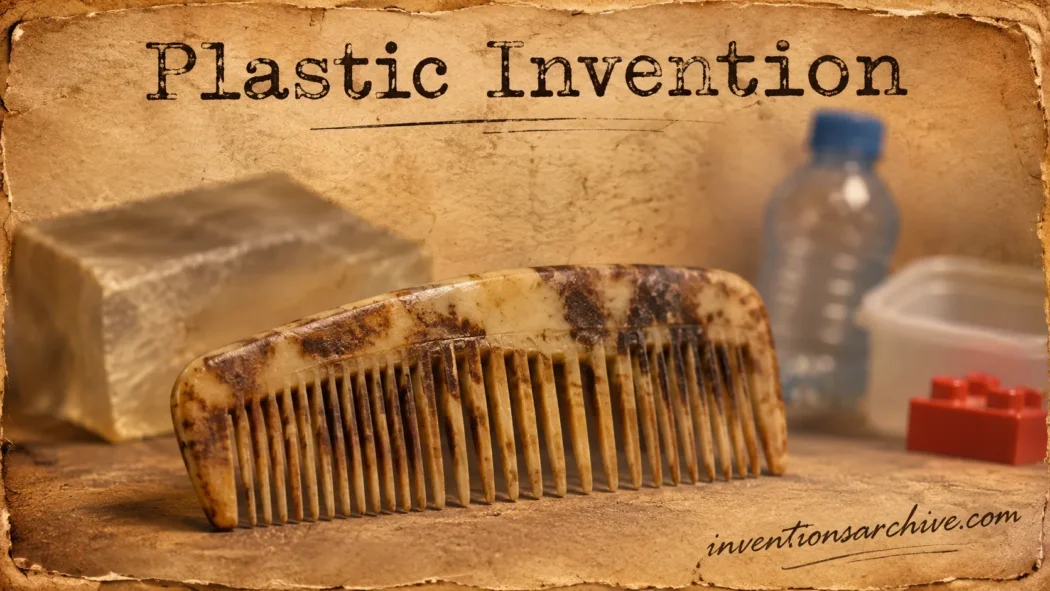
| Early Uses | Combs, decorative objects, billiard balls, electrical insulation and molded components |
Plastic was not invented by one person on one date. Alexander Parkes developed Parkesine, an early man-made plastic demonstrated in London in 1862. John Wesley Hyatt and his brother Isaiah helped turn cellulose-based plastic into a practical commercial material through their work on Celluloid. In 1907, Leo Hendrik Baekeland developed Bakelite, generally recognized as the first fully synthetic plastic.
These inventions belong to different stages of the same history. Parkesine and Celluloid modified a polymer already present in plants. Bakelite introduced a material formed from comparatively small chemical starting substances. Later chemists developed polyethylene, nylon, PVC and other polymers, while new machinery made them suitable for production on a much larger scale.
Why Manufacturers Needed a Substitute for Natural Materials
Before the first man-made plastics, manufacturers relied on ivory, horn, tortoiseshell, bone, wood, shellac, natural rubber and other materials with limited supplies or restricted working properties. Ivory was prized for billiard balls, piano keys and ornamental goods. Tortoiseshell was used for combs and accessories. The price and availability of these materials depended on harvesting animals or collecting natural products, and the size and shape of an object were constrained by its raw material.
Natural rubber, gutta-percha and shellac already showed that organic substances could be softened, formed and hardened. The development of vulcanized rubber in the nineteenth century also demonstrated how chemical treatment could improve a material’s usefulness. The new challenge was to create substances that manufacturers could mold repeatedly, color consistently and produce without depending on a particular animal or naturally shaped object.
Electrical equipment added another demand: parts that would resist electric current, retain their shape and function around heat. This requirement became especially valuable as telegraphy, telephones and electrical appliances spread.
Alexander Parkes and the Development of Parkesine
A Moldable Material Made from Cellulose
Alexander Parkes (1813–1890), an English inventor experienced in metallurgy and industrial chemistry, experimented with cellulose nitrate in the 1850s. Cellulose is the structural polymer found in plants, including cotton and wood. Chemical modification produced cellulose nitrate, which could be processed into new forms when combined with suitable plasticizing substances.
Parkes developed a material that could be softened and shaped, then become comparatively rigid after cooling. He called it Parkesine. Unlike Bakelite, Parkesine was not synthesized entirely from small chemical starting substances: it was based on a natural polymer that had been chemically altered. It is therefore more precisely described as an early semi-synthetic plastic. [a]
The 1862 London Exhibition and Surviving Objects
Parkes publicly displayed his material at the International Exhibition in London in 1862. The display showed that an artificial substance could reproduce the appearance of ivory, horn and other decorative materials while being fashioned into different shapes and colors.
Objects attributed to Parkes survive in the Science Museum Group’s collections, including molded samples, knife handles, decorative pieces and a collection of Parkesine specimens dated to about 1862. Such objects provide physical evidence of what the material could do; their dates should not be confused with the date of the first laboratory experiment. [b]
Why the Parkesine Business Failed
Parkes helped establish the Parkesine Company in the 1860s, but industrial production proved difficult. Expensive manufacturing, inconsistent product quality and problems maintaining workable material limited the business. The company ceased operating after only a short period. Daniel Spill, associated with Parkes’s enterprise, continued work on related cellulose-based plastics, including Xylonite.
Parkesine demonstrated that an engineered substitute could be molded into finished goods. It did not establish a reliable, large-scale consumer market. That distinction helps explain why later accounts sometimes credit Parkes with the invention of plastic and Hyatt with its first sustained commercial success.
John Wesley Hyatt, Celluloid and the Ivory Billiard Ball Challenge
The Search for a Practical Billiard Ball
In the 1860s, the American billiards trade sought substitutes for costly ivory. A prize of $10,000 was advertised for a suitable alternative, encouraging John Wesley Hyatt of Albany, New York, to experiment with different compositions. The prize is firmly part of the historical account, but reports differ on whether Hyatt actually received the money. It should not be treated as a documented payment.
Hyatt’s early work was gradual. A patent granted in 1865 concerned a billiard-ball construction using existing materials. His 1869 patents addressed molding compositions and imitation ivory. Those early claims were not identical to the later, better-known Celluloid process.
How Celluloid Became Easier to Manufacture
John Wesley Hyatt and Isaiah Hyatt developed methods of working with cellulose nitrate and camphor. Camphor helped make the material easier to soften and form; pressure and heat enabled more consistent shaping into useful objects. Their U.S. Patent No. 105,338, issued on July 12, 1870, described an improvement in treating and molding pyroxylin, a name then used for certain forms of cellulose nitrate. [c]
Celluloid was a thermoplastic: it could soften under suitable conditions and retain a molded shape after cooling. Manufacturers could form sheets, imitate expensive surface finishes and produce repeated parts more economically than by carving each piece from ivory or horn. The Hyatt brothers’ contributions included both the composition and ways of processing it.
From Combs and Collars to Photographic Film
Celluloid appeared in combs, brush handles, detachable shirt collars, cuffs, jewelry, toys and decorative fittings. Its ability to resemble tortoiseshell, ivory or polished stone made it attractive to buyers who could not afford products made from the natural originals. Celluloid also served as a flexible transparent base for photographic and motion-picture film, although film production involved additional specialized developments.
The material carried a serious limitation. Cellulose nitrate is highly flammable, and Celluloid products could burn rapidly. Fire risks affected manufacturing, storage and nitrate-based motion-picture film archives. As alternative polymers became available, many applications moved away from Celluloid. Its historical value rests in the industrial processing methods and consumer markets it helped establish, rather than in universal suitability for every product. [d]
Leo Baekeland’s Bakelite: The First Fully Synthetic Plastic
Why Phenol-Formaldehyde Chemistry Was Different
Leo Hendrik Baekeland, a Belgian-born chemist working in the United States, investigated synthetic resins as possible substitutes for natural shellac, which was used in finishes and electrical insulation. Chemists before him had studied reactions between phenol and formaldehyde, but the resulting hard, insoluble substances were difficult to control or turn into usable products.
In 1907, Baekeland developed controlled methods of producing a phenol-formaldehyde resin with practical manufacturing properties. His work continued through patents and industrial development, and he publicly presented Bakelite to the American Chemical Society in 1909. The material was fully synthetic because its polymer network was created through chemical reactions rather than by modifying a pre-existing natural polymer such as cellulose. [e]
The Bakelizer and a Resin That Permanently Hardened
Baekeland used equipment he called a Bakelizer to manage the conditions under which the resin formed and hardened. An original Bakelizer used around 1909 is preserved at the Smithsonian’s National Museum of American History. Baekeland’s laboratory notebooks also survive, establishing a record of the material’s development.
Bakelite belongs to the class of thermosetting plastics. During curing, chemical bonds form a connected molecular network. Once that network is established, the finished material does not melt back into a moldable liquid when reheated. This is fundamentally different from a thermoplastic that can be softened and reshaped under appropriate processing conditions.
The resulting electrical insulation, dimensional stability and ability to take detailed molded forms made phenolic resins useful for switches, electrical fittings, radio cabinets, telephone components and other manufactured parts. Bakelite products could also contain fillers to adjust their properties. Its success depended on controlling the reaction and on developing a workable industrial process, not simply on observing that phenol and formaldehyde could react.
Who Invented Plastic? The Three Historical Distinctions
| Inventor | Material and Period | What the Work Established |
|---|---|---|
| Alexander Parkes | Parkesine; developed in the 1850s, demonstrated in 1862 | An early moldable, cellulose-based man-made plastic |
| John Wesley and Isaiah Hyatt | Celluloid; improvements patented in the late 1860s and 1870 | More reliable processing and commercially successful consumer applications |
| Leo Hendrik Baekeland | Bakelite; developed in 1907, publicly presented in 1909 | A practical fully synthetic, thermosetting plastic |
The phrase first plastic depends on the definition being used. Parkesine and Celluloid belong to the early history of chemically modified natural polymers. Bakelite belongs to the history of plastics synthesized without an existing natural polymer as their starting molecular structure. Neither Parkes nor the Hyatt brothers invented polyethylene, PVC, nylon or every subsequent plastic. Those materials required different chemical discoveries.
How Polymer Science Changed the Search for New Plastics
The nineteenth-century pioneers could make useful materials before chemists understood the molecular structures responsible for their properties. During the 1920s, German chemist Hermann Staudinger argued that polymers consisted of extremely large molecules held together by chemical bonds. This macromolecular explanation challenged earlier interpretations that treated polymeric substances as loose associations of smaller molecules.
The long-chain model helped researchers investigate why molecular size, chemical composition, branching and arrangement affected strength, flexibility, melting behavior and solubility. Staudinger received the 1953 Nobel Prize in Chemistry for his work in macromolecular chemistry. [f]
At DuPont, Wallace Hume Carothers and his research colleagues applied this growing understanding to the development of synthetic fibers. Later breakthroughs in polymerization catalysts also allowed chemists to control how chains formed, leading to plastics with distinct densities, stiffness and processing properties. The invention of a new plastic became a more deliberate process of designing a polymer and producing it consistently, rather than discovering a single moldable substance by trial and error.
How Major Modern Plastics Were Developed
Polyvinyl Chloride: Turning an Old Polymer into a Useful Product
Polyvinyl chloride, or PVC, had been observed in nineteenth-century chemistry, but the early material was too rigid and difficult to process for many purposes. In 1926, Waldo L. Semon, working for B. F. Goodrich in Ohio, developed ways of making PVC more workable while investigating materials for a rubber-related application. [g]
Plasticizers made certain PVC compositions flexible enough for uses such as cable insulation, coated fabrics and other soft products. Rigid PVC, formulated differently, later became widely used for pipes, window profiles and building products. The same base polymer could therefore serve applications with very different mechanical requirements.
Polyethylene: From a Laboratory Curiosity to Mass Production
Polyethylene has more than one defensible starting date. Hans von Pechmann observed a polyethylene-like substance in 1898, but the development that led to industrial production came in 1933 at Britain’s Imperial Chemical Industries, where Eric Fawcett and Reginald Gibson encountered the polymer during high-pressure research.
Further work at ICI established a process for manufacturing low-density polyethylene (LDPE), commercially produced by the end of the 1930s. [h] Its insulating properties were valuable in electrical applications, including wartime communications equipment. Later advances in catalysts opened the way to high-density polyethylene (HDPE), a more rigid material used in containers, pipes and other molded products.
In 1951, J. Paul Hogan and Robert L. Banks at Phillips Petroleum developed catalyst technology that made new forms of polyethylene and polypropylene possible under different manufacturing conditions. [i] The story of polyethylene therefore includes an early observation, an industrial discovery and subsequent inventions that produced polymers with different molecular structures.
Nylon: A Synthetic Polymer Designed for Fibers
DuPont’s research group led by Carothers developed nylon as part of its investigation of long-chain molecules. On February 28, 1935, chemist Gerard Berchet, a member of the group, prepared the polymer later known as nylon 6,6. DuPont subsequently developed the production techniques needed to make strong, uniform filaments.
Nylon appeared in toothbrush bristles in 1938 and entered large-scale fiber production in 1939. Nylon stockings reached nationwide U.S. sales in 1940. The polymer was also used in parachutes and industrial textiles during the Second World War. Its development showed that synthetic polymers could replace natural textile fibers as well as carved or molded solid materials. [j]
PTFE: Roy Plunkett’s Unexpected Discovery
In 1938, Roy J. Plunkett, a DuPont chemist investigating refrigerants, discovered that a stored chemical had formed a white solid: polytetrafluoroethylene (PTFE). The finding was unexpected, but researchers recognized the unusual chemical resistance and low-friction properties of the polymer.
PTFE later entered industrial seals, electrical insulation, low-friction components and nonstick coatings. Teflon is a trade name associated with PTFE and related products; it is not the chemical name of every fluoropolymer. [k]
PET: A Polyester Before It Was a Bottle
British chemists John Rex Whinfield and James Tennant Dickson developed polyethylene terephthalate (PET) in 1941 while working on synthetic polyester materials. Its early commercial importance was in fibers, including those sold under names such as Terylene and Dacron.
PET’s later packaging success depended on new methods of making strong, lightweight, transparent containers. In 1973, DuPont engineer Nathaniel Wyeth patented a process associated with the development of the PET beverage bottle. The distinction matters: PET polymer had existed for decades before the familiar plastic bottle became commercially practical. [l]
Polypropylene and the Control of Molecular Arrangement
Propylene-based polymers were investigated through several research programs. The Phillips Petroleum work of Hogan and Banks in 1951 was an early industrial advance. In 1954, Giulio Natta produced highly regular, crystalline polypropylene using advances associated with Karl Ziegler’s catalyst research.
Controlling the arrangement of units along polymer chains allowed polypropylene to combine low weight with useful stiffness, heat resistance and moldability. It became widely used in household goods, packaging, textile fibers and vehicle parts. Ziegler and Natta shared the 1963 Nobel Prize in Chemistry for discoveries in polymer chemistry and technology.
Other developments broadened the available materials. Polystyrene became a commercially important packaging and molded-goods plastic, while polymethyl methacrylate (PMMA), often called acrylic, offered a transparent alternative for signs, lenses and glazing. These polymers were not variations of Bakelite: each depended on its own chemistry and processing techniques.
The Manufacturing Processes That Made Plastics Commonplace
Early plastic invention was inseparable from the problem of shaping material without ruining it. Some resins could be pressed into heated molds; others needed to be softened, injected, pushed through a forming opening or expanded into hollow shapes. The appropriate method depended on whether the polymer could be remelted and on the properties required of the finished part.
Compression Molding and Bakelite Components
Compression molding allowed phenolic compounds to be formed inside molds as they cured. The resulting parts could have repeated dimensions, molded details and insulating properties suitable for switches and appliance components. Unlike a thermoplastic operation, curing a thermoset produces a chemical change that is not simply reversed by heating the product again.
Injection Molding and Extrusion
Injection molding developed into a way of forcing softened plastic into a closed mold and producing large numbers of similarly shaped parts. It was especially useful for objects with detailed forms, such as housings, fittings and molded consumer products. Early work by the Hyatt brothers helped establish mechanical methods for processing cellulose-based materials; later machinery and controls made injection molding far more capable.
Extrusion continuously forms softened material into products such as tubing, film, sheets and profiles. Rather than manufacturing one molded item at a time, it produces a continuous length that can be cut or further processed. The growth of PVC pipe, plastic film and wire coverings depended on this kind of production capability.
Blow Molding and the Plastic Bottle
Blow molding creates hollow containers by expanding softened plastic against a mold. Later developments in stretch-blow molding made PET beverage bottles possible with suitable strength, transparency and low weight. Their commercial success required both the polyester material and a manufacturing technique suited to hollow, pressure-resistant packaging.
Why Different Plastics Behave Differently
A polymer is a molecule containing repeating chemical units. Some polymers occur naturally, including cellulose and natural rubber. Synthetic polymers are created through chemical reactions that form molecular chains or networks. Not every polymer is a plastic: natural fibers and many elastomers are polymers too. The word plastic generally refers to materials that can be shaped during manufacture and retain a useful form.
Thermoplastics such as polyethylene, polypropylene and PET can soften or melt when heated under suitable conditions. They are commonly shaped by injection molding, extrusion and other thermal processes. Thermoplastics still have practical limits: repeated heating, contamination or chemical degradation can reduce their properties.
Thermosets such as cured Bakelite form connected molecular networks. They do not flow back into a melt after curing, which makes conventional remolding difficult. This distinction explains why the same recycling or reshaping method cannot be applied to every plastic.
Composition matters within each family. The difference between LDPE and HDPE involves molecular branching and packing, which affect density and stiffness. Plasticizers can make PVC more flexible, while fillers, pigments and stabilizers modify color, strength, durability or performance during processing. A plastic’s behavior depends on its polymer structure, additives and manufacturing history, not just its name.
From Early Cellulose Plastics to Modern Material Problems
The original Parkesine and Celluloid materials came from plant-derived cellulose, although their chemical modification and the hazards associated with some early formulations distinguish them from today’s sustainability claims. Much of the later plastics industry relied on feedstocks derived from oil and natural gas. Modern bio-based plastics return to renewable raw materials in some applications, but their origin does not determine how quickly they break down after disposal.
Biodegradable and compostable are different technical descriptions. A bio-based polymer may be designed to last as long as a fossil-derived equivalent. Some compostable materials require controlled industrial conditions, and neither term should be taken to mean that a discarded object will rapidly disappear in any environment. [m]
Scale changed the consequences of the invention. Plastics Europe’s Plastics the Fast Facts 2025 report estimates global plastics production at 430.9 million metric tonnes in 2024, under its specified production categories. That figure describes material production, not the amount of plastic waste generated in the same year. [n] The durability that made polymers valuable in electrical parts, pipes and packaged goods also complicates disposal when short-lived products enter waste streams.
Mechanical recycling can process selected thermoplastics into new material, although mixed polymers, additives and contamination limit what can be recovered. Research into chemical and enzyme-assisted recycling seeks other routes, especially for polymers such as PET, but a method effective for one resin cannot automatically be extended to all plastics. The difficulty of recovering material after use is closely connected to the same molecular properties that made each plastic useful in the first place.
Parkesine established a route from modified plant matter to shaped articles. Celluloid showed how a moldable material could reach a consumer market. Bakelite demonstrated controlled manufacture of a fully synthetic polymer. Polyethylene, nylon, PET, polypropylene and the processes used to shape them emerged through later, separate inventions. Today’s variety of plastics is the result of those linked but distinct advances in chemistry and manufacturing.
Sources and Verification
- [a] Seth C. Rasmussen — From Parkesine to Celluloid: The Birth of Organic Plastics — Peer-reviewed history distinguishing early semi-synthetic cellulose plastics.
- [b] Science Museum Group — Collection of Parkesine objects made by Alexander Parkes — Museum catalogue documenting the material, maker and surviving objects dated to about 1862.
- [c] U.S. Patent No. 105,338 — Improvement in Treating and Molding Pyroxyline — Historical patent text identifying the Hyatt brothers and the July 1870 process.
- [d] Science History Institute — Celluloid: The Eternal Substitute — Historical research on Celluloid’s composition, products and fire hazards.
- [e] American Chemical Society — Bakelite, First Synthetic Plastic — Chemical landmark documentation of Baekeland’s 1907 work, Bakelizer and industrial development.
- [f] NobelPrize.org — The Nobel Prize in Chemistry: The Development of Modern Chemistry — Institutional account of Staudinger’s macromolecules and the work of Ziegler and Natta.
- [g] National Inventors Hall of Fame — Waldo L. Semon — Inventor record describing the development of usable PVC formulations.
- [h] American Chemical Society — The History of Polyethylene — Scholarly chapter tracing the 1933 discovery, industrial production and subsequent catalyst developments.
- [i] American Chemical Society — Discovery of Polypropylene and High-Density Polyethylene — Chemical landmark documentation of the Phillips catalyst research.
- [j] American Chemical Society — Wallace Carothers and the Development of Nylon — Research and industrial history of nylon 6,6 and its first commercial uses.
- [k] Science History Institute — Roy J. Plunkett — Scientific biography documenting the 1938 PTFE discovery.
- [l] American Chemical Society — Introduction to PET and Its Recycling Journey — Scholarly history of polyester, the PET bottle and recycling developments.
- [m] U.S. Environmental Protection Agency — Frequently Asked Questions About Plastic Recycling and Composting — Government explanations of bio-based, biodegradable and compostable material terminology.
- [n] Plastics Europe — Plastics the Fast Facts 2025 — Industry report providing defined global production figures for 2024.