
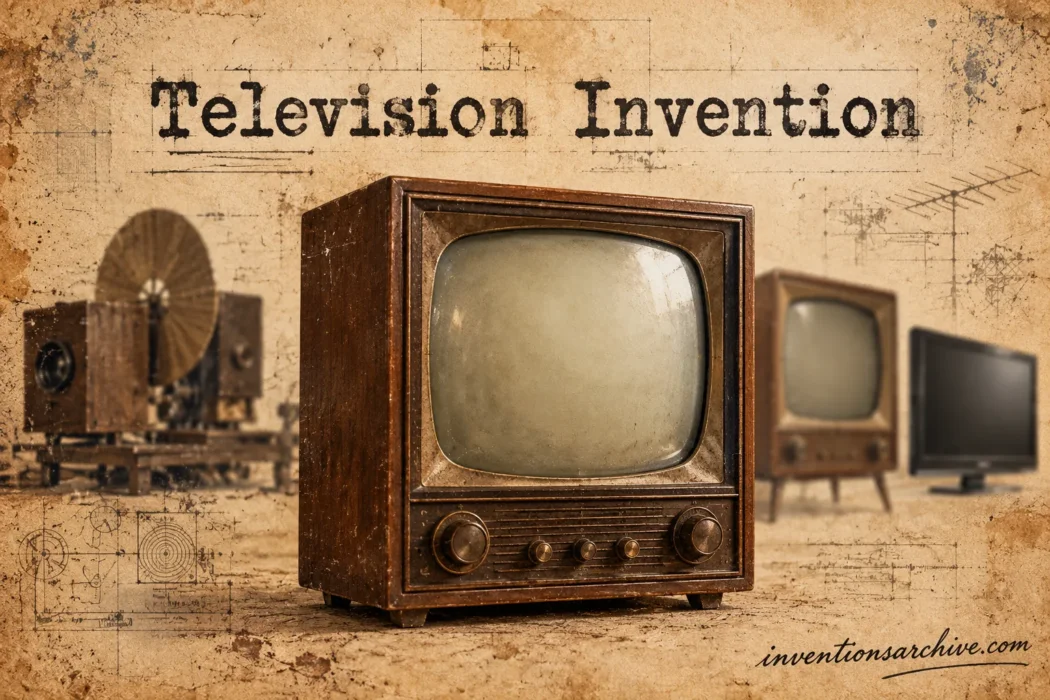
| Invention Name | Television |
|---|---|
| Short Definition | A system for converting moving visual scenes into transmissible signals and reconstructing them as images at a distant receiver. |
| Approximate Date or Period | 1884–1930s, with major mechanical and electronic milestones in the 1920s and early 1930s. |
| Geography | Germany, Britain, the United States and Japan were major centers of early development. |
| Inventor or Source Culture | Attribution varies Paul Nipkow, A. A. Campbell-Swinton, John Logie Baird, C. Francis Jenkins, Kenjiro Takayanagi, Philo Farnsworth and Vladimir Zworykin each contributed different parts of the system. |
| Category | Communication, imaging and broadcasting technology |
| Importance | Made moving visual information transmissible over distance and created the technical basis for television broadcasting. |
| Evidence Status | Confirmed milestones, disputed single-inventor attribution Surviving apparatus, patents, contemporary publications and museum records document different stages. |
| Main Problem Solved | How to scan a changing scene, encode brightness information, transmit it, keep transmitter and receiver synchronized, and reconstruct the scene as a moving image. |
| Development Path | Mechanical scanning → working mechanical television → CRT display → all-electronic image scanning → practical electronic camera systems → regular broadcast television |
| System Principle | A scene is divided into picture elements in sequence, converted into a varying signal, transmitted, then rebuilt in matching order at the receiver. |
| Early Use Context | Laboratory experiments, public demonstrations, experimental broadcasts and small early receiver markets before regular public television services. |
Television has no single inventor whose work alone corresponds to the modern system. The answer changes according to what is meant by “invented television.” John Logie Baird is closely associated with the first public demonstration of a working television system in 1926. Philo Farnsworth is central to the first successful all-electronic television system in the United States. Paul Nipkow supplied an earlier mechanical scanning principle, A. A. Campbell-Swinton described an electronic approach before the necessary camera technology existed, Kenjiro Takayanagi demonstrated cathode-ray-tube image reception in Japan, and Vladimir Zworykin helped develop an electronic camera tube suited to practical broadcasting.
The dispute over “who invented television” comes from treating several different achievements as though they were the same event. A patent, a working laboratory device, a public demonstration, an electronic camera, a commercial receiver and a regular broadcast service are different kinds of evidence. Television reached those stages at different times and through different inventors.
The Problem Before Television: Turning a Picture Into a Signal
A moving picture cannot be transmitted electrically as a complete two-dimensional surface all at once using the early technology of the nineteenth century. The scene has to be broken into small portions, measured in sequence and reconstructed in the same sequence at the receiving end. That principle of scanning became one of television’s defining technical ideas.
Paul Nipkow and the 1884 Scanning Disk
In 1884, German inventor Paul Nipkow proposed a rotating disk with apertures arranged in a spiral. As the disk turned, successive holes passed across different parts of an image. Each revolution could therefore divide the scene into a sequence of scanned lines. Later mechanical television systems adopted versions of this approach. Science Museum Group records describe Nipkow’s disk principle as the idea on which Baird later built part of his mechanical apparatus.[a]
Nipkow had not created a complete television system in the later sense. Scanning was only one part of the problem. A workable system also needed light-sensitive detection, electrical amplification, transmission, synchronization and a receiver capable of rebuilding the changing image. Those supporting technologies were not yet mature enough for high-quality moving television.
Campbell-Swinton Proposed an Electronic Route in 1908
Mechanical scanning was not the only path being considered. In a letter published by Nature in June 1908, Scottish electrical engineer Alan Archibald Campbell-Swinton proposed using cathode-ray beams at both the transmitting and receiving ends. He described beams swept across surfaces by electromagnetic fields rather than a pair of spinning picture-scanning mechanisms.[b]
The proposal anticipated the architecture of later electronic television, but it was still a proposal. Campbell-Swinton explicitly recognized that the transmitting side required a suitable photoelectric method that did not yet exist. His place in television history is therefore different from Baird’s or Farnsworth’s: he described an electronic system before engineers had the components needed to make that system work.
John Logie Baird and the Working Mechanical Television
By the mid-1920s, electrical amplification, photoelectric cells and radio techniques had advanced far enough for mechanical television to move beyond diagrams. John Logie Baird assembled these available technologies into a working system that could scan a subject, turn changes in brightness into an electrical signal and reconstruct the image at a receiver.
Baird first showed silhouette television publicly at Selfridges in London in April 1925. Later that year he produced moving images with tonal gradation rather than a simple light-or-dark outline. Tonal gradation mattered because it allowed facial features and other details to become recognizable instead of appearing only as silhouettes.[a]
The 26 January 1926 Demonstration at 22 Frith Street
On 26 January 1926, Baird invited members of the Royal Institution and other observers to his rooms at 22 Frith Street in Soho, London. Science Museum Group preserves a receiver used in that demonstration and records the event as a public showing of his mechanical television system. The surviving receiver used a disk perforated with 30 holes arranged in a spiral and a neon lamp whose brightness changed with the incoming television signal.[c]
The transmitting and receiving disks had to rotate in synchronization. At the transmitter, different parts of the illuminated subject were scanned in sequence. A photoelectric cell converted changes in reflected light into a varying electrical signal. At the receiver, the signal controlled the light output of a neon lamp while another scanning disk exposed the corresponding points in sequence. When the process ran quickly enough and stayed synchronized, the viewer perceived a complete moving picture.
Why Baird’s System Was Television Even Though It Was Mechanical
It is misleading to dismiss Baird’s apparatus as something other than television simply because its scanner was mechanical. It performed the central television task: a changing visual scene was analyzed, converted into an electrical signal, transmitted and reconstructed at another location. What later changed was the method used to scan and reproduce the image.
Mechanical television also exposed its own limitations. Higher picture detail demanded more scanning information, tighter synchronization and faster operation. A rotating disk has physical size, speed and balance constraints. Brightness and image size were also difficult to improve while keeping the mechanical system stable. Those limits made electronic scanning a more promising route for higher-resolution broadcast television.
Charles Francis Jenkins and the American Mechanical Path
Baird was not alone in developing mechanical television. In the United States, C. Francis Jenkins worked on mechanical image transmission and receivers that he called Radiovisors. A surviving Jenkins Radiovisor in the Smithsonian’s National Museum of American History uses a mechanical scanning drum, a neon lamp and an optical system to produce a small picture. The museum dates that receiver to about 1928 and identifies Jenkins as its inventor.[e]
Jenkins’s work matters because it shows that mechanical television emerged through parallel experimentation rather than from one isolated laboratory. His later receiver kits also reveal one of the technology’s persistent problems: keeping a rotating scanner synchronized with the transmitted picture. Mechanical television could work, but maintaining a stable, detailed image became harder as engineers pushed for better performance.
Kenjiro Takayanagi Put the Television Image on a CRT in 1926
Television development in Japan followed another path. At Hamamatsu Higher Technical School, now associated with Shizuoka University, Kenjiro Takayanagi began television research in 1924. On 25 December 1926, he succeeded in transmitting and displaying the Japanese katakana character イ on a cathode-ray tube.[f]
Takayanagi’s 1926 apparatus was a hybrid. The transmitting side still used a Nipkow disk to scan the image, while the receiving side reconstructed it electronically with a cathode-ray tube. This distinction is important. Takayanagi had demonstrated electronic image display, but he had not yet eliminated mechanical scanning from the whole chain.
The achievement nevertheless addressed one of the main weaknesses of mechanical receivers. A cathode-ray tube could direct an electron beam across a screen without a large spinning image disk. Takayanagi’s later research moved further toward fully electronic television, but the 1926 “イ” experiment already showed how electronic display could replace a mechanical picture-reconstruction system.
Philo Farnsworth and the All-Electronic Breakthrough
The major step away from mechanical scanning came from Philo T. Farnsworth. His system used electronic scanning at the camera rather than physically dissecting the scene with a rotating disk. That difference is why Farnsworth has one of the strongest claims to the invention of all-electronic television.
The Image Dissector Converted an Optical Image Into Electrical Information
The Smithsonian preserves an experimental Farnsworth image dissector made in 1927. In the tube, an optical image fell on a specially coated photosensitive surface. The surface emitted electrons in proportion to the light falling on it, creating an electronic representation of the image. By scanning that electron image, the apparatus could turn successive picture information into electrical signals. Those signals could then be reconstructed as visible light at the receiver.[g]
This removed the central scanning disk from the camera. Electronic deflection could move the scanning process without a large rotating image analyzer. It opened a route to television systems that could support more picture lines, better control and later improvements in camera sensitivity.
Farnsworth’s 1927 Television Patent
Farnsworth filed his U.S. application for a “Television System” on 7 January 1927; the patent was granted as US 1,773,980 on 26 August 1930. The patent describes a system intended to form an electrical image, scan its elementary areas and produce an electrical signal corresponding to the light intensity of those areas. It also states the aim of performing the image analysis without the mechanically moving scanning parts used by earlier television systems.[h]
The filing date should not be confused with a complete commercial television service. A patent records a claimed invention in legal and technical form; it does not by itself prove mass adoption, broadcast readiness or superiority over every competing design. In Farnsworth’s case, however, the patent, surviving 1927 image-dissector hardware and later demonstrations together provide unusually strong evidence for his role in electronic television.
Vladimir Zworykin and the Camera Tube Needed for Practical Broadcasting
Vladimir K. Zworykin, working with RCA, pursued another electronic television line. The device most closely associated with this work is the iconoscope, an electronic camera tube designed to store and scan image information on a photosensitive target.
Science Museum Group preserves a prototype iconoscope made by Zworykin on 9 November 1931 and records that it was successfully tested the following day.[i] The Smithsonian also preserves an early RCA photoelectric plate associated with Zworykin’s iconoscope work and describes the iconoscope as an important step toward a practical television camera.[j]
The contrast with Farnsworth is technical as well as historical. Farnsworth’s image dissector sampled an electron image directly and initially suffered from limited sensitivity. The iconoscope used charge storage on a target, allowing more usable signal to accumulate before scanning. This made the camera side of electronic television more suitable for studio operation and helped electronic systems move toward regular broadcasting.
Calling Zworykin “the inventor of television” without qualification would erase the earlier mechanical systems, Farnsworth’s electronic work and Campbell-Swinton’s earlier electronic proposal. His better-defined place is in the development of practical electronic television camera technology and RCA’s broader system engineering.
Mechanical and Electronic Television Solved the Same Job Differently
| Technical Task | Mechanical Television | Electronic Television |
|---|---|---|
| Image scanning | Rotating perforated disk or scanning drum physically samples the image. | Electron beams and electronic deflection scan image information. |
| Transmitter | Optical scanner and photoelectric cell produce a changing electrical signal. | Electronic camera tube converts the optical image into an electron or charge pattern that is scanned. |
| Receiver | Modulated lamp and synchronized mechanical scanner reconstruct the picture. | Cathode-ray tube scans a luminous screen electronically. |
| Synchronization | Mechanical speed and phase must remain closely matched. | Electrical scanning and timing control replace the large rotating image scanner. |
| Resolution growth | More picture detail places greater demands on disk geometry, rotation and light output. | Electronic scanning can support higher line counts without enlarging or accelerating a picture-scanning disk. |
| Long-term outcome | Useful for experiments and early broadcasts but eventually displaced. | Became the basis of mainstream analog broadcast television. |
Television Required More Than a Camera and a Screen
The invention is easier to understand when broken into the technical problems engineers had to solve. No one person solved all of them first.
Scanning the Scene
The system had to divide a two-dimensional picture into an ordered sequence. Nipkow’s disk offered a mechanical answer. Later electronic systems used controlled electron beams or electronic image targets.
Converting Light Into an Electrical Signal
A television camera needs a way to make picture brightness affect an electrical quantity. Mechanical systems combined optical scanning with photoelectric cells. Electronic camera tubes converted the optical image into an electron or stored-charge pattern that could be scanned.
Keeping Transmitter and Receiver in Step
The receiver must reconstruct picture elements in the same order in which the transmitter scans them. If the timing or position drifts, the image tears, rolls or becomes unrecognizable. Synchronization was especially difficult in mechanical systems because motors and rotating scanners had to remain closely matched.
Reconstructing Brightness in the Correct Position
Baird’s receiver varied the brightness of a lamp behind a rotating disk. Electronic systems used a cathode-ray tube, where a controlled electron beam swept across a fluorescent screen. The brightness of the beam changed with the video signal, building the picture line by line.
Producing Enough Detail and Sensitivity for Real Scenes
Early demonstrations could work with brightly illuminated faces, silhouettes or simple high-contrast symbols. A broadcast camera had to reproduce moving people and sets under practical studio conditions. Improvements in photosensitive targets, charge storage, amplification and camera tubes were therefore just as important as proving that a picture could be transmitted at all.
From Experiment to Regular Broadcast Television
By the mid-1930s, television was moving from laboratory demonstrations into organized public broadcasting. Britain provides a clear example of the transition. At Alexandra Palace in London, the BBC initially tested two competing high-definition systems: one from the Baird company and one from Marconi-EMI. The Marconi-EMI 405-line electronic system became the selected standard for the service.
On 2 November 1936, the BBC launched a regular public high-definition television service from Alexandra Palace.[k] This date did not mark the invention of television itself. It marked a different stage: television had become an operating broadcast service with studios, scheduled programming, standardized equipment and receivers intended for public use.
That distinction explains why a date such as 1926 or 1927 cannot carry the entire history. Baird could publicly demonstrate working television before the final broadcast architecture was settled. Farnsworth could demonstrate electronic scanning before television became a public service. Zworykin and RCA could improve camera technology after earlier television systems had already worked. Broadcasting depended on those earlier inventions plus standards, transmitters, studio equipment and manufacturing.
Which Inventor Has the Strongest Claim?
| Milestone | Person | What the Evidence Supports |
|---|---|---|
| Mechanical scanning principle | Paul Nipkow | 1884 rotating-disk scanning concept later used in mechanical television. |
| Early all-electronic system proposal | A. A. Campbell-Swinton | 1908 published proposal using cathode-ray beams for transmitter and receiver, before a suitable electronic camera existed. |
| Working public mechanical television demonstration | John Logie Baird | Public demonstration at 22 Frith Street on 26 January 1926 with recognizable moving images and surviving apparatus. |
| American mechanical television development | C. Francis Jenkins | Independent mechanical systems and Radiovisor receivers used in the late 1920s. |
| CRT image reception milestone | Kenjiro Takayanagi | Displayed the character イ on a cathode-ray tube on 25 December 1926 while retaining mechanical scanning at the transmitter. |
| All-electronic television system | Philo Farnsworth | 1927 image-dissector hardware and patent evidence document electronic image scanning without a mechanical picture-scanning disk. |
| Practical electronic camera-tube development | Vladimir Zworykin and RCA | Iconoscope development in the early 1930s helped make electronic television cameras more suitable for broadcasting. |
Why “Baird or Farnsworth?” Is Too Narrow
Baird and Farnsworth represent two different stages, so asking which one “really” invented television compresses the history into a false either-or choice.
Baird’s claim is strongest when the question concerns the first public demonstration of a working television system. His 1926 apparatus transmitted recognizable moving images using mechanical scanning, and physical components from that work survive in museum collections.
Farnsworth’s claim is strongest when the question concerns all-electronic television. His image dissector removed the rotating picture scanner from the transmitting system and established a route much closer to the architecture that later dominated television.
The two claims are compatible because they refer to different technical achievements. Baird showed that practical moving-image television could work with mechanical scanning. Farnsworth helped establish that the scanning process itself could be electronic.
Who Invented Television?
If “television” means the first publicly demonstrated working system capable of transmitting recognizable moving images, John Logie Baird has the strongest commonly accepted claim, centered on his London demonstration of 26 January 1926.
If the question means the first successful all-electronic television system, Philo Farnsworth has the stronger claim. His 1927 image-dissector work and patent record document a television system that analyzed the picture electronically rather than with a rotating mechanical scanner.
If the question means the complete technical lineage of modern broadcast television, no single-inventor answer is accurate. Nipkow supplied the scanning concept used by early mechanical systems. Campbell-Swinton described electronic scanning before it could be realized. Baird and Jenkins made mechanical television work in practice. Takayanagi demonstrated CRT-based reception in Japan. Farnsworth developed all-electronic scanning, while Zworykin and RCA advanced electronic camera technology toward practical broadcasting. Television was therefore an invention assembled across several countries, laboratories and technical generations.
Sources and Verification
- [a] Baird televisor — Science Museum Group collection record documenting Baird’s transmitting apparatus, Nipkow’s 1884 scanning principle, Baird’s 1925 silhouette demonstration and his later moving image with tonal gradation.
- [b] Distant Electric Vision — A. A. Campbell-Swinton’s 1908 letter in Nature outlining cathode-ray scanning at the transmitting and receiving ends.
- [c] Experimental television receiver used by JL Baird in demonstration, made 1925-1926 — Science Museum Group collection record for the receiver used at Baird’s 26 January 1926 Frith Street demonstration.
- [d] From Strathclyde to the world: 100 years since television’s first demonstration — University of Strathclyde account of the 1926 event and its 2026 centenary at 22 Frith Street.
- [e] Jenkins “Radiovisor” mechanical television receiver — Smithsonian National Museum of American History object record documenting Jenkins’s mechanical receiver and scanning system.
- [f] 高柳健次郎アーカイブ — Shizuoka University’s Takayanagi archive records the 25 December 1926 イ experiment and explains its Nipkow-disk transmitter and CRT receiver.
- [g] Experimental Farnsworth image dissector — Smithsonian National Museum of American History record for Farnsworth’s 1927 transmission tube and its operating principle.
- [h] US1773980A – Television system – Google Patents — Patent record for Farnsworth’s television system, filed 7 January 1927 and granted 26 August 1930, including claims for electronic image analysis without a mechanical picture scanner.
- [i] Prototype Iconoscope tube, 1931 — Science Museum Group collection record for Zworykin’s prototype iconoscope made in November 1931.
- [j] experimental photoelectric plate by Vladimir Zworykin — Smithsonian record describing an early RCA iconoscope component and the role of the iconoscope in practical television cameras.
- [k] BBC at Alexandra Palace — Alexandra Palace history documenting the BBC’s launch of regular high-definition television service on 2 November 1936 and the Baird versus Marconi-EMI system trials.