
| Inventor | Hedy Lamarr |
|---|---|
| Birth Name | Hedwig Eva Maria Kiesler |
| Born | November 9, 1914, Vienna, Austria-Hungary (now Austria) |
| Died | January 19, 2000, Casselberry, Florida, United States |
| Nationality | Austrian-born American |
| Occupations | Inventor and film actress |
| Best-Known Invention | Secret Communication System, using synchronized frequency hopping |
| Co-Inventor | George Antheil, American composer and inventor |
| Patent | U.S. Patent 2,292,387 |
| Patent Filed | June 10, 1941 |
| Patent Granted | August 11, 1942 |
| Other Inventive Ideas | Aircraft wing concepts, an effervescent beverage tablet, and traffic-signal improvements |
| Main Technical Field | Radio communication, electronic control, and mechanical synchronization |
| Original Purpose | Reducing interference with radio-controlled torpedo guidance |
| Invention Evidence | Confirmed U.S. patent Additional ideas documented in biographical accounts |
| Development and Influence | Mechanical frequency coordination; historical connection to later electronic frequency-hopping communication |
| Recognition | 1997 Electronic Frontier Foundation special recognition; 2014 National Inventors Hall of Fame induction |
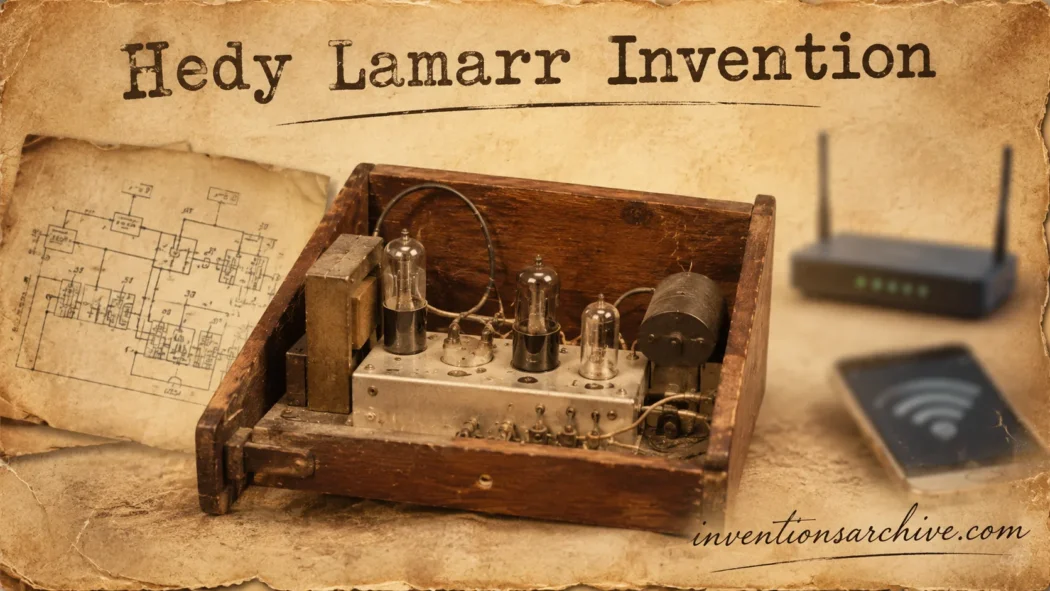
Hedy Lamarr (1914–2000) was an Austrian-born American inventor and Hollywood actress who co-developed a patented frequency-hopping communication system with composer George Antheil during World War II. Their invention proposed changing radio frequencies in a synchronized pattern to make remote-control signals more difficult to intercept or disrupt.
Lamarr received U.S. Patent 2,292,387 in 1942 under the name Hedy Kiesler Markey. Although the system was originally intended for radio-controlled torpedoes and was not adopted for wartime service, its operating principle belongs to the history of frequency-hopping wireless communication. Related techniques are used in technologies such as Bluetooth.
Her inventive interests extended beyond radio engineering. Historical accounts describe her experiments with aircraft design, a tablet intended to produce a carbonated beverage, and improvements to traffic signals. The frequency-hopping system, however, remains her most clearly documented technical achievement because the patent and supporting development papers survive.
Hedy Lamarr’s Early Life and Interest in Technology
Hedy Lamarr was born Hedwig Eva Maria Kiesler in Vienna on November 9, 1914. Her father, Emil Kiesler, was a bank director, and her mother, Gertrud, was a pianist. She grew up in a household that encouraged an interest in music and the arts.
As a child, Lamarr was curious about mechanical devices and how they worked. Although she did not pursue formal engineering studies, she developed an interest in technical problems that continued throughout her life.
She studied acting in Berlin under theater director Max Reinhardt and began appearing in European films while still young. In 1933, she married Friedrich Mandl, an Austrian arms manufacturer and dealer.
Mandl’s professional environment exposed her to discussions involving military equipment and weapons technology. This experience is frequently associated with her later interest in the problems of radio-controlled weapons. The precise extent of her technical knowledge during the marriage is difficult to reconstruct, and her subsequent invention should not be attributed to a formal engineering education she did not receive.
Lamarr left Mandl in 1937 and traveled to England, where she met Metro-Goldwyn-Mayer executive Louis B. Mayer. She subsequently moved to Hollywood and adopted the professional name Hedy Lamarr.
Her American film career included Algiers (1938), Boom Town (1940), White Cargo (1942), and Samson and Delilah (1949). During her years in Hollywood, she continued pursuing technical ideas independently of her acting work. [a]
What Did Hedy Lamarr Invent?
Lamarr is associated with several inventive ideas, but they do not all have the same documentary status. Her frequency-hopping communication system is supported by a granted patent, engineering drawings, and surviving correspondence. Other designs are described in institutional biographies and accounts of her personal experiments.
| Invention or Design Idea | Purpose and Contribution | Historical Evidence |
|---|---|---|
| Secret Communication System | Synchronized radio-frequency changes intended to protect remote-control communication from interference | Patented in 1942 |
| Aircraft Wing Concepts | Wing-shape ideas inspired by the streamlined forms of birds and fish, associated with her discussions with Howard Hughes | Biographically documented |
| Effervescent Beverage Tablet | A dissolving tablet intended to produce a flavored carbonated drink when added to water | Reported personal experiment |
| Traffic Signal Improvement | A proposed improvement to traffic-signal operation or design | Reported design idea |
The American Academy of Arts and Sciences identifies these activities as part of Lamarr’s independent inventive work. The surviving documentation does not establish that her aircraft, beverage, and traffic-signal ideas became commercially adopted products or that they received patents comparable to her communication system. [b]
Aircraft Design Ideas and Howard Hughes
Lamarr’s relationship with aviation entrepreneur Howard Hughes gave her opportunities to discuss technical problems involving aircraft. Hughes was interested in improving aircraft performance, and Lamarr became interested in the relationship between natural shapes and aerodynamic design.
Accounts of their association describe Lamarr studying the forms of birds and fish to develop ideas for more streamlined airplane wings. She reportedly examined how different shapes might move through air or water with less resistance.
The approach involved a recognizable engineering principle: examining natural forms for characteristics that might be adapted to mechanical design. However, the surviving accounts do not establish that a particular Hughes aircraft incorporated a wing designed by Lamarr.
Her involvement is better understood as an example of her independent design experimentation rather than proof that she invented a new aircraft or a specific production wing.
The Effervescent Drink Tablet
Lamarr also experimented with a tablet that could be dissolved in water to create a flavored carbonated beverage. The concept was intended to simplify beverage preparation by combining ingredients in a compact form.
The idea is described in accounts of her inventive activities during her Hollywood years. It did not become a documented commercial success, and no comparable patent record has been established for the tablet.
The experiment nevertheless illustrates that Lamarr’s interests were not confined to radio technology. She considered everyday consumer problems as well as mechanical and military applications.
Traffic Signal Improvements
Biographical descriptions of Lamarr’s inventions also mention an improved traffic stoplight. The available institutional accounts identify the concept but provide limited technical information about its proposed mechanism.
Without a detailed surviving design or verified patent record, it is not possible to establish exactly how her traffic-signal idea differed from existing systems or whether it was ever implemented.
Why Hedy Lamarr Became Interested in Wartime Radio Communication
During World War II, Lamarr wanted to contribute to the Allied war effort. Her familiarity with discussions of military equipment led her to consider the vulnerability of remotely controlled weapons to radio interference.
A radio-controlled torpedo could theoretically receive steering instructions after launch. This would allow operators to adjust its direction rather than relying entirely on an initial course.
The difficulty was maintaining communication when the opposing side might detect or interfere with the operating frequency. If a control system continuously used the same radio channel, an adversary could attempt to disrupt the signal by transmitting interference on that frequency.
Lamarr proposed that the transmitting and receiving devices should change frequencies together. The authorized receiver would follow the transmitter through a predetermined sequence rather than remain tuned to a single radio channel.
An interfering transmitter concentrated on one frequency would then be less likely to prevent all communication. This approach was intended to reduce the vulnerability of the guidance link, although it could not guarantee protection against every possible form of interference.
Turning the concept into a workable arrangement required a reliable way to coordinate the frequency changes at two separate locations. That problem became central to Lamarr’s collaboration with George Antheil.
Her Collaboration With George Antheil
George Antheil was an American composer born in Trenton, New Jersey, in 1900. He was known for experimental musical works, including Ballet Mécanique, which involved mechanical musical instruments and the challenge of coordinating their operation.
Lamarr met Antheil in 1940 at the home of actress Janet Gaynor and costume designer Gilbert Adrian. They discovered a shared interest in invention and began working together on the radio guidance problem.
Antheil’s background provided experience with machines that performed actions according to recorded sequences. He had worked with mechanical pianos and had received French Patent No. 578,777 in 1924 for an apparatus related to recording musical notes on paper.
A player piano operates through a perforated paper roll. As the roll advances, its holes determine when particular musical actions occur. If two devices use matching records and move them in synchrony, they can follow corresponding sequences of instructions.
Lamarr and Antheil applied this concept to changing radio frequencies. Instead of controlling musical notes, a moving record could determine which radio channel was selected at a particular moment.
The Smithsonian Institution’s National Museum of American History preserves the Hedy Lamarr and George Antheil Invention Papers, collection NMAH.AC.1590. The collection includes handwritten notes, drawings, an invention notebook, and correspondence with their attorneys and the National Inventors Council.
The documents record their collaboration from 1940 to 1942. They support the account that Lamarr contributed the basic radio-control concept while Antheil helped develop the mechanical synchronization arrangement. [c]
Hedy Lamarr’s 1942 Secret Communication System Patent
Lamarr and Antheil filed their United States patent application on June 10, 1941. The patent was granted on August 11, 1942, as U.S. Patent 2,292,387, Secret Communication System.
Lamarr was identified in the patent as Hedy Kiesler Markey, reflecting names she had used before and during her marriage to Gene Markey. George Antheil appeared as the second inventor.
The patent described a communication system using different carrier frequencies and matching records to coordinate changes between a transmitting station and a receiving station.
How the Patented System Worked
The proposed system used a transmitter, a receiver, and two corresponding perforated records. One record controlled the transmitting equipment, while the other controlled the receiver.
Both records were intended to advance at matching rates. Their patterns caused the radio equipment to select corresponding frequencies at the appropriate times.
When the transmitter changed to a new frequency, the receiver would make the same change. Because the two devices followed matching instructions, the receiver could continue accepting the intended communication.
The patent described clock-like mechanisms for moving the records and recognized the need to maintain synchronization. If the records moved out of alignment, the transmitter and receiver might select different frequencies and lose communication.
Although the patent illustrated its application to torpedoes, the claimed communication principle was broader than a single type of naval equipment.
Why the Number 88 Appears in the Patent
Descriptions of Lamarr’s invention frequently mention 88 frequencies, a number associated with the 88 keys of a standard piano.
Related articles: Frequency Hopping Invention: The Technology Behind Secure Wireless Communication
The patent explained that a conventional player-piano record could contain 88 longitudinal rows of perforations, allowing a corresponding arrangement to select among 88 carrier frequencies.
That number represented a possible implementation, not evidence that an operational 88-frequency torpedo guidance system had been built.
The patent’s illustrated example used a smaller arrangement with seven transmitter channels, designated A through G. Four of those channels, D through G, were available to the intended receiver. The remaining transmitter channels could carry misleading signals that the receiver would disregard.
This feature was intended to make unauthorized interpretation of the transmissions more difficult. It was part of the proposed communication design rather than a modern encryption system.
What the Patent Did and Did Not Invent
The patented invention coordinated changes in radio frequency between two separated devices. Its contribution lay in the proposed synchronization arrangement and its application to protected radio communication.
It did not introduce radio transmission itself, invent the torpedo, or create a complete autonomous targeting system. The communication method was intended to assist remote guidance, not replace every other part of a weapon’s navigation or control equipment.
Frequency hopping also differs from digital encryption. Changing a radio carrier frequency can complicate reception or interference, but it does not automatically encrypt the information carried by the signal.
The original patent specifies the equipment, mechanical sequencing arrangements, and communication principles in considerably more detail than later popular accounts. [d]
Was Hedy Lamarr the First Person to Invent Frequency Hopping?
The Lamarr–Antheil patent was an early documented implementation of coordinated frequency-hopping communication. The broader idea of changing radio frequencies to complicate interception or interference had appeared in earlier work.
For example, Dutch inventor Willem Broertjes received U.S. Patent 1,869,659 on August 2, 1932, for a method of maintaining secrecy in wireless telegraphic messages. His proposal involved communication over changing working frequencies and the use of additional transmissions to make unauthorized reception more difficult.
The earlier patent does not establish that Broertjes designed the same mechanism later patented by Lamarr and Antheil. It does show that radio-frequency variation was not an entirely new concept in 1941.
Lamarr’s documented contribution was the particular synchronized communication arrangement she developed with Antheil. Historical credit for the patented system belongs to both inventors, while the broader development of frequency-agile radio involved earlier researchers and subsequent engineering work. [e]
Why the U.S. Navy Did Not Use Lamarr’s Invention During World War II
Lamarr and Antheil intended their invention to support Allied military communication, but the U.S. Navy did not adopt the proposed system for wartime torpedo guidance.
Historical accounts commonly attribute the lack of adoption to practical concerns about a mechanically synchronized apparatus. Equipment involving moving records, timing mechanisms, and frequency-control components would have needed to satisfy demanding reliability and integration requirements.
The surviving patent establishes that a detailed design was developed and legally protected. The Smithsonian invention papers document attempts to bring the proposal to the attention of relevant defense authorities.
Those records do not establish that a complete operational torpedo using the Lamarr–Antheil system was successfully deployed during World War II.
Some later accounts describe the Navy dismissing the invention because it resembled a player-piano mechanism. That explanation should be treated as a historical account rather than the sole demonstrated reason for rejection.
As electronic radio systems developed, frequency changes could be controlled without relying on the mechanical recording arrangement proposed in 1942. The patent expired in 1959, before later digital wireless technologies became widespread.
Did Hedy Lamarr Invent Wi-Fi, Bluetooth, or GPS?
Lamarr is often described as the inventor of Wi-Fi, Bluetooth, or GPS. These descriptions compress several decades of radio engineering into one person’s invention.
Her patented system is associated with the history of spread-spectrum communication, particularly frequency hopping. Later technologies use related principles, but their complete systems were developed through subsequent research, electronic engineering, and technical standards.
Hedy Lamarr and Bluetooth
Bluetooth provides a direct modern example of a radio technique based on coordinated frequency changes.
Bluetooth Classic uses 79 radio channels in the 2.4 GHz band. Connected devices coordinate channel selection so they can communicate while changing frequencies.
Bluetooth Low Energy uses 40 channels, including 37 general-purpose data channels. Connected devices employ adaptive frequency hopping, which allows communication to avoid channels experiencing unfavorable conditions.
These systems replace the mechanical records described by Lamarr and Antheil with electronic timing, digital algorithms, and channel-management procedures.
The relationship is a shared engineering principle: the transmitter and receiver must agree on the frequencies used during communication. Bluetooth’s complete specification was developed decades after the 1942 patent. [f]
Hedy Lamarr and Wi-Fi
Early Wi-Fi standardization included frequency-hopping techniques. The original IEEE 802.11 standard, ratified in 1997, included a frequency-hopping spread-spectrum physical-layer option for wireless networking.
The IEEE Standards Association identifies Lamarr’s work as part of the technical history connected with early wireless networking.
Modern Wi-Fi, however, primarily relies on other radio methods, including orthogonal frequency-division multiplexing (OFDM) and orthogonal frequency-division multiple access (OFDMA), depending on the generation of the standard.
Lamarr therefore did not invent Wi-Fi as a complete networking technology. Her patent belongs to the earlier development of radio-frequency coordination and spread-spectrum communication. [g]
Hedy Lamarr and GPS
GPS is sometimes included in lists of technologies supposedly invented by Lamarr. The connection is less direct than the one with Bluetooth.
GPS signals use spread-spectrum methods involving pseudorandom codes. These systems are generally based on direct-sequence spreading rather than the mechanically controlled frequency hopping described in Lamarr’s patent.
Both approaches are part of the wider history of spread-spectrum radio engineering. Lamarr did not invent satellite navigation, GPS positioning calculations, or the GPS signal architecture.
How Hedy Lamarr’s Invention Was Recognized
Lamarr’s public career was dominated by her work in film, while her technical interests remained relatively unfamiliar to much of the public.
Her communication patent attracted renewed attention as historians and technology organizations examined the development of wireless communication and the contributions of inventors whose work had received limited recognition.
In 1997, the Electronic Frontier Foundation honored Hedy Lamarr and George Antheil for their work on communication technology. Its historical awards records identify them as special honorees, with Antheil recognized posthumously. [h]
Lamarr died on January 19, 2000, in Casselberry, Florida, at the age of 85.
In 2014, she was inducted into the National Inventors Hall of Fame for the frequency-hopping communication system covered by U.S. Patent 2,292,387. The institution records her collaboration with Antheil and identifies the invention’s contribution to wireless communication history. [i]
Her inventive work is also preserved through archival collections. The Smithsonian’s surviving papers make it possible to study the development of the communication system through contemporaneous drawings, correspondence, and patent documents rather than relying exclusively on later recollections.
Hedy Lamarr’s Place in the History of Invention
Hedy Lamarr’s technical achievement is most clearly represented by the frequency-hopping communication patent she developed with George Antheil. The design addressed an identifiable wartime communication problem and proposed a method for coordinating frequency changes between separated radio devices.
Her other reported experiments, including aircraft wing concepts, a beverage tablet, and traffic-signal ideas, show the range of subjects that attracted her interest. Their historical status differs from the communication patent because equivalent technical records have not been established.
The 1942 patent was not the beginning of all frequency-hopping research, and the mechanical system was not adopted for wartime service. Its surviving drawings and claims nevertheless document an inventive approach that shares an operating principle with later electronic communication systems.
Lamarr’s record as an inventor is therefore grounded in a specific collaborative patent, a documented series of technical experiments, and historical recognition of her contribution to radio communication. Her work demonstrates how ideas developed outside formal engineering institutions could enter the documented history of technology.
Sources and Verification
-
[a]
Smithsonian Institution — Hedy Lamarr and George Antheil Invention Papers — The National Museum of American History’s archival collection provides Lamarr’s biographical background, career details, correspondence, and the historical record of her collaboration with Antheil. -
[b]
American Academy of Arts and Sciences — Hedy Lamarr — The Academy’s institutional biography documents her inventive interests, including aircraft wing concepts, an effervescent beverage tablet, traffic-signal ideas, and wartime radio communication. -
[c]
Smithsonian Institution — Lamarr and Antheil Collaboration Records — The same archival collection contains the inventors’ development papers, technical sketches, and correspondence with patent attorneys and the National Inventors Council. -
[d]
U.S. Patent 2,292,387 — Secret Communication System — The original patent record verifies the inventors, application and grant dates, claims, synchronized frequency-hopping mechanism, and illustrated transmitter and receiver arrangements. -
[e]
U.S. Patent 1,869,659 — Willem Broertjes — The 1932 patent provides primary documentary evidence of earlier radio communication methods involving changing working frequencies. -
[f]
Bluetooth Special Interest Group — Bluetooth Technology Overview — The official Bluetooth technology overview documents radio channel counts, frequency-hopping operation, and the differences between Bluetooth Classic and Bluetooth Low Energy. -
[g]
IEEE Standards Association — Hedy Lamarr and Wireless Communication — IEEE’s historical account explains the relationship between Lamarr’s invention, frequency-hopping radio, and the original IEEE 802.11 wireless networking standard. -
[h]
Electronic Frontier Foundation — Pioneer Awards Historical Record — The organization’s archived awards record confirms the special recognition given to Lamarr and Antheil in 1997. -
[i]
National Inventors Hall of Fame — Hedy Lamarr — The official inductee record verifies her patent, collaboration with George Antheil, life dates, and induction in 2014.