
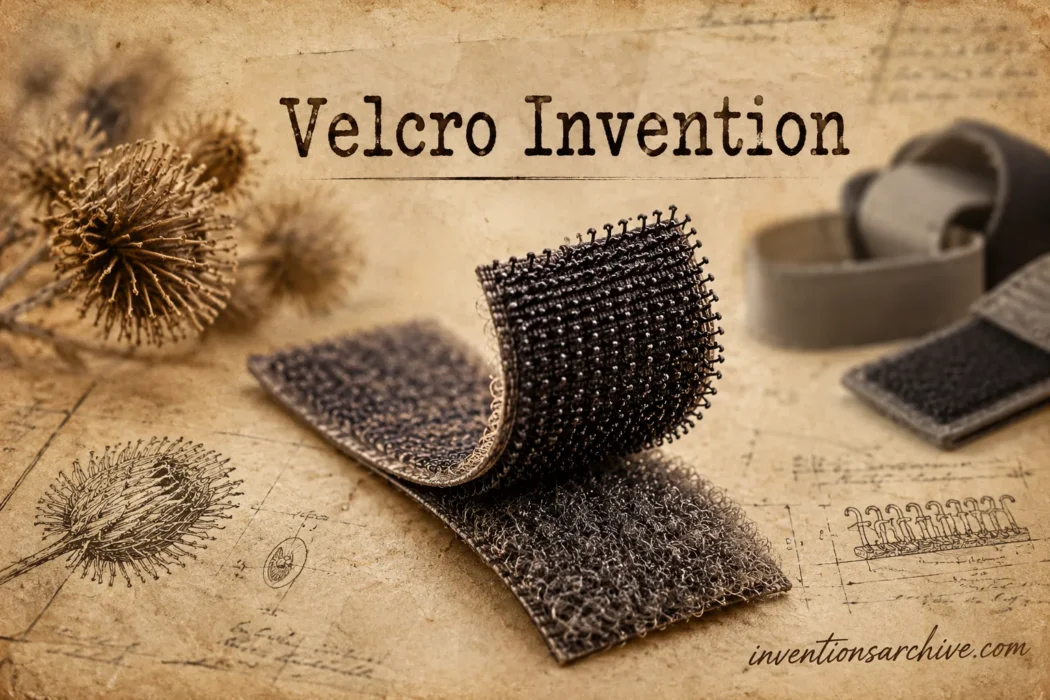
| Invention Name | Hook-and-loop fastener, widely associated with the VELCRO® Brand |
|---|---|
| Short Definition | A reusable fastener in which many small hooks mechanically engage loops on an opposing flexible surface. |
| Approximate Date or Period | Idea conceived in 1941; Swiss patent priority in 1951; U.S. patent granted in 1955 |
| Geography | Switzerland, with textile development work also carried out in France |
| Inventor or Source Culture | George de Mestral, Swiss engineer and inventor |
| Category | Fastening technology, textile engineering and biomimicry |
| Importance | Created a flexible, reusable closure based on dense mechanical engagement rather than a slider, button or adhesive bond. |
| Evidence Status | Confirmed De Mestral’s attribution and the development of his fastening fabrics are documented by surviving patent records and institutional histories. |
| Main Problem Solved | Repeatedly joining flexible surfaces without precise button alignment or a sliding mechanism |
| Development Path | Burdock observation → microscope study → textile experiments → heat-set synthetic hooks → patented fastening fabric → separate hook-and-loop surfaces |
| How It Works | Dense hooks catch loops when the surfaces are pressed together; peeling releases the engagements progressively. |
| Material or Technical Basis | Woven pile structures and heat-set synthetic filaments, including nylon |
| Key U.S. Patent | US 2,717,437, Velvet Type Fabric and Method of Producing Same, granted September 13, 1955 |
| Trademark Distinction | VELCRO® is a registered brand name; hook-and-loop fastener is the generic technical term. |
The invention commonly called Velcro began with a natural fastening mechanism rather than with a textile product. In 1941, Swiss engineer George de Mestral returned from a hunting trip in the Jura Mountains with burdock burrs clinging to his clothing and his dog’s fur. He examined them under a microscope and found that their grip came from numerous tiny curved hooks that caught hairs and loops in fabric.
That observation supplied the mechanical idea, but it did not supply a manufacturable fastener. The harder task was reproducing a burr-like hook at textile scale, making thousands of those hooks behave consistently, providing a surface they could engage, and ensuring that the elements could separate and recover their shape again and again. De Mestral spent years turning a biological attachment mechanism into an engineered textile closure.
A Burr Was the Model, Not the Finished Invention
Burdock does not attach itself with glue. Its burrs carry many small hooks that catch suitable structures on passing animals and fabrics. For the plant, this attachment helps carry its seeds away from the parent plant. For de Mestral, the useful feature was the geometry: a curved projection could catch a loop or fiber, hold temporarily, and release without requiring a permanent chemical bond.
The principle is now commonly discussed as an example of biomimicry, in which a biological mechanism inspires an engineered solution. De Mestral was not copying the appearance of a burr. He was extracting a function from it: repeated mechanical engagement between hooks and structures that the hooks could catch.
| Burdock Burr | Engineered Fastener |
|---|---|
| Curved natural hooks project from the burr. | Manufactured hooks project from a flexible backing. |
| Hooks catch animal hair or loops in cloth. | Hooks engage a deliberately produced loop surface. |
| Hook size and orientation vary naturally. | Textile production aims for controlled size, spacing and orientation. |
| The biological purpose is seed dispersal. | The engineered purpose is repeated fastening and release. |
This distinction matters because the inventive work occurred between the observation and the usable product. Seeing that burrs contained hooks was the beginning. Producing a repeatable closure from that observation required material selection, weaving methods, heat treatment and controlled cutting.
The Engineering Problem Was Reproducibility
A natural burr can work even when its hooks differ slightly from one another. Industrial fasteners have a different requirement. Thousands of small elements must be produced across a strip of material, remain attached to their backing, engage predictably and survive repeated opening.
WIPO’s history of the invention describes years of experimentation and work with a weaver at a textile plant in France. Early attempts involved cotton, but cotton did not provide the combination of shape retention and repeated use that de Mestral needed. Synthetic fibers gave him more control over the geometry of the fastening elements.
Why Nylon Mattered
De Mestral’s 1955 U.S. patent specifies a raised pile made from artificial or synthetic resin material and explicitly identifies nylon as a suitable example. Its value was not simply that it was a strong textile fiber. A synthetic filament could be shaped under heat and made to retain that form after cooling.
That property addressed one of the central problems in copying the burr mechanism. A fastening hook has to project from the fabric, catch another structure and flex during separation without immediately losing the geometry that lets it work again. Heat-setting a synthetic filament made controlled hook shapes practical in a woven textile.
The Hook Side Was Especially Difficult
Producing a surface full of loops was already familiar to textile manufacturing. Producing dense rows of small hooks with dependable geometry was more difficult. De Mestral needed a method that could form the pile, stabilize its shape and then convert selected loops into hooks without detaching them from the woven base.
This is why the invention cannot be reduced to the phrase “hooks on one side and loops on the other.” The value of the system depended on finding a reproducible way to manufacture those structures at useful density and with enough resilience for repeated fastening.
What the 1955 Patent Actually Described
The main surviving U.S. patent record gives an unusually clear view of the engineering behind the early invention. De Mestral claimed Swiss priority dated October 22, 1951, filed the U.S. application on October 15, 1952, and received U.S. Patent 2,717,437 on September 13, 1955.
The patent title was Velvet Type Fabric and Method of Producing Same. That wording reflects the textile route de Mestral used. The underlying fabric contained ordinary warp and weft threads plus additional pile-forming threads. Those extra threads were formed into raised loops around supporting elements during weaving.
The patent then described a thermal treatment that caused the synthetic pile threads to retain the shape given to them. After the loops had been set, they could be cut so that part of the raised pile ended in hook-shaped sections. The result was a fabric covered with many small material-engaging elements.
The patent proposed these fabrics for garments, curtains and similar applications where they could replace slider-operated fasteners, buttons or press fasteners. It also mentioned cleaning uses such as clothes or shoe brushes, showing that de Mestral initially regarded the hooked textile as a material platform rather than only as the familiar closure sold today.
From Hook-to-Hook Fabric to the Familiar Hook-and-Loop Pair
The development continued after the 1955 patent. U.S. Patent 3,009,235, filed by de Mestral in 1958 with Swiss priority from 1957 and granted in 1961, described a separable fastening device in which one element carried hooks and the other carried loops.
The later patent also explains why the change mattered. In the earlier hook-to-hook arrangement, only part of the hook population was likely to encounter another hook in a useful orientation. A dense loop surface gave each hook many more possible structures to catch. Increasing the probability of engagement produced a more dependable fastening surface.
The loop side and hook side could also be optimized differently. The patent describes looped fabrics made from multifilament yarn, with the filaments spread to present many catch points. For the hook side, heat-set loops could be cut into hook forms. This separation of functions is much closer to the arrangement now recognized as a conventional hook-and-loop fastener.
Why Pressing Joins the Surfaces but Peeling Releases Them
When the two surfaces are pressed together, only a fraction of the individual elements need to connect. Across a sufficiently large area, many small engagements form at the same time. Their combined resistance can hold the two flexible pieces together even though each individual connection is small.
Direction matters. Pulling the joined surfaces so that many engagements resist separation together distributes the load across numerous hooks and loops. Peeling one surface away from an edge is different: the connections release progressively rather than all at once. De Mestral’s later patent explicitly distinguished the greater force needed to release many hooks together from the relative ease of progressively peeling the layers apart.
This behavior helps explain why hook-and-loop material can hold an object or garment securely while still allowing a person to open it without operating teeth, a slider, a button shank or a rigid latch.
Why the Name Velcro Can Mislead the History
The generic technology and the commercial name are not identical. De Mestral formed the word Velcro from the French words velours, meaning velvet, and crochet, meaning hook. The name became associated so closely with the fastening principle that it is often used generically in everyday speech.
VELCRO®, however, is a registered trademark. Velcro Companies states that the trademark was first registered in Switzerland in 1956 and in the United States in 1958. The neutral technical term for the fastening mechanism is hook-and-loop fastener. Products made by other manufacturers may use the same general fastening principle without being VELCRO® Brand products.
The distinction also helps clarify the chronology. The fastening concept was already under development before the brand registration. The 1941 observation, the years of textile experimentation, the 1951 Swiss patent filing and the 1955 U.S. patent belong to the invention story; the VELCRO® trademark belongs to the commercial identity built around it.
Commercial Adoption Took Longer Than the Initial Idea
A useful mechanical concept did not guarantee immediate acceptance. WIPO’s account describes almost eight years of development work before the burr-inspired fastening mechanism could be reproduced successfully. De Mestral then faced another problem: producing strips with consistent fastening behavior at industrial scale.
New looms, cutting methods and production controls were needed for the hook material. The fastener also had to enter markets already accustomed to buttons, snaps and zippers. Clothing manufacturers did not immediately treat the unfamiliar textured strips as a replacement for established closures.
Commercial expansion nevertheless followed during the 1950s. A 1957 licensing agreement extended production and sales beyond Europe, while a 1959 New York fashion presentation showed garments and products fitted with the new fasteners. Fashion alone did not become the technology’s defining market. Its ability to fasten flexible surfaces without precise alignment opened uses in footwear, equipment, transportation, medical products and aerospace hardware.
NASA Popularized a Fastener It Did Not Invent
A persistent version of the story credits NASA with inventing Velcro. The patent chronology rules that out. De Mestral’s original observation dates to 1941, his Swiss patent application dates to 1951, and his U.S. patent was granted in 1955. American space-program use came later.
NASA did, however, give hook-and-loop fastening unusually visible applications. Apollo records show it used for securing wristwatches, cuff checklists, equipment and other items. Smithsonian National Air and Space Museum collections preserve Apollo 11 objects with Velcro tabs, closures and attachment areas, including removable spacesuit pockets and equipment pouches.
Its usefulness in spacecraft was easy to understand. A removable item could be held against a surface and then detached without a conventional latch. Flexible fastening patches could also be placed on clothing, storage equipment and cabin hardware. NASA’s Apollo Lunar Surface Journal documents astronauts using long Velcro straps on watches and later cuff checklists.
WIPO’s 2026 study reports that approximately 3,300 square inches of VELCRO® Brand fastener were used on the interior and exterior of the Apollo 11 spacecraft. Spaceflight did not create the technology, but it gave an already patented invention a powerful public association with the space age.
What George de Mestral Actually Invented
De Mestral did not invent natural hooks, and a burdock burr was not itself a ready-made textile fastener. His contribution was converting the burr’s attachment principle into a repeatable manufactured system. That required a flexible backing, raised textile elements, synthetic material capable of retaining a formed shape, controlled cutting and a way to produce many engaging points across a surface.
The surviving patents also show that the design evolved. The 1955 U.S. patent centered on heat-set hooked pile fabric and demonstrated hook-to-hook engagement. Later work separated the two fastening functions more clearly into a hook-bearing element and a loop-bearing element, improving the chances that hooks would find something to catch.
This development path is one reason the invention remains a useful example of biomimicry. De Mestral did not reproduce an organism literally. He identified a mechanical strategy in nature, isolated the useful geometry, changed the materials and then adapted textile machinery until that strategy could be manufactured reliably.
The original patent rights have long since expired, allowing hook-and-loop technology to be produced by many companies and in many forms. Development did not stop with de Mestral’s early textiles. Different hook geometries, molded fasteners, specialized loop structures, industrial attachment systems and material combinations followed from the same general principle.
WIPO reported in 2026 that Velcro Companies had filed more than 2,100 patent applications worldwide, while the company’s trademark guidance listed 1,332 registered trademarks. Those modern figures describe a much larger intellectual-property portfolio than de Mestral’s original invention, but the mechanical idea underneath it can still be traced to the same sequence: observe a burdock burr, understand why it catches, and engineer a reusable surface that can do the same job predictably.
Sources and Verification
- US2717437A – Velvet type fabric and method of producing same — The surviving U.S. patent record verifies George de Mestral’s patent dates, the title of the invention, the woven pile structure, heat-setting process, hook formation and the early hook-to-hook fastening arrangement.
- US3009235A – Separable fastening device — De Mestral’s later patent documents the move toward distinct hook and loop elements, explains the greater probability of engagement with a dense loop surface and describes progressive peeling behavior.
- Who came up with the idea for Velcro? — The Library of Congress documents de Mestral’s burr observation, microscope examination and the relationship between the natural hook mechanism and the later fastener.
- From a Mountain Walk to 2,100 Patents: The Velcro IP Story — The World Intellectual Property Organization provides detailed documentation of the 1941 observation, textile development, Swiss patent history, commercial expansion, Apollo use and the company’s patent portfolio reported in 2026.
- The VELCRO® Brand Trademark Guidelines — Velcro Companies verifies the derivation of the VELCRO® name, the distinction between the trademark and the generic hook-and-loop term, and trademark registration dates in Switzerland and the United States.
- Fastenings: Velcro — NASA’s Apollo Lunar Surface Journal records operational uses of Velcro fastening straps during Apollo missions, including wristwatches and cuff checklists.
- Pocket, Checklist and Scissors, Collins, Apollo 11 — The Smithsonian National Air and Space Museum documents an Apollo 11 spacesuit pocket assembly held in place with Velcro tabs, providing surviving material evidence of the fastener’s space-program use.